A tariff refund for machinery importers is directly available only to the importer of record that paid the eligible IEEPA duties. If your company bought machinery through another business that acted as importer of record, that distinction matters: the government refund goes to the importer of record, not automatically to the end buyer.
Sorting out the right party and the right refund route can be as important as identifying the duties paid. This guide explains how importer-of-record status affects eligibility, how to pursue a refund, what can influence payment timing, and how to assess separate Section 301 options. You’ll also see why a potential IEEPA recovery doesn’t automatically resolve every tariff cost on a machinery shipment. The steps ahead focus on the entry records, filing path, and distinctions that help you move forward with a clearer picture of what may be recoverable.
Key Takeaways
- Match each machinery entry to the importer of record and the duties actually paid before assessing who can pursue recovery.
- Choose the filing route based on whether the entry is unliquidated, recently liquidated, or already past the applicable administrative window.
- Protect protest rights: for liquidated U.S. customs entries, a protest under 19 U.S.C. § 1514 may be filed within 180 days from liquidation, according to the Office of the Law Revision Counsel, U.S. House of Representatives.
- Plan cash-flow expectations around the refund process: payment timing can depend on declaration acceptance, liquidation, and the accuracy of entry records.
- Assess Section 301 duties separately from IEEPA refunds, then review the relevant machinery entries and supporting customs documentation for possible recovery routes.
Importer of record eligibility
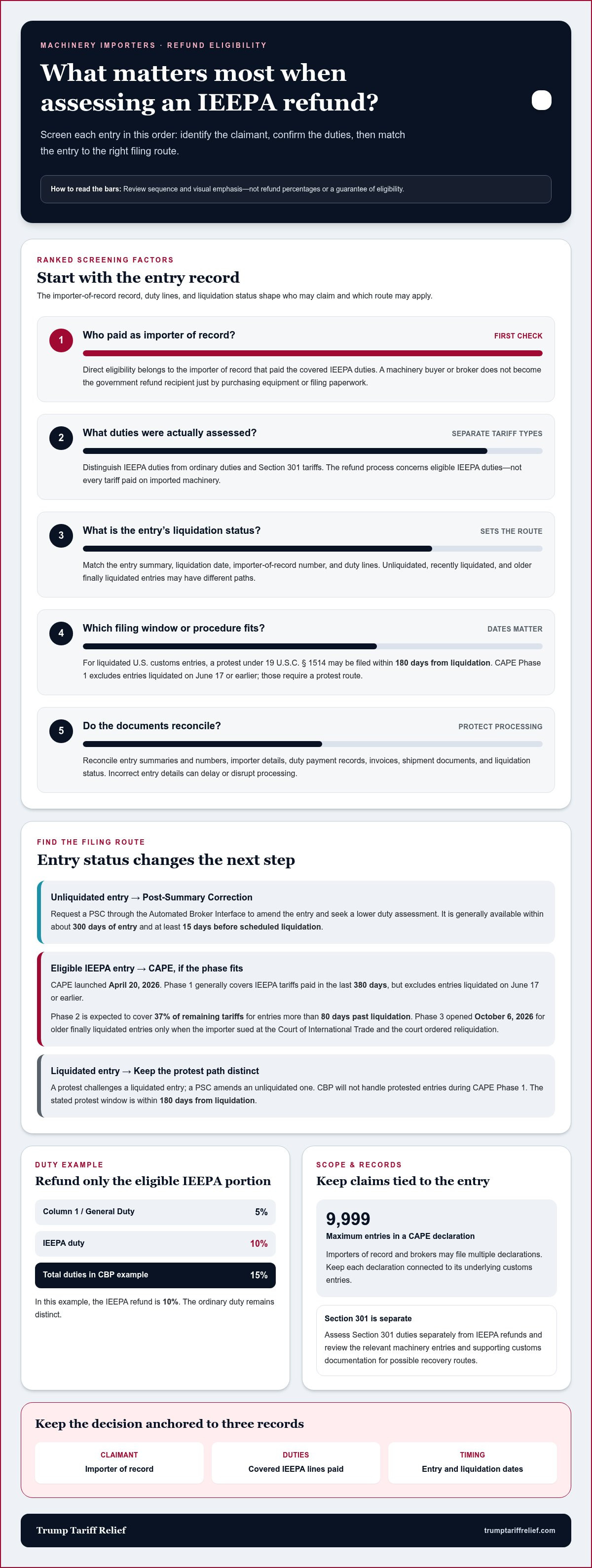
Start with the customs entry record: direct eligibility belongs to the importer of record that paid the covered duties. Machinery buyers and brokers should distinguish IEEPA duties from other tariff charges before pursuing recovery.
-
Check Entry Eligibility and Liquidation
Match each machinery shipment to its entry summary, importer-of-record number, duty lines, and liquidation status. An estimated 300,000 U.S. importers of record paid the IEEPA tariffs involved in the refund process, but that estimate does not establish any individual company’s eligibility.
Then compare each entry’s dates with the applicable refund route. IEEPA tariffs paid in the last 380 days are generally eligible for filing in CAPE Phase 1. Entries liquidated on June 17 or earlier are outside Phase 1 and require a protest route instead. Record liquidation dates carefully because they affect available filing options and deadlines.
-
Identify Eligible Tariffs and Refund Share
Separate IEEPA charges from ordinary duties and Section 301 tariffs. The Supreme Court held on February 20, 2026, in Learning Resources, Inc. v. Trump, that IEEPA does not authorize the President to impose tariffs. The refund process concerns eligible IEEPA duties, not every tariff paid on imported machinery.
Use the entry’s duty calculation to identify the potentially refundable portion. In CBP’s example, a 5% Column 1/General Duty rate plus a 10% IEEPA duty equals 15% total duties, while the IEEPA refund is 10%. The ordinary duty remains distinct. CAPE Phase 1 is estimated to cover roughly 63% of IEEPA tariffs paid, so an eligible entry’s recoverable share depends on the duties assessed and the phase that accepts it.
-
Assess Claimant and Filing Risks
Confirm who is listed as importer of record before assigning the claim. Only that importer is directly eligible to receive a government tariff refund. A customs broker may file declarations, and brokers and importers may submit multiple CAPE declarations, but a broker or machinery buyer does not become the refund recipient simply by handling the filing or purchasing the equipment. Private agreements may give another supply-chain party a claim to proceeds from the importer.
For goods imported into U.S. territories or under free trade agreements, the label alone doesn’t determine eligibility. Review the specific entry’s duty lines and importer-of-record record to establish whether covered IEEPA duties were assessed. Incorrect entry details can delay or disrupt processing. For liquidated entries, the Office of the Law Revision Counsel, U.S. House of Representatives, states that a protest under 19 U.S.C. § 1514 may be filed within 180 days from liquidation, making accurate dates essential.
What should importers of record do to get a refund?
Start by checking each entry’s liquidation status, then match it to the available administrative or court-ordered route. For a tariff refund for machinery importers, the correct procedure depends on entry timing, prior filings, and whether the claim concerns IEEPA duties.
-
Select the Refund Procedure
Sort machinery entries into unliquidated, recently liquidated, and older finally liquidated groups. For unliquidated entries, request a Post-Summary Correction through the Automated Broker Interface to amend the entry and seek a lower duty assessment. A PSC is generally available within about 300 days of entry and at least 15 days before scheduled liquidation.
For eligible IEEPA entries, use CBP’s CAPE process, launched April 20, 2026. Phase 1 excludes entries liquidated on June 17 or earlier, which require a protest instead. Phase 2 is expected to cover 37% of remaining tariffs for entries more than 80 days past liquidation. Phase 3 opened October 6, 2026, for older finally liquidated entries only when the importer sued at the Court of International Trade and the court ordered reliquidation.
-
Gather Documents and Entry Records
Gather each entry summary, entry number, importer-of-record details, liquidation status, and duty payment records. Reconcile those records with invoices and shipment documents so the machinery declared, tariff lines, and IEEPA duties paid all correspond. Keep protest decisions, PSC submissions, and CAPE correspondence with the related entry file.
Check that identifiers and duty figures match across documents before filing. CAPE declarations can include up to 9,999 entries, and importers of record and brokers may file multiple declarations. Grouping accurate entries helps avoid mixing eligible claims with entries requiring another path. CBP processes CAPE refunds through ACE, so preserve records connecting each declaration to its underlying customs entries. These records support a well-documented tariff refund for machinery importers.
-
Protect Filing Rights and Distinguish Other Routes
For U.S. customs entries that have already been liquidated, importers may file a protest under 19 U.S.C. § 1514 within 180 days from liquidation, according to the Office of the Law Revision Counsel, U.S. House of Representatives. CBP will not handle protested entries during Phase 1 of CAPE, so keep the protest route distinct from CAPE submissions.
A protest challenges a liquidated entry; a PSC amends an unliquidated one. Duty drawback is a separate recovery route for goods later exported or used to make exported products, with claims due within 5 years of import and recovery of up to 99% of duties. For machinery importers weighing these options, a tariff refund for machinery importers requires matching the filing route to the entry status and export circumstances. For process support, review how refund recovery works alongside your entry summary and filing history.
Refund processing timelines
Track the CAPE declaration, CBP liquidation, and payment as separate milestones. For machinery entries, the acceptance date alone does not show when funds will reach the designated account.
- Record the CAPE acceptance date and monitor each entry’s status in ACE. CBP processes IEEPA tariff refund claims through the Automated Commercial Environment and its CAPE refund functionality. CBP says valid refunds generally go out 60 to 90 days after a CAPE declaration is accepted. That is the expected processing window after acceptance, not a guarantee that every claim follows the same path.
Keep the declaration’s entries consistent with their customs records. If details need correction or CBP must resolve an entry-level issue, the claim’s progress may depend on that work. Check that importer-of-record details, duty amounts, and entry identifiers match across the declaration and supporting records. Accurate, consistent documentation helps you track which claims are moving toward payment and which need attention.
- Separate declaration processing from the final payment stage. CBP generally sends most IEEPA duty refunds to the designated ACH account 3 to 5 weeks after liquidation or reliquidation. The CAPE acceptance window and this payment interval refer to different milestones. Track both dates rather than treating acceptance as the date money arrives.
Confirm that the designated ACH account can receive the refund and that payment details remain current. CBP launched an electronic ACH payment program for refunds in the first quarter. Refund interest on overpayments is governed by 19 U.S.C. § 1505; its calculation generally runs from the duty deposit or estimated payment date to liquidation or reliquidation. That makes the entry’s payment and liquidation records relevant to reconciling the final amount.
- Review supply agreements before estimating who will ultimately receive the economic benefit. The importer of record receives the government refund directly. A machinery buyer’s claim to a share depends on the importer first receiving the funds, while private contracts may establish rights between supply-chain parties.
Suppliers aren’t legally obligated to share refunds with customers simply because customers bore tariff costs. Review purchase contracts, tariff surcharges, and related communications to identify any agreed allocation. A surcharge passed to customers may create a refund-sharing obligation under ASC 606, while contractual terms can shape other private claims. Treat government payment and any later contractual distribution as separate steps in the recovery timeline.
Refund amounts accepted and sent for payment
- Reconcile the accepted claim amount against the customs entry records before forecasting cash receipts. As of October 2, 2026, CBP had accepted about $136.6 billion in IEEPA refund claims into CAPE. By that date, CBP had certified and sent about $126 billion, including interest, to the Treasury for payment. These figures represent different stages, so acceptance alone doesn’t mean a refund has been certified or disbursed.
Compare the duties accepted for each machinery entry with the original payment documentation. Separate IEEPA charges from ordinary duties and other tariff amounts. If a customs broker prepared the entry, reconcile its summary with the importer’s payment records. This can help identify a mismatch before the claim reaches the payment stage.
- Confirm the importer’s ACH payment details in ACE and keep the relevant account information current. CBP launched an electronic ACH payment program for refunds in the first quarter. Since CAPE refunds move through ACE, match the payment destination to the importer of record associated with the entries, not automatically to a broker, machinery buyer, or supplier.
After liquidation or reliquidation, CBP generally sends most IEEPA duty refunds to the designated ACH account within 3 to 5 weeks. Track that milestone separately from declaration acceptance and Treasury certification. If the payment hasn’t appeared, compare the ACE status, liquidation record, and bank account details before treating the amount as missing. The entry-level documentation should support every reconciliation.
- Check whether offsets or private agreements affect the amount your business ultimately receives. Under 19 C.F.R. § 24.72, CBP may apply a refund to legally fixed and undisputed unpaid debts owed to the United States. Therefore, the gross refund shown in a claim may differ from the net payment after an applicable offset.
Then review supplier contracts and customer records. Whether a supplier shares a refund with a buyer may depend on their agreement. Contract terms may establish separate private rights, while a downstream buyer’s claim depends on the importer first receiving the refund. Keep invoices, tariff-surcharge records, agreements, and payment documentation together to trace any later distribution.
- Separate payment status from eligibility phase when forecasting machinery recovery. CAPE Phase 2 is expected to cover 37% of remaining tariffs for entries more than 80 days past liquidation. That threshold concerns which entries fall within the phase, not an extra payment waiting period. Track each entry’s phase, liquidation status, certification, and ACH payment as distinct checkpoints.
Section 301 tariff refund options
Treat Section 301 duties as a separate issue from IEEPA refunds. Review each machinery entry, its status, and any export history before choosing a filing route.
- Identify the Section 301 duties recorded on each machinery entry. These tariffs have burdened imports from China and other countries since 2018, but the Supreme Court’s IEEPA ruling did not itself make Section 301 duties refundable. The potential for future refunds related to Section 301 tariffs is a separate issue, so don’t include those amounts automatically in an IEEPA claim.
Compare the entry summary with the duty payment record and identify which tariff provision produced each charge. Keep Section 301 amounts distinct from duties imposed under the International Emergency Economic Powers Act. That separation helps prevent an IEEPA filing from overstating the tariff amount it seeks to recover.
- Check whether each entry remains unliquidated and whether a correction is available. For unliquidated U.S. customs entries, a Post-Summary Correction can amend the entry through the Automated Broker Interface and seek a lower duty assessment. CBP says a PSC is generally available within about 300 days of entry, and at least 15 days before scheduled liquidation.
Compare the entry’s liquidation date with the correction window before preparing a filing. If the entry has liquidated, a PSC is no longer the same route. For a liquidated entry, a protest under 19 U.S.C. § 1514 may be filed within 180 days from liquidation, according to the Office of the Law Revision Counsel, U.S. House of Representatives. Track each deadline against its own entry record.
- Review export history for a possible duty drawback claim. U.S. importers may recover up to 99% of import duties through drawback when goods are later exported or used to make exported products. A drawback claim must be filed within 5 years of import. For machinery, establish whether the imported goods themselves were exported or were used to produce exported products.
Keep import, export, and production records together to connect the goods and duties. Drawback is a distinct route from an IEEPA refund claim, and eligibility depends on the qualifying export circumstances. Don’t treat drawback as a refund of every Section 301 charge without matching the entry to the relevant export activity.
- Maintain a separate tracking file for Section 301 entries and IEEPA CAPE claims. CAPE processes IEEPA refunds, while the Section 301 options described here involve entry corrections, protests, or drawback when their criteria apply. Review your machinery tariff recovery options with entry summaries, payment records, and export documentation organized by shipment.
Trump Tariff Relief: IEEPA Tariff Refund Recovery
Trump Tariff Relief helps machinery importers assess IEEPA refund eligibility and pursue recovery when their company is the importer of record. Its Tariff Eligibility Assessment can help distinguish potentially recoverable IEEPA duties from Section 301 charges, while Customs Documentation Management supports the entry records needed for a filing.
Trump Tariff Relief can help organize customs documentation, assess entries, and manage the IEEPA refund process. The service is contingency-based, with no upfront cost: payment is only a percentage of funds successfully recovered. If your company bought machinery through another importer, review your agreements with the importer to understand any private rights to proceeds.
For a review of your machinery entries and potential IEEPA recovery, contact Trump Tariff Relief or visit trumptariffrelief.com.
Turn Your Entry Records Into a Clear Next Step
Turn your machinery import records into a focused recovery plan. A tariff refund for machinery importers depends on more than identifying duties paid: the claimant, entry history, documentation, and any private agreements all shape the route forward. Keep records organized so each decision can be tied to the relevant shipment and importer of record.
Trump Tariff Relief offers IEEPA Tariff Refund Recovery, Tariff Eligibility Assessment, and Customs Documentation Management. These services help assess your position, organize supporting records, and pursue the relevant IEEPA recovery process. If your company bought machinery through another importer, include the related supply agreements in your review so any contractual rights are considered alongside the government claim.
Take the next step with a focused review of your machinery entries and recovery options. Contact Trump Tariff Relief today to discuss a practical path forward.
Frequently Asked Questions
Does CBP charge a fee for refunds?
CBP’s tariff refund is a repayment of eligible duties, not a paid refund service. Any charge for outside assistance is separate from the government’s refund calculation. Trump Tariff Relief uses a contingency-based model: payment is only a percentage of funds successfully recovered. Review any service arrangement separately from CBP’s entry and payment records to distinguish the government refund from assistance costs.
What other immediate action items are also required or best practice for tariff refunds?
Keep entry summaries, commercial invoices, transportation documents, and duty statements together by shipment. Confirm who acted as importer of record and keep that party’s filing records aligned with the entry data. Review supply agreements for terms about tariff surcharges or refund sharing. Maintain a clear record of CBP notices, protests, corrections, and payment details so your finance and trade teams work from the same claim history.
What other legal issues are emerging as the duty refund process develops?
Refund recovery can raise contract, accounting, and offset questions beyond the customs filing. Suppliers aren’t legally required to share government refunds with customers, so agreements and surcharge terms may shape private claims. A surcharge passed to customers may also raise ASC 606 considerations. Under ASC 450, a refund is a gain contingency and generally isn’t recognized until realized or virtually certain. CBP may also offset legally fixed, undisputed debts.
What are the timelines for requesting a tariff refund?
Timing depends on the entry’s status and chosen process. CBP says valid IEEPA refunds generally go out 60 to 90 days after CAPE declaration acceptance. Most payments are sent to the designated ACH account 3 to 5 weeks after liquidation or reliquidation. These are separate milestones, not one combined deadline. For machinery entries, track CAPE acceptance and liquidation individually, then reconcile the payment status against the entry record.
Can machinery importers get refunds for tariffs paid under IEEPA or Section 301?
Eligible IEEPA duties may be pursued through the applicable refund process, but Section 301 duties are a separate tariff category. The Supreme Court’s IEEPA ruling doesn’t automatically make Section 301 payments refundable. Review Section 301 entries for other applicable routes, including corrections, protests, or drawback when goods are exported or used to make exported products. Keep the tariff types separate in records and claims.
What is the current U.S. process for claiming a tariff refund on machinery imports?
For eligible IEEPA duties, the current administrative route is CBP’s CAPE process through ACE. Organize the entry data and supporting documents, then match each entry to the importer of record and its status. A CAPE declaration can include up to 9,999 entries, and importers of record and brokers may file multiple declarations. Unliquidated entries may instead require a Post-Summary Correction through the Automated Broker Interface.
What deadlines apply to tariff refund claims for imported machinery?
Deadlines vary by filing route and entry status. According to the Office of the Law Revision Counsel, U.S. House of Representatives, importers may protest liquidated U.S. customs entries under 19 U.S.C. § 1514 within 180 days from liquidation. A Post-Summary Correction is generally available within about 300 days of entry and at least 15 days before scheduled liquidation. Duty drawback claims are due within 5 years of import.
How do importers calculate a machinery tariff refund, including duties, interest, and fees?
Start with the IEEPA duty shown on the entry, not the total duty bill. In CBP’s example, a 5% Column 1/General Duty rate plus a 10% IEEPA duty produces 15% total duties, with the IEEPA refund equal to 10%. Interest on overpayments is governed by 19 U.S.C. § 1505. Reconcile any netting or offsets separately, and distinguish service charges from government refunds.
Ready to find out what your business may be owed?
Check My Eligibility