Auto parts importers may qualify for a tariff refund if their entries meet the rules for the applicable refund process. CBP’s Phase 1 CAPE process launched on April 20, 2026, and covers qualifying U.S. import entries from March 22, 2025 through February 24, 2026, including certain entries within 80 days of liquidation. A tariff refund for auto parts importers depends on the entry, the duties paid, and whether the claim meets the process requirements.
It’s understandable to assume that a part’s tariff treatment is straightforward, but the HTS classification and country of origin can change the eligibility analysis. This guide explains how the 2026 refund process works, what those details mean for auto parts and components, and how to distinguish an IEEPA tariff refund from other possible recovery routes. You’ll see which records help establish a claim and where an eligibility assessment can help make the next steps clearer.
Key Takeaways
- Match each entry’s HTS classification and country of origin to its duty assessment; these details can affect whether a tariff refund claim fits.
- Track liquidation dates carefully: U.S. Customs and Border Protection says importers must file a protest within 180 days of liquidation to challenge a duty assessment.
- Separate IEEPA duties from other tariffs, such as Section 301 or Section 232 duties, because the refund route depends on the tariff involved.
- If imported goods are later exported or used to make exported products, U.S. Customs and Border Protection says duty drawback can recover up to 99% of import duties.
Are Tariffs Refundable for US Importers in 2026?
Some U.S. importers may qualify for refunds of IEEPA duties on eligible entries. For auto parts businesses, eligibility depends on the tariff charged, entry details, and liquidation status.
Importer Refund Eligibility
IEEPA refund eligibility applies to qualifying U.S. import entries, including automotive shipments assessed IEEPA tariffs. Phase 1 covers eligible entries from March 22, 2025 through February 24, 2026. The U.S. Supreme Court decision dated February 20, 2026, applies only to 2025 IEEPA emergency tariffs. Importers should distinguish those duties from other charges recorded for the same shipment.
Eligible Tariffs on Imported Auto Parts
The refund applies to qualifying IEEPA tariffs, not every duty on an auto part. If an entry includes IEEPA and other tariff charges, identify each separately before assessing recovery. An importer of record or its authorized customs broker may submit a CAPE claim. Paying duties through a customs broker does not change this: the importer of record remains central to eligibility, while an authorized broker can file. CAPE, not a Post Summary Correction, is the route for IEEPA refunds.
Refund Claim Deadlines
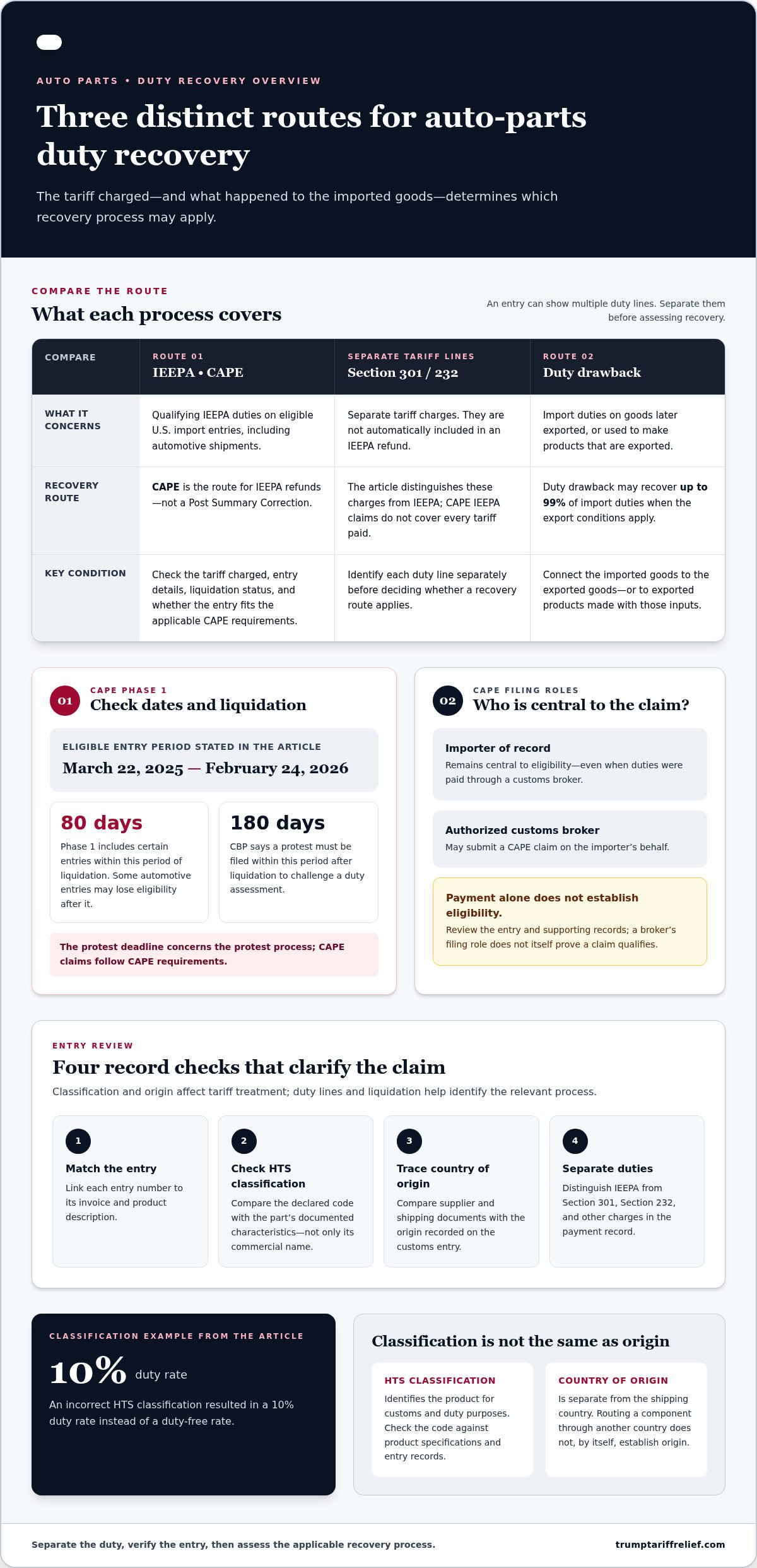
Claim deadlines depend on the entry’s liquidation status and the remedy being pursued. Phase 1 includes certain entries within 80 days of liquidation; some automotive entries may lose eligibility after that period. U.S. Customs and Border Protection says importers must file a protest within 180 days of an entry’s liquidation to challenge the duty assessment. That protest deadline matters when disputing an assessment through the protest process, while CAPE claims follow CAPE requirements.
Checking for Tariff Overpayments
Compare each entry’s duty assessment with its tariff line, shipment records, origin details, and liquidation status. These records help identify whether IEEPA duties were charged and whether the entry falls within Phase 1 dates. Review broker-provided entry documentation alongside the importer’s own payment and shipment records; a broker’s role in filing doesn’t by itself establish eligibility. Entries outside Phase 1’s dates, or beyond its 80-day liquidation window, may not qualify for that phase.
HTS classification and country of origin
An HTS classification identifies an imported product for customs and duty purposes. For auto parts, the code should reflect the component’s actual characteristics, not just its commercial name. A brake component, electrical assembly, or engine part may require a different classification analysis. Because duties are tied to entry details, the code on the customs record can affect whether the assessed payment was correct and which entries merit review.
Compare the declared HTS code with the part’s description and supporting product records. An example illustrates the financial stakes: an incorrect HTS classification resulted in a 10% duty rate instead of a duty-free rate. That example shows why a familiar part name alone doesn’t establish the right classification. Review product specifications, invoices, and entry records together, then identify whether the declared code matches the item that crossed the border.
Country of origin is separate from the country that shipped the part. Routing a component through another country does not, by itself, establish its origin. Compare supplier records and shipment documents with the country recorded on the customs entry. If the records conflict, flag the entry for closer review before estimating a refund. Origin can affect the applicable tariff treatment, while HTS classification identifies the product category. Both details matter.
For entries within the applicable IEEPA refund period ending February 24, 2026, preserve the classification and origin records tied to each shipment. A focused review can follow this sequence:
- Match each entry number to its invoice and product description.
- Compare the declared HTS code with the part’s documented characteristics.
- Trace the recorded origin through supplier and shipping documents.
- Separate IEEPA duties from other duties shown on the payment record.
These comparisons can help identify entries where a classification, origin detail, or duty line deserves scrutiny. For a clearer picture of the IEEPA refund review process, see how entry records support recovery analysis.
Auto parts and component tariff refunds
Auto parts imports may involve several duty lines, so the refund route depends on the tariff charged and the shipment’s later use. Separating IEEPA duties from other charges helps avoid treating every duty as part of one refund claim.
Recovering Section 301 or Section 232 Duties
IEEPA refund eligibility does not automatically include Section 301 or Section 232 duties on auto parts. The Supreme Court decision applies to 2025 IEEPA emergency tariffs, while Section 301 and Section 232 charges are separate tariff lines. If a component’s entry shows multiple duties, identify each charge before assessing recovery. That distinction matters because a CAPE IEEPA refund claim concerns IEEPA duties, not every tariff paid on the entry.
Export activity may offer a separate recovery route. U.S. Customs and Border Protection says importers can recover up to 99% of import duties through duty drawback when imported goods are later exported or used to make exported products. For an auto parts importer, the relevant records connect imported goods to exported goods or products made with those inputs.
Risks of Filing a Refund Claim
A refund claim carries the risk of pursuing the wrong duty or relying on incomplete entry records. If an importer combines IEEPA charges with Section 301 or Section 232 duties, the claim may not match the recovery process. Compare the duty lines, shipment documents, and liquidation details before filing. The importer of record or its authorized customs broker may submit a CAPE claim.
Timing also matters. Some automotive entries may lose Phase 1 eligibility 80 days after liquidation. A delayed review can therefore leave an importer outside that window. Keep the entry and payment records aligned, and distinguish a CAPE refund request from a protest or drawback claim. Each route addresses a different basis for recovery, so the tariff type and shipment history should guide the filing.
Which U.S. tariffs on imported auto parts are eligible for refunds?
Eligibility depends on the tariff authority recorded for each entry. An auto part’s product category alone does not make every duty refundable.
The 2026 CAPE process addresses qualifying IEEPA duties, not every tariff paid on imported components. The stated Phase 1 window covers qualifying U.S. entries from March 22, 2025 through February 24, 2026. If an auto-parts entry shows IEEPA duties within that period, it may fit the program’s scope. The importer must still meet CAPE requirements, including applicable entry and liquidation criteria.
Section 301 and Section 232 duties are separate from IEEPA tariffs. IEEPA duties were sometimes added on top of those charges, so one entry can contain multiple tariff lines. Section 301 tariffs on imports from China have been in place since 2018. A Section 301 or Section 232 charge does not become an IEEPA duty simply because it appears beside one. Assess each line under its own tariff authority.
Entry records can show which charges were assessed. Compare the tariff line and duty payment with the entry summary, product description, and country of origin. Then separate IEEPA amounts from Section 301 or Section 232 amounts. Informal U.S. entries under $800 were generally exempt from the IEEPA duties discussed here. That distinction can help identify entries that warrant closer review.
For an auto-parts importer, the key eligibility question is whether the entry includes qualifying IEEPA duties within the stated Phase 1 dates. A component’s classification and origin may clarify the tariff treatment, but neither replaces the entry’s recorded tariff authority. Keep the supporting shipment and payment records together. This makes the basis for each potential refund claim easier to assess.
Review the IEEPA tariff explanation to understand how these duties differ from other tariff charges.
Trump Tariff Relief: IEEPA Tariff Refund Recovery
Trump Tariff Relief helps importers assess potential IEEPA refund eligibility and manage the recovery process. If your auto parts entries include IEEPA duties, its Tariff Eligibility Assessment can help distinguish potentially eligible charges from Section 301 or Section 232 duties. The team also provides Customs Documentation Management and handles the IEEPA Tariff Refund Recovery process, from reviewing entry records through government filings.
Trump Tariff Relief can help organize shipment and payment records, assess how liquidation timing affects an entry, and determine whether a claim fits the applicable process. The work is contingency-based, with no upfront cost. Payment is only a percentage of funds successfully recovered, so there is no win, no fee.
Contact Trump Tariff Relief to discuss your import records and possible next steps.
Turn Your Eligibility Review Into a Clear Next Step
A tariff refund for auto parts importers starts with a clear picture of each entry, not an assumption that every duty can be recovered. Bring together the classification, origin, tariff line, and supporting shipment records. This gives your business a practical basis for identifying entries that merit attention and the documentation needed to support a claim.
Trump Tariff Relief can help move the process forward with a Tariff Eligibility Assessment, Customs Documentation Management, and IEEPA Tariff Refund Recovery. The review connects entry records to the appropriate recovery path, helping your team understand the potential scope of a claim.
When you’re ready to discuss your import records, contact Trump Tariff Relief. A focused review can help turn a complex tariff question into a more informed business decision.
Frequently Asked Questions
Can I file a refund now?
Yes, the CAPE process is open, but a claim must meet the requirements for the applicable phase. CBP launched Phase 3 on October 6, 2026. Check the entry’s tariff details, dates, and liquidation status against that phase’s eligibility criteria. IEEPA refunds must go through CAPE, not a Post Summary Correction. Filing now doesn’t make an entry eligible if it falls outside the applicable rules.
How do I request an IEEPA tariff refund?
Submit a CAPE claim through the importer of record or its authorized customs broker. Gather the entry summary, commercial invoice, transportation documents, and duty statement to connect the claim to the shipment and duties paid. Keep records organized by entry, since imports may have different tariff lines and liquidation statuses. CAPE refunds are issued electronically by ACH.
Can Automotive Companies Recover IEEPA Tariffs?
Yes. Automotive companies may qualify if they are the importer of record for entries assessed eligible IEEPA duties. A tariff refund for auto parts importers depends on the entry’s tariff line, import dates, and liquidation status, not the industry alone. For example, an auto-parts shipment with IEEPA and Section 301 charges requires those amounts to be distinguished. Only qualifying IEEPA duties are included in an IEEPA refund claim.
Can I still get a refund on entries that have already liquidated?
Possibly. Liquidation doesn’t automatically rule out a CAPE refund, but the entry’s phase requirements and liquidation date matter. Phase 1 includes certain entries within 80 days of liquidation. Separately, U.S. Customs and Border Protection says importers must file a protest within 180 days of liquidation to challenge a duty assessment. A protest and a CAPE claim are distinct routes, so identify the issue before filing.
How Much Could My Automotive Tariff Refund Be Worth?
The value of a tariff refund for auto parts importers depends on the eligible IEEPA duties actually paid on qualifying entries. Add the IEEPA duty amounts shown in entry and payment records, while separating Section 301 or Section 232 charges. The refund may include statutory interest where applicable, as determined by CBP. Shipment value alone doesn’t establish the recoverable amount; duty assessments and entry eligibility matter.
How long does it take to receive a refund?
Most valid IEEPA refunds are expected within 60-90 days after CAPE acceptance. CAPE refunds are paid electronically by ACH and typically arrive 3 to 5 weeks after liquidation or reliquidation. These timeframes refer to different points in the process, so acceptance and liquidation timing both matter. A claim requiring further review or corrected documentation may follow a different processing path.
Ready to find out what your business may be owed?
Check My Eligibility