
The estimated financial impact of Section 301 tariffs is substantial: the forced-labor tariffs are projected to cost U.S. businesses and consumers billions of dollars annually. Rates generally range from 10% to 12.5%, with the amount applied depending on the country and tariff structure. For importers, that duty can raise landed costs before a product reaches the U.S. market.
It’s easy to assume that only the importer bears a tariff bill. In practice, costs can flow through supplier contracts, pricing decisions and supply chains, affecting businesses and consumers in different ways.
This article explains how tariff rates work, how they can affect prices and operating costs, and how annual cost estimates fit into the wider picture. A company’s exposure depends on the goods it imports, their country of origin and how applicable duties interact, so understanding these factors can help identify where tariff costs are pressuring your business.
Key Takeaways
- Understand how country-specific rates of 10% or 12.5% apply, and why the tariff structure can change the total duty on an import.
- Trace how added import costs can affect supplier decisions, business expenses and prices paid by consumers.
- Compare the estimated annual cost to U.S. businesses and consumers with broader projections of tariff revenue.
- Assess how country of origin, product classification and applicable exceptions can shape a shipment’s tariff exposure.
- Separate Section 301 costs from IEEPA duties: eligible businesses can explore IEEPA Tariff Refund Recovery with support for eligibility assessment and customs documentation.
Section 301 rates and country-specific measures
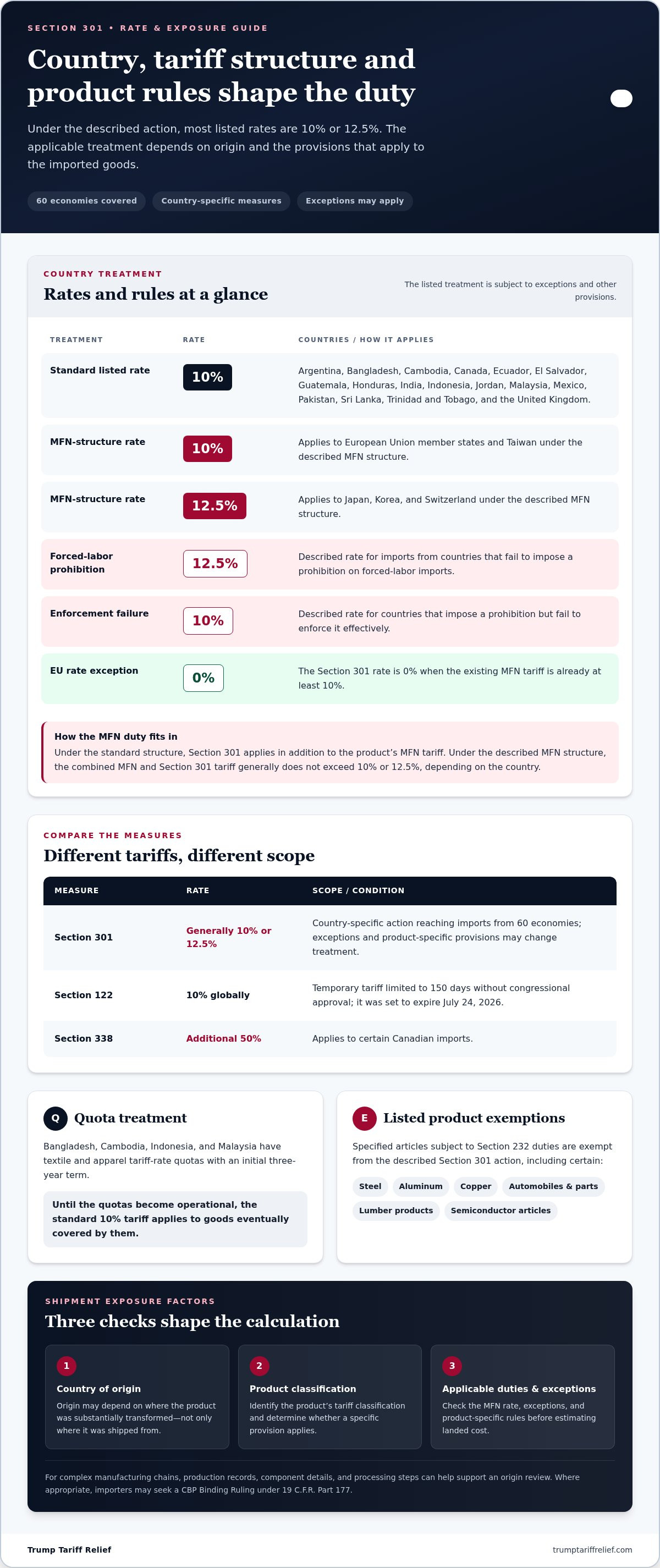
The financial impact of Section 301 tariffs depends on the imported product, its country of origin, and the applicable tariff structure. The described U.S. action took effect after 12:01 a.m. ET on July 24, 2026, and covers 60 economies. Most listed rates are 10% or 12.5%, subject to exceptions and other provisions.
Under the standard structure, the Section 301 duty applies in addition to the product’s most-favored-nation (MFN) tariff. That means an importer may owe both the ordinary MFN duty and the Section 301 duty. Under the described MFN structure, however, the combined MFN and Section 301 tariff generally does not exceed 10% or 12.5%, depending on the country. For the European Union, the Section 301 rate is 0% when the existing MFN tariff is already at least 10%.
The standard 10% rate applies to Argentina, Bangladesh, Cambodia, Canada, Ecuador, El Salvador, Guatemala, Honduras, India, Indonesia, Jordan, Malaysia, Mexico, Pakistan, Sri Lanka, Trinidad and Tobago, and the United Kingdom. Under the MFN structure, the described 10% tariff applies to European Union member states and Taiwan. Japan, Korea, and Switzerland face the described 12.5% tariff under that structure. The applicable country treatment matters before an importer calculates duty or adjusts a product’s landed cost.
Country-specific provisions also affect particular goods. Imports from countries that fail to impose a forced-labor prohibition face 12.5%, while imports from countries that impose one but fail to enforce it effectively face 10%, subject to exceptions. Bangladesh, Cambodia, Indonesia, and Malaysia have textile and apparel tariff-rate quotas with an initial three-year term. Until those quotas become operational, the standard 10% tariff applies to goods eventually covered by them.
How do Section 301 tariff costs compare with other U.S. tariffs and trade measures? Section 301 rates under this action are generally 10% or 12.5%. By comparison, the temporary Section 122 tariff was set at 10% globally and limited to 150 days without congressional approval; it was set to expire July 24, 2026. A separate Section 338 measure sets an additional 50% tariff on certain Canadian imports.
Which industries and products have been most affected by Section 301 tariffs? The action reaches imports from 60 economies, while textile and apparel goods from Bangladesh, Cambodia, Indonesia, and Malaysia receive specific quota treatment. Listed exemptions include certain products subject to Section 232 duties, such as steel, aluminum, copper, automobiles and parts, lumber products, and semiconductor articles.
To estimate import costs, identify the product’s country of origin and tariff classification, then determine whether an MFN rate, an exception or a product-specific provision applies. Origin may depend on where the product was substantially transformed, so the supplier’s shipping location alone may not determine its tariff treatment.
Evidence and country-specific findings supporting tariffs
The United States Trade Representative (USTR) opened two Section 301 investigations in March 2026. On March 12, it initiated investigations into 60 economies over alleged failures to prohibit or effectively enforce prohibitions on imports made with forced labor. On March 11, it opened a separate excess-capacity investigation covering 16 economies. These actions relied on Section 301 of the Trade Act of 1974, as amended, codified at 19 U.S.C. 2411.
The process included public participation. Written comments on both investigation groups were due April 15, 2026. Public hearings for the forced-labor investigations were scheduled to begin April 28, while hearings for the excess-capacity investigation were scheduled to begin May 5. The Trade Representative determined on June 2, 2026, that the investigated economies’ practices were unreasonable, burdened or restricted U.S. commerce, and were actionable under Section 301(b)(1).
Those findings are country-specific, not a blanket determination that every product from an economy involves forced labor. The stated investigation concerned whether an economy prohibited imports made with forced labor or effectively enforced that prohibition. Under the resulting action, imports from countries that fail to impose such a prohibition face a 12.5% tariff; imports from countries that impose one but fail to enforce it effectively face 10%, subject to exceptions. Five countries, Honduras, India, Sri Lanka, Jordan, and Trinidad and Tobago, moved from 12.5% to 10% after imposing or committing to impose prohibitions.
Country of origin also matters when a product moves through multiple countries. U.S. Customs and Border Protection applies a substantial-transformation analysis to determine origin for Section 301 trade remedies. In practical terms, the review focuses on whether processing changes a product’s identity or character enough to establish a new origin, rather than relying only on the shipping country. Importers assessing a complex manufacturing chain can organize production records, component details, and processing steps. Where appropriate, they may seek a CBP Binding Ruling under 19 C.F.R. Part 177.
Product exceptions can change the result even when an origin is covered. The described Section 301 action exempts specified articles subject to Section 232 duties, including certain steel, aluminum, copper, automobile and parts, lumber, and semiconductor articles. Separate China Section 301 exclusions also remain relevant: 178 exclusions are in effect through 11:59 p.m. Eastern time on November 9, 2026. USTR made conforming amendments to four exclusions in September 2026 after statistical reporting categories changed on July 1.
For a shipment review, match the product classification and manufacturing history against the applicable country measure, exclusion, and effective period. This matters because an exception may depend on the precise article, not simply its industry label. CBP implemented updated China exclusion treatment in ACE on September 23, 2026, following USTR’s conforming amendments. Importers should therefore connect entry records to the exact product and origin analysis used for each claim.
Effects on prices and supply chains
A Section 301 duty first changes the importer’s cost calculation. If a covered component enters under the 10% rate, the duty raises its landed cost before domestic handling, distribution, or retail pricing. At 12.5%, the increase is larger on the same dutiable value. The actual effect then depends on contracts, margins, inventory, and how much of the added expense each business absorbs.
Cost pressure can pass through several stages. A U.S. importer might absorb a duty to protect a customer relationship, negotiate a lower supplier price or pass some of the added expense into a wholesale quote. A manufacturer using imported inputs may then face higher production costs, even if its finished product isn’t directly subject to the tariff. Retailers make their own pricing decisions based on inventory, competing goods and margins.
Supply-chain responses involve trade-offs. A company sourcing a covered input from an affected country might find another supplier, redesign a product or change its purchasing plans. Each option can require new quality reviews, production scheduling and logistics coordination. Moving final assembly alone may not change tariff treatment: U.S. Customs and Border Protection uses substantial-transformation analysis to determine a product’s country of origin.
The USTR’s 2026 investigations cover 60 economies over forced-labor import prohibitions and 16 economies over excess manufacturing capacity. Those actions can influence sourcing decisions beyond the specific goods ultimately assessed duties. For example, a buyer may map supplier locations, identify components exposed to country measures, and compare alternative production routes. That analysis can help reveal where a tariff may restrict supply flexibility, rather than simply increasing one shipment’s cost.
Consumers may face some of the cost through higher prices, but a tariff rate does not translate directly into an equal retail-price increase. The importer, supplier, manufacturer, distributor and retailer each make decisions that affect how much cost is passed on. A business with existing inventory may feel the impact later than one replenishing stock under a new entry. Product substitution can also change demand and purchasing patterns.
Keep separate tariff authorities distinct. The Supreme Court held on February 20, 2026, that the International Emergency Economic Powers Act did not authorize the President to impose tariffs. That ruling concerned IEEPA, not the separate Section 301 authority under the Trade Act of 1974. For a company assessing exposure, the practical sequence is to match each import’s classification and origin, identify the applicable measure or exception, then trace the duty through input costs, contracts, and pricing.
Federal policy can affect businesses differently across states. A U.S. manufacturer importing parts may face direct pressure on input costs, while a domestic retailer may feel it through supplier quotes. The financial impact therefore depends on each firm’s role in the supply chain, not simply its state or industry. Mapping affected goods to purchase records and pricing decisions helps finance and procurement teams see where costs arise.
Potential economic harm and tariff efficacy
Tariffs can pressure foreign practices by raising the cost of covered imports. The policy goal behind the 2026 forced-labor action is to respond to failures to prohibit or effectively enforce prohibitions on goods made with forced labor. Its effectiveness depends on whether the affected economies change those practices, and whether enforcement continues after any policy response.
The economic burden can extend beyond the importer paying duties at entry. A business may absorb costs, renegotiate supplier terms, change sourcing or raise prices. U.S. manufacturers that rely on imported inputs can also face higher expenses. This helps explain why tariff revenue and the broader economic effect are different measures: federal revenue does not show how costs are distributed among firms and households.
What is the estimated impact of Section 301 tariffs on U.S. jobs, wages, and economic output? The available estimates here quantify fiscal effects, not a specific change in jobs, wages, or output. According to the Congressional Budget Office, trade policy changes through July 31, 2026, would increase projected primary deficits by $0.7 trillion and total deficits by $0.9 trillion over FY 2027-2036, relative to its February 2026 baseline.
Those deficit estimates are not a measure of tariff effectiveness. To assess whether Section 301 achieves its stated purpose, distinguish the intended policy response from the cost imposed on U.S. importers. Evidence of a country adopting a prohibition or improving enforcement may show a policy change; it does not, by itself, quantify effects on employment or production. Businesses can separately track duty payments, supplier changes, and input costs to understand their own exposure.
What are the risks and potential costs of future Section 301 tariff changes? A change to a rate, exemption, or tariff-rate quota could alter import costs and sourcing plans. The Trade Representative may modify or terminate tariffs, exemptions, or quotas under Section 307 of the Trade Act of 1974, subject to specific presidential direction. The described measures remain in place indefinitely absent subsequent amendment.
Because tariff measures can differ by product and country, it’s important to track the exact measure that applies. A change affecting one economy or product category may not apply to another shipment, so import records should link each entry to its origin and classification. Businesses with long supplier contracts may also face a gap between a policy change and their next purchasing cycle. Reviewing purchase commitments alongside tariff treatment can reveal where renegotiation or inventory decisions may matter.
Keep separate legal authorities distinct. On February 20, 2026, the Supreme Court held that the International Emergency Economic Powers Act did not authorize the President to impose tariffs. That ruling addressed emergency economic powers under IEEPA; it did not itself repeal Section 301. A sound economic assessment therefore separates duties under each authority, measures their individual costs, and avoids treating one court decision as a change to every tariff program.
Estimated annual costs for U.S. businesses and consumers
Estimates show the scale of the forced-labor tariffs’ potential cost, but they measure different things. The Committee for a Responsible Federal Budget estimated the tariffs would raise about $90 billion annually over the next decade. Separate estimates put annual costs to U.S. Revenue collected by the federal government and costs borne across the economy are related, but they are not interchangeable measures.
The projected revenue figures also differ by method and time frame. The Tax Foundation estimated conventional revenue of $58.2 billion in 2027. The Tax Policy Center estimated $55.7 billion in revenue for that year. These are forecasts, not a tally of duties already collected. The difference reflects separate estimates of how the measures may affect imports, prices, and economic activity.
How much tariff revenue has the U.S. collected under Section 301? The figures above estimate future revenue, rather than report cumulative collections. For the forced-labor tariffs, estimates include about $90 billion annually over the next decade and 2027 projections of $58.2 billion from the Tax Foundation and $55.7 billion from the Tax Policy Center.
Another projection looks beyond one year. Section 301 tariffs on imports from roughly 60 economies are estimated to raise $900 billion through FY 2036. That long-range estimate covers a wider period than the annual projections, so it should not be added to them as though each figure represents a separate cost. The estimates describe potential revenue under different assumptions, not a guaranteed cash total.
A national estimate is a starting point, not a company-specific bill. Actual exposure depends on the products imported, their dutiable value, applicable country treatment and any relevant exceptions. A U.S. company importing a covered input may pay duties directly; another may feel the effect through supplier prices. Consumers may face some costs if businesses pass expenses along, while other firms absorb costs or change their sourcing.
To make estimates useful, finance teams can separate duty payments from other import expenses, then connect entries to product, origin and supplier records. Comparing those records with purchasing and pricing data helps show which costs are direct and which may flow through the supply chain. It also prevents national projections from being mistaken for an individual importer’s exposure.
The financial impact of Section 301 tariffs therefore depends on both the government’s revenue estimate and how businesses respond. The 2027 projections differ from the next-decade estimate because they use different periods and analytical approaches. For a separate review of duties paid under another tariff authority, assess potential tariff refund eligibility.
Trump Tariff Relief: IEEPA Tariff Refund Recovery
Trump Tariff Relief helps businesses assess and pursue potential refunds of tariffs paid under IEEPA, a separate authority from Section 301. If your company paid IEEPA duties, its records and entries can be reviewed through a Tariff Eligibility Assessment. Section 301 duties are distinct, so this recovery process addresses eligible IEEPA tariffs, not Section 301 charges.
For qualifying IEEPA refund matters, Trump Tariff Relief provides IEEPA Tariff Refund Recovery and Customs Documentation Management. The team reviews eligibility and organizes supporting documentation for the recovery process. The service is contingency-based, with no upfront cost: payment is only a percentage of funds successfully recovered.
If you paid IEEPA tariffs and want to know whether your entries may qualify, contact Trump Tariff Relief for an eligibility assessment.
Turn tariff exposure into a clear next step
Use your tariff review to separate duties by authority and connect each entry to its supporting records. That distinction matters: Section 301 duties and IEEPA tariffs arise under different authorities, so a review of one does not establish eligibility for recovery under the other. If your business paid IEEPA tariffs, a focused assessment can help organize the relevant entries and customs documentation for potential recovery.
The financial impact of Section 301 tariffs is best managed with clear records and decisions grounded in the duties that actually applied. Trump Tariff Relief offers IEEPA Tariff Refund Recovery, Tariff Eligibility Assessment, and Customs Documentation Management for businesses evaluating that separate refund opportunity. An assessment can help clarify whether pursuing recovery fits your circumstances, without confusing it with Section 301 costs.
For a practical review of your IEEPA tariff records, contact Trump Tariff Relief. A clear starting point can help your business decide what to do next with confidence.
Frequently Asked Questions
What are Section 301 tariffs and which imports do they cover?
Section 301 tariffs are trade measures the United States may impose when the U.S. Trade Representative determines a foreign country’s act, policy, or practice is unreasonable or discriminatory and burdens or restricts U.S. commerce. Coverage depends on the investigation and resulting tariff action, not simply a country’s name. For a shipment, compare its country of origin and product classification with the specific measure and any applicable exception.
How have Section 301 tariffs affected U.S. import prices and consumer prices?
Section 301 duties can raise an importer’s cost, but consumer prices don’t automatically rise by the same percentage. An importer may absorb some expense, renegotiate supplier terms, or pass costs into wholesale pricing. The effect can also differ over time: a retailer selling inventory already purchased may face different cost pressures than one ordering replacement stock under the tariff. Imported components can affect prices of finished U.S. products too.
How have Section 301 tariffs affected U.S. businesses, costs, and profits?
Tariffs can increase expenses for importers and businesses using covered goods as inputs. The effect on profits depends on margins, contracts and pricing power. To assess exposure, finance teams can compare import entries with product-level purchasing and sales records. Separating duties paid directly from added supplier charges helps identify where costs arise and whether particular products or customer contracts are absorbing the pressure.
How have Section 301 tariffs changed U.S. imports, supply chains, and trade with China?
Tariff exposure can lead businesses to reconsider suppliers, production locations or product design, but the effect on U.S.-China trade varies by product and company. A change in shipping route alone doesn’t necessarily change origin treatment. For example, if a product is assembled in a third country using Chinese components, the importer may need to examine where substantial transformation occurred and retain records of the manufacturing process.
What exclusions, refunds, or waiver procedures are available for Section 301 tariffs?
Some goods may qualify for product exclusions, and eligible duties may qualify for drawback under 19 U.S.C. § 1313 when statutory requirements are met. CBP may also allow a Post Summary Correction within its filing timeframe or a protest within the applicable protest period. These routes are distinct from IEEPA tariff refund recovery: Trump Tariff Relief’s recovery service concerns eligible IEEPA duties, not Section 301 refunds. Review entry records and supporting documents to identify the relevant pathway.
Ready to find out what your business may be owed?
Check My Eligibility