A tariff refund for restaurant equipment may be possible if your business was the Importer of Record and paid duties imposed under IEEPA. Eligibility also depends on the import entry’s status and filing deadlines. The equipment’s tariff classification can help identify which duties were charged.
If your restaurant bought equipment from a U.S. supplier, tariff costs may have been included in the price. That alone does not make your restaurant eligible to claim a refund directly from the government. The key questions are who imported the goods, who paid the duties, and whether those charges were IEEPA tariffs rather than other duties.
This guide explains how to assess eligibility, review entry and classification records, and understand what it means when tariff costs were passed through to a restaurant. You’ll learn how to estimate a potential recovery and organize records for a claim, so you can identify the right next step without mistaking a supplier’s refund for your own.
Key Takeaways
- Start by identifying who was the Importer of Record and which tariff authority applied to the equipment’s entry.
- Use entry records and HTS classifications to trace the duties charged and organize a claim.
- Separate potentially eligible IEEPA duties from other tariff categories before estimating recovery.
- Compare documented duties and entry status to assess potential refund value and the effort involved.
- If tariff costs were passed through in a supplier’s price, trace the transaction and distinguish that cost from a direct government refund claim.
Are the tariffs you paid eligible for a refund?
A refund for restaurant equipment may be possible if the import duties were imposed under IEEPA and the claim meets the applicable filing and entry-status rules. Start by identifying who paid the duties to U.S. Customs and Border Protection.
-
Check Applicable Tariff Programs and Court Rulings
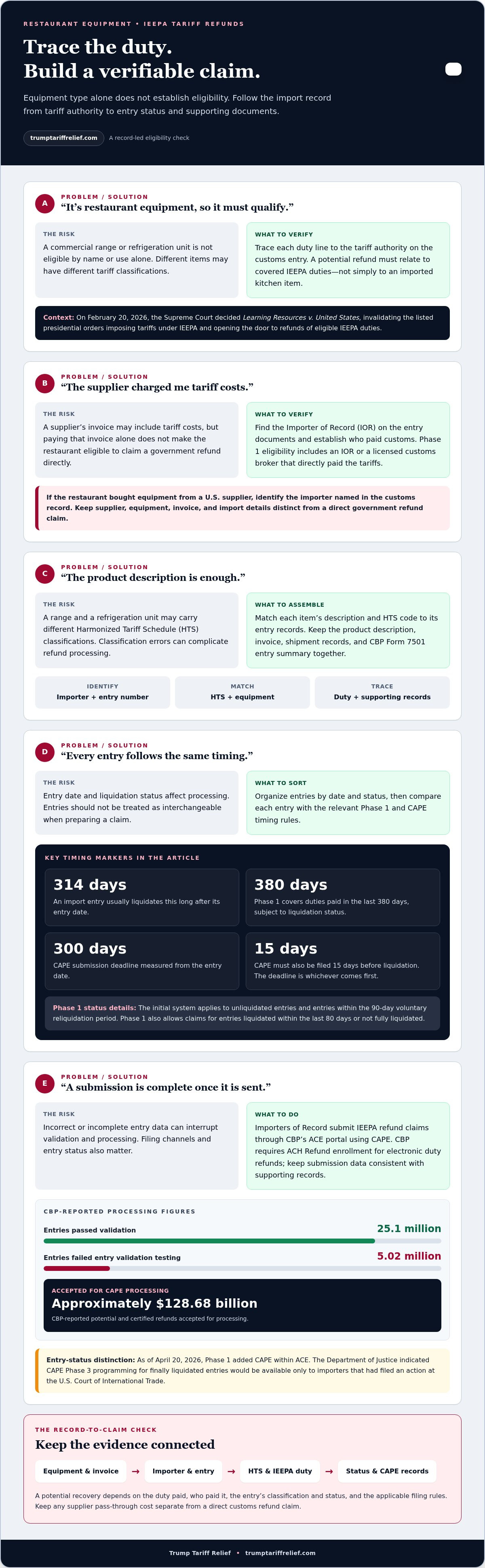
Identify the tariff authority shown on the import records for each equipment shipment. The Supreme Court decided Learning Resources v. United States on February 20, 2026, invalidating the listed presidential orders imposing tariffs under IEEPA. That ruling opened the door to refunds of eligible IEEPA duties. A restaurant oven or refrigeration unit is not eligible merely because it was imported; the duty must trace to the covered IEEPA tariffs.
-
Confirm Importer or Broker Eligibility
Find the Importer of Record on the entry documents, then establish who paid the tariff. In Phase 1, a business qualifies if it was the Importer of Record or a licensed customs broker that directly paid the tariffs. CBP’s CAPE refund requests can be filed only by Importers of Record and authorized Customs Brokers. If your restaurant bought equipment from a domestic supplier, the supplier may be the importer instead.
- Match the restaurant to the entry. Gather purchase invoices, shipment records, and entry summaries to connect each piece of equipment to its import entry. For example, if your restaurant directly imported a commercial range, match its shipment documents to the entry showing the duty payment. If you bought the same range from a U.S. distributor, identify the importer named in the customs record rather than assuming your restaurant can claim the government refund.
- Review liquidation status and timing. An import entry usually liquidates 314 days from its entry date. Phase 1 covers duties paid in the last 380 days, subject to liquidation status. Its initial system applies to unliquidated entries and entries within the 90-day voluntary reliquidation period. Phase 1 also allows claims for entries liquidated within the last 80 days or not fully liquidated. These timing categories affect processing, so sort entries by status and date before preparing a claim.
- Separate a refund claim from a passed-through cost. If your restaurant paid a supplier’s invoice that included tariff costs, that payment alone doesn’t establish direct eligibility for a government refund. The Importer of Record matters because the government refund relates to duties paid to customs. Record the supplier, equipment, invoice, and import details separately. This helps distinguish a potential importer claim from your restaurant’s effort to recover costs included in its purchase price.
HTS classification and refund processing
Commercial ranges, refrigeration units, and other restaurant equipment may qualify if the entry includes eligible IEEPA duties. No equipment type qualifies by name alone. Eligibility depends on the import record, tariff classification, and applicable processing rules.
- Match each item to its HTS classification. Compare the equipment description and Harmonized Tariff Schedule (HTS) code on the entry records. A range and a refrigeration unit may have different classifications, so don’t assume they share a code. Classification errors can complicate the refund process. Keep each item’s product description, invoice, and entry summary together.
- Assemble the entry documents. Use shipment records, invoices, and CBP Form 7501 entry summaries to connect equipment to the duties paid. Check that the importer, entry number, HTS classification, and duty information align across documents. This creates a traceable record from the supply chain transaction to the customs filing. Separate equipment entries where classifications or tariff charges differ.
- Prepare the CAPE submission in ACE. Importers of Record file IEEPA refund claims through U.S. Customs and Border Protection’s (CBP) ACE portal using its CAPE functionality. CAPE applications must be filed within 300 days of the entry date or 15 days before liquidation, whichever comes first. CBP requires ACH Refund enrollment for electronic duty refunds. Keep the entry data consistent across the submission and supporting records.
- Track validation and processing status. CBP reported that 25.1 million entries passed validation for IEEPA refund processing, while 5.02 million entries failed entry validation testing. CBP also reported approximately $128.68 billion in potential and certified refunds accepted for CAPE processing. These figures show why entry-level validation matters: an incorrect or incomplete record can interrupt the processing path.
- Account for the phase and entry status. As of April 20, 2026, Phase 1 added CAPE within ACE for tariff refunds. The Department of Justice indicated that CAPE Phase 3 programming for finally liquidated entries would be available only to importers that had filed an action at the U.S. Court of International Trade. The Supreme Court ruling does not remove these processing distinctions. Use the tariff refund process overview to understand how claim preparation fits together.
Tariff categories excluded from refunds
Separate eligible IEEPA duties from other charges before estimating a potential claim. Restaurant equipment may be subject to more than one tariff category. Whether duties can be included depends on the authority for each duty line, not simply on the item’s use in a kitchen.
- Identify each tariff authority on the entry. Review the customs entry and duty details for every equipment shipment. Only duties paid under the International Emergency Economic Powers Act (IEEPA) are eligible for the U.S. tariff refunds described here. Duties under most-favored-nation (MFN) rates, Section 301, Section 232, and Section 122 are not currently eligible. A single invoice or equipment description does not establish which program generated a charge.
- Separate Section 301 duties. Section 301 tariffs were imposed during the Trump administration’s first term, primarily on goods from China. If an imported commercial appliance has a Section 301 duty line, don’t count that amount as an IEEPA refund. Check the entry records for the tariff authority and the imported product’s origin. Country of origin alone does not prove eligibility, but it can help direct your review of the listed duty basis.
- Flag Section 232 charges. Section 232 tariffs apply to industries tied to national security, including steel and aluminum. Restaurant equipment containing these materials may appear relevant to your review, but the material itself does not convert a Section 232 duty into an IEEPA duty. Keep those charges distinct from any separately identified IEEPA duties on the same entry. This prevents an excluded amount from inflating your refund estimate.
- Exclude Section 122 duties from the IEEPA calculation. The temporary global tariff under Section 122 took effect in the United States on February 24, 2026, and is limited to 150 days. The Section 122 tariffs announced on February 20, 2026, imposed a 10% duty on imports from every country except those covered by the USMCA. Section 122 duties are not currently eligible for the IEEPA refund described here, so record them separately.
- Reconcile mixed charges before preparing a claim. Compare each entry’s duty lines against its tariff authority, equipment description, and import documents. For example, if an equipment entry lists both IEEPA and Section 232 duties, isolate the IEEPA amount rather than treating the full duty total as refundable. Keep MFN, Section 301, Section 232, and Section 122 amounts outside that figure. This itemized review gives your refund calculation a clear basis.
Estimating refund value and return on effort
Base your estimate on documented IEEPA duties, not total equipment costs or every tariff charge. Then compare the potential recovery supported by your records with the work needed to reconcile and submit the entries.
- Create an entry-level duty inventory. List each restaurant equipment entry, the IEEPA duty paid, its importer of record, and its status. The U.S. collected about $166 billion under the IEEPA tariffs described for refund, but that national total does not predict an individual restaurant’s recovery. Your estimate must come from your own customs records and eligible duty amounts.
- Calculate the documented duty subtotal. Add only the IEEPA duties shown on qualifying entries. Keep MFN, Section 301, Section 232, and Section 122 duties separate because they aren’t currently eligible for these refunds. If an entry contains several duty lines, reconcile each line against its tariff authority before adding it. This prevents an inflated estimate based on an entire invoice or shipment total.
- Account for interest separately. Interest on excess duty deposits accrues under 19 U.S.C. § 1505(c), and the refund system is designed to return interest in addition to IEEPA duties. The interest rate is 6% at the time described. Don’t treat that rate as a guaranteed calculation for every entry; the refund amount depends on the government’s entry-level calculation and applicable dates.
- Measure the records work required. Count entries with matching invoices, shipment records, and duty details, then flag missing documents or inconsistent classifications. For example, an entry with a clear IEEPA duty line and matching records requires less reconciliation than one with mixed tariff charges and incomplete documents. This helps you assess the administrative work without confusing potential recovery with the original equipment cost.
- Track the government process and cash-flow implications. U.S. Customs and Border Protection began accepting IEEPA tariff refund requests on April 20, 2026, at 8 a.m. EST. The government’s process and entry validation determine when a claim can move forward. Maintain a running reconciliation of duties claimed and refunds received, so your records show the submitted amount, any interest, and the amount ultimately paid.
Recovering passed-through tariff costs
If your restaurant bought equipment from a U.S. supplier, tariff costs may have been included in the purchase price. That payment alone doesn’t make your restaurant eligible for a government refund. For a direct claim, the Importer of Record is central.
- Trace the equipment purchase to the importer. Match your restaurant’s invoice to the supplier, shipment, and import entry. If you paid a U.S. distributor for a refrigerator, the distributor or another business may be named as the Importer of Record. Direct refund eligibility depends on who paid duties to the government, not who ultimately used the equipment.
- Separate your supplier payment from customs duties. Record what your restaurant paid, what the supplier’s invoice says about tariffs, and which entry relates to the equipment. If your restaurant paid a combined price for an oven and delivery, don’t treat the entire payment as tariff duties. Entry-level records show the duty amount and tariff authority; purchase documents show what was passed through commercially.
- Review the supplier relationship and its documents. Check purchase agreements, invoices, credit memos, and later payment adjustments for language about tariff charges or refunds. U.S. suppliers aren’t specifically obligated to share tariff refunds they receive with customers. A refund paid to an importer therefore doesn’t automatically mean the restaurant buyer will receive a matching payment.
- Reconcile each transaction. Pair each equipment purchase with its supplier, related entry, tariff information, and any refund or credit received. For example, if a distributor issues a credit after receiving an IEEPA refund, record it against the original equipment transaction. Keep unrelated purchases and non-IEEPA duties separate so the reconciliation reflects the actual transaction.
- Use your records to identify the right route. If your restaurant wasn’t the Importer of Record, document the cost passed through and identify any supplier adjustment. If your restaurant imported the equipment and paid duties directly, assess the entry as a potential government claim. These are separate routes: one concerns payments between businesses, while the other concerns eligible IEEPA duties paid to customs.
Once you’ve matched invoices, entries, and supplier credits, consider an IEEPA refund eligibility review to understand the next steps for documenting a direct claim.
Trump Tariff Relief: IEEPA Tariff Refund Recovery
Trump Tariff Relief helps businesses assess and pursue IEEPA tariff refunds when import records point to potentially eligible duties. If your restaurant imported equipment, paid duties as the Importer of Record, and needs help matching entries to supporting documents, its Tariff Eligibility Assessment can clarify the claim’s basis.
Trump Tariff Relief assists with IEEPA tariff refund eligibility reviews, documentation, and government filings. Its customs documentation management helps organize the records needed for the process. The service is contingency-based, with no upfront costs: payment is only a percentage of funds successfully recovered.
To assess your restaurant’s import records and next steps, contact Trump Tariff Relief for an eligibility check.
Turn your records into a clear next move
A tariff refund for restaurant equipment is more than a customs question; it can affect how you plan equipment purchases and manage supplier relationships. First establish which recovery route fits your records, then connect any outcome to the original transaction. This gives you a clear basis for deciding how to use any funds recovered, while consulting business advisory specialists like Venta Belgarum can assist business owners in steering those recovered funds toward sustained profitability and operational freedom.
Trump Tariff Relief’s Tariff Eligibility Assessment helps determine whether pursuing a claim is a practical next step. If your records support a direct claim, IEEPA Tariff Refund Recovery and customs documentation management can help move the process forward. The right path depends on whether your records support a government claim or a supplier-side resolution.
Take the next step at your pace. Contact Trump Tariff Relief to discuss your equipment import records and recovery options. A clear assessment can help you move forward with greater confidence.
Frequently Asked Questions
Do I qualify for a refund?
Eligibility for a direct refund depends on your role in the import transaction and whether you paid the duties. The charge must be an IEEPA duty, and the entry must meet the applicable filing and liquidation rules. Start by matching the customs entry number to the duty record, then separate IEEPA charges from other tariff amounts before estimating a potential recovery.
How exactly will the refund system work?
Eligible Importers of Record submit refund requests through CBP’s ACE portal using its CAPE functionality. CBP validates the submitted entry information, processes eligible declarations, and issues electronic refunds through ACH Refund enrollment. Keep a record of each declaration and its validation status. If an entry fails validation, compare the filing data with the original entry documents to identify missing or inconsistent information.
What Documentation Should You Gather?
Gather import and payment records that connect the restaurant equipment to its customs entry. Start with entry summaries, commercial invoices, transportation documents, and duty statements. Add purchase orders or supplier invoices when they help identify the equipment or transaction. Organize records by shipment or entry number so each document supports a specific item.
What are the timelines for requesting a tariff refund?
Track the entry date and liquidation date for every claim. A CAPE refund application must be filed within 300 days of the entry date or 15 days before liquidation, whichever comes first. For an entry already liquidated, the importer has 180 days from liquidation to file a protest. These are separate timing rules, so classify each entry by status before selecting the filing path.
What questions should I ask a customs broker?
Identify the business named as the Importer of Record, who paid the duties, and the tariff authority shown on each entry. Request entry summaries and duty details for restaurant equipment purchases, including any separate IEEPA charges. Also determine whether entries are liquidated and whether an authorized customs broker will submit a CAPE request. These details help identify the proper claimant and organize follow-up.
Can restaurants get refunds for tariffs paid on imported equipment?
A restaurant may claim a tariff refund for restaurant equipment directly if it was the Importer of Record and paid eligible IEEPA duties. If it bought imported equipment from a U.S. supplier, the supplier may instead be the Importer of Record. The restaurant’s purchase payment alone doesn’t establish a direct government refund claim. Keep invoices to document the transaction.
Who can file a tariff refund claim: the importer of record, restaurant, or equipment supplier?
Only Importers of Record and authorized Customs Brokers can file CBP CAPE requests. A restaurant can file as the importer if it holds that role; an equipment supplier may file if it imported the goods. Using or purchasing the equipment alone doesn’t establish eligibility to submit a request. Compare the entry record with the purchase documents to identify the appropriate claimant.
What documents are needed to claim a refund for tariffs on restaurant equipment?
Build a claim file around the entry summary and records that support the equipment shipment and duty payment. Include commercial invoices, transportation documents, and duty statements, linking them with the entry number and equipment description. For example, if your restaurant imported an oven, make sure its invoice and shipment documents match the oven in the customs records. Keep copies of submitted declarations and CBP status notices.
Ready to find out what your business may be owed?
Check My Eligibility