
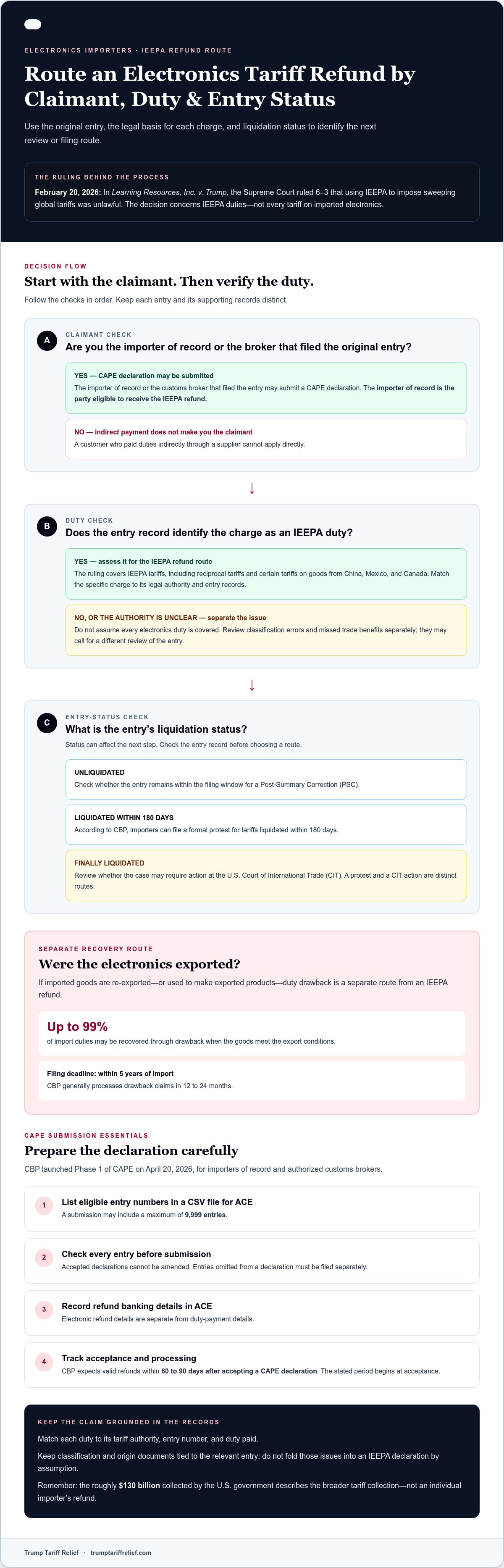
A tariff refund for electronics importers may be available for duties collected under the International Emergency Economic Powers Act (IEEPA). On February 20, 2026, the Supreme Court ruled that using IEEPA to impose sweeping global tariffs was unlawful. Claims go through U.S. Customs and Border Protection’s CAPE process, and the importer of record is eligible to receive the refund; CBP expects valid refunds within 60 to 90 days after accepting a CAPE declaration.
That ruling opened a path to recover qualifying duties, but refunds aren’t automatic. The right filing route depends on who made the original entry and its status. A customs broker that filed the entry may submit a CAPE declaration, but the importer of record remains central to the claim.
This guide explains who can file, which electronics entries may qualify, how liquidation timing affects the process, and when a case may require action at the U.S. Court of International Trade. You’ll also learn what to prepare for a CAPE submission and how to distinguish IEEPA duties from other tariffs not addressed by the Supreme Court ruling.
Key Takeaways
- Identify whether you’re the importer of record or the customs broker that filed the original entry before preparing a CAPE claim.
- Separate IEEPA refund questions from classification errors and missed trade benefits, which may call for a different review of your entries.
- Use entry status to guide your next step: according to U.S. Customs and Border Protection, importers can file a formal protest for tariffs liquidated within 180 days.
- Distinguish IEEPA duties from other tariffs on imported electronics to see which charges the Supreme Court ruling may affect.
- Review whether finally liquidated entries may require action at the U.S. Court of International Trade before deciding how to pursue recovery.
Who is eligible to file a tariff refund claim?
For a tariff refund for electronics importers, first distinguish who may submit a claim from who may receive the proceeds. CAPE eligibility also depends on the entry and the duties paid.
-
Check Classification Errors and Missed Trade Benefits
Compare each electronics entry’s tariff classification with its product description, invoice, and customs records. If an error led to excess duties, identify the affected entry and the correction sought. Don’t assume a classification issue belongs in an IEEPA claim.
Review whether the entry missed an available trade benefit, such as a preference tied to the goods’ origin. A supplier invoice or origin records may support that review. Match each document to the entry and duty paid, keeping these issues separate from IEEPA refund declarations.
-
Review Claim Filing Requirements
Identify the importer of record and the customs broker that filed the original entry. Either may submit a CAPE declaration, but only the importer of record is eligible to receive an IEEPA refund. A customer who paid duties indirectly through a supplier cannot apply directly.
Prepare eligible entry numbers in a CSV file for ACE, with a maximum of 9,999 entries per submission. Accepted declarations can’t be amended, so list entries carefully; omitted entries must be filed separately. Record refund banking details in ACE for electronic payment, separate from duty-payment details.
-
Check Tariff Eligibility and Drawback
Separate the tariff authority from the product category. The Supreme Court ruling concerns IEEPA duties, not every charge on imported electronics. Check the entry record for the legal basis of each duty before including it in a refund declaration.
If imported electronics are re-exported, duty drawback is a separate recovery route. U.S. importers may recover up to 99% of import duties when goods are exported or used to make exported products, and must file within 5 years of import. CBP generally processes drawback claims in 12 to 24 months.
Financing or selling a refund claim is separate from establishing eligibility. Before signing an agreement, compare any advance, repayment source, recourse, assignment terms, and fees. Risks include naming the wrong importer, omitting entries, or relying on weak classification or origin records. Keep any denial notice and its stated grounds. A protest and action at the U.S. Court of International Trade are distinct routes, and entry status affects the next step. Review a tariff refund for electronics importers entry by entry, aligning supporting documents and the filing route before submission.
Supreme Court decision and IEEPA tariff refunds
Use the Supreme Court ruling to distinguish potentially refundable IEEPA duties from other charges on your electronics entries. Then trace each duty through the entry record and refund process.
- Match the tariff to the legal authority. On February 20, 2026, the Supreme Court decided Learning Resources, Inc. v. Trump by a 6-3 vote. It ruled that using the International Emergency Economic Powers Act (IEEPA) to impose sweeping global tariffs was unlawful.
The ruling concerns IEEPA tariffs, including reciprocal tariffs and certain tariffs on goods from China, Mexico, and Canada. It doesn’t make every duty on an imported device refundable. Check the entry record for the measure behind each charge rather than assuming a tariff’s country or product category determines eligibility.
- Reconcile the affected charges against your customs records. Compare entry summaries and duty-payment records with the tariff authority shown for each shipment. For example, if an entry lists an IEEPA measure alongside a separate tariff, distinguish those amounts before preparing refund claims. This helps ensure a claim doesn’t include unrelated duties beyond the scope of the Supreme Court decision.
The U.S. government had collected roughly $130 billion in tariffs that the Court deemed illegal in February 2026. That figure describes the broader collection, not an individual importer’s refund. Your records must connect the specific IEEPA tariff paid to the entry and the importer of record.
- Track administration and processing through the designated CAPE route. U.S. Customs and Border Protection launched Phase 1 on April 20, 2026, for importers of record and authorized customs brokers. A refund claim isn’t automatic: eligible entries must be declared, and incomplete entry details can interrupt processing.
Keep a working schedule of declarations submitted, entries included, and any processing status. CBP expects valid refunds within 60 to 90 days after accepting a CAPE Declaration. That period starts at acceptance, not when duties were first paid or when a shipment entered the supply chain.
For electronics importers, the practical first move is to map each duty to its authority, then match that charge to entry documentation. A clear explanation of IEEPA tariffs can help distinguish the covered measure from other duties.
Unliquidated and liquidated tariff entries
Classify each entry by liquidation status before choosing a refund route. That status affects whether CAPE processing, a protest, or possible court action needs attention.
- Separate unliquidated entries from liquidated entries in your customs records. For an unliquidated entry, check whether it remains within the filing window for a Post-Summary Correction (PSC). Importers can generally file a PSC within 300 days of entry, before liquidation, and may file up to 15 days before scheduled liquidation.
Use the entry number, entry date, and scheduled liquidation date to guide your decision. A PSC can address an eligible correction while the entry remains unliquidated, but it is not the CAPE route for an IEEPA refund claim. Keep these filing tracks separate to support compliance and avoid sending an IEEPA request through the wrong channel.
- For liquidated entries, calculate the time since liquidation and identify any protest already filed. According to U.S. Customs and Border Protection, importers can file a formal protest for tariffs liquidated within 180 days. Record the liquidation date and preserve the entry summary, duty payment record, and protest correspondence.
CAPE Phase 1 doesn’t handle protested entries. If an entry was liquidated within 80 days and you want it processed in CAPE Phase 1, CBP advises withdrawing the protest. That choice affects the entry’s route, so compare the protest status with the phase criteria before acting. Do not assume a pending protest will move automatically into consolidated CAPE administration.
- Review the 90-day voluntary reliquidation window separately from the protest deadline. Under 19 U.S.C. § 1501, the voluntary reliquidation window is 90 days after liquidation. Entries liquidated within the preceding 80 days may still fall within that window, so prepare the refund calculation and supporting records promptly.
For entries finally liquidated outside the available administrative path, court action may matter. CAPE Phase 3 programming for finally liquidated entries is available only to importers that have filed an action at the U.S. Court of International Trade. The U.S. Department of Justice has argued that CBP lacks authority to reliquidate beyond the 90-day voluntary window. Treat that position as a litigation issue, not as a substitute for checking each entry’s actual status.
Build an entry-level schedule showing liquidation status, deadlines, protest status, and the next filing step. This gives your team a practical basis for prioritizing IEEPA refund processing and avoiding missed procedural routes.
Whether importers need to file suit at the CIT
A lawsuit isn’t automatically required for every IEEPA refund claim. The key distinction is entry status: CAPE phases cover administrative processing, while finally liquidated entries may require action at the U.S. Court of International Trade.
- Sort entries by liquidation status and existing filings. List each entry number, liquidation date, protest status, and CAPE declaration status. This separates entries that may qualify for the administrative process from those that may need court action.
For Phase 1, CBP does not handle protested entries. For an entry liquidated within 80 days, CBP advises withdrawing a protest if the importer wants Phase 1 processing. Compare those conditions before choosing a route. Don’t assume an existing protest will transfer into CAPE or that every entry in one shipment has the same status.
- Identify finally liquidated entries separately. CAPE Phase 3 programming for finally liquidated entries is available only to importers that have filed an action at the U.S. Court of International Trade. That makes the suit question especially important for this category, rather than a universal filing step for all importers.
Build an entry-level record showing which finally liquidated entries are involved and whether a court action has been filed. Keep supporting entry documents and duty records together. If an importer has a mix of unliquidated, recently liquidated, and finally liquidated entries, don’t treat them as one claim group. The relevant phases and requirements can differ by entry status.
- Weigh the administrative route against the court-related route for each group. More than 300,000 distinct importers had claims, while only about 3,000 lawsuits had been filed at the time described. Those figures show a gap between the number of potential claimants and filed cases, but they don’t establish whether a particular importer should sue.
Use the figures as context, not as a decision rule. The question turns on whether the entry is finally liquidated and whether Phase 3 applies. Track CAPE declarations and processing of entries alongside any filed action, so the record reflects both administrative and court steps. An importer with entries in different phases may need to monitor each route independently.
Before submitting declarations, reconcile the entry list with the importer of record and any broker filings. This helps identify which entries can proceed through CAPE and which are finally liquidated and tied to CIT action.
Which U.S. tariffs on imported electronics are eligible for refunds?
Start with the legal authority shown for each duty, not the fact that the shipment contains electronics. The Supreme Court ruling concerns IEEPA tariffs, not every tariff assessed on imported devices or components.
- Match each charge to its tariff authority. On February 20, 2026, the Supreme Court ruled that using the International Emergency Economic Powers Act (IEEPA) to impose sweeping global tariffs was unlawful. The ruling covered IEEPA tariffs, including reciprocal tariffs and certain tariffs on goods from China, Mexico, and Canada.
Review entry records and duty calculations line by line. If an electronics shipment includes an IEEPA charge, separate it from other tariffs listed for the same entry. Eligibility depends on the authority behind the charge, not simply the product’s country of origin, type, or place in the supply chain.
- Keep tariffs imposed under other laws outside an IEEPA refund request. Section 301 tariffs on imports from China have been in place since 2018. The Supreme Court’s IEEPA ruling does not, by itself, establish that those separate Section 301 duties qualify for an IEEPA refund.
Apply the same distinction to Section 232 duties and Section 122 surcharges. A 10% temporary import surcharge under Section 122 began on February 24, 2026. The U.S. Court of International Trade held those tariffs unlawful on May 7, 2026, and they expired on July 24, 2026, after the statute’s 150-day limit without an extension. These measures have separate legal histories and should not be grouped automatically with IEEPA duties.
- Build a tariff-by-tariff inventory for each electronics entry. Record the entry number, product description, duty type, and amount paid. If a single entry shows both an IEEPA tariff and a Section 301 duty, identify the IEEPA amount separately for the CAPE refund process.
Then check whether the records support the claimed amount and identify the importer of record. A product classification or origin issue may affect the duty calculation, but it is distinct from the Supreme Court decision. Align supporting invoices, entry summaries, and payment records with the specific charge under review.
Use this distinction to focus your review on potentially refundable IEEPA charges while preserving separate questions about other tariff measures. Assess your electronics entries for IEEPA tariff eligibility before preparing refund claims.
Trump Tariff Relief: IEEPA Tariff Refund Recovery
Trump Tariff Relief helps importers assess IEEPA refund eligibility and manage the recovery process. If your electronics entries include potentially eligible IEEPA duties, its Tariff Eligibility Assessment and Customs Documentation Management can help organize the entry records and supporting documents for a claim.
For businesses ready to pursue recovery, IEEPA Tariff Refund Recovery covers the process from eligibility assessment and documentation through government filings. It is contingency-based: there are no upfront costs, and payment is only a percentage of the amount recovered.
Entries involving other tariff authorities or complex liquidation histories may need careful review before filing. Trump Tariff Relief can assess your IEEPA refund eligibility and help manage the recovery process.
Turn Your Entry Review Into a Recovery Plan
Make tariff review part of your import-control process. Assign someone to reconcile customs entries, duty records, and supporting documents, then keep a clear record of decisions and unresolved questions. This creates a stronger basis for future filings and helps your team distinguish recovery work from routine purchasing and supply-chain decisions.
A tariff refund for electronics importers depends on more than identifying a potentially affected charge. Entry ownership, tariff authority, documentation, and procedural status all shape the path forward. Trump Tariff Relief offers a Tariff Eligibility Assessment, Customs Documentation Management, and IEEPA Tariff Refund Recovery for businesses pursuing eligible claims.
Bring your entry records into focus and choose a next step grounded in the details of your imports. Contact Trump Tariff Relief to discuss your recovery options and move forward with a clearer plan.
Frequently Asked Questions
When Will Importers Receive Tariff Refunds?
CBP expects valid refunds within 60 to 90 days after accepting a CAPE Declaration. This clock starts at acceptance, not when the electronics entered the United States. After liquidation or reliquidation, an IEEPA refund paid by ACH typically arrives in 3 to 5 weeks. Keep those milestones separate when planning cash flow, and record the declaration’s acceptance date alongside the entry numbers included.
How do the refunds work?
Importers or authorized brokers submit eligible IEEPA entries through CAPE, with declarations sent as CSV files. Each submission can list up to 9,999 entry numbers. CBP reviews entries and processes accepted refunds electronically through ACH. An importer must record refund banking details in ACE separately from the details used for duty payments. Because accepted declarations can’t be amended, omitted entries require a separate submission.
Can I still get a refund on entries that have already liquidated?
Yes, liquidated entries can remain relevant, but the route depends on their status and timing. For example, an entry with a protest already filed needs separate attention because CBP does not handle protested entries during CAPE Phase 1. Finally liquidated entries may require action at the U.S. Court of International Trade for CAPE Phase 3 processing. Track each entry independently rather than treating a shipment as one case.
What other immediate action items are also required or best practice for tariff refunds?
Register in ACE for electronic ACH refunds and enter refund banking details separately from duty-payment details. Reconcile entry numbers against customs records before building CAPE CSV declarations. Keep a copy of every file submitted and log which entries it includes, since accepted declarations can’t be amended. Retain invoices, duty statements, and entry summaries together to support an entry-level review.
What other legal issues are emerging as the duty refund process develops?
Refund administration intersects with other tariff measures and court procedures. Section 301 tariffs on imports from China remain distinct from IEEPA duties. Section 122 tariffs expired on July 24, 2026, after the statute’s 150-day limit without an extension. Separately, the U.S. Department of Justice has argued that CBP lacks authority to reliquidate entries beyond the 90-day voluntary reliquidation window.
Will Tariffs Be Refunded Under the Latest U.S. Trade Policies?
Not all tariffs on electronics qualify for refunds under the Supreme Court’s IEEPA decision. That ruling concerns duties imposed under IEEPA; Section 301 and Section 232 duties arise under different authorities. The administration has also pursued other tariff mechanisms, so review each charge’s legal basis and entry record. A product’s origin or electronics classification alone doesn’t determine whether a duty is covered.
Who can claim a tariff refund: importer of record, customs broker, or buyer?
The importer of record is eligible to receive an IEEPA refund. The importer of record or the customs broker that filed the original entry may submit a CAPE declaration. A buyer or consumer who paid duties indirectly through a supplier cannot apply directly for the IEEPA refund. Check the entry paperwork to identify the importer of record and the broker associated with the filing.
How do electronics importers file a U.S. customs duty refund or protest?
For an IEEPA refund, submit eligible entry numbers through CAPE, not through a Post-Summary Correction. Prepare the declaration as a CSV file and keep omitted entries for separate submissions. For a protest, U.S. Customs and Border Protection allows importers to protest tariffs liquidated within 180 days. Record liquidation dates and protest status for each entry before selecting the filing route.
Ready to find out what your business may be owed?
Check My Eligibility