
A tariff refund for clothing importers may be available for eligible entries that paid duties under the International Emergency Economic Powers Act (IEEPA). The U.S. Customs and Border Protection CAPE refund module went live on April 20, 2026; its first phase covers certain unliquidated entries and entries liquidated within 80 days of submission. U.S. Customs and Border Protection says approved claims take 60 to 90 days to be issued.
It’s understandable to want a clear answer: a court ruling does not mean every apparel entry automatically qualifies for a refund. Eligibility depends on the entry, the duties paid, and its liquidation status, so reviewing the records is essential.
This article explains which clothing imports may qualify, how tariff overpayments can happen, and how claims and refund timing work. You’ll also learn what to check on customs entry documents, including IEEPA tariff codes, and how the claims process shapes your next steps.
Key Takeaways
- Review apparel entries for IEEPA duty codes in the 9903.01.xx series and assess their origin and entry dates.
- Entry liquidation status can affect which refund route applies, so organize entry-level records before pursuing a claim.
- Classification errors and trade-agreement treatment can contribute to overpayments; compare the declared details with each entry’s supporting documents.
- Refunds aren’t automatic. Eligible claims go through CBP’s CAPE process, and electronic payment information in ACE is needed for ACH refunds.
- Processing depends on claim acceptance and entry status. The article explains the key timing considerations and how to assess potential recovery.
Which entries are eligible for tariff refunds?
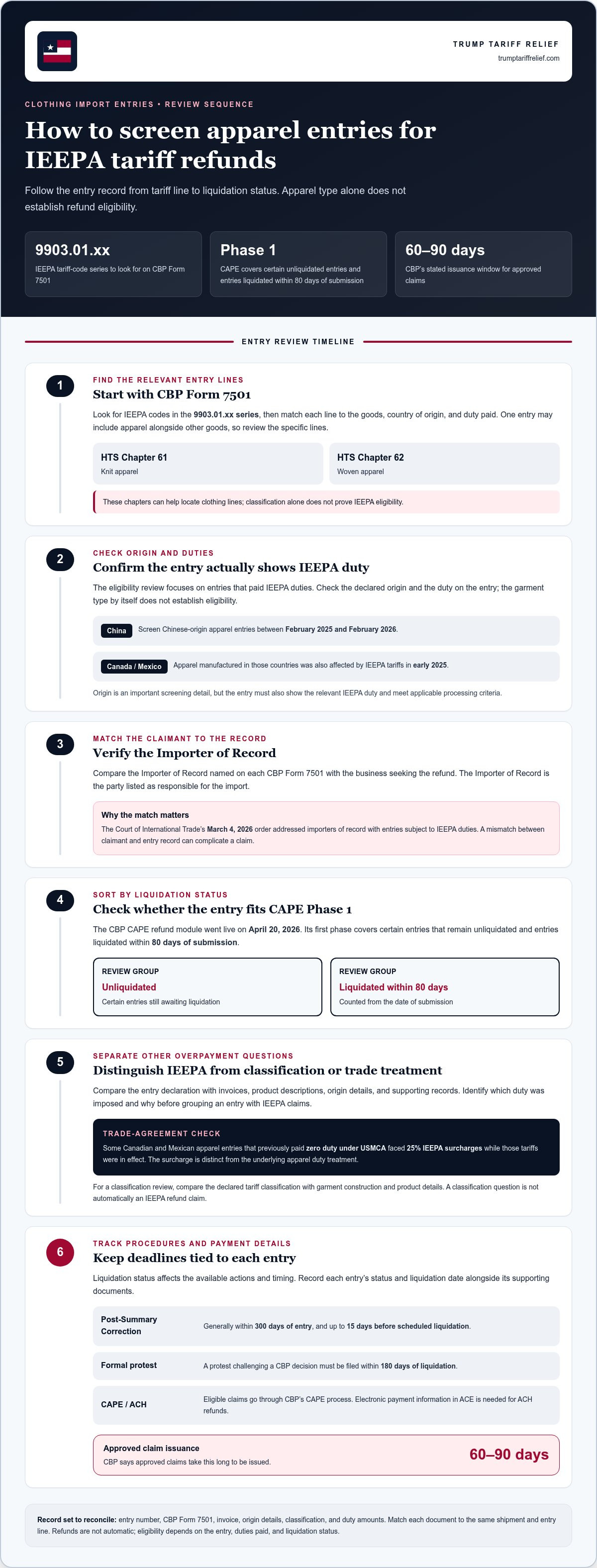
Start with the entry record. Eligibility depends on whether the clothing import incurred IEEPA duties and meets the applicable refund criteria. Origin, tariff codes, Importer of Record details, and liquidation status can help identify entries for review.
IEEPA Tariff Refund Eligibility
IEEPA tariff refund eligibility applies to import entries that paid duties imposed under the International Emergency Economic Powers Act. The garment type alone does not establish whether those duties qualify for recovery.
The Supreme Court ruled on February 20, 2026, that IEEPA does not authorize the President to impose tariffs. The eligibility checklist focuses on entries that included Chinese-origin apparel between February 2025 and February 2026. Canadian and Mexican apparel manufactured in those countries was also affected by IEEPA tariffs in early 2025.
Country of origin is an important screening detail, but not the only one. The entry must also show the relevant IEEPA duty and meet the applicable processing criteria.
Importer of Record Eligibility
The Importer of Record is the party named on the customs entry as responsible for the import. That designation matters because the Court of International Trade ordered a specific benefit for importers of record with entries subject to IEEPA duties.
On March 4, 2026, the Court of International Trade ordered that those importers are entitled to the benefit of the Supreme Court’s Learning Resources decision. Compare the Importer of Record details on each CBP Form 7501 with the business seeking the refund. A mismatch between the claimant and the entry record can complicate a claim, even when the apparel and duty appear relevant.
Identifying Eligible Entries and Lines
Eligible entries are customs filings that show potentially refundable IEEPA duties and meet the applicable entry-status criteria. Review the specific lines: a single entry may include apparel alongside other goods.
Review CBP Form 7501 for IEEPA codes in the 9903.01.xx series, then match those lines to the goods, origin, and duty paid. Apparel classifications commonly appear in HTS Chapters 61 and 62, covering knit and woven apparel, respectively. The chapter helps locate clothing lines; it does not establish IEEPA eligibility by itself.
Also sort entries by liquidation status. The checklist includes entries that remain unliquidated or were liquidated within the past 80 days; CAPE Phase 1 covers certain unliquidated entries and entries liquidated within 80 days of submission.
Common claim problems include an incorrect Importer of Record, missing IEEPA codes, or entry details that do not support the claimed origin or duty. Importers can challenge a CBP decision by filing a protest under 19 U.S.C. § 1514 within 180 days of liquidation.
Customs classification and trade-agreement overpayments
Customs overpayments can have different causes and follow different refund paths. Distinguish IEEPA duties from classification errors and trade-agreement treatment, then assess each entry using its declaration, supporting records, and liquidation status.
Trade-agreement treatment can reveal an overpayment worth examining. Some Canadian and Mexican apparel entries that previously paid zero duty under USMCA faced 25% IEEPA surcharges while those tariffs were in effect. That surcharge is distinct from the underlying apparel duty treatment. Compare the entry’s declared country of origin, claimed USMCA treatment, and additional tariff lines. If the record shows an IEEPA duty, include the entry in the refund review rather than assuming USMCA treatment removed every charge.
Classification also deserves a line-by-line review. Apparel generally falls within HTS Chapters 61 and 62, for knit and woven garments, respectively. A declaration should match the garment’s construction and product details; a mismatch can affect the duty calculation. Review the declared tariff classification against invoices, product descriptions, and entry lines. A classification question is not automatically an IEEPA refund claim: identify which duty was imposed and why before grouping it with other claims.
Liquidation status shapes available actions and deadlines. Importers can generally file a Post-Summary Correction within 300 days of entry, up to 15 days before scheduled liquidation. A formal protest challenging CBP’s decision must be filed within 180 days of liquidation. Track each entry’s liquidation date and status, then coordinate the timing of any correction or protest. The refund process can be affected if an entry’s status changes while records are being assembled.
The customs broker who handled the import documents can help compile entry-level data and reconcile declarations with supporting records. Share the entry number, CBP Form 7501, invoice, origin details, classification, and duty amounts for review. Match each document to the same shipment and entry line. Accurate records help distinguish an IEEPA amount from ordinary customs duties or charges imposed under another authority. Keep a record of corrections and filed claims for consistent follow-up.
Refund accounting can also affect transactions with downstream customers. If your clothing business passed tariff costs on to customers, review customer agreements, invoices, and internal records to understand how a refund affects those transactions. Future tariff exposure is a separate issue: recovery of eligible IEEPA duties does not resolve duties imposed under other authorities. Keep future entries separate from past refund claims, and assess the tariff basis of each entry. U.S. Customs and Border Protection has begun accepting claims for eligible duties paid under the tariffs.
For an organized review, use the customs refund review process to understand how entry records and claim preparation fit together.
Will tariff refunds be issued automatically?
No. Clothing importers need to identify eligible entries, validate duty and entry data, and submit the required claim. The CAPE process also distinguishes entry eligibility from payment, so accurate filing matters.
Refund Filing and Processing
Refund filing means submitting eligible entry information through U.S. Customs and Border Protection’s CAPE process for review. A court decision does not identify an importer’s entries or send payment automatically.
CBP’s CAPE module went live on April 20, 2026, to process IEEPA refund claims. Eligible companies can pursue refunds through CAPE; its first phase covers certain unliquidated entries and entries liquidated within 80 days of submission. A claim’s entry status determines whether it fits that phase.
After acceptance, valid IEEPA refunds through CAPE are generally issued within 60 to 90 days. That estimate applies after acceptance, not simply after an importer begins assembling records. Claim review, entry liquidation or reliquidation, system readiness, and claim volume can affect the overall timeline. U.S. Customs and Border Protection says electronic refunds require ACH payment information on file in ACE.
Eligibility Rules and Filing Deadlines
A U.S. customs duty refund claim must identify eligible duties and meet the filing route’s entry-status requirements. Deadlines matter because a missed correction or protest window can limit options for addressing an entry.
For IEEPA claims, CAPE Phase 1 includes certain unliquidated entries and entries liquidated within 80 days of submission. Importers can generally file a Post-Summary Correction within 300 days of entry, up to 15 days before scheduled liquidation. A formal protest challenging a CBP decision must be filed within 180 days of liquidation.
Prepare records that connect the apparel, duty, and claimant to each entry. Useful documents include CBP Form 7501, entry-level data, commercial invoices, product descriptions, country-of-origin details, and duty payment records. The Form 7501 helps identify tariff lines and codes; invoices and product records support the declared goods and origin. Keep liquidation dates and status alongside those documents.
Before filing, reconcile each entry’s declared origin, tariff line, IEEPA duties, and Importer of Record details. Mismatches can delay review or weaken a claim. The CAPE process requires electronic ACH information in ACE for electronic payment. Confirm that the payment details correspond to the importer seeking the refund, then keep the filing record and any CBP decision for follow-up.
Refund timing and urgency
Refund timing has more than one clock. The 80-day liquidation window affects which entries fit CAPE Phase 1, while processing time begins later. Clothing importers should separate eligibility deadlines, claim review, and payment timing. Treating them as one estimate can obscure the step that needs attention first.
U.S. Customs and Border Protection’s CAPE module went live on April 20, 2026. The first phase includes certain unliquidated entries and entries liquidated within 80 days of submission. That cutoff makes liquidation status a practical priority: identify each entry’s status, record its liquidation date, and organize entries by whether they meet the phase’s criteria. A recent entry and one liquidated earlier may follow different paths.
CBP said approved IEEPA refund claims would take 60 to 90 days to be issued. That estimate concerns approved claims, not the time required to gather entry records, file, or reach acceptance. Claim volume, system readiness, and liquidation or reliquidation status can affect the process. A complete entry-level submission helps address the review stage, but the clock does not start simply because an importer has begun collecting documents.
A separate timing estimate concerns payment after liquidation. CAPE refunds are typically credited by ACH 3 to 5 weeks after liquidation or reliquidation. This period differs from CBP’s 60 to 90 days after acceptance: the milestones are not interchangeable. Track claim acceptance and entry liquidation separately, then confirm that electronic ACH payment information is on file in ACE.
The court process also shaped the refund schedule. The U.S. Court of International Trade temporarily paused immediate compliance with its IEEPA refund order while CBP implemented the refund system. On March 27, 2026, the court amended its order to require CBP to liquidate or reliquidate entries subject to IEEPA duties without those duties, including previously finally liquidated entries. These developments explain why entry status and the government’s processing route both matter.
Urgency comes from preserving the right claim path, not assuming every duty is refundable. For each apparel entry, track the liquidation date, identify IEEPA duties, and note whether the entry is unliquidated or within the CAPE Phase 1 window. Keep records of submissions and status changes. Duties imposed under other authorities may have different treatment, so don’t combine them with IEEPA amounts when planning recovery.
Changes in tariff administration can cause confusion. A refund for eligible IEEPA duties does not automatically settle later duties on international shipments or future entries. Keep separate records for past claims and new import activity. This helps your business track refunds without assuming a policy change makes every customs charge eligible.
Direct importer refund opportunities
For clothing businesses, the recovery opportunity begins with duties they paid directly as Importer of Record. The Supreme Court’s February 20, 2026, decision addressed tariffs imposed under the International Emergency Economic Powers Act. Eligible refunds include interest. That can make reviewing company-paid entries worthwhile, particularly where IEEPA duties affected apparel costs, inventory planning, or cash flow.
Potential exposure varies by origin and tariff classification. An estimate for mid-size U.S. importers typically spans hundreds of thousands to millions of dollars. That range depends on sourcing country and HTS classification. Treat it as a screening signal, not a calculation: the amount for your business depends on its entries, duties paid, and eligible lines.
The scale of the process is substantial. U.S. Customs and Border Protection reported that more than 330,000 importers paid about $166 billion in tariffs on over 53 million shipments. As of April 14, 56,497 importers had completed electronic payment registration and were eligible for refunds totaling $127 billion, including interest. Those figures show why entry-level records and payment setup matter for direct claimants.
Start by matching the company’s entry data to its accounting records. Separate IEEPA duties from other customs charges, then reconcile each amount against CBP Form 7501 and payment documentation. Customs brokers who handled the shipments can help compile entry-level data, but the importer should retain its own claim and payment records. Also confirm ACH information is on file in ACE for electronic refunds.
Account for any refund carefully. If tariffs were deducted through cost of goods sold or capitalized into inventory, a refund may be taxable when received. Finance teams should connect the refund to the accounting treatment used when the duty was paid. This review can clarify the economic effect of recovery instead of treating the entire customs payment as a simple cash gain.
Keep IEEPA refunds distinct from duty drawback. The drawback program can allow recovery of up to 99% of import duties when goods are exported or used in products that are exported. That route depends on export activity, while an IEEPA refund concerns eligible duties paid under the emergency tariffs. Separate records help avoid blending different eligibility rules or claims.
If your company has identified IEEPA duties in its apparel entries, partner with Trump Tariff Relief to start an IEEPA tariff refund recovery review to assess the entries and documentation.
Trump Tariff Relief: IEEPA Tariff Refund Recovery
Trump Tariff Relief helps clothing importers assess and pursue eligible IEEPA tariff refunds. Its Tariff Eligibility Assessment reviews whether entries may qualify, while Customs Documentation Management supports the records needed for claims. If entries appear eligible, IEEPA Tariff Refund Recovery manages the process from assessment and documentation through government filings.
The service is contingency-based: there are no upfront costs, and Trump Tariff Relief is paid only if a refund is successfully recovered, as a percentage of the amount recovered. This can suit importers with potential IEEPA duties who need help organizing entry details and pursuing a claim. The service focuses on tariff recovery, not ongoing customs brokerage or general corporate legal services.
Contact Trump Tariff Relief to discuss IEEPA refund recovery for your apparel entries.
Turn Your Entry Review Into a Recovery Plan
Move from a general possibility to an entry-level decision. A focused review connects apparel records, IEEPA duties, and claim documentation, helping your business decide where to focus. The right tariff refund for clothing importers strategy starts with clear records and a defined path for eligible claims.
Trump Tariff Relief offers a Tariff Eligibility Assessment to evaluate potential recovery, Customs Documentation Management to organize claim records, and IEEPA Tariff Refund Recovery to pursue eligible refunds. These services support different stages, from initial review through documentation and filing. Your entry details determine which step is most relevant.
Take the next step when you’re ready to turn your records into a practical recovery plan. Contact Trump Tariff Relief to discuss your tariff refund claim. A clear assessment can help your business move forward with purpose.
Frequently Asked Questions
What is the current status of IEEPA tariff refunds?
IEEPA refunds are being processed through CBP’s CAPE system, which went live on April 20, 2026. The Supreme Court ruled on February 20, 2026, that IEEPA does not authorize the President to impose tariffs, and CBP has begun accepting claims for eligible duties. That ruling does not mean every importer receives an automatic payment. Entries must meet the applicable criteria and be submitted through the refund process.
Are Tariffs Refundable for US Importers in 2026?
Yes, qualifying IEEPA duties can be refundable in 2026, but refunds are not universal or automatic. Eligibility depends on the importer of record, the tariff assessed, origin, entry data, and CAPE phase criteria. CBP’s electronic process is operational, and valid accepted CAPE refunds are generally issued within 60 to 90 days. That timeline applies after acceptance, not from the date duties were paid.
Are tariff refunds taxable when received?
A refund may be taxable when received if the original tariffs were deducted through cost of goods sold or capitalized into inventory. For example, a clothing business that included duties in inventory costs should connect the refund to those accounting records. Tax treatment depends on how the original payment was handled and the business’s circumstances. Keep the refund notice and entry-level accounting records together for review.
Are there risks beyond customs and tax?
Yes. A refund can affect customer pass-through arrangements, inventory valuation, and internal financial records. For example, if a retailer charged customers a separate tariff surcharge, its contracts and invoices may shape how it handles a later recovery. Tie the refund to the affected imports and coordinate trade, finance, and sales records to help keep customs filings and customer accounts consistent.
Can I still get a refund on entries that have already liquidated?
Liquidation does not automatically rule out a refund. On March 27, 2026, the Court of International Trade amended its order to require CBP to liquidate or reliquidate entries subject to IEEPA duties without those duties, including previously finally liquidated entries. CAPE Phase 1 separately covers entries liquidated within 80 days of submission. The entry’s status and applicable claim route determine how it proceeds.
How do tariff refunds affect cost of goods sold?
If duties were recorded in cost of goods sold, a refund can affect the accounting for those costs when received. If duties were capitalized into inventory, trace the refund to the inventory and sales records linked to those entries. For example, reconcile the refund amount with the original duty payment and the period when the cost was recognized. This creates a clear audit trail for finance review.
Which U.S. tariffs on imported clothing may be eligible for refunds?
A tariff refund for clothing importers generally concerns eligible IEEPA duties, not every duty assessed on apparel. Review the entry for IEEPA codes in the 9903.01.xx series and match them to the apparel lines and origin records. IEEPA tariffs affected Chinese-origin apparel during 2025, while Canadian and Mexican apparel manufactured there was affected in early 2025. Other tariff authorities require separate analysis.
Can clothing importers get refunds for tariffs paid under IEEPA or other trade measures?
Clothing importers can pursue refunds for eligible IEEPA duties through the applicable CBP process. The IEEPA ruling does not automatically make duties under other trade measures eligible. Separate each entry’s charges by tariff authority, then review its classification, origin, and supporting records. For example, an entry with both IEEPA and another duty should not include the entire duty amount in an IEEPA refund claim.
Ready to find out what your business may be owed?
Check My Eligibility