
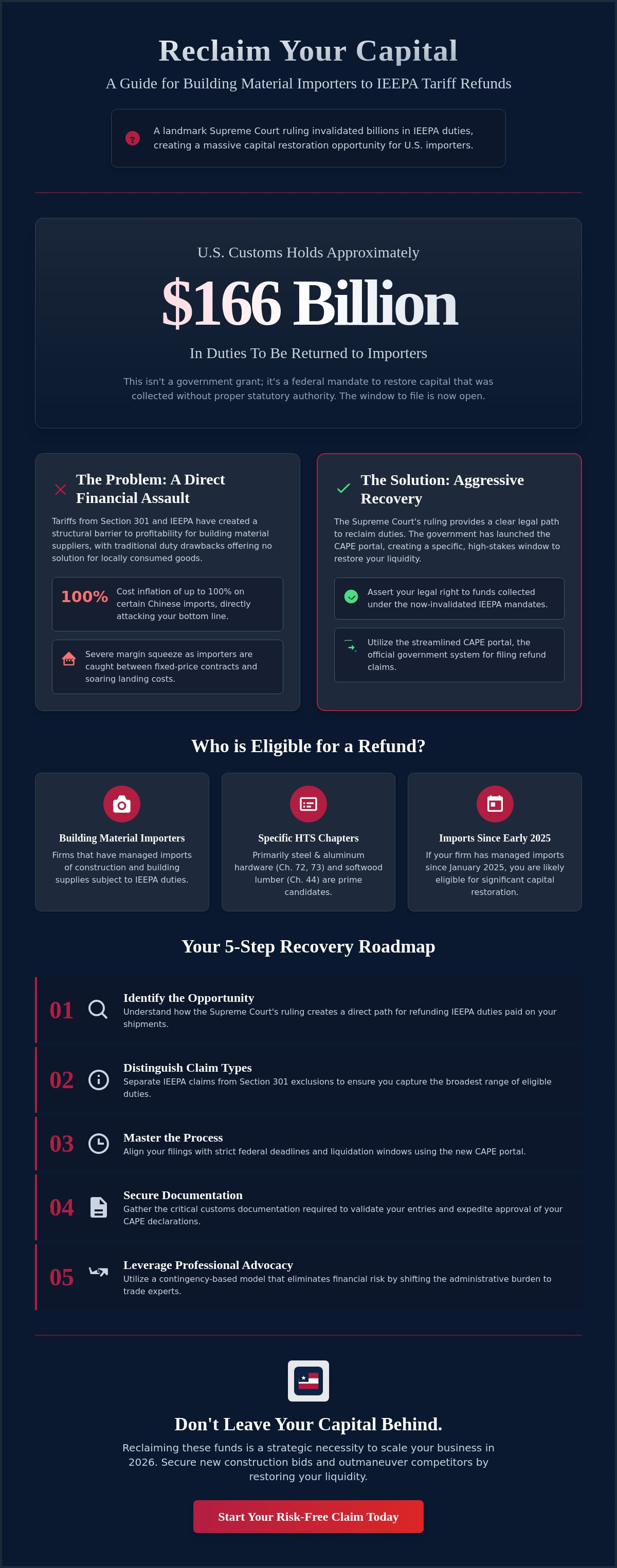
Did you know that U.S. Customs and Border Protection is currently holding approximately $166 billion in duties that must be returned to importers following the Supreme Court's ruling against IEEPA tariffs? For building material suppliers, these costs haven't just been line items; they've been a direct assault on your bottom line. You've likely struggled with thinning margins while trying to decipher if your shipments fall under Section 301 or the now-invalidated IEEPA mandates. This guide clarifies the tariff refund process for building materials, offering a professional roadmap to reclaiming the capital your business is legally owed.
It's time to move from financial defense to aggressive recovery. If your firm has managed imports since January 2025, you are likely eligible for a significant restoration of capital. While the government won't issue these refunds automatically, the launch of the CAPE portal provides a specific, high-stakes window to restore your liquidity. We'll examine the phased rollout of the refund system, identify the specific HS code intersections that trigger eligibility, and show you how a streamlined recovery process can handle the documentation burden on your behalf.
Key Takeaways
- Identify how the Supreme Court's landmark ruling invalidated billions in IEEPA duties, creating a massive capital restoration opportunity for construction importers.
- Distinguish between Section 301 exclusions and IEEPA claims to ensure you're capturing the broadest possible range of eligible building materials.
- Master the multi-phased tariff refund process for building materials to ensure your filings align with strict federal deadlines and liquidation windows.
- Secure the critical customs documentation required to validate your entries and expedite the approval of your CAPE declarations.
- Leverage a professional, contingency-based advocacy model that eliminates financial risk by shifting the administrative burden to trade experts.
The Financial Impact of Tariffs on Building Materials
The construction industry has endured a relentless assault on profitability since early 2025. Between Section 301 duties and the broad application of the International Emergency Economic Powers Act (IEEPA), building material costs have been artificially inflated by as much as 100% for certain Chinese imports. This isn't just a tax; it's a structural barrier that has forced many firms into a severe margin squeeze. Importers, caught between fixed-price contracts and soaring landing costs, have often been unable to pass these expenses to contractors or developers. Traditional duty drawbacks are insufficient here. They typically require the re-export of goods, but building materials are consumed locally, leaving the importer to swallow the loss. Trump Tariff Relief exists to right this financial wrong by managing the complex tariff refund process for building materials on your behalf.
Common Impacted Materials: Steel, Lumber, and Hardware
The volatility of import duties has hit specific HTS chapters with surgical precision. Steel and aluminum hardware under Chapters 72 and 73, along with softwood lumber in Chapter 44, have seen duty rates fluctuate wildly. Some Chinese finished goods currently face stacked rates between 35% and 100%. While Section 301 remains a hurdle, the Supreme Court's February 2026 ruling specifically targeted the illegal use of IEEPA for these duties. If your imports fall under these categories, they are prime candidates for recovery. Identifying these opportunities requires a deep dive into your entry history. The potential for capital restoration is massive, especially considering CBP collected roughly $175 billion in IEEPA duties since January 2025.
Why Cost Recovery is Essential for 2026 Project Scaling
Reclaiming these funds is a strategic necessity for firms planning to scale in the second half of 2026. With $166 billion currently eligible for refund across the industry, companies that ignore the tariff refund process for building materials are essentially leaving their expansion capital in the hands of the federal government. Reclaiming this capital provides the liquidity needed to secure new construction bids and outmaneuver competitors who remain burdened by high overhead. We treat this as a high-stakes financial move. It ensures you have the resources to grow while others are stuck in a cycle of debt. Understanding the legal shift is the first step toward recovery; our resources on IEEPA explained provide the necessary context for your internal audit.
Understanding the IEEPA Tariff Refund Opportunity
The International Emergency Economic Powers Act (IEEPA) was never intended to be a permanent mechanism for taxing trade. On February 20, 2026, the Supreme Court confirmed this in a landmark ruling that invalidated the legal justification for a massive portion of building material duties. This isn't a loophole or a temporary grant program. It's a federal mandate requiring the restoration of capital that was collected without proper statutory authority. Unlike standard customs protests, which often involve narrow disputes over HTS classifications, this recovery path is a direct result of a systemic legal failure. For importers who have seen their capital tied up in federal accounts, the China tariff refund legitimacy is backed by the highest court in the land and managed through the U.S. Customs and Border Protection Trade Remedies framework.
The tariff refund process for building materials has been streamlined via the CAPE portal, but the burden of proof remains with the importer. You aren't just asking for a favor; you're asserting a legal right to funds that CBP estimates total roughly $166 billion across the broader import market. This process is now the primary vehicle for righting the financial wrongs of the last several years. It requires a methodical approach to data, but the payoff is the successful restoration of your firm’s operating liquidity.
The Legal Precedent for Building Material Importers
The government overreached when it applied broad-brush tariffs to essential construction goods under the guise of an emergency. The ruling specifically addresses the 2018 to 2024 timeframe, during which many building material shipments were subjected to stacked duties. This period represents the primary window for recovery claims. If your firm paid duties on steel, lumber, or hardware during these years, you have a high probability of eligibility. For a deeper dive into the regulatory framework that makes this possible, our page on IEEPA explained details the specific legal arguments that won this battle.
Eligibility Requirements for Construction Firms
To qualify, your firm must have been the "Importer of Record" (IOR) at the time of entry. This means you were the party responsible for paying the duties and filing the entry documentation with CBP. Whether you are a large-scale distributor or a mid-sized supplier, your eligibility hinges on the liquidation status of your entries. Small-to-mid-sized construction suppliers often assume these programs are reserved for massive corporations, but that's a mistake. The CAPE system is designed to handle entries from over 330,000 importers. If you're unsure where your entries stand, a preliminary eligibility assessment is the most efficient way to confirm your standing.
Comparing Section 301 and IEEPA Recovery Strategies
Many building material importers have already faced the frustration of a denied Section 301 exclusion. It's a common story: you spent months compiling data to prove your flooring or hardware couldn't be sourced elsewhere, only to receive a generic rejection from the USTR. This is where the IEEPA recovery path differs fundamentally. While Section 301 exclusions focus on the product's necessity or economic hardship, IEEPA claims challenge the legal authority used to collect the money in the first place. You aren't asking for an exception; you're identifying a legal error that applies to the entire tariff action. This makes the IEEPA-based tariff refund process for building materials a far more potent tool for capital restoration, as it bypasses the subjective criteria that saw so many construction applications fail.
The legal landscape has shifted significantly since the Supreme Court's decision. To successfully navigate the tariff refund process for building materials, you must understand the distinction between product-level exclusions and systemic legal challenges. Understanding The New Section 301 Tariff Regime is helpful for future planning, but for historical recovery, the IEEPA ruling is the primary catalyst. Importers who were previously denied relief under Section 301 are often still eligible for IEEPA refunds because the two programs operate on entirely different legal foundations. We don't want you to assume that a past failure with an exclusion request means your money is gone forever.
The 3-Year Deadline: Why Timing is Everything
The tariff refund statute of limitations is the most dangerous hurdle in your recovery journey. Customs law typically operates on a rolling three-year window from the date of entry liquidation, which is the final calculation of duties by CBP. If you wait for a "perfect" time to file, you're likely watching your eligible capital expire day by day as entries age out of the system. This isn't a situation where patience is rewarded; it's a race against the clock. The 2026 deadline serves as the final threshold for many 2023 imports to remain eligible for recovery. Missing this window means the government keeps your capital permanently, regardless of the legality of the original duty.
List 3 and List 4a: The Construction "Sweet Spot"
List 3 and List 4a represent the construction "sweet spot" because they contain the vast majority of finished goods used in residential and commercial builds. These lists were the primary targets of the IEEPA overreach, covering everything from vinyl flooring to specialized steel fasteners. To reclaim these funds, you must file a "CAPE" declaration through the Automated Commercial Environment (ACE) Portal. This process is highly technical and requires precise data matching across your entire entry history. We recommend a tariff refund assessment to quickly verify which of your HTS codes fall into these high-recovery categories. It's the fastest way to confirm eligibility without getting bogged down in the thousands of pages of tariff schedules.
The Step-by-Step Tariff Refund Filing Process
The transition from legal theory to capital restoration requires a meticulous execution of the tariff refund process for building materials. While the federal government has established the mechanism for recovery, the administrative burden rests entirely on the importer's shoulders. We take a different approach. Our we-do-the-work model shifts the technical heavy lifting from your internal staff to our recovery experts. This process utilizes the Automated Commercial Environment (ACE) Portal, the primary gateway for all trade communication with U.S. Customs and Border Protection. Success depends on the quality of your data. This makes the required documents for IEEPA tariff refund the most critical part of your submission package.
Phase 1: The Eligibility Audit
To begin, we aggregate every 7501 form and entry summary associated with your building material shipments since January 2025. This isn't a simple data pull. Internal accounting systems often miss entries that were misclassified or buried in bulk shipments. We use specialized software to scan thousands of entries, identifying every dollar that falls under the IEEPA overreach. Since CBP collected roughly $175 billion in these duties, the audit must be exhaustive. If an entry is within 180 days of liquidation, or if it remains unliquidated, it fits into Phase 1 of the CAPE rollout that launched on April 20, 2026. Identifying these hidden opportunities is where most firms find their greatest recovery potential.
Phase 2: Filing the CAPE Declaration
Once the audit is complete, we move to the CAPE declaration, a pivotal step in the tariff refund process for building materials. This is a formal statement filed through the ACE Portal that identifies specific entries subject to the refund. Precision is non-negotiable. Even a minor error in HTS classification or a mismatched entry number can trigger an immediate CBP rejection. We manage all communication with U.S. Customs and Border Protection, ensuring that your declarations are accepted and processed within the estimated 60 to 90-day window. We also track the phased rollout, including the June 29, 2026, launch for reconciliation entries and the Phase 3 launch for finally liquidated entries in late July. Handling these technical hurdles ensures your team stays focused on construction operations while we focus on your financial restoration.
To see how we can streamline your recovery, explore our full recovery process here.
Maximizing Recovery with Professional Trade Advocacy
Navigating the tariff refund process for building materials shouldn't represent a new financial risk for your business. Most importers are understandably wary of engaging in long, expensive legal battles with no guarantee of success. We've eliminated that barrier by utilizing a pure contingency-fee model. This means our team only receives a fee if we successfully deposit recovered capital back into your accounts. Unlike traditional trade attorneys who bill by the hour regardless of the outcome, our success is tied directly to your restoration. This high-performing partnership ensures that we take on the heavy lifting and the risk, allowing you to maintain focus on your 2026 project pipelines; similarly, for companies facing outstanding commercial account issues, Whole King Company Limited provides professional recovery services to safeguard your business liquidity.
Transparency is the cornerstone of our advocacy. You deserve to know exactly where your claims stand within the federal bureaucracy. By understanding how it works, you can see the methodical path we take from the initial data audit to the final CAPE declaration acceptance. We position ourselves as your insider advocate, navigating the same systems that have historically felt like a black box to construction executives. We don't just file paperwork; we provide a shortcut through a complex regulatory maze.
Why DIY Filings for Building Materials Often Fail
Construction supply chains are notoriously complex, often involving reconciliation entries that aggregate multiple shipments over time. Attempting to manage the tariff refund process for building materials internally often leads to catastrophic errors. A single HTS code mistake or a failure to match entry summaries with the correct CAPE declaration can disqualify a multi-million dollar claim instantly. Our dedicated team monitors CBP system updates and CAPE portal notifications daily. We identify and resolve these technical discrepancies before they lead to a rejection, ensuring your filing is bulletproof from day one. You don't have the time to become a customs expert, so we bring that expertise to you.
Securing Your Capital for the Future
The window for IEEPA recovery is not open indefinitely. As entries age out and reach their three-year statute of limitations, your opportunity to reclaim lost margins vanishes. This capital belongs in your firm's growth initiatives, not in a federal treasury account. Reclaiming these funds allows you to reinvest in your workforce, upgrade your equipment, and bid more aggressively on future contracts. If you have lingering questions about specific HTS eligibility or the timeline for issuance, our FAQ provides direct answers to the most common importer concerns. We invite you to start with a no-risk preliminary assessment today. It's the most assertive step you can take to right the financial wrongs of the last trade cycle and secure your firm's competitive edge.
Secure Your Construction Margins with Decisive Recovery Action
The Supreme Court's mandate has shifted the trade landscape from passive loss to active financial recovery. You now have a clear path to reclaim duties that were collected without proper statutory authority. By initiating the tariff refund process for building materials, your firm can convert years of trade volatility into immediate operating liquidity. This isn't just about administrative compliance. It's a strategic move to restore the profit margins that high import costs have eroded since early 2025.
Don't let the complexity of the CAPE portal or the strict federal deadlines prevent you from claiming what is legally yours. Our team provides specialized IEEPA legal expertise and national coverage for all US importers, operating on a strictly contingency-based model. If we don't recover your money, you don't pay a fee. It's time to stop the margin squeeze and reinvest in your firm's future. Take the first step toward restoration today.
Get Your Free Building Materials Tariff Eligibility Assessment
Frequently Asked Questions
Is the building material tariff refund program a real government initiative?
Yes, the IEEPA refund program is a legitimate federal initiative mandated by the Supreme Court’s February 20, 2026, ruling. Following this decision, U.S. Customs and Border Protection established the Consolidated Administration and Processing of Entries (CAPE) portal on April 20, 2026. This system was specifically designed to handle the restoration of roughly $166 billion in duties that were collected without legal authority. It is a formal administrative process, not a discretionary program.
What specific building materials are eligible for an IEEPA refund?
Eligibility focuses primarily on finished construction goods found on Section 301 List 3 and List 4a. This includes essential items like vinyl flooring, steel fasteners, aluminum hardware, and specialized timber products. While Section 232 tariffs on raw metals remain in place, the IEEPA ruling targets the illegal stacking of duties on these finished materials. Successfully navigating the tariff refund process for building materials requires verifying your specific HTS codes against these impact lists.
How far back can I go to claim refunds on imported construction goods?
You can generally reclaim duties on entries filed since January 2025, though the legal precedent addresses the broader 2018 to 2024 timeframe. The most critical factor is the liquidation status of your entries. Most claims must be filed within three years of the date your entry was liquidated by CBP. Because this is a rolling deadline, entries from early 2023 are reaching their final threshold for recovery in 2026.
Do I need my original customs broker to file an IEEPA claim?
You aren't required to use your original customs broker to file an IEEPA recovery claim. While brokers handle daily entries, they often lack the specialized legal infrastructure required for high-stakes federal litigation recovery. Many importers choose a dedicated recovery partner to manage the tariff refund process for building materials because it requires a different set of technical data audits and CAPE declaration expertise than standard customs clearance.
How long does the average building material tariff refund take to process?
CBP estimates a processing time of 60 to 90 days once a CAPE Declaration is accepted through the ACE Portal. This timeline begins after your data has been audited and the formal declaration is submitted. However, the total time from initial audit to check issuance can vary based on the complexity of your entry history and the specific phase of the CAPE rollout your entries fall under.
What happens if my building material claim is denied by CBP?
If a claim is denied, it is often due to technical discrepancies or HTS classification errors in the filing. CBP requires absolute precision in matching entry summaries with the CAPE declaration. A denial isn't necessarily the end of the road, but it does require a professional review to identify and correct the underlying data error. This highlights why having an expert advocate monitor the submission is vital for a successful outcome.
Are there any upfront costs to start the tariff recovery process?
There are no upfront costs to begin an eligibility assessment or initiate the recovery process with our team. We operate on a contingency basis, which means we only receive a fee if we successfully recover your capital. This model eliminates the financial risk for your firm and ensures our incentives are perfectly aligned with yours. You don't pay for hours billed; you only pay for results delivered.
Ready to find out what your business may be owed?
Check My Eligibility