What if the millions of dollars your company paid in import duties over the last several years weren't a permanent loss, but a recoverable asset? For many importers, the Section 301 tariff rebate for consumer goods has shifted from a legal theory into a tangible financial lifeline following the landmark invalidation of certain IEEPA-linked duties earlier this year. You've likely watched your margins shrink under the weight of 25% duties while navigating a customs bureaucracy that feels designed to keep your capital locked away.
We're here to help you navigate this high-stakes landscape and right a significant financial wrong. You'll discover how your business can identify eligible List 3 or List 4a products and reclaim capital to reinvest in your core operations. This guide breaks down the implications of the February 2026 legal developments and provides a streamlined, low-risk roadmap for filing your claim before the strict statute of limitations expires. The window to act is narrowing, but the opportunity for recovery has never been more clear.
Key Takeaways
- Learn how recent legal challenges at the Court of International Trade have authorized a path to recover duties paid on Chinese consumer imports.
- Understand why a Section 301 tariff rebate for consumer goods provides a more effective recovery strategy than standard duty drawback for products sold domestically.
- Identify the specific eligibility requirements, including "substantial transformation" rules and HTS codes associated with Lists 3 and 4a.
- Master the two-step process for auditing your 2018-2026 import records to ensure no capital is left behind before the 2026 statute of limitations expires.
- Discover how a specialized, contingency-based partnership can handle the heavy lifting of customs documentation management with zero upfront financial risk.
What is the Section 301 Tariff Rebate for Consumer Goods?
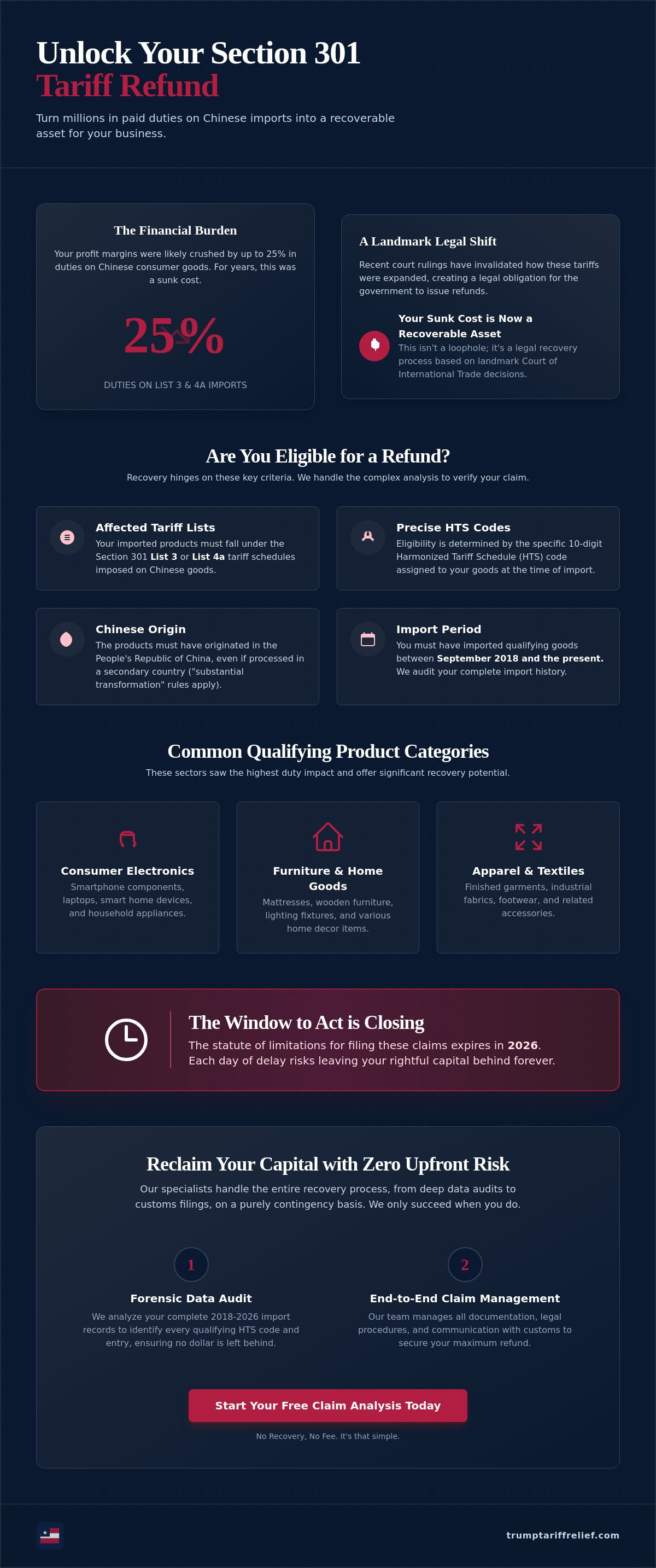
The Section 301 tariff rebate for consumer goods isn't a mere administrative adjustment; it's a rigorous legal recovery process designed to return capital to businesses that were forced to pay billions in duties. This recovery mechanism stems from extensive litigation at the Court of International Trade (CIT), where importers argued that the United States Trade Representative (USTR) exceeded its statutory authority under Section 301 of the Trade Act of 1974. While standard exclusions often apply to narrow product categories for limited timeframes, these rebates target the broader illegality of how the tariffs were expanded. It's a fundamental distinction that turns a sunk cost back into a recoverable asset.
Consumer goods importers found themselves at the epicenter of this trade war. Lists 3 and 4a were specifically curated to include retail-facing products that had previously been shielded from earlier tariff rounds. This included several major categories:
- Consumer Electronics: Components for smartphones, laptops, and household appliances.
- Furniture and Home Goods: Mattresses, wooden frames, and lighting fixtures.
- Apparel and Textiles: Finished garments and industrial fabrics.
By the time these duties reached 25%, profit margins for many importers had all but vanished. This rebate process allows companies to treat those "lost" duties as accounts receivable rather than permanent losses. We identify the specific HTS codes that qualify, ensuring every dollar wrongfully collected is accounted for in your claim.
The Legal Catalyst: IEEPA and the Supreme Court
The International Emergency Economic Powers Act (IEEPA) provides the executive branch with broad authority, but that power isn't absolute. In February 2026, the Supreme Court issued a decision that clarified the boundaries of this authority, effectively invalidating certain tariff expansions that lacked proper procedural justification. This ruling was the catalyst for the current wave of 2026 claims. Because the government collected these duties under an invalidated framework, they're now facing a legal obligation to return those funds. You can learn more about these specific statutory limits in our guide on IEEPA explained.
List 3 vs. List 4a: Identifying Your Goods
Identifying where your products fall within the regulatory lists is the first step toward recovery. List 3 encompasses a massive scope of Chinese imports established in September 2018 that were subjected to escalating duty rates. List 4a, which followed, added another layer of complexity by targeting even more specialized consumer items. While the Supreme Court's 2026 decision specifically impacts the procedural validity of these expansions, eligibility depends on precise HTS code matching. If your goods were part of these specific tranches, the path to a Section 301 tariff rebate for consumer goods is now open. We handle the heavy lifting of categorizing your import history to maximize your potential recovery.
Eligibility Criteria for Consumer Product Importers
Determining your eligibility for a refund starts with a forensic look at your import records. To qualify for a Section 301 tariff rebate for consumer goods, your products must have originated in the People's Republic of China. This sounds straightforward, but the "substantial transformation" rule often complicates the narrative. If your goods underwent processing in a secondary country, they may still be classified as Chinese origin depending on whether that process resulted in a new and different article of commerce. We analyze these nuances to ensure your claim stands up to CBP scrutiny while maximizing the volume of eligible entries.
The most critical element of your eligibility is the 10-digit Harmonized Tariff Schedule (HTS) code assigned to your goods. These codes act as the DNA of your claim. If your imports were hit with the 10% or 25% ad valorem duties under List 3 or List 4a, it's highly likely you've overpaid. You can cross-reference your specific codes with CBP's Section 301 FAQs to confirm their status, though our team typically handles this deep-dive audit to identify every missed opportunity. Without precise HTS matching, even the most valid claim will be rejected by the bureaucracy.
Common Consumer Goods Categories for Refunds
Electronics and home appliances represent the largest potential claims because their high unit values resulted in massive duty outlays. Textiles, footwear, and apparel also offer significant recovery potential, though navigating the complex List 4a rules requires specialized expertise to ensure compliance. High-volume imports in the home improvement and furniture sectors were equally devastated by the 25% duty hikes. Just as businesses in these sectors rely on specialists like Rescue Roofing Tulsa to maintain their physical infrastructure, importers need expert guidance to recover their financial assets. If your business moved significant inventory in these categories between 2018 and 2026, the capital currently held by the government belongs back in your accounts.
The 'Protest' Requirement: Did You File?
Historically, the right to a refund was contingent on filing a timely protest with U.S. Customs and Border Protection. However, the legal landscape shifted dramatically following recent court rulings that challenged the USTR's procedural compliance. Learn how the IEEPA ruling changed eligibility for companies that didn't file original protests. These developments have opened a window for recovery that many businesses previously thought was closed forever. It's no longer just about whether you protested at the time; it's about whether you're prepared to act now. If you're ready to see what's recoverable, a professional tariff eligibility assessment is the most efficient way to secure your standing.
Rebate vs. Duty Drawback: Choosing the Right Strategy
Many importers confuse duty drawback with the Section 301 tariff rebate for consumer goods. They aren't the same. Duty drawback is a refund of duties paid on imported goods that are subsequently exported. If your electronics or apparel stayed in the United States and were sold to domestic retailers, traditional drawback won't help you. The Section 301 rebate, however, is based on the legal invalidity of the tariff collection itself under Section 301 of the Trade Act of 1974. This means you can recover capital regardless of whether the goods were exported or sold domestically. It's a specialized recovery path that targets the duty itself, not the movement of the cargo.
This recovery has a profound impact on your tax and accounting strategy. It isn't just found money; it's the restoration of squeezed margins. For many consumer brands, recovered duties are treated as a reduction in the cost of goods sold (COGS) or as a specialized legal settlement. Because these refunds can span several fiscal years, they often require coordination with your accounting team to ensure the capital is properly recognized on your balance sheet. Standard logistics providers simply don't have the legal depth to manage these multi-year financial reconciliations.
Why Traditional Customs Brokers Fall Short
Traditional customs brokers are excellent at moving cargo and managing daily entry filings. They aren't trade litigators. Most brokers operate on high-volume, low-margin models that focus on the present, not on complex multi-year litigation recovery. There's also a subtle conflict of interest at play. Admitting that a Section 301 claim is valid sometimes implies that the original filing strategy could've been more aggressive. You need specialized trade counsel who understands the intersection of the IEEPA and customs law. We act as that specialized partner, handling the heavy lifting that brokers aren't equipped to touch.
Financial Impact: Calculating Your Potential Recovery
Estimating your recovery starts with a calculation of the total ad valorem duties paid on List 3 and List 4a items since 2018. Don't just look at the principal. The government is typically required to pay interest on wrongfully collected duties. This interest can add a significant percentage to your total recovery, especially for claims dating back several years. The formula is simple: (Total Section 301 Duties Paid) + (Applicable Statutory Interest) = Your Potential Recovery. If you have questions about specific variables or HTS eligibility, check our frequently asked questions about refund amounts. We prioritize these high-value calculations to ensure you know exactly what's at stake before we move forward.
The 2026 Deadline: Navigating the Statute of Limitations
Time is the most significant barrier between your business and its recovered capital. The legal window to secure a Section 301 tariff rebate for consumer goods is governed by strict statutes of limitations that don't wait for administrative convenience. If you don't act before these deadlines pass, the opportunity to reclaim millions in duties effectively vanishes. We've developed a rigorous five-step protocol to ensure your claim is filed accurately and on time.
- Step 1: Conduct an immediate internal audit of all import records from 2018 through 2026 to capture every eligible entry.
- Step 2: Identify specific HTS codes associated with Section 301 List 3 and List 4a to separate qualifying goods from non-eligible imports.
- Step 3: Verify the "liquidated" status of your entries with U.S. Customs and Border Protection (CBP) to determine the exact filing window for each protest or claim.
- Step 4: Engage a contingency-based recovery specialist who understands the nuances of the IEEPA litigation before the filing window shuts.
- Step 5: Submit formal documentation and summonses to the Court of International Trade to preserve your legal standing.
Why the Window is Closing Fast
The legal framework for challenging government actions generally operates under two-year and three-year rules. While some importers believe tolling agreements will protect their rights indefinitely, these agreements are often narrow and might not cover every specific product category or entry date. It's a high-stakes gamble to assume your business is automatically protected by someone else's litigation. Once the statute expires, the capital is legally forfeited to the Treasury. There are no extensions for missed deadlines in the world of federal trade law.
The Risks of Delaying Your Filing
Waiting until the final months of 2026 is a strategic error. Large-scale government settlements often operate on a first-come, first-served basis, and those who file late risk being caught in massive administrative backlogs. As more businesses realize their eligibility for a Section 301 tariff rebate for consumer goods, CBP's processing times will inevitably lengthen. A delay doesn't just postpone your refund; it increases the risk that procedural errors cannot be corrected before the clock runs out. You can review our frequently asked questions to understand how these timelines impact your specific recovery potential. Don't leave your capital in the hands of the government. Start your tariff eligibility assessment today to secure your place in the recovery queue.
How Trump Tariff Relief Recovers Your Capital
Recovering millions in wrongfully paid duties shouldn't require a massive upfront investment or a leap of faith. Most importers hesitate to pursue a Section 301 tariff rebate for consumer goods because they fear the legal bill will eventually eclipse the recovery. We've eliminated that barrier by positioning ourselves as a high-performing partner rather than a traditional service provider. Our model is built on a simple premise: we only win if you win. This shifts the financial risk from your balance sheet to our expertise, ensuring that your pursuit of financial restoration is entirely capital-positive.
Our specialized focus on IEEPA and Section 301 litigation allows us to navigate the federal bureaucracy with a level of precision that general corporate counsel can't match. We handle the heavy lifting of customs documentation management and government filings, allowing your team to stay focused on core operations. By providing a professional tariff eligibility assessment, we offer the peace of mind that comes with knowing exactly what's recoverable before a single document is filed. We're here to right a financial wrong and restore the margins that have been squeezed by the 25% duties applied to your inventory. Securing a Section 301 tariff rebate for consumer goods is about more than just paperwork; it's about reclaiming the capital your business needs to scale.
Our 3-Phase Recovery Process
We've streamlined the path to recovery into three distinct, manageable stages. This methodical approach ensures that no detail is overlooked while maintaining the momentum necessary to meet strict 2026 deadlines.
- Phase 1: Zero-cost data extraction and eligibility audit to identify every qualifying HTS code in your import history.
- Phase 2: Expert legal and trade analysis where we apply the latest IEEPA court rulings to maximize your claim's total value.
- Phase 3: Formal filing and aggressive management of the refund process through to the final disbursement of capital.
Why Contingency is the Only Logical Choice
Hourly legal fees are a deterrent that the government counts on to keep capital locked away in the Treasury. When you pay by the hour, you're funding a process; when you work with us on contingency, you're investing in a result. This structure perfectly aligns our incentives with your maximum possible refund. We've optimized every step of our internal workflow to be as efficient as possible, ensuring that the path to your capital is clear and low-friction. You can see exactly how our recovery process works and why it's the most effective way to reclaim what's yours before the window of opportunity closes forever.
Act Now to Restore Your Import Margins
The window to recover wrongfully paid duties is closing, but the opportunity for financial restoration has never been more accessible. By understanding the distinction between standard duty drawback and the specialized Section 301 tariff rebate for consumer goods, your business can effectively navigate the complexities of IEEPA litigation. You've seen how precise HTS identification and the 2026 legal developments have shifted the burden of proof back onto the government. Don't let your hard-earned capital remain locked in the Treasury simply because the bureaucracy is difficult to navigate.
Our specialized IEEPA trade experts provide national recovery services for all US importers with zero upfront financial risk. We operate on a contingency-based model; we only succeed when you receive your refund. This is your chance to right a financial wrong and reinvest significant capital into your future growth. Secure your free tariff eligibility assessment today and take the first step toward reclaiming what's yours. Your recovery is our priority, and we're ready to lead the charge.
Frequently Asked Questions
Is the Section 301 tariff refund real for small businesses?
Yes, the rebate is available to any importer of record regardless of company size. If your business paid duties on List 3 or 4a items, you have a legal right to seek recovery. Small businesses often benefit most from this capital injection because it directly restores profit margins that were previously eroded by the 25% duty hikes. We focus on ensuring every eligible entity receives its fair share of recovered capital.
What specific consumer goods are eligible for a List 3 rebate?
List 3 includes a massive range of products such as furniture, luggage, vacuum cleaners, and electronic components. If your product's 10-digit HTS code was included in the September 2018 expansion, it qualifies for a Section 301 tariff rebate for consumer goods. We verify these codes against the USTR's master lists to ensure your specific inventory is eligible. This forensic audit is the only way to guarantee no capital is left behind.
How long does it take to receive a Section 301 refund check?
The timeline for disbursement depends on the current stage of litigation and CBP processing speeds. While the legal catalyst occurred in February 2026, administrative backlogs can extend the wait once a claim is filed. We manage the process through to disbursement to ensure your capital is released as efficiently as possible. Acting early helps you avoid the inevitable end of year rush that typically slows down government payments.
Can I claim a rebate if I already passed the tariff cost to my customers?
Yes, your pricing strategy does not impact your legal eligibility for a refund. The rebate is based on the fact that you, as the importer of record, paid duties that were later found to be procedurally invalid. The government owes the refund to the entity that paid the duty, not the end consumer who purchased the finished product. Your internal accounting decisions don't change the government's obligation to return wrongfully collected funds.
What documents do I need to start a Section 301 claim?
You need your entry summaries, specifically CBP Form 7501, and commercial invoices for the period between 2018 and 2026. These documents provide the HTS codes and duty amounts necessary to calculate your total recovery. If you don't have these on hand, we can often assist in extracting this data directly from your historical import records. Complete documentation is the foundation of a successful and defensible claim at the Court of International Trade.
Is there a minimum duty amount required to file a recovery claim?
There is no legal minimum, but the recovery must be economically viable for your business. Because we operate on a contingency basis, we typically look for claims where the potential refund justifies the administrative effort of customs documentation management. We provide a preliminary assessment to help you determine if the recovery value warrants a formal filing. Our goal is to ensure the process remains a high reward, low risk partnership for your company.
What happens if the government appeals the IEEPA ruling?
An appeal may delay disbursement, but it doesn't change the necessity of filing your claim before the statute of limitations expires. If you wait for the final outcome of every appeal, you risk missing the strict 2026 deadlines that legally forfeit your right to the capital. Filing now preserves your standing regardless of future court maneuvers. We monitor these legal developments daily to ensure your claim remains in the strongest possible position.
Can my current customs broker file this Section 301 claim for me?
Most brokers focus on daily entry filings and lack the specialized legal expertise required for IEEPA litigation recovery. Filing a Section 301 tariff rebate for consumer goods involves complex summonses and legal arguments that go beyond standard customs brokerage. You need trade experts who specialize in recovery litigation rather than standard logistics. We act as a powerful ally, taking on the heavy lifting that standard service providers aren't equipped to handle.
Ready to find out what your business may be owed?
Check My Eligibility