
Did you know that between $166 billion and $175 billion in unlawful tariffs is currently waiting to be reclaimed by U.S. importers? It's frustrating to watch your operational capital sit in government accounts while you struggle to navigate the confusion of CBP Phase 1 and Phase 2 rollouts. Determining your IEEPA refund eligibility for industrial machinery is the first step toward righting this financial wrong and securing the capital your business needs to grow. You've likely paid these duties on entries between February 2025 and February 2026, and the window to act is closing fast.
We understand that the fear of missing strict filing deadlines is real, especially with the government's recent June appeal creating fresh uncertainty. This guide will show you how to confirm your eligibility and reclaim your capital, including statutory interest of up to 7%, with zero upfront risk. We'll break down the CAPE portal timelines, explain the distinction between liquidated and unliquidated entries, and provide a streamlined path to a rapid recovery of your import duties.
Key Takeaways
- Learn how the 2026 Supreme Court ruling invalidated specific IEEPA tariffs, creating a massive financial recovery opportunity for industrial equipment importers.
- Determine your IEEPA refund eligibility for industrial machinery by identifying the specific Executive Orders, such as EO 14257, that triggered these unlawful duty collections.
- Navigate the critical differences between Phase 1 and Phase 2 filing windows to ensure your entries are submitted before strict CBP deadlines expire.
- Identify the essential documentation required for a successful claim, including CBP Form 7501 and the commercial invoices needed to verify your HTS codes.
- Discover a low-risk path to reclaiming your capital through a contingency-based recovery model that eliminates upfront legal costs and hourly fees.
Understanding IEEPA Refund Eligibility for Industrial Machinery
On February 20, 2026, the U.S. Supreme Court delivered a landmark 6-3 decision in Learning Resources v. United States. This ruling effectively dismantled the legal justification for billions of dollars in tariffs imposed under the International Emergency Economic Powers Act (IEEPA). For manufacturers and industrial importers, this means the "reciprocal" and "emergency" duties collected between early 2025 and February 2024 were taken without proper constitutional authority. Identifying your IEEPA refund eligibility for industrial machinery isn't just a legal exercise; it's a critical financial recovery operation for your balance sheet. These funds represent capital that was unlawfully diverted from your operations, and the path to reclaiming it is now legally mandated.
The Legal Basis for Machinery Duty Recovery
The Court's decision centered on the executive branch overstepping its delegated powers. By April 2026, the Court of International Trade (CIT) endorsed a comprehensive refund process, mandating that the government return duties paid from February 2025 through February 24, 2026. If your firm imported specialized equipment under the "Reciprocal Trade Deficit" or "Fentanyl Crisis" emergency orders, you were likely subjected to these unlawful charges. It's essential to distinguish these from Section 301 China tariffs or Section 232 steel and aluminum duties. Those programs remain in place and are entirely ineligible for this specific recovery window. This refund is a unique, time-sensitive opportunity resulting from a specific constitutional violation.
Why Industrial Equipment is a Primary Recovery Category
Industrial machinery importers are among the most heavily impacted parties in this $175 billion recovery pool. Because industrial assets carry high unit values, even a 10% or 25% tariff surcharge results in massive capital drains. Executive Order 14257, which targeted "reciprocal trade deficits" in the heavy equipment sector, and EO 14329, which impacted specialized equipment from the Russian Federation, were primary catalysts for these costs. You can find a deeper breakdown of these specific mandates on our IEEPA Explained page.
The sheer scale of these imports means many industrial firms are sitting on six-figure or seven-figure recovery opportunities. With statutory interest rates currently set at approximately 6-7% per annum, the total value of your claim grows every day the government holds your funds. However, the window to file is dictated by the status of your customs entries. Whether your machinery imports are unliquidated or finally liquidated determines which recovery phase you must enter, making immediate documentation review a necessity for any high-volume importer.
Key Executive Orders Impacting Machinery Importers
The path to recovery starts with identifying the specific executive mandates that drained your capital. While the Supreme Court's ruling provides the legal foundation, your claim's success depends on linking your imports to the specific Executive Orders (EOs) now deemed unlawful. For the industrial sector, EO 14257 is the primary culprit. This order, focused on "Reciprocal Trade Deficit Tariffs," disproportionately targeted heavy machinery and mechanical components. If your business imported industrial assets under this mandate, you are at the forefront of IEEPA refund eligibility for industrial machinery. To explore ways to reinvest these funds into your company's transportation infrastructure, you can discover Tim Halpin Equipment Corp for professional truck equipment and upfitting services.
Other critical triggers include EO 14329, which imposed duties on specialized equipment from the Russian Federation, and EO 14195, which disrupted chemical processing and industrial supply chains. You can verify these on your CBP Form 7501 by looking for secondary HTS codes in the 9903.xx.xx range. These are the specific markers of IEEPA duty collection. As highlighted by Britannica on IEEPA and tariffs, the broad and often overreaching application of these emergency powers is exactly what the Court eventually curtailed. If you aren't sure which orders hit your bottom line, you can request a preliminary eligibility assessment to map your entries against these specific mandates.
Identifying Eligible HTS Codes for Machinery
Your recovery strategy must focus on Chapter 84 and Chapter 85 of the Harmonized Tariff Schedule. Chapter 84 covers nuclear reactors, boilers, and mechanical appliances, while Chapter 85 encompasses electrical machinery and equipment. These chapters represent the core of industrial trade and were heavily targeted by the reciprocal duty programs. It's vital to remember that the tariff wasn't applied directly to these primary codes; instead, it was layered on as a secondary duty. If your entry summaries show a 9903 code alongside your primary industrial HTS, you've likely identified a refundable entry. Confirming your IEEPA refund eligibility for industrial machinery requires a precise audit of these secondary code pairings.
The 2026 Deadline: Why Urgency is Critical
Time is your greatest adversary in customs recovery. While unliquidated entries are currently being processed through the CAPE system, liquidated machinery entries face a much tighter window. You generally have only 180 days from the date of liquidation to file a formal protest with CBP. Missing this window often means forfeiting your right to a refund entirely, regardless of the Supreme Court's ruling. For a deeper dive into these cutoffs, consult our guide on the Tariff Refund Statute of Limitations. The 2026 filing window is a non-negotiable legal cutoff that requires immediate action to preserve your capital.
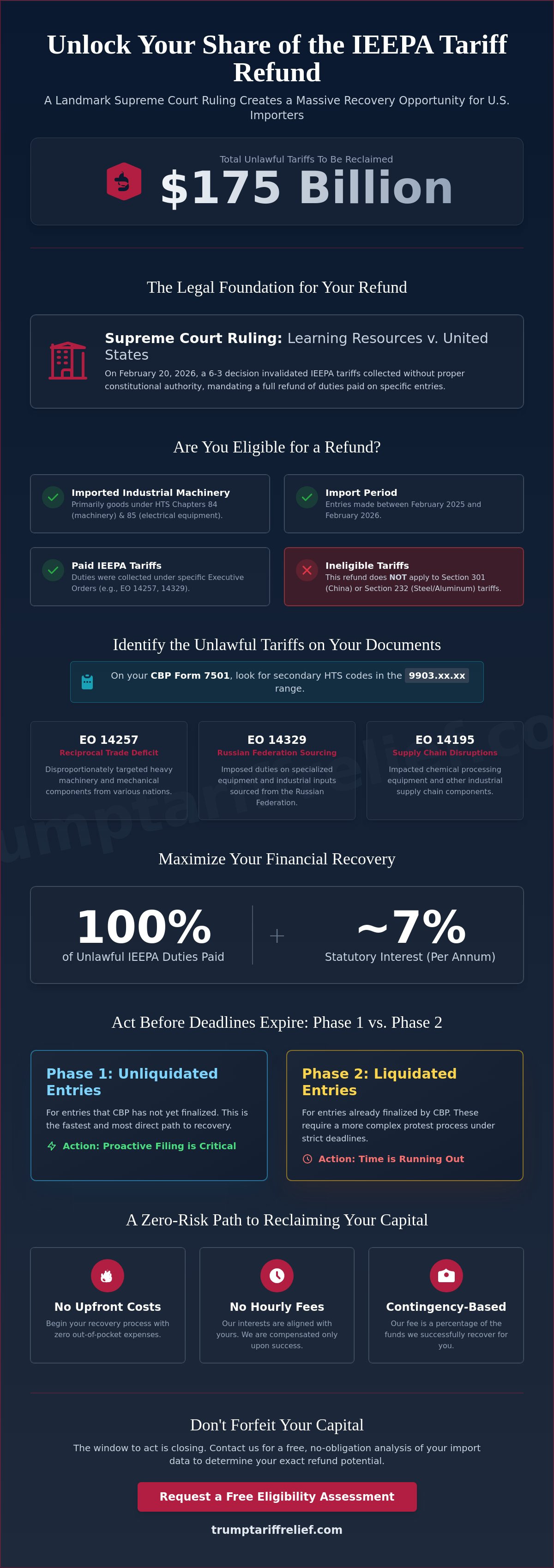
Phase 1 vs. Phase 2: When Can You Claim Your Refund?
The rollout of the Consolidated Administration and Processing of Entries (CAPE) system has created a tiered recovery timeline that determines exactly when you can access your capital. U.S. Customs and Border Protection (CBP) isn't processing all $175 billion in refunds at once. Instead, they've implemented a phased approach that prioritizes entry status. If your business is seeking to confirm IEEPA refund eligibility for industrial machinery, you must first categorize your imports as either unliquidated or finally liquidated. This distinction is the difference between a streamlined automated refund and a complex legal battle to preserve your rights.
CBP launched Phase 1 on April 20, 2026. This initial window is restricted to unliquidated entries and those liquidated within 80 days of the claim submission. For many machinery importers, this covers the most recent shipments from the tail end of the unlawful tariff period. If your entries fall outside this window, you must look toward Phase 2, scheduled for June 29, 2026, or Phase 3, expected in late July. The Council on Foreign Relations provides essential context for defining an 'international emergency', illustrating how the broad interpretation of presidential power under IEEPA led to the very tariffs now being refunded. Understanding this background helps importers realize that these duties weren't just expensive; they were legally flawed from the start.
The Status of Your Machinery Entries
Determining your current standing requires a deep dive into the ACE portal. You'll need to generate an entry summary report to identify which shipments are "open" (unliquidated) and which are "closed" (liquidated). For a machinery importer, final liquidation means CBP has finalized the duty assessment and the 180-day protest window has begun to tick. If you've missed the 90-day voluntary reliquidation window under 19 U.S.C. § 1501, filing a formal protest is often the only way to safeguard your IEEPA refund eligibility for industrial machinery. Protesting ensures your claim remains active even as the government appeals the broader CIT mandate.
Navigating the CBP Rollout Timeline
The Trade Programs Directorate recently reported "satisfactory progress" in Phase 1, with the first ACH interest-bearing refunds disbursed on May 12, 2026. While this is a positive sign for the industry, the government's June 2 appeal introduces a layer of risk for Phase 3 entries. If your equipment liquidated more than 80 days ago, you may need to join the growing number of importers filing protective lawsuits at the U.S. Court of International Trade. For real-time updates on these shifting deadlines and phase requirements, we recommend reviewing our FAQ page. Acting now ensures you don't fall behind as the CAPE system moves into its most complex implementation stages.
Securing a legal victory at the Supreme Court is a hollow triumph if your internal records aren't prepared for the scrutiny of a federal audit. The burden of proof lies entirely with you, the importer. To confirm IEEPA refund eligibility for industrial machinery, you must assemble a comprehensive evidentiary package that leaves no room for bureaucratic delay. The CBP Form 7501, or Entry Summary, stands as your "golden document" in this process. It's the only record that definitively links your business to the specific, unlawful duties paid during the 2025-2026 window. If this document is missing or contains errors, your recovery attempt will likely fail before it even reaches a human reviewer.
Beyond the entry summary, you'll need commercial invoices and packing lists to verify your primary HTS codes. Industrial machinery is technically complex, often involving thousands of components classified under Chapter 84 or 85. You must demonstrate that the secondary IEEPA surcharge (typically a 9903 code) was applied specifically to these eligible goods. Proof of payment is equally critical. CBP requires ACH records or bank-certified payment confirmations to prove these duties were settled. For open or unliquidated entries, you can utilize the Post Summary Correction (PSC) process to flag your claims for automated processing within the Phase 1 window.
The Machinery Importer’s Checklist
To ensure your records meet federal standards, we recommend following our Required Documents Checklist. For heavy equipment, gathering technical specifications and engineering diagrams is a vital defensive measure. These documents allow you to justify your HTS classifications if CBP attempts to reclassify your goods to avoid a payout. Incomplete documentation is the #1 reason for CBP claim rejection in 2026.
Avoiding Common Filing Errors
Precision is your best defense against claim denial. One of the most frequent mistakes is misidentifying IEEPA duties as Section 301 China tariffs, which are not eligible for these refunds. Because machinery shipments are often massive, "blanket" filings that fail to isolate specific IEEPA line items are frequently rejected by the CAPE system. Utilizing professional customs documentation management ensures that every entry is audited for accuracy before submission. If your internal records are disorganized or incomplete, you should start a professional documentation audit today to preserve your IEEPA refund eligibility for industrial machinery and secure your capital.
Reclaiming Your Capital: The Contingency-Based Recovery Path
The scale of the IEEPA tariff refund opportunity is unprecedented, with an estimated $175 billion currently earmarked for restoration to U.S. importers. For industrial firms, the stakes are exceptionally high. High unit values for heavy equipment mean that even a handful of customs entries can represent millions of dollars in tied-up capital. Choosing the right recovery partner is the final hurdle in securing these funds. Traditional law firms often demand $500 or more per hour to navigate tariff protests, regardless of the outcome. This billable-hour model forces your company to take on all the financial risk while the firm profits from the complexity of the bureaucracy. We believe that's the wrong approach to righting a legal wrong.
Our "Success Fee" model shifts the risk entirely. We operate as the active engine for your recovery, meaning we only receive a fee once your refund is successfully disbursed by the government. This eliminates the need for upfront consulting packages and ensures our interests are perfectly aligned with your bottom line. Recovered capital, including the statutory interest of 6-7%, provides a significant liquidity injection that can be immediately deployed for 2026 machinery upgrades, R&D initiatives, or facility expansions. As seen in John Deere's May 2026 disclosure of a $272 million recovery, the financial impact of confirming your IEEPA refund eligibility for industrial machinery can be transformative for a corporate balance sheet. For organizations planning to use these funds for international growth, particularly ventures between the U.S. and Israel, the Israel Cross Border Law Firm provides expert guidance on the legal complexities of cross-border investment.
Why Machinery Firms Prefer Contingency
Corporate cash flow is the lifeblood of industrial operations. By utilizing a contingency-based model, you preserve your operational budget while our specialized trade consultants handle the heavy lifting. Navigating the ACE portal and managing CAPE system submissions requires a level of technical precision that internal teams rarely have the time to master. We've optimized the filing process to move faster than traditional legal teams, ensuring your claims are positioned at the front of the queue for Phase 1 and Phase 2 disbursements. Our "we-do-the-work" narrative means your executives can stay focused on production while we handle the documentation and government correspondence.
Next Steps for Your Machinery Refund
The first step in your recovery journey is a comprehensive HTS code audit to confirm your IEEPA refund eligibility for industrial machinery. We'll map your Chapter 84 and 85 entries against the unlawful Executive Orders to determine your total recovery potential. Once filed, the timeline from submission to government disbursement can be as short as 30 to 60 days for unliquidated entries in the Phase 1 window. Don't let your capital sit in government accounts while the 2026 filing windows close. You can get your free IEEPA eligibility assessment today and begin the process of restoring your company's rightful capital.
Reclaim Your Industrial Capital Before the 2026 Deadlines Expire
The 2026 Supreme Court mandate has opened a brief, high-stakes window to reclaim billions in unlawfully collected duties. For machinery importers, this isn't just about regulatory compliance; it's about restoring significant capital that belongs on your balance sheet. By definitively confirming your IEEPA refund eligibility for industrial machinery and organizing your CBP Form 7501 records now, you can navigate the CAPE portal's phased rollout with professional confidence. The government's ongoing appeals only heighten the urgency to act before these filing windows close forever.
We provide the specialized expertise needed to manage complex industrial HTS classifications and the strategic timing of Phase 1 and Phase 2 claims. Our contingency-based model ensures you only pay when we successfully recover your funds, removing all financial risk from the equation. We take on the administrative burden and the heavy lifting so your team can stay focused on production and growth. Don't let your company's capital sit in government accounts any longer. Secure Your Machinery Refund Assessment Now and take the first step toward financial restoration.
Frequently Asked Questions
Is industrial machinery actually eligible for an IEEPA refund in 2026?
Yes, industrial machinery imports are a primary category for recovery following the 2026 Supreme Court ruling in Learning Resources v. United States. If your firm paid reciprocal trade deficit tariffs or emergency duties on heavy equipment between February 2025 and February 2026, you likely have IEEPA refund eligibility for industrial machinery. These funds are legally mandated for return because the underlying executive orders were found to be unconstitutional.
How do I know if my machinery was taxed under IEEPA or Section 301?
You must examine the secondary HTS codes on your CBP Form 7501 entry summaries. Section 301 duties targeting China and Section 232 duties on steel and aluminum are not eligible for this refund. Look for codes in the 9903.xx.xx range that specifically reference IEEPA mandates like EO 14257. If you see these secondary surcharges paired with your primary Chapter 84 or 85 machinery codes, those entries qualify for recovery.
What is the deadline for filing an IEEPA refund claim for machinery?
Deadlines vary based on the liquidation status of your entries. For unliquidated entries, you should file through the CAPE portal immediately to catch the current Phase 1 and Phase 2 windows. For liquidated entries, you generally have only 180 days from the date of liquidation to file a formal protest. Missing this non-negotiable legal cutoff results in a permanent forfeiture of your capital, regardless of the Supreme Court's ruling.
Can I claim a refund if my machinery entries are already liquidated?
Yes, but the process is more complex and typically requires a formal protest or a protective lawsuit at the U.S. Court of International Trade. Just as you would explore ייצוג בתיקים פליליים for sensitive criminal or security matters, navigating these complex international trade lawsuits requires a high degree of legal precision. While Phase 1 of the CAPE system focuses on unliquidated entries, Phase 3 is designed for older, liquidated shipments. Because the government appealed the CIT mandate for universal refunds on June 2, 2026, acting quickly to preserve your rights on liquidated entries is essential.
Do I need a lawyer to file for an IEEPA tariff refund?
A lawyer isn't strictly required by CBP, but the technical nature of industrial HTS classifications makes specialized expertise necessary. Many firms find that traditional law firms charging high hourly rates create unnecessary financial risk. A contingency-based recovery service provides a more efficient path. This model offers the same specialized knowledge and ACE portal navigation without the burden of upfront legal fees or hourly billing.
What happens if CBP rejects my machinery refund claim?
If a claim is rejected due to documentation errors or HTS classification disputes, you have the right to file a formal protest. Rejections often occur because of incomplete records or a failure to distinguish IEEPA duties from other tariff programs. We manage this risk by auditing every document before submission. This ensures your IEEPA refund eligibility for industrial machinery is backed by unassailable evidence and technical specifications.
How much does it cost to use a recovery service for IEEPA tariffs?
Our service operates on a pure contingency-fee model. There are no upfront costs, consulting fees, or hourly rates for our assessment and documentation management services. We only receive a percentage of the funds we successfully recover for your business. If we don't secure a refund for your industrial machinery imports, you owe us nothing. This approach allows you to pursue your capital with zero financial risk.
How long does it take for the U.S. government to issue the check?
The government has already begun disbursing ACH refunds, with the first interest-bearing payments issued on May 12, 2026. For unliquidated entries processed through Phase 1, the timeline from filing to payment typically ranges from 30 to 60 days. Liquidated entries or those requiring manual review under Phase 2 and Phase 3 will likely take longer. The current government appeals may also impact the speed of final disbursements for more complex claims.
Ready to find out what your business may be owed?
Check My Eligibility