
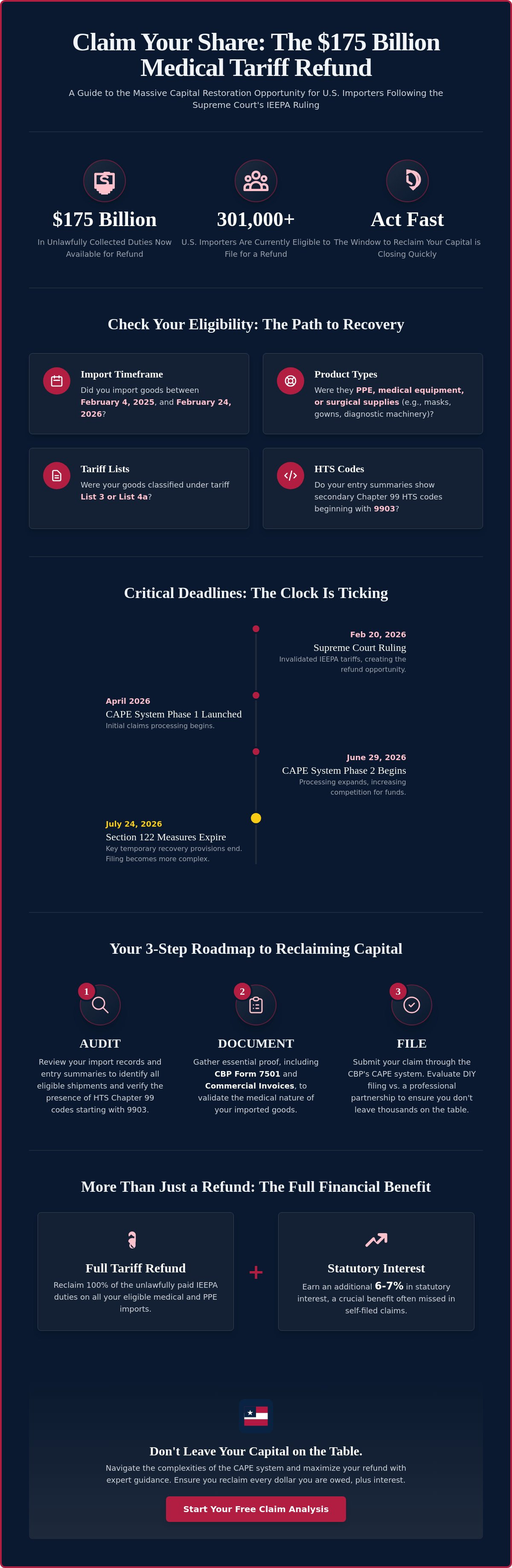
Over 301,000 U.S. importers are currently eligible to reclaim their share of $175 billion in unlawfully collected duties, yet the window to act is closing fast. If your business imported PPE or medical equipment between February 4, 2025, and February 24, 2026, you've likely felt the financial strain of aggressive IEEPA tariffs that the Supreme Court has now ruled illegal. It's frustrating to watch your capital sit in government accounts while you struggle with complex HTS code classifications and the technicalities of the CBP's new CAPE system. You deserve a direct, low-risk strategy for how to claim tariff refund for medical supplies without the typical administrative headache.
This article provides the precise legal roadmap to recovering thousands in overpaid tariffs plus statutory interest currently averaging 6-7%. We'll demystify the 2026 filing deadlines and show you exactly which Chapter 99 codes, specifically those beginning with 9903, qualify for immediate restoration. We'll also preview the upcoming CAPE Phase 2 and Phase 3 rollouts so you can position your firm for a successful recovery before the government's temporary Section 122 measures expire on July 24, 2026.
Key Takeaways
- Understand why the Supreme Court invalidated IEEPA tariffs and how this creates a massive capital restoration opportunity for medical importers.
- Learn how to identify eligible medical equipment and PPE by auditing Chapter 99 HTS codes within your previous entry summaries.
- Discover the specific technical steps for how to claim tariff refund for medical supplies while navigating the CBP’s phased CAPE system rollouts.
- Gather the critical documentation, including CBP Form 7501 and commercial invoices, required to prove the medical nature of your imported goods.
- Evaluate the risks of DIY filing through the ACE Portal versus a professional recovery partnership to ensure you don't leave thousands in interest on the table.
The IEEPA Ruling: Why Medical Supply Importers are Owed Refunds
On February 20, 2026, the legal landscape for U.S. trade shifted dramatically. The Supreme Court's landmark ruling in Learning Resources v. United States effectively dismantled a year-long tax on global supply chains. This high-stakes decision confirmed that the executive branch overstepped its authority by using the International Emergency Economic Powers Act to impose broad-based tariffs. For medical importers, this isn't just a legal victory; it's a massive financial restoration opportunity. An estimated $175 billion is now owed back to businesses that were forced to pay these unlawful duties on critical medical gear, PPE, and surgical equipment.
The impact has been particularly severe for those importing goods under List 3 and List 4a. These categories were flooded with essential items like diagnostic machinery, protective gowns, and laboratory supplies. If your firm imported these materials between February 2025 and February 2026, your operating capital has been sitting in government coffers. Understanding how to claim tariff refund for medical supplies is the first step toward reclaiming your liquidity and righting this regulatory wrong.
The Legal Catalyst for Financial Restoration
The court found a clear distinction between lawful Section 301 tariffs, which target specific trade practices, and IEEPA duties, which were misapplied as a catch-all economic weapon. This distinction is vital for your recovery strategy. While Section 301 tariffs remain in effect for many categories, the IEEPA-based duties paid during the eligibility period are now categorized as overpayments. The IEEPA refund is a legal right for importers who paid duties under specific trade actions.
The 2026 Deadline: Why Time is the Importer’s Enemy
The window for recovery is legally finite and closing fast. U.S. Customs and Border Protection (CBP) is currently processing claims through the CAPE system, but the rollout is structured to favor those who move quickly. Phase 1 launched in April 2026, and Phase 2 is set to begin on June 29, 2026. By the time Phase 3 arrives in late July, the government's position on finally liquidated entries will likely become more restrictive, requiring active litigation at the Court of International Trade.
Waiting until the end of 2026 isn't just risky; it's a gamble with your company's bottom line. Statute of limitations rules for trade protests are notoriously rigid. You can review the tariff refund statute of limitations to see how these strict timelines apply to your specific entry summaries. Every month of delay also impacts your total recovery, as interest is currently accruing at an estimated $650 million per month across the industry. Filing your claim now ensures you secure your place in the disbursement queue before the temporary Section 122 measures expire.
Identifying Eligible Medical Supplies: HTS Codes and Criteria
The path to financial restoration begins with a rigorous audit of your import records. Not every medical item qualifies for recovery, so you must distinguish between standard duties and the unlawful IEEPA overlays. The Supreme Court ruling specifically targets duties collected under the International Emergency Economic Powers Act, which were often layered on top of existing Section 301 tariffs. To understand how to claim tariff refund for medical supplies, you first need to identify the intersection of your primary 8-digit HTS codes and the specific Chapter 99 secondary codes that triggered the overpayment.
Personal Protective Equipment (PPE) represents one of the largest pools of recoverable capital. Masks, surgical gloves, and isolation gowns were frequently classified under List 4a, subjecting them to specific duty rates during the eligibility period. Diagnostic and surgical equipment, often found in List 3, carry even higher recovery potential due to their sophisticated nature and higher unit costs. However, many importers fall into the "Exclusion Trap." If your products previously received a Section 301 exclusion, you might mistakenly believe you aren't owed a refund. In reality, the IEEPA duties were often applied independently of those exclusions. You must verify if IEEPA-specific codes, typically starting with 9903, appear on your entry summaries despite any prior exclusions you secured.
Common Medical HTS Classifications Owed Refunds
High-value recovery targets often reside within Chapter 90 of the Harmonized Tariff Schedule. You should prioritize auditing entries containing codes such as 9018.12.00 (ultrasonic scanning apparatus), 9018.19.95 (patient monitoring systems), and 4015.11.01 (surgical gloves). Dual-use items, such as laboratory-grade glassware or specialized plastic tubing, also qualify if they were imported under the affected IEEPA lists. To begin your assessment, pull your past CBP Form 7501 documents and look for the secondary HTS codes in the 9903 series. These are the "smoking guns" that indicate you paid the unlawful duties. If you are overwhelmed by the volume of your past entries, you can request a preliminary Tariff Eligibility Assessment to streamline the identification process.
List 3 vs. List 4a: Where Your Medical Gear Sits
The amount of capital you can reclaim depends heavily on which list your goods were assigned to. List 3 items were hit with a 25% duty rate, while List 4a items generally faced a 7.5% rate. Medical supplies frequently straddled these two lists. For example, complex surgical lasers might sit on List 3, while simpler consumables like bandages might be on List 4a. By categorizing your imports into these two buckets, you can create a reliable framework for calculating your total refund potential. This distinction is critical because it dictates the urgency and the potential ROI of your filing effort, especially as interest continues to accrue on these overpaid amounts.
The CAPE System vs. Professional Recovery: Evaluating Your Best Path
The Consolidated Administration and Processing of Entries (CAPE) system is the government's official response to the Supreme Court's mandate. It's designed to centralize billions in disbursements. However, for medical importers, this automation is a double-edged sword. If you choose the DIY route, you're responsible for reconciling thousands of entries across multiple phases. Any data mismatch between your internal records and the CBP's database can trigger an immediate flag. These "partial refund traps" often result in importers receiving only a fraction of what they're truly owed because they failed to account for liquidated entries or complex reconciliation filings. Understanding how to claim tariff refund for medical supplies requires more than just portal access; it requires a deep understanding of how CAPE categorizes different entry types.
Sophisticated importers are increasingly moving away from internal filings in favor of contingency-based recovery. The time investment required for an internal team to audit a year's worth of medical imports is staggering. While your staff focuses on supply chain logistics, an external expert can navigate the regulatory hurdles with surgical precision. This ensures that no capital is left on the table, especially regarding the statutory interest that has been accruing since the duties were first paid.
The Technical Hurdles of the ACE Portal
Accessing the CAPE system requires a fully functional Automated Commercial Environment (ACE) portal and a designated Trade Account Owner (TAO). Many medical firms haven't updated these administrative roles in years. If your TAO is no longer with the company, you're locked out of the recovery process before it even begins. Technical errors in CAPE declarations, such as failing to link the correct Chapter 99 codes to the underlying 7501 entry, lead to immediate rejection without a clear path for appeal. You can see how it works when you bypass this bureaucracy by partnering with specialists who manage the portal technicalities on your behalf.
Why a Success-Fee Model Protects Your Margins
Medical equipment distributors often operate on razor-thin margins. Diverting your internal compliance team to handle a year's worth of tariff audits is a significant drain on resources. If you hire a traditional law firm, you'll likely face high hourly fees regardless of whether they recover a single cent. A success-fee model removes this financial barrier entirely. You only pay a percentage of the actual capital restored to your accounts. This contingency model protects your cash flow while ensuring your advocate is highly motivated to maximize your total payout. It aligns the interests of the recovery expert with your bottom line, removing the risk of "throwing good money after bad" in pursuit of your how to claim tariff refund for medical supplies objectives.
Maintaining a robust legal strategy extends beyond trade compliance; for instance, those managing medical facilities or warehouses should explore Premises Liability with The Todd Law Group, PLLC to safeguard against personal injury claims.
Documentation Requirements for a Successful Medical Tariff Claim
While the Supreme Court ruling establishes your legal right to a refund, the burden of proof remains squarely on your shoulders. U.S. Customs and Border Protection won't automatically disburse funds based on a vague request; they require a forensic paper trail that links your specific medical imports to the invalidated IEEPA duties. The centerpiece of this effort is the CBP Form 7501, or Entry Summary. This document serves as the official legal record of your transaction, detailing the HTS codes used and the exact amount of duty paid. Without a complete set of 7501 forms for the 2025-2026 period, your claim will likely stall in the CAPE portal's verification phase.
Beyond the entry summary, you must provide commercial invoices and packing lists that verify the medical nature of your goods. This is particularly important for items that were classified under generic HTS codes but were specifically destined for healthcare or surgical use. If you're wondering how to claim tariff refund for medical supplies when your records are incomplete, the first step is a documentation audit. Many importers discover that their customs brokers have purged older files or are slow to respond to requests. Recovering these records is a critical component of Customs Documentation Management, ensuring your filing is bulletproof before it hits the government's desk.
The Importer’s Essential Checklist
To secure your refund plus the 6-7% statutory interest, you must gather these five essential components:
- CBP Form 7501 Entry Summaries for all eligible import dates.
- Commercial Invoices detailing specific medical product specifications.
- Packing Lists confirming quantities, weights, and medical designations.
- Evidence of duty payment, such as bank records or ACH statements.
- Your active ACH Merchant ID to facilitate electronic refund issuance.
You can download a detailed version of this list through our specialized guide on required documents for IEEPA tariff refund.
Overcoming Data Discrepancies
Data mismatches are a primary cause for claim rejection in the CAPE system. If your medical gear was misclassified at the time of entry, you might assume you've lost your chance at a refund. This is where professional audits become invaluable. Experts can identify hidden refunds that your broker might have overlooked by cross-referencing your packing lists with eligible HTS categories from Chapter 99. If errors exist, trade counsel can often correct past entries through a formal protest or reconciliation process. This level of claim verification is the only way to ensure you aren't leaving a portion of your $175 billion share on the table due to clerical mistakes made years ago. To ensure your documentation meets the strict 2026 standards, you should start your documentation audit today.
Reclaiming Your Capital: Partnering for Medical Tariff Recovery
The opportunity currently facing medical importers is unprecedented. With an estimated $175 billion in total refunds available, the question isn't whether your firm is owed money, but how quickly you can secure it. This capital represents more than just a line item; it's the restoration of liquidity that was unlawfully drained from your operations. For those wondering how to claim tariff refund for medical supplies, the complexity of the CAPE portal and the strict 2026 deadlines make professional advocacy a necessity rather than a luxury. We act as your specialized engine, navigating the bureaucracy to ensure your business receives its full entitlement plus the 6-7% statutory interest.
Trump Tariff Relief stands as a powerful ally for the medical sector. We understand that your internal teams are focused on patient outcomes and supply chain integrity, not the forensic auditing of year-old customs entries. By partnering with us, you gain access to a "we-do-the-work" narrative where our success is directly tied to yours. Our IEEPA Tariff Refund Recovery service is designed to be low-risk and high-reward, removing the financial barriers that often prevent small to mid-sized firms from pursuing their legal rights against federal overreach.
Expertise in Medical Trade Regulations
Navigating the intersection of IEEPA and Section 301 requires more than just general legal knowledge. It demands an insider’s grasp of how the CBP processes medical HTS codes under the new CAPE framework. We manage the entire process end-to-end, from the initial Tariff Eligibility Assessment to the final electronic disbursement. Our team identifies the nuances in List 3 and List 4a that general customs brokers often miss, ensuring that dual-use items and previously excluded goods are correctly flagged for recovery. We handle the technicalities of the ACE portal and the Trade Account Owner requirements so your staff don't have to.
Start Your Recovery Today
The 2026 window for IEEPA claims is legally finite. As the government transitions through CAPE Phase 2 and Phase 3, the requirements for finally liquidated entries will only become more stringent. This is your money, not the government’s. Every day you wait is a day that your capital remains in the Treasury Department instead of your bank account. We offer a streamlined, 5-minute preliminary assessment to verify your eligible HTS codes and estimate your total recovery potential. There are no upfront consulting packages or hidden fees; we only collect a success fee once your capital is restored. Claim your free medical tariff eligibility assessment now and take the first step toward righting this regulatory wrong.
Restore Your Capital Before the 2026 Window Closes
The Supreme Court's ruling has transformed years of financial strain into a historic opportunity for medical importers to reclaim billions in overpaid duties. By auditing your 9903-series HTS codes and securing your 7501 entry summaries, you can finally right the wrong of unlawful IEEPA tariffs. Success in this landscape requires precision, as the phased CAPE rollouts leave little room for clerical errors or missed deadlines. The $175 billion pool is available, but it won't wait for those who hesitate.
Mastering how to claim tariff refund for medical supplies doesn't have to be a drain on your internal resources. Trump Tariff Relief offers the specialized trade expertise and end-to-end documentation management required to navigate the ACE portal with confidence. Because we operate on a contingency-based model, you face no financial risk. We handle the heavy lifting, and you only pay a fee once your capital is successfully restored to your accounts.
Don't let your hard-earned capital sit in government accounts while interest continues to accrue. Get Started with Your Free Medical Tariff Recovery Assessment today and secure the financial future of your medical supply business. You've fought hard for your margins; now it's time to win them back.
Frequently Asked Questions
Is the IEEPA tariff refund for medical supplies a real program?
Yes, it is a legitimate recovery process established after the U.S. Supreme Court ruled on February 20, 2026, that IEEPA-based tariffs were unlawful. U.S. Customs and Border Protection is currently administering these refunds through the Consolidated Administration and Processing of Entries (CAPE) system. This isn't a grant or a loan; it's a mandatory restoration of capital for importers who paid duties between February 4, 2025, and February 24, 2026.
Which medical HTS codes are eligible for a tariff refund?
Eligibility is determined by the presence of Chapter 99 secondary codes, specifically those beginning with 9903, on your entry summaries. Common medical targets include diagnostic apparatus (9018.12.00), patient monitoring systems (9018.19.95), and surgical gloves (4015.11.01). If your 7501 form shows an IEEPA duty was applied alongside these primary medical classifications, you likely have a valid claim. A precise audit is necessary to confirm every eligible HTS code in your portfolio.
What is the deadline to file a medical tariff refund claim in 2026?
The window is closing rapidly as the CAPE system moves through its final phases. Phase 2 for reconciliation entries launches on June 29, 2026, while Phase 3 for finally liquidated entries is expected in late July 2026. Because the temporary Section 122 replacement tariffs are set to expire on July 24, 2026, you should file immediately to ensure your claim is processed before regulatory shifts or further government appeals create new barriers.
Do I need my customs broker to file the IEEPA refund for me?
No, you aren't required to use your original customs broker to recover these funds. While brokers can file through the ACE portal, many lack the specialized legal resources to manage complex IEEPA protests or reconciliation audits. You have the right to partner with a specialized recovery firm that focuses exclusively on how to claim tariff refund for medical supplies. This often ensures a more thorough audit of your past entries than a standard brokerage provides.
What if my medical supplies were already excluded from Section 301 tariffs?
You likely still qualify for a refund if you paid IEEPA-specific duties. The government often applied IEEPA tariffs as a separate layer of duty, even on goods that had secured Section 301 exclusions. This "exclusion trap" caused many medical importers to overpay without realizing their specific exclusion didn't cover the new emergency powers act duties. Reviewing your entry summaries for 9903 codes is the only way to verify if these extra charges were applied.
How long does it take for CBP to process medical tariff refunds?
Processing times vary by entry status, but the Treasury Department has already disbursed approximately $22 billion as of early June 2026. Entries that are unliquidated or recently liquidated move the fastest. More complex reconciliation or finally liquidated entries may take longer, especially if litigation is required. Filing early places you higher in the disbursement queue as interest continues to accrue at roughly 6-7%.
What are the fees for professional IEEPA tariff recovery services?
Professional recovery services for medical importers typically operate on a contingency-fee basis. This means there are no upfront costs, consulting packages, or hourly legal fees to worry about. You only pay a percentage of the capital that is actually restored to your business. This model protects your operating margins and ensures your recovery partner is fully motivated to identify every possible refund and interest payment owed to your firm.
Can I claim a refund if my business has since changed its sourcing away from China?
Yes, your current sourcing strategy doesn't impact your eligibility for past overpayments. The refund is based on duties paid during the specific IEEPA window from February 2025 to February 2026. Even if you have completely diversified your supply chain since then, you are legally entitled to recover the capital you lost while the unlawful tariffs were in effect. Your past entry summaries remain the definitive proof of your right to restoration.
Ready to find out what your business may be owed?
Check My Eligibility