
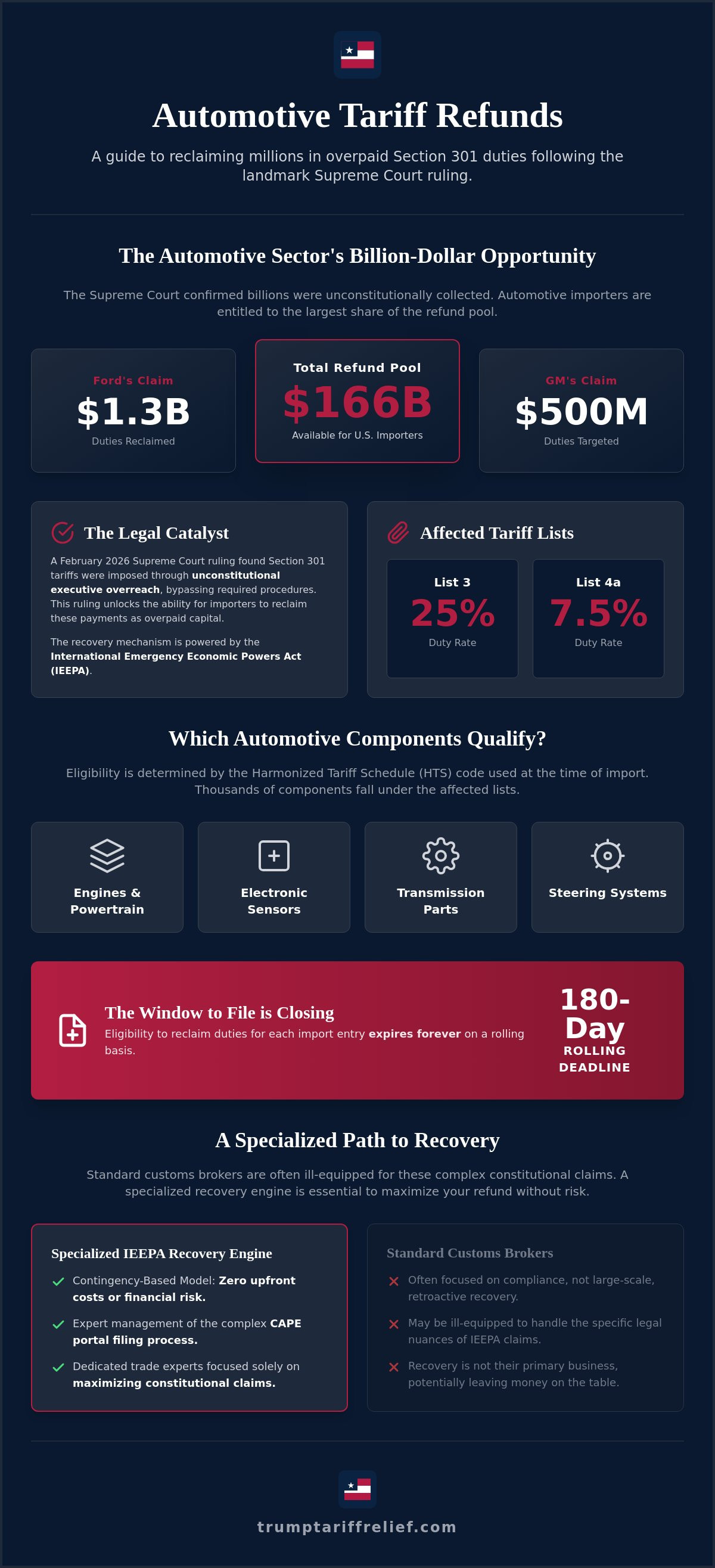
If Ford is reclaiming $1.3 billion and General Motors is eyeing $500 million, how much of your capital is still sitting in the federal government’s accounts? The February 2026 Supreme Court ruling confirmed that billions in Section 301 duties were collected under an unconstitutional overreach of executive authority. You've likely watched your margins erode under these taxes for years, assuming these costs were simply the price of doing business. The opportunity to secure a tariff refund for automotive parts is finally here, but the window is closing as individual entry deadlines expire on a rolling 180-day basis.
We recognize that the fear of high legal fees often stops recovery efforts before they've even started. This guide reveals how to reclaim your capital through an assertive, contingency-based recovery engine that handles the heavy lifting for you. You'll learn how to navigate the CAPE portal, distinguish between IEEPA eligibility and ongoing Section 232 duties, and restore your company's cash flow without any upfront investment. We're providing the roadmap to right this financial wrong and return millions in overpaid duties to your balance sheet where they belong.
Key Takeaways
- Learn why the automotive sector is entitled to the largest share of the $166 billion federal refund pool following the 2026 Supreme Court ruling.
- Identify which specific HTS codes and components, from engines to electronic sensors, qualify for a tariff refund for automotive parts.
- Understand the critical 180-day rolling deadline that dictates when your eligibility to reclaim liquidated entries expires forever.
- Discover how a specialized IEEPA recovery engine manages the complex CAPE portal filing process with zero upfront costs or financial risk.
- See why standard customs brokers are often ill-equipped to handle these specialized constitutional claims compared to dedicated trade experts.
The $20 Billion Opportunity: IEEPA Tariff Refunds for the Automotive Sector
The automotive industry is currently standing at the threshold of a massive financial restoration. The February 2026 Supreme Court ruling didn't just change trade law; it exposed a fundamental overreach in how billions of dollars were collected from importers. This mechanism for recovery is known as an IEEPA tariff refund. It allows businesses to reclaim duties paid under mandates now deemed unconstitutional. For manufacturers and suppliers, this represents an opportunity to secure a tariff refund for automotive parts that were unfairly taxed during the height of the China trade war. IEEPA stands for the International Emergency Economic Powers Act, and its role in recent tariff litigation has become the primary engine for righting these financial wrongs.
The Legal Catalyst: Supreme Court and IEEPA
The court's decision specifically targeted the procedural failures surrounding Section 301 List 3 and List 4a tariffs. List 3 carried a staggering 25% duty, while List 4a imposed a 7.5% rate. The ruling confirmed that the executive branch bypassed necessary administrative requirements. These payments are now considered recoverable capital rather than a sunk cost of doing business. This shift in trade law favors the importer for the first time in years. It's a high-stakes moment for your balance sheet. The narrative has moved from compliance to justice. We're now focused on reclaiming every dollar that should never have left your accounts.
Why Automotive Parts are Prime for Recovery
No industry felt the weight of Section 301 more than automotive. Because of the high-volume nature of vehicle production, small percentage duties on individual components snowballed into millions of dollars in overpaid taxes. The complexity of modern supply chains meant that every tier of production was impacted. From tier-one manufacturers importing engines to tier-three suppliers bringing in electronic sensors—components that companies like 億鑫鴻景電子 (Yixin Hongjing Electronics) help manage through specialized recycling—the overpayment was systemic.
Success in this landscape requires precision. Proper classification using the Harmonized Tariff Schedule (HTS) is the foundation of any successful claim. If your components were classified under affected codes, the potential for a tariff refund for automotive parts is substantial. You can find a deeper dive into the specific statute and how it applies to your specific situation by visiting our page on IEEPA Explained. The automotive sector holds the largest share of the refund pool because the sheer scale of the imports matches the scale of the government's error. We take on the risk of navigating this bureaucracy to ensure your capital is returned promptly.
Determining Eligibility: Which Automotive Components Qualify for a Refund?
Determining eligibility isn't a matter of opinion; it's a matter of technical classification. If your business imported components from China during the height of Section 301, your path to a tariff refund for automotive parts begins with your import data. The government's error wasn't limited to a single category. It spanned thousands of line items across the regulatory framework. Identifying which of your parts qualify requires a forensic look at your historical customs entries, focusing specifically on the distinction between List 3 and List 4a classifications.
List 3 and List 4a Classifications
The recovery opportunity centers on two specific tranches of tariffs. List 3, which took effect in September 2018, imposed a heavy 25% duty on a vast array of industrial components. List 4a followed in September 2019, adding a 7.5% tax to remaining categories. Common automotive components like transmission parts, steering columns, and specialized hardware often fell under these lists. "Mixed-use" parts, those that could serve both automotive and industrial purposes, are particularly complex. If these were classified under an affected code, they're eligible for recovery regardless of their final application. It's a high-stakes audit where missing a single code could mean leaving six figures on the table.
Identifying Eligible HTS Codes for Auto Parts
Your internal teams should begin by auditing every entry liquidated within the last few years. According to the Automotive Body Parts Association on Tariff Refunds, the scope of eligible importers is broader than many initially realized. Focus your search on high-value components:
- Internal combustion engines and related assembly parts.
- Electronic sensors, control modules, and wiring harnesses.
- Chassis components, including suspension systems and braking assemblies.
- Body panels and structural reinforcements.
Many parts were misclassified during the initial chaos of the trade war. A part your broker labeled as "general hardware" might actually qualify for a tariff refund for automotive parts if correctly identified under its specific automotive code. You can start your own internal review by looking at our guide on the Tariff Refund Assessment process.
This precision in classification is also vital for high-spec industrial equipment. For example, power quality components from Energy Control Systems must be correctly coded to avoid the very types of overpayments currently being recovered in the automotive sector.
Internal Audit Checklist
Before engaging with the CAPE portal, your team needs a clear view of the potential recovery. Use this checklist for a preliminary scan of your import history:
- Gather all Form 7501 Entry Summaries from 2018 to the present.
- Isolate all entries with Section 301 duties (List 3 or List 4a).
- Verify the liquidation status of each entry to identify those within the 180-day protest window.
- Cross-reference codes against the master list of unconstitutional mandates.
If this process feels overwhelming, remember that you don't have to manage the bureaucracy alone. You might find it easier to see how the recovery process works when handled by trade experts.
The Filing Process: Navigating Customs Bureaucracy Without the Risk
Reclaiming your capital isn't just about filing a form; it's a strategic operation that requires navigating the government’s complex Consolidated Administration and Processing of Entries (CAPE) portal. The burden of proof rests entirely on the importer. You must present a flawless evidentiary trail to U.S. Customs and Border Protection (CBP) to prove that your payments fall under the unconstitutional mandates. Securing a tariff refund for automotive parts requires a level of forensic accounting and secure data management that most internal departments aren't staffed to handle. To ensure your digital infrastructure can support these data-heavy audits, Trinity Networx, LLC provides the managed IT support and cybersecurity small businesses need to keep their sensitive records protected. We act as the engine of recovery, taking on the administrative burden and the technical risk so your team can stay focused on the assembly line.
The process moves through a logical sequence: data identification, validation of HTS codes, and electronic filing via the Automated Commercial Environment (ACE). CBP anticipates that valid refunds will be issued within 60 to 90 days after a CAPE Declaration is accepted. However, this timeline only applies to submissions that meet every technical requirement. Our "we-do-the-work" model is designed to bypass the bureaucratic friction that typically stalls these claims, ensuring your capital is restored as quickly as the system allows.
Documentation Requirements for Automotive Importers
CBP demands a complete paper trail for every claim. For manufacturers with high-volume imports, this means precise data mapping across thousands of individual customs entries. You'll need to gather specific records to validate your claim:
- Form 7501 Entry Summaries for every affected shipment.
- Commercial invoices clearly detailing the components and their origins.
- Definitive proof of duty payment, such as bank records or CBP statements.
- Bills of lading to verify the transport and arrival of goods.
If your records are incomplete or your data mapping is imprecise, the government will likely reject the claim. We specialize in reconstructing these trails and validating every entry against the latest regulatory updates. You can find a more detailed breakdown of these requirements in our recovery process guide.
Specialized Recovery vs. General Customs Brokerage
Many automotive suppliers mistakenly assume their standard customs brokers will handle these refunds. While brokers are vital for routine compliance and moving goods across borders, they're often not equipped for the nuances of IEEPA litigation recovery. Routine brokerage is a "forward-looking" service. Specialized recovery is a "backward-looking" legal and financial action designed to right a constitutional wrong. This Guide to IEEPA Tariff Refunds outlines the technical rigor required to successfully navigate the CAPE program. We possess the insider knowledge needed to manage the phased rollout of these refunds and address the specific legal challenges that standard brokers might overlook. If your goal is a successful tariff refund for automotive parts, you need a partner who understands the difference between a standard duty drawback and a constitutional recovery action.
Critical Deadlines: Why Automotive Suppliers Must Act Before the 2026 Cutoff
Time is the most ruthless filter in the recovery process. While the Supreme Court provided the legal catalyst for a tariff refund for automotive parts, the statute of limitations provides the hard stop. If you fail to act within the prescribed windows, your capital doesn't just sit in a government account; it becomes a permanent donation to the federal treasury. Many suppliers operate under the dangerous misconception that it's already too late to file for payments made in 2023 or 2024. In reality, the clock is still ticking for those entries, but the window for the earliest China trade war duties is slamming shut right now. Missing these deadlines means a permanent loss of capital that could have been reinvested into your R&D or manufacturing scale.
Understanding the 3-Year Statute of Limitations
The deadline for recovery isn't a single fixed date for your entire history. Instead, it functions as a rolling deadline determined by the liquidation date of each individual customs entry. A formal protest to preserve your refund rights must be filed within 180 days of the liquidation of that specific entry. This creates a high-stakes environment where eligibility for older entries is continuously expiring. You can see a detailed breakdown of how these timelines impact your specific portfolio by reviewing the Tariff Refund Statute of Limitations. If you wait for a convenient time to audit your records, you've likely already lost thousands in recoverable duties.
Avoiding Common Filing Errors in Automotive Claims
The urgency of the 2026 cutoff often leads to rushed, sloppy filings that CBP rejects almost immediately. A common error is failing to file "protective protests" for entries that haven't yet liquidated but fall under the unconstitutional mandate. These protests are essential to freeze the clock and preserve your right to a tariff refund for automotive parts once the liquidation process completes. A preliminary assessment is the only way to beat the clock without sacrificing accuracy. It identifies which entries are at immediate risk of expiring and prioritizes them for filing. Don't let bureaucratic delays or internal hesitation turn your recoverable capital into a total loss. You can start your eligibility assessment today to ensure every eligible dollar is accounted for before the window closes.
Partnering for Recovery: How Trump Tariff Relief Secures Your Automotive Refund
Navigating the federal bureaucracy to secure a tariff refund for automotive parts isn't just a compliance task; it’s a high-stakes financial recovery operation. Trump Tariff Relief functions as your specialized advocate, moving with the speed and precision required to beat rolling deadlines. We position ourselves as the active engine of your claim, meaning we handle the forensic audits, the data mapping, and the complex CAPE portal filings. You don't need to divert your internal resources or hire expensive consultants to chase these unconstitutional payments. We take on the heavy lifting and the risk, allowing your team to focus on the core business of automotive manufacturing.
Our approach is defined by a "no-nonsense" commitment to results. We understand that the automotive supply chain is already under immense pressure. Adding the burden of complex trade litigation is often unfeasible for lean teams. That’s why we’ve streamlined the path to recovery, acting as a seasoned mentor who has navigated these bureaucratic systems before. We don't just provide advice; we execute the strategy that returns capital to your balance sheet, which can then be reinvested into growth initiatives or professional branding with Transfers by MoreTranz.
The Contingency Model: Zero Upfront Risk
Our commitment to righting this financial wrong is backed by a purely contingency-based model. We don't charge hourly legal fees, and we don't sell upfront consulting packages. Our success is inextricably linked to yours. We only receive a fee if we successfully recover your capital. This percentage-based structure ensures our motivations are perfectly aligned with your CFO and supply chain leadership. It’s a low-friction partnership where the financial barrier to entry is removed entirely. If there is no refund, there is no cost to your business. This assertive approach turns a complex legal challenge into a straightforward opportunity for capital restoration.
Recovering these funds allows for strategic reinvestment into your workforce. For businesses looking to expand their technical or marketing capabilities with their restored capital, TrustTech Recruitment provides the specialized staffing expertise required to find top-tier candidates for permanent and contract roles.
Starting Your Preliminary Assessment Today
The window for reclaiming these duties is shrinking every day as entries liquidate and the 180-day protest windows close. Delaying your audit doesn't just postpone the refund; it risks the permanent loss of your eligibility. We offer a streamlined, no-obligation preliminary assessment to determine exactly how much of your capital is recoverable. By reviewing your automotive import history, we can identify the specific HTS codes and entry dates that qualify for a tariff refund for automotive parts. This initial scan provides the clarity you need to make an informed decision about your recovery strategy.
Our onboarding process is designed for maximum efficiency. You can see the full breakdown of How It Works and begin the recovery process without delay. We provide the steady hand and specialized knowledge needed to navigate this fleeting opportunity. Don't let your overpaid duties remain in government hands. Start your assessment now to secure your company’s financial restoration before the 2026 cutoff becomes a permanent barrier.
Secure Your Financial Restoration Before the Window Closes
The shift in trade law following the February 2026 Supreme Court ruling isn't just a legal footnote; it's a mandate for your company to reclaim capital that was never lawfully owed. You've identified the qualifying components and recognized the critical rolling deadlines that threaten your eligibility every single day. Now, the choice is between letting those millions remain as a permanent federal donation or taking assertive action to restore your balance sheet. Securing a tariff refund for automotive parts requires a partner with specialized IEEPA legal expertise who can navigate the CAPE portal's technical rigor on your behalf.
Trump Tariff Relief provides national coverage for all US automotive importers on a strictly contingency-based model. We operate with a simple promise: no recovery, no fee. This removes the risk of high legal costs and allows your team to focus on production while we handle the heavy lifting. Don't let your overpaid duties expire under the 180-day liquidation rule. Claim Your Automotive Tariff Refund Assessment Now and begin the process of righting this financial wrong. Your capital belongs in your accounts, not the government's.
Frequently Asked Questions
Is the China tariff refund for automotive parts real?
Yes, the refund program is currently active following the February 2026 Supreme Court ruling. This landmark decision invalidated billions in Section 301 duties collected under the International Emergency Economic Powers Act (IEEPA). U.S. Customs and Border Protection (CBP) began accepting these applications through the CAPE portal on April 20, 2026. This is a legitimate mechanism for importers to reclaim capital paid on List 3 and List 4a entries.
Which specific automotive HTS codes are eligible for IEEPA refunds?
Eligibility is determined by codes found on Section 301 List 3 and List 4a. While thousands of codes qualify, common automotive examples include those for transmission shafts, gear boxes, steering wheels, and electronic control modules. If your parts were classified under these specific tranches during the trade war period, they're likely candidates for recovery. A technical audit of your historical 7501 forms is required to confirm exact eligibility.
What is the deadline to file a tariff refund claim in 2026?
There is no single universal deadline; instead, you must file a protest within 180 days of an entry’s liquidation date. This creates a rolling expiration where older entries lose eligibility every day. To secure a tariff refund for automotive parts, you must identify and act upon these entries before that 180-day window closes. Missing this specific window results in a permanent forfeiture of your right to reclaim those duties.
How long does the IEEPA tariff recovery process take?
CBP anticipates processing valid refund claims within 60 to 90 days after a CAPE Declaration is accepted. However, the total timeline depends on the speed of your documentation gathering and the accuracy of your data mapping. If your submission is flawless, you can expect the capital to be restored to your accounts within that three-month window. Incomplete filings or bureaucratic delays can extend this timeframe significantly.
Can I file for a refund if I already use a customs broker?
Yes, you can and should pursue these refunds even if you have an existing customs broker. Most brokers focus on forward-looking compliance and routine entries rather than retroactive constitutional litigation. We work alongside your current trade partners to manage the specialized IEEPA recovery engine. This ensures your routine operations continue without interruption while we focus exclusively on reclaiming your overpaid capital.
What are the fees for IEEPA tariff refund recovery services?
Our recovery services are provided on a contingency-fee basis, meaning there are no upfront costs or hourly consulting fees. We only receive payment if we successfully secure your refund from the federal government. This model eliminates financial risk for your organization and aligns our incentives with your recovery goals. If we don't recover your capital, you owe us nothing for the assessment or filing services.
Do I need to be a manufacturer to claim an automotive tariff refund?
No, any importer of record who paid Section 301 duties on eligible parts can file a claim. This includes tier-one through tier-three suppliers, aftermarket distributors, and retailers. Even companies specializing in premium electric mobility, such as Tartarian E-bikes, may be eligible for recovery if their components were imported under the affected HTS codes. If your business was the entity that technically paid the duties to U.S. Customs, you hold the legal right to the tariff refund for automotive parts. The program is designed to restore capital to any business impacted by the unconstitutional tax mandates.
What happens if my tariff refund claim is denied?
If a claim is denied, you typically have the right to appeal the decision through the standard CBP administrative process. Denials often stem from technical errors in HTS classification or gaps in the evidentiary trail. We manage the entire response process, including providing additional documentation or legal arguments to overturn the denial. Because we operate on contingency, we're highly motivated to ensure every claim is technically perfect from the start.
Ready to find out what your business may be owed?
Check My Eligibility