
Over $175 billion in IEEPA tariffs is currently sitting in government accounts, yet not a single dollar will be returned to your business automatically. You've likely spent the last few months staring at thousands of entry summaries, wondering how to translate that mountain of data into a successful CAPE Declaration before the window closes. It's frustrating to know that while the Supreme Court ruled these tariffs unconstitutional in February 2026, the burden of proof still rests entirely on your shoulders.
To reclaim what's yours, you must navigate a complex digital landscape where one data mismatch can lead to a rejected claim. This guide clarifies the specific documents needed for IEEPA tariff refund recovery, ensuring your filing is audit-proof and ready for the Phase 3 deadlines approaching in late July. We'll examine how to leverage your ACE portal data and identify which internal records, from CBP Form 7501s to ACH payment proofs, are non-negotiable for a successful recovery strategy. By the end of this checklist, you'll have a clear path to reclaiming your capital without the administrative overwhelm.
Key Takeaways
- Identify the critical 2026 filing deadlines for Phase 3 entries to ensure your business reclaims its share of the estimated $175 billion in available refunds.
- Master the specific list of documents needed for IEEPA tariff refund recovery, focusing on CBP Form 7501 accuracy and verified ACH transaction records.
- Navigate the ACE portal with confidence by learning the precise requirements for submitting CAPE Declarations and using the IEEPA search function.
- Determine whether Post-Summary Corrections or formal Protests are the right strategic choice for your unliquidated versus finally liquidated entries.
- Leverage a contingency-based partnership to manage the high-volume data auditing and documentation heavy lifting without any upfront financial risk.
The Critical Role of Documentation in IEEPA Refund Claims
The Supreme Court's February 20, 2026, ruling in Learning Resources, Inc. v. Trump fundamentally altered the trade landscape by declaring that the International Emergency Economic Powers Act (IEEPA) does not authorize the executive branch to impose tariffs. This landmark decision effectively invalidated billions in duties collected between February 2025 and February 2026. However, winning in court is only the first step toward financial restoration. For the 330,000 affected importers, the challenge has shifted from legal theory to administrative execution. U.S. Customs and Border Protection (CBP) has made it clear that refunds are not automatic. They require proactive filing and flawless record-keeping.
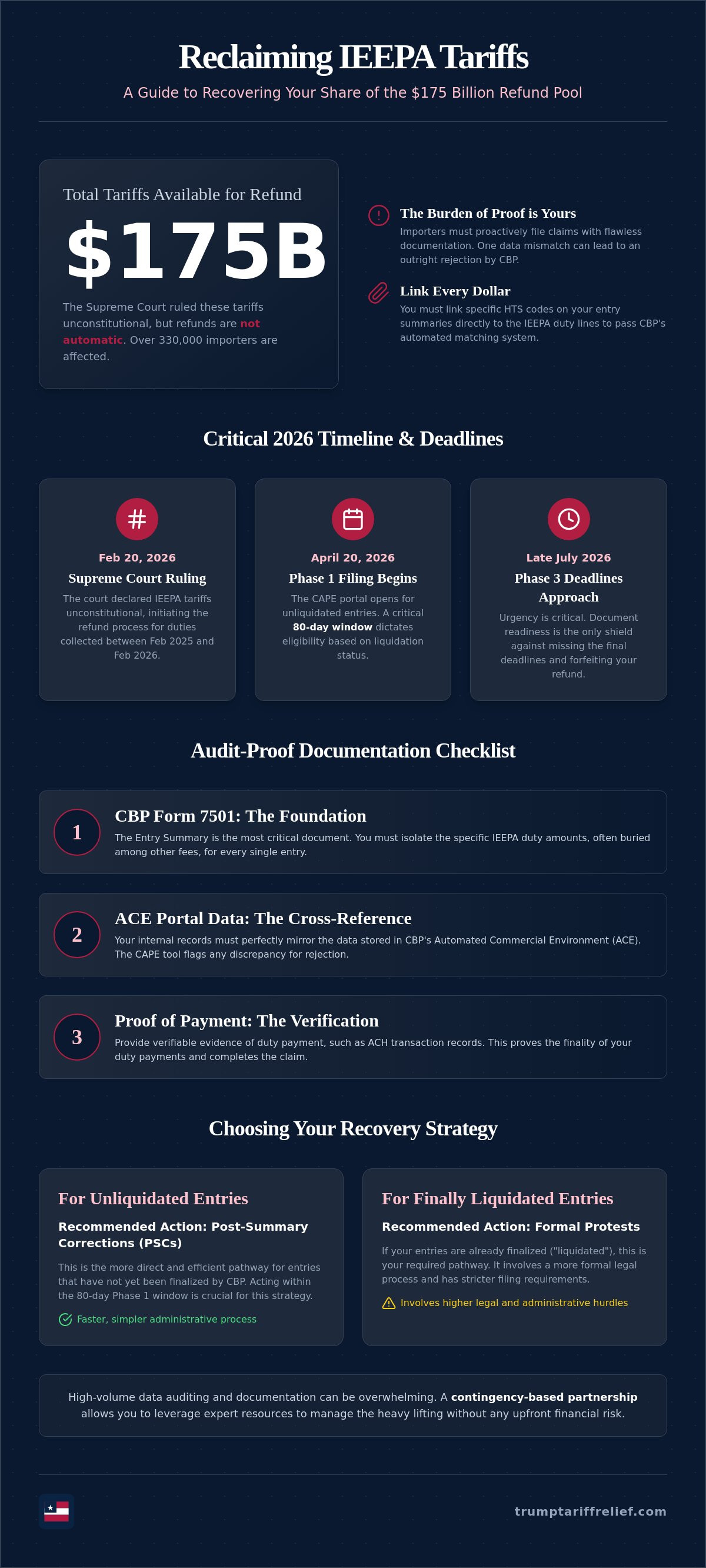
The current 2026 refund landscape is divided into strict operational phases that dictate how and when you can claim your capital. Phase 1, which launched on April 20, 2026, focuses on unliquidated entries and those liquidated within 80 days of filing. Phase 2, covering reconciliation entries, began in late June 2026. In every phase, the speed of your recovery is directly tied to the precision of your records. CBP utilizes the CAPE tool to match data, and any discrepancy between your filing and their internal records will trigger a manual review or an outright rejection. Identifying the correct documents needed for IEEPA tariff refund recovery is the only way to bypass these bureaucratic bottlenecks.
Why "Standard" Customs Records Often Fall Short
Many importers mistakenly believe their standard ERP exports or monthly broker reports provide sufficient detail for a CAPE Declaration. They don't. Legacy systems often aggregate duty payments, making it difficult to isolate the specific IEEPA surcharges from standard Section 301 duties or other fees. To secure a refund, you must be able to link specific HTS codes directly to the IEEPA duty lines on your entry summaries. Without this granular connection, CBP's automated matching system will fail. In the context of the 2026 IEEPA recovery, the burden of proof means the importer bears the entire responsibility of providing verifiable evidence that specific duties were paid on eligible entries before CBP will authorize a disbursement.
The 2026 Timeline: Urgency and Documentation
Time is your greatest adversary in this recovery process. For Phase 1 entries, there is a critical 80-day window that dictates eligibility based on liquidation status. If your documentation isn't ready when the CAPE portal opens for your specific entry type, you risk falling into the "finally liquidated" category, which carries much higher legal hurdles. Document readiness is the only shield against missed deadlines. You can review our detailed guide on how IEEPA recovery works to understand how these windows impact your specific claims. Being prepared now ensures you aren't left behind as the government processes the estimated $175 billion in total claims.
The Core Documents Every Importer Must Assemble
The transition from legal victory to capital recovery requires more than just a list of entry numbers. To successfully reclaim your funds, you must build a comprehensive dossier that proves both the eligibility of your goods and the finality of your duty payments. The list of documents needed for IEEPA tariff refund claims is specific, and CBP's automated CAPE tool is designed to flag any filing that lacks verifiable evidence. If your internal records don't mirror the data stored in the Automated Commercial Environment (ACE), your claim will likely face an immediate administrative freeze.
Since the Supreme Court ruled that the President exceeded the authority granted under 50 U.S. Code § 1701, your documentation must prove that your imports were subject to those specific, invalidated orders. This means going beyond high-level summaries. You need to provide the granular data that links every dollar paid to a specific entry and a specific HTS code. If your internal team is struggling to locate these specific records, our customs documentation management experts can audit your ACE history to fill the gaps and ensure your filing is audit-proof.
CBP Form 7501: The Foundation of Your Claim
CBP Form 7501, the Entry Summary, is the most critical document in your recovery package. On multi-page summaries, you must isolate the specific IEEPA duty amounts, which are often buried among standard Section 301 duties or harbor maintenance fees. Accuracy here is non-negotiable. You'll need to verify the "Entry Type" code, typically '01' for consumption or '11' for informal entries, to ensure eligibility for the current 2026 refund phases. If your digital archives are corrupted or missing 7501 files, you must act quickly to pull these records from your broker or request a formal data dump from ACE before the Phase 3 deadlines in late July.
Verifying Proof of IEEPA Duty Payment
CBP won't issue a disbursement based on an invoice alone; they require proof that the money actually left your accounts. You must match each entry number to a specific ACH transfer ID or wire confirmation. This is where many high-volume importers stumble. If your duties were paid via a Customs Broker's account, you need the broker's "Statement Number" to link your reimbursement to the broker's payment to CBP. This statement number serves as the unique identifier in CBP's financial records and is the only way to prove that the government received the funds you're now reclaiming. Without this link, your claim lacks the "finality" required for processing.
Finally, ensure your commercial invoices and packing lists are high-resolution digital files. While the CAPE Declaration itself is a .csv submission, CBP often requests these underlying documents during the 60 to 90-day processing window to verify HTS eligibility. Formatting these as clear, searchable PDFs will prevent manual review delays and keep your recovery on track for the Q3 2026 payout schedule.
Navigating the ACE Portal and CAPE Declarations
The Consolidated Administration and Processing of Entries (CAPE) tool, launched on April 20, 2026, is now the exclusive mechanism for reclaiming unconstitutional duties. Unlike traditional paper based protests, a CAPE Declaration is a purely digital submission. It functions as a structured .csv file that must be uploaded through the specific CAPE tab within your Automated Commercial Environment (ACE) Secure Data Portal. This system was designed to handle the massive influx of 53 million affected entries, but its automated nature means it is unforgiving of data entry errors. If the information in your upload doesn't align perfectly with the documents needed for IEEPA tariff refund verification, the system will trigger a status of "Action Required," stalling your recovery indefinitely.
Success starts with having the correct administrative permissions. Only the designated Trade Account Owner (TAO) or a user with specifically delegated "CAPE Filing" rights can access the necessary tools. Once inside, you must utilize the IEEPA Search function to identify eligible entries across your entire import history. This tool cross references your importer of record (IOR) number with known IEEPA duty lines. For a deeper dive into the technical specifications of these filings, you should consult the official CBP Guidance on IEEPA Duty Refunds. Understanding these technicalities prevents common ACE portal errors, such as "Duplicate Entry" flags or "Invalid HTS" mismatches, which frequently occur when importers try to file without a clean, audited dataset.
Establishing ACH Refund Capability
Even a perfect CAPE submission won't result in a payout if your financial configuration is outdated. You must ensure your ACE account is specifically enrolled in the ACH Refund program, which is distinct from the ACH Debit program used for duty payments. This often requires an update to your CBP Form 5106 (Importer ID Input) to provide current banking information and verify your company's legal status. If you haven't updated your 5106 in the last year, CBP may reject the refund attempt for security reasons. You can see how it works to ensure your financial profile is ready for the direct deposit of your recovered capital.
Creating a Compliant CAPE Submission
Efficiency is vital when managing high volume claims. CBP currently limits CAPE filings to batches of 5,000 entries per .csv upload. For high volume importers, this means your documentation strategy must involve precise data segmenting to avoid system timeouts. If you are attaching supporting evidence to an existing ACE protest, ensure every file name includes the primary entry number to facilitate rapid matching by CBP technicians. In the 2026 trade environment, a CAPE Declaration is not a suggestion; it is the mandatory digital key required to unlock billions in wrongfully collected IEEPA duties. By preparing your datasets now, you position your business at the front of the queue for the 60 to 90 day processing window.
Documentation Strategy for High-Volume Importers
High-volume recovery is not just a manual task; it's a data engineering challenge. When your business manages tens of thousands of entries across multiple fiscal years, the standard approach to gathering documents needed for IEEPA tariff refund recovery quickly collapses. You cannot rely on manual downloads from the ACE portal for each individual transaction. Instead, you must implement a strategy that automates the extraction of IEEPA data directly from your customs broker’s underlying reports. This allows you to identify specific duty lines that are often obscured in high-level summaries. Accuracy at this scale is the only way to avoid the administrative freezes that plague unorganized filings.
Whether a company is a large industrial importer or a specialized provider like QLD Shade, this level of data precision is the only way to ensure that every recoverable dollar is identified and claimed.
The strategic choice between a Post-Summary Correction (PSC) and a formal Protest depends entirely on the liquidation status of your entries. For unliquidated entries, a PSC is typically the most efficient route to capital recovery. However, if an entry has already liquidated, you have a strict 180-day window to file a formal Protest. Missing this window forfeits your claim for that specific entry unless it qualifies for the broader Phase 3 "finally liquidated" category scheduled for late July 2026. Data silos are the enemy here. Your internal teams must sync their records to ensure every entry is funneled into the correct filing path before the statute of limitations expires.
Liquidated vs. Unliquidated: Different Document Paths
Each filing path requires a distinct evidentiary set to satisfy CBP auditors. Unliquidated entries often rely on the original entry summary and proof of initial payment. Liquidated entries require a higher standard of proof regarding the finality of that payment and the specific protest grounds. If you're dealing with "Deemed Liquidation," where CBP fails to act within a statutory timeframe, your legacy data must show the exact date the entry was originally filed to prove the government's inaction. You can find more detail in our Required Documents for IEEPA Tariff Refund checklist.
Audit-Proofing Your Documentation Set
CBP is aggressively scrutinizing Phase 2 and Phase 3 claims for "double-dipping." If your business previously claimed a duty drawback on any of these imports, you're ineligible for an IEEPA refund on those same entries. Your shadow file—a mirror record of everything submitted to ACE—must include documentation proving that no prior drawback was filed. Additionally, HTS classification consistency is vital. If you've changed the classification of a product mid-year, your documentation must explain the shift to prevent an audit flag. For a deeper dive into these technicalities, our IEEPA explained resource provides the necessary regulatory context.
Managing this level of documentation is an administrative burden your team doesn't need to carry. Our customs documentation management experts identify every recoverable dollar across your entire fiscal history, ensuring no entry is left behind.
Streamlining Your Recovery with Trump Tariff Relief
The window for IEEPA capital recovery is closing fast. While the Supreme Court's ruling restored your legal right to these funds, the administrative burden of gathering the documents needed for IEEPA tariff refund claims remains a significant barrier to entry. Internal logistics and accounting teams are already stretched thin. Asking them to audit millions of potential entries across multiple fiscal years is a recipe for missed deadlines and rejected claims. Trump Tariff Relief acts as your specialized partner, taking on the heavy lifting of the documentation process so your team can focus on core operations. We are the active engine that drives your claim from archive to ACH payment.
Our approach removes the friction from the recovery process. We don't just provide a checklist; we execute the entire audit. By managing the data extraction and validation phases, we ensure that your submission to the CAPE portal is audit-proof from day one. This level of professional oversight is critical when dealing with the estimated $175 billion in total recoverable duties. With the first refunds already hitting importer accounts as of May 2026, the speed of your documentation assembly determines your place in the processing queue. We provide the momentum you need to cross the finish line before the Phase 3 deadlines in late July.
The Value of Professional Documentation Management
Internal teams often struggle with the technical nuances of the CAPE tool. It's not just about uploading a file; it's about ensuring every data point matches CBP’s internal records perfectly. Our trade experts identify "hidden" eligible entries that standard broker reports frequently miss, maximizing the total value of your recovery. Because we operate on a contingency-fee model, our interests are perfectly aligned with yours. We only get paid if the documentation holds up and a refund is issued, making this a low-risk, high-reward partnership for your business. We provide the elite expertise required to navigate the Automated Commercial Environment (ACE) without the overhead of upfront consulting fees. We assume the risk so you can reap the rewards of professional advocacy.
Next Steps: Your Preliminary Assessment
Securing your capital starts with a clear understanding of your eligibility. To begin, you only need to provide basic access to your ACE data. Our systems securely ingest and analyze your transaction history to build a comprehensive filing strategy. We handle the formatting of .csv files, the management of Trade Account Owner permissions, and the resolution of any data mismatches that could delay your payout. We ensure your CBP Form 5106 is up to date and your ACH enrollment is verified. Don't let your capital sit in government accounts while the 2026 deadlines approach. You should schedule your free IEEPA eligibility assessment today to ensure your business is at the front of the refund queue. Every day you wait is a day your capital remains in the hands of the treasury instead of your balance sheet.
Secure Your Capital Before the 2026 Recovery Window Closes
The transition from unconstitutional duty collection to full capital restoration hinges entirely on the precision of your data. As we've explored, the Supreme Court's ruling in February 2026 provided the legal foundation, but the CAPE tool and Phase 3 deadlines in late July mandate a level of administrative rigor that most internal teams aren't equipped to handle. Mastering the documents needed for IEEPA tariff refund recovery is no longer just a compliance task; it's a high-stakes financial recovery operation where even a minor mismatch in an ACE filing can freeze your capital indefinitely.
You don't have to navigate these bureaucratic hurdles alone. Trump Tariff Relief offers direct expert management of all ACE and CAPE filings with a specialized focus on high-volume industrial importers. Our contingency-fee model ensures that you face no financial risk; if we don't recover your funds, you don't pay a fee. We take on the heavy lifting of the documentation audit to ensure your business is at the front of the refund queue. Claim Your IEEPA Refund Assessment today and let us help you reclaim what is rightfully yours. Your capital belongs on your balance sheet, not in a government account.
Frequently Asked Questions
What is the most important document needed for an IEEPA tariff refund?
CBP Form 7501, the Entry Summary, is the foundational record required for your claim. It serves as the primary evidence for the specific documents needed for IEEPA tariff refund recovery. This form isolates the exact duty lines and HTS codes that qualify for restoration under the 2026 ruling. Without a clean, digital version of this summary, CBP's automated CAPE tool cannot verify the validity of your request.
Can I file for a refund if I don’t have the original CBP Form 7501?
You can still file by retrieving historical data directly from the ACE Secure Data Portal. While a physical paper summary isn't required for the initial CAPE submission, you must have the digital record of the entry. If your internal files are missing, a targeted data pull can reconstruct the necessary entry details, ensuring your claim remains audit-proof before the upcoming Phase 3 deadlines.
How do I prove that I was the one who actually paid the IEEPA tariffs?
Proof of payment requires matching your internal ACH transaction IDs or bank wire confirmations to specific CBP entry numbers. If your duties were paid through a broker's account, you must obtain the Statement Number. This unique identifier is the only way to prove to CBP that the government received the funds you're now reclaiming as unconstitutional and rightfully yours.
What is a CAPE Declaration and why is it required in 2026?
A CAPE Declaration is a structured .csv file submitted via the ACE portal. It became the mandatory mechanism for all IEEPA refund requests after the Supreme Court's February 20, 2026, decision. This tool was designed to automate the processing of over 53 million entries, making it the only path for importers to secure their share of the estimated $175 billion in total refunds.
Is there a difference in documentation for liquidated vs. unliquidated entries?
Liquidated entries require a formal Protest filed within 180 days, whereas unliquidated entries are typically handled through Post-Summary Corrections. The evidentiary burden is higher for liquidated entries, as you must prove the protest was filed within the strict legal statute of limitations. Phase 3 entries, which are finally liquidated, follow a distinct path that opens in late July 2026.
What happens if my customs broker no longer has my records from 2025?
You should immediately file a request for a comprehensive data export from the ACE portal. This report provides a complete history of your import activity, including HTS classifications and duty amounts paid. Since brokers aren't always able to produce legacy reports on demand, an ACE data dump is the most reliable way to recover 2025 information for your 2026 filing.
Do I need to provide documentation for the de minimis exemption changes?
Documentation is only necessary if IEEPA duties were actually assessed and paid on those entries. If your shipments fell under the $800 de minimis threshold and no tariffs were paid, there is nothing to reclaim. However, if your de minimis status was revoked or duties were paid in error, you'll need the original entry summary to prove the specific financial loss.
Can I automate the document collection process for my IEEPA claim?
Automation is the most effective way to handle high-volume claims involving thousands of entries. By syncing your ACE portal data with automated extraction tools, you can identify every eligible transaction without manual review. This strategy is essential for ensuring that the documents needed for IEEPA tariff refund recovery are organized, accurate, and ready for submission before the 2026 windows close.
Ready to find out what your business may be owed?
Check My Eligibility