
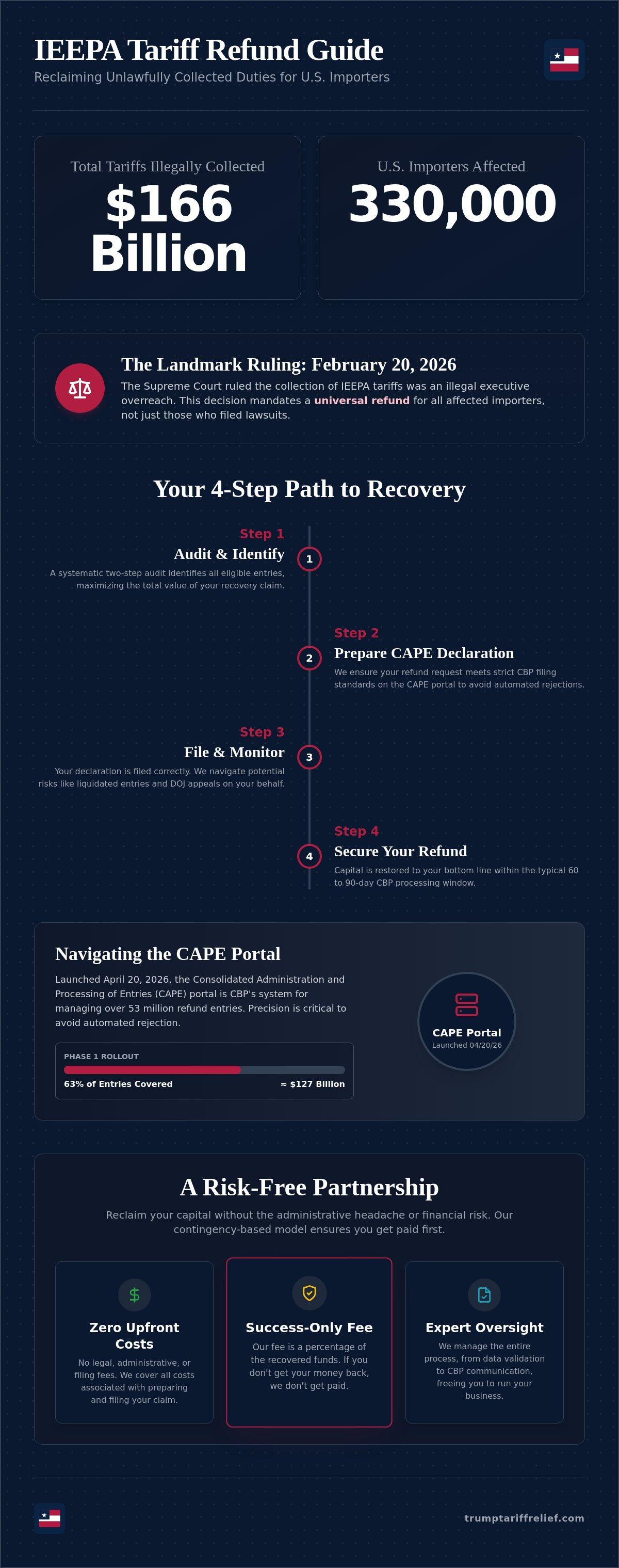
Over $166 billion in IEEPA tariffs was collected from 330,000 importers before the Supreme Court declared these duties illegal on February 20, 2026. For many companies, this capital has been sitting in government accounts rather than funding operations, growth, or payroll. It's frustrating to watch your hard-earned capital remain tied up in unlawful duties, especially when the path to recovery seems blocked by the complexities of the CAPE portal and the fear of stalling audits or government appeals.
You deserve a straightforward way to reclaim what's yours without the administrative headache or the risk of high legal fees. This article provides the roadmap you need to secure an IEEPA tariff refund for small business with zero upfront costs and professional oversight. We'll explore the phased rollout of the Consolidated Administration and Processing of Entries (CAPE) system, clarify eligibility requirements for importers of record, and demonstrate how a success-only recovery model ensures you get paid first. By the end of this guide, you'll understand exactly how to navigate the 60 to 90 day processing window to restore your bottom line.
Key Takeaways
- Understand the legal implications of the February 2026 Supreme Court ruling and why it mandates the return of $166 billion in unlawfully collected duties.
- Master the technical requirements of the CAPE portal to ensure your refund requests meet strict CBP filing standards for faster processing.
- Differentiate between liquidated and unliquidated entries to safeguard your capital against potential delays from ongoing Department of Justice appeals.
- Follow a systematic two-step audit process to accurately identify all eligible entries and maximize the total value of your recovery claim.
- Leverage a risk-free contingency partnership to secure an IEEPA tariff refund for small business without incurring any upfront legal or administrative costs.
The 2026 Supreme Court Ruling on IEEPA Tariffs and Small Business
On February 20, 2026, the U.S. Supreme Court delivered a decisive blow to executive overreach in trade policy. In the landmark case of Learning Resources, Inc. v. Trump, the court determined that the administration lacked the statutory power to impose indefinite tariffs under the International Emergency Economic Powers Act (IEEPA). This decision shifted the landscape from a period of aggressive duty collection to an era of mandatory restoration. For years, small businesses watched their capital drain into government accounts; now, that capital is legally required to be returned. This historic ruling has paved the way for an IEEPA tariff refund for small business owners who were unfairly targeted by these duties.
Unlawful Collection: Righting a Financial Wrong for Importers
The administration originally utilized IEEPA as a workaround to bypass the procedural safeguards and time limits inherent in Section 301 investigations. While Section 301 of the Trade Act of 1974 requires specific findings and public comment periods, IEEPA was treated as a "blank check" for trade enforcement. The Supreme Court ruled this was a significant overstep. The President cannot use emergency powers to permanently rewrite trade law or bypass Congressional intent. If your business imported goods subject to these specific duties, those funds are now classified as recoverable. This includes billions paid on consumer goods, electronics, and industrial components that were previously categorized as lost costs. The February 2026 ruling stands as the definitive catalyst for the largest tariff refund event in U.S. history.
The CIT Refund Order and CBP Compliance Updates
Following the Supreme Court's decision, the U.S. Court of International Trade (CIT) issued a mandate to U.S. Customs and Border Protection (CBP). This "universal refund" order is critical for the average importer. It means that an IEEPA tariff refund for small business is available to all affected companies, not just the original plaintiffs who funded the litigation. You don't need to have filed a lawsuit years ago to benefit from this 2026 victory. CBP is now required to facilitate these payments through the newly launched CAPE portal. Understanding the nuances of this ruling is the first step in identifying which of your entries qualify for immediate recovery. For a deeper dive into the legal mechanics, see our guide on understanding the IEEPA ruling. This shift in compliance means the burden has moved from the taxpayer to the government to make things right.
How the IEEPA Refund Process Works for Small Businesses: CAPE and ACE
Following the 2026 Supreme Court ruling, U.S. Customs and Border Protection (CBP) launched the Consolidated Administration and Processing of Entries (CAPE) portal on April 20, 2026. This specialized tool operates within the existing Automated Commercial Environment (ACE) to manage the unprecedented volume of claims. While the ACE portal is a familiar utility for most importers, the CAPE application is a distinct, high-stakes environment where precision is mandatory. Securing an IEEPA tariff refund for small business operations requires more than just submitting a list of entries; it demands a rigorous data validation process to avoid immediate rejection. You can get a preliminary eligibility assessment to ensure your data is submission-ready before interfacing with these government systems.
CBP is currently processing over 53 million entries, which makes automated rejection a frequent reality for many businesses. If your data doesn't perfectly align with government records, the system will flag your declaration for manual review or outright denial. Common pitfalls include mismatched banking information for Automated Clearing House (ACH) transactions or attempting to file for entries that haven't reached the correct phase of the rollout. Phase 1, which began in April, covers roughly 63% of affected entries, totaling nearly $127 billion. If you misidentify an entry's status or liquidation date, your entire claim could be stalled indefinitely.
Filing the CAPE Declaration Correctly: Attestation vs. Entry
A CAPE Declaration isn't a mere administrative upload; it's a legal attestation. When you submit, you're certifying that your business was the importer of record and directly paid the duties in question. This carries significant legal weight that many standard customs brokers are hesitant to shoulder. They often lack the specialized infrastructure to audit years of historical data for absolute accuracy. To mitigate risk, you must ensure every entry number in your declaration, up to the 9,999 limit per submission, is verified against both your internal records and CBP’s database. It's often safer to partner with a team that focuses exclusively on recovery to avoid compliance errors that could invite future audits.
Timeline for Issuance of Refunds in 2026
Speed is a priority for the government, yet the process remains methodical. Once a CAPE declaration is accepted, CBP estimates a processing time of 60 to 90 days for the funds to be issued. The first refunds for Phase 1 were issued on May 12, 2026, proving that the system is functional for those who file correctly. Payments are disbursed directly to the importer’s ACE-linked bank account via ACH. If your entries are fully liquidated, they fall into Phase 3, which began in late July 2026. To understand the sequential steps of this rollout and where your business fits in, you can view the full breakdown of how it works. Navigating these timelines requires a clear understanding of your entry lifecycle and prompt action to meet the current filing windows.
Navigating Risks: Liquidated Entries and DOJ Appeals
To secure an IEEPA tariff refund for small business, you must first categorize your imports by their liquidation status. In plain English, an unliquidated entry is "open." Customs has not yet finalized the duty calculation, making these the easiest funds to recover. Conversely, a liquidated entry is a "closed book." Under standard protocols, Customs considers these transactions final 314 days after entry. While the Court of International Trade (CIT) ordered a universal refund for both categories in 2026, the Department of Justice (DOJ) has since filed an appeal to block payments on liquidated entries for companies that were not part of the original lawsuit. This legal maneuvering makes the timing of your filing a critical factor in your recovery success.
CBP typically operates within an 80 day window for voluntary reprocessing after a court mandate. If you miss this administrative window, your path to recovery becomes significantly more complex. The government is currently managing a massive liability, and their legal strategy involves narrowing the pool of eligible recipients whenever possible. By filing your claim immediately, you establish your position before any potential stay of the CIT order takes effect. Waiting for the final outcome of the DOJ appeal could result in your business being permanently barred from reclaiming duties on liquidated entries.
The DOJ Appeal: What Small Businesses Need to Know
The government's 2026 appeal specifically targets "non-litigants." If your business did not participate as a named plaintiff in the original litigation, your eligibility for refunds on liquidated entries rests entirely on the CIT’s universal order remaining intact. The DOJ argues that the court exceeded its authority by extending relief to every importer in the country. This creates a high stakes environment for small firms. Filing your CAPE declaration now is the most effective way to safeguard your rights. It signals your intent to recover and ensures you are in the system before any restrictive legal precedents are set. A proactive approach is the only way to mitigate the risk of a sudden policy reversal.
Mitigating 'CAPE Attestation' Risks and Audits
When you submit a refund request through the CAPE portal, you are providing a formal legal attestation. You certify that all data is accurate and that your company is the rightful recipient of the funds. Errors in this submission don't just lead to a rejection; they can trigger a broader customs audit of your entire import history. To avoid unwanted government scrutiny, your documentation must be flawless. We recommend reviewing our IEEPA FAQ for a detailed breakdown of common filing risks. Ensuring your entry summaries and proof of payment are reconciled before submission is critical for any IEEPA tariff refund for small business strategy. Professional oversight ensures that your claim is a path to capital restoration, not a catalyst for a regulatory headache.
Calculating Your Recovery Potential and Meeting 2026 Deadlines
Quantifying your financial exposure is the first step toward a successful recovery. For many importers, the total amount of capital tied up in these unlawful duties is significantly higher than initially estimated. To secure an IEEPA tariff refund for small business, you must move beyond surface-level accounting and perform a deep forensic audit of your import history. This process involves five critical steps designed to satisfy the rigorous data requirements of the CAPE portal while maximizing your total payout.
- Step 1: Identify all entries. Gather every entry summary (CBP Form 7501) subject to IEEPA duties since the inception of the tariffs.
- Step 2: Segregate by status. Categorize entries as unliquidated, liquidated, or protested to determine the specific filing path required.
- Step 3: Audit HTS codes. Verify that the Harmonized Tariff Schedule codes used at the time of entry match the specific lists invalidated by the Supreme Court to prevent automated rejection.
- Step 4: Calculate the total claim. Aggregate the principal duties paid across all eligible entries and determine the additional interest owed by the government.
- Step 5: Submit the declaration. File your verified claim before the 2026 statute of limitations expires to preserve your right to recovery.
Precision in these initial calculations is vital. The government will not correct your math or suggest additional entries you might have missed. If you fail to include an eligible entry in your CAPE declaration, those funds remain in the Treasury. To ensure you aren't leaving capital on the table, you should request a comprehensive tariff eligibility assessment today.
The Critical 2-Year and 3-Year Statute of Limitations
The window for recovery is not indefinite. Under U.S. trade law, most claims against the government are subject to a strict two-year statute of limitations for judicial review, while administrative protests often must be filed within 180 days of liquidation. The "finality of liquidation" rule is a significant hurdle for small business importers; once an entry is finalized and the window closes, it's nearly impossible to reopen. You must act before these 2026 deadlines pass to ensure your liquidated entries remain eligible for the universal refund order. For a detailed breakdown of these timelines, read our guide on the Tariff Refund Statute of Limitations: The Critical Deadlines for IEEPA Claims.
Maximizing Interest Recovery on Your Refund
Your recovery shouldn't be limited to the principal amount you paid. Because these tariffs were collected unlawfully, the government is often required to pay interest on the funds they held. This interest typically begins accruing from the date of the duty payment or the date of the protest filing, depending on the entry's legal status. While principal recovery restores your initial capital, total interest-inclusive restoration accounts for the time-value of that money and provides a more complete financial remedy. Professional oversight ensures that your IEEPA tariff refund for small business includes every dollar of interest allowed under current trade regulations.
Trump Tariff Relief: Risk-Free IEEPA Recovery for Small Businesses
Securing an IEEPA tariff refund for small business shouldn't require you to gamble your remaining operational capital on uncertain legal outcomes. While the 2026 Supreme Court ruling has cleared the path for recovery, the administrative hurdles remain high. Many traditional consulting firms and legal practices operate on hourly billing or fixed retainer models, forcing you to bear the financial risk even if the government denies your claim. This approach is often unsustainable for small firms already impacted by years of unlawful duty collection. Trump Tariff Relief was founded to eliminate this barrier, offering a high-stakes advocacy model that prioritizes your recovery over our billable hours.
We provide a comprehensive, end-to-end solution that removes the administrative burden from your internal team. Our trade experts don't just point you toward the CAPE portal; we navigate its complexities on your behalf. From forensic data validation to ensuring full compliance with the latest Court of International Trade (CIT) mandates, we manage every technical detail. Our "Success-Only" guarantee means you'll never see an invoice from us unless we successfully recover your capital. It's a partnership built on performance, designed to restore your bottom line without adding a single dollar of financial risk to your balance sheet.
No Upfront Costs, No Hourly Billing
Our contingency-fee model ensures that our interests are perfectly aligned with yours. Because we only earn a fee when you receive your refund, we're highly motivated to maximize the total amount recovered, including all applicable interest. Unlike general customs brokers who focus on ongoing entries, our specialized focus is entirely on the recovery of past duties. This dedication allows us to identify eligible entries that others might overlook, particularly within the complex Phase 2 and Phase 3 rollouts of the CAPE system. This process ensures there's no impact on your current operational cash flow, allowing you to focus on growth while we handle the reclamation of your frozen capital.
Your Partner in Financial Restoration
Navigating the current trade landscape requires more than just filing a form; it requires a strategic defense against government appeals and shifting regulatory deadlines. We handle the intricacies of the DOJ appeal and the specific challenges associated with liquidated entries so you don't have to. Our team performs the heavy lifting, from the initial eligibility assessment to the final government filing and precise interest calculation. We ensure your business is positioned to receive an IEEPA tariff refund for small business before the looming 2026 statute of limitations expires. Don't leave your capital in the hands of the Treasury when a risk-free path to restoration is available. Start Your Risk-Free IEEPA Recovery Assessment today and let us secure the justice your business deserves.
Reclaim Your Capital Before the 2026 Window Closes
The Supreme Court ruling in Learning Resources, Inc. v. Trump has fundamentally shifted the balance of power back to the importer. Your business no longer has to accept unlawful duties as a permanent loss. By leveraging the CAPE portal and understanding the nuances of the DOJ’s current appeals, you can restore critical liquidity to your operations. Success depends on acting before the 2026 statute of limitations expires and ensuring your data validation is flawless to avoid government rejection.
Securing an IEEPA tariff refund for small business is a complex administrative challenge, but it doesn't have to be a financial risk. We provide a specialized, contingency-based recovery service that manages the entire documentation and filing process with $0 in upfront costs. Our team offers deep expertise in the specific legal precedents required to win, ensuring your claim is managed with professional precision. We handle the heavy lifting, from initial assessment to final disbursement, so you can focus on your core business.
Don't let your hard-earned capital sit in a government account while legal windows are still open. Start Your Risk-Free IEEPA Recovery Assessment today. It's time to reclaim what's yours and put that capital back to work for your company’s future.
Frequently Asked Questions
Is the IEEPA tariff refund real or a scam?
The IEEPA tariff refund is a legitimate government mandate resulting from the Supreme Court's February 20, 2026, ruling in Learning Resources, Inc. v. Trump. U.S. Customs and Border Protection established the CAPE portal specifically to return approximately $166 billion in unlawfully collected duties. This is a court-ordered restoration of capital, not a marketing gimmick or a scam.
How long does it take to receive an IEEPA tariff refund in 2026?
CBP estimates a processing window of 60 to 90 days after they accept your CAPE declaration. The first wave of Phase 1 refunds was issued on May 12, 2026, for those with accurate banking information in the ACE portal. If your data contains errors or mismatches, the timeline can extend significantly as manual review becomes necessary.
What is the deadline to file for an IEEPA refund in 2026?
There's no official final deadline announced as of July 2026, but you shouldn't wait. The statute of limitations for many liquidated entries is rapidly approaching, and the DOJ's ongoing appeals could result in a stay of payments. Filing immediately is the only way to establish your claim and protect your right to recovery before administrative windows close.
Can I still get a refund if my entries are already liquidated?
Yes, the Court of International Trade issued a universal refund order that includes liquidated entries for all importers. While the Department of Justice is currently appealing this order to exclude non-litigants, the mandate remains in effect. Securing an IEEPA tariff refund for small business requires you to file while these entries are still covered by the current judicial ruling.
What documents are required for a small business IEEPA refund claim?
You must provide entry summaries (CBP Form 7501), commercial invoices, and proof of payment to U.S. Customs. These documents prove you were the importer of record and that your company directly paid the duties. Flawless documentation is the only way to pass the CAPE portal's automated validation checks and avoid a full customs audit.
What is a CAPE Declaration in the ACE portal?
A CAPE Declaration is a specialized electronic submission that allows you to claim refunds for up to 9,999 entry numbers at once. It's the primary vehicle for an IEEPA tariff refund for small business within the Automated Commercial Environment. Submitting this declaration acts as a formal legal attestation that your business is eligible for the funds requested.
Do I need a lawyer to file for a tariff refund?
You don't need a lawyer to submit a claim, but specialized oversight is critical for managing the administrative burden and legal risks. The CAPE portal is a high-stakes environment where a single data error can lead to a permanent rejection. Most small businesses find that a success-only partner provides the necessary expertise without the risk of hourly legal fees.
What happens if the government appeals the CIT refund order?
The government's 2026 appeal aims to block refunds for companies that weren't part of the original lawsuit, specifically targeting liquidated entries. If the appeal succeeds, the window for recovery could shut for thousands of importers. By filing your claim now, you establish your position in the system and safeguard your capital against future changes in trade policy.
Ready to find out what your business may be owed?
Check My Eligibility