Paying a law firm thousands of dollars to recover money the Supreme Court already ruled belongs to you isn't just a business expense; it's a second injustice. You've already shouldered the heavy financial burden of unlawful 25% tariffs on Canadian and Mexican goods or 10% on Chinese imports since early 2025. It's only natural to fear throwing good money after bad, especially when navigating complex tariff refund fee structures and the technical volatility of the new CAPE system. You shouldn't have to pay for the privilege of correcting a regulatory error.
You deserve a recovery process that prioritizes your bottom line over billable hours. This guide will show you how to secure your maximum IEEPA refund plus the 6% interest mandated by law without any upfront financial risk. We'll examine why a contingency-based model is the only path that aligns your consultant's incentives with your own success. You'll learn how to navigate the 2026 filing windows with professional precision, ensuring that every unliquidated entry is identified and reclaimed before the window of opportunity expires.
Key Takeaways
- Capitalize on the Supreme Court's recent ruling by identifying which IEEPA duty payments from the 2025-2026 window are currently eligible for full restoration.
- Evaluate the pros and cons of different tariff refund fee structures to avoid open-ended legal bills that can erode your total recovery.
- Learn how a pure contingency model shifts the entire financial burden and risk from your balance sheet to a specialized recovery partner.
- Streamline your claim process by leveraging professional documentation management to handle the high-stakes filing requirements of the new CAPE system.
Understanding the Financial Stakes of IEEPA Tariff Refunds in 2026
Importers are currently standing before a massive financial threshold. Following the landmark Supreme Court ruling in Learning Resources Inc. v. Trump on February 20, 2026, the legal landscape for trade duties shifted overnight. This decision effectively invalidated billions of dollars in tariffs collected between February 1, 2025, and February 23, 2026. We're now looking at a recovery pool exceeding $170 billion. This isn't a government stimulus or a discretionary grant; it's a court-mandated restoration of capital that was taken under an unlawful application of trade law. For many businesses, these refunds represent the difference between a stagnant year and a period of aggressive expansion.
The mechanism for this recovery is the Consolidated Administration and Processing of Entries (CAPE) system. Launched in its first phase on April 20, 2026, CAPE is designed to streamline the massive volume of IEEPA claims. However, the system is rigid. Only the Importer of Record (IOR) is eligible to receive these direct government refunds. If your business acted as the IOR, the responsibility to initiate the claim falls entirely on your shoulders. Because the technical requirements for filing through CAPE are so precise, choosing between different tariff refund fee structures is the most important financial decision you'll make this quarter. You need a partner who understands the system's nuances without demanding heavy upfront payments that risk your remaining liquidity.
The Supreme Court Ruling and the Catalyst for Recovery
The legal precedent established in early 2026 clarified that the executive branch overstepped its authority. The court ruled that the International Emergency Economic Powers Act (IEEPA) does not grant the power to impose long term, broad based tariffs for economic leverage. The International Emergency Economic Powers Act (IEEPA) is a federal law that grants the president authority to regulate international commerce during a declared national emergency. This ruling created a specific, high stakes window for recovery. If you don't file your claim within the designated regulatory periods, that capital remains in the government's accounts permanently. It's a "use it or lose it" scenario where the catalyst for restoration is the importer's own initiative.
Why Importers are Racing to File in 2026
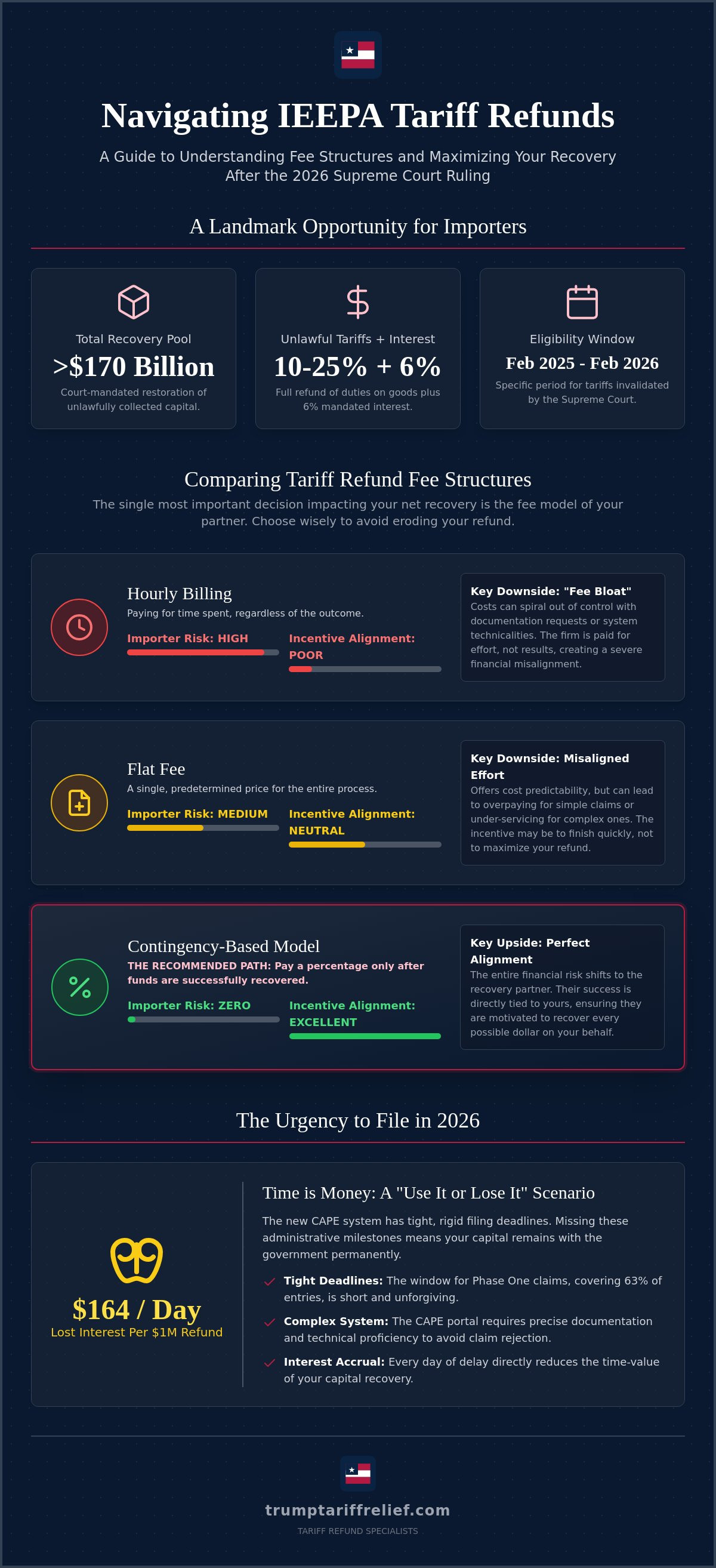
Urgency is the defining characteristic of the 2026 trade environment. While standard customs protests often allow for a longer window, the specific administrative deadlines tied to the CAPE portal rollout are much tighter. Phase one already covers approximately 63% of eligible entries, including unliquidated entries and those within the 90 day voluntary reliquidation period. If you miss these administrative milestones, your path to recovery becomes significantly more expensive and legally complex. Importers are racing to file because every day of delay is a day of lost interest. With the government mandated 6% interest rate on "excess moneys deposited," a delayed filing for a million dollar refund costs your business roughly $164 per day in lost interest alone. Leaving money on the table isn't just about the principal; it's about the time value of your capital.
Comparing Tariff Refund Fee Structures: Hourly vs. Flat vs. Contingency
Selecting a partner for duty recovery is a high stakes decision that directly impacts your final net return. Most importers find themselves choosing between three primary tariff refund fee structures: hourly billing, flat fees, or contingency based models. Each structure carries its own set of risks and incentives. While a traditional law firm might prioritize billable hours, a specialized recovery partner focuses on the total volume of capital restored to your balance sheet. Understanding these differences is essential to ensure that the cost of reclaiming your money doesn't eclipse the value of the refund itself.
The Breakdown of Hourly Legal Billing
Hourly billing is the standard for many general corporate legal services, but it's often a poor fit for complex IEEPA claims. The primary risk here is "fee bloat." Because the Official IEEPA Refund Process involves meticulous data mining across thousands of individual entry lines, an hourly model can quickly become a financial black hole. If a CBP officer requests additional documentation or if the CAPE system rejects a filing due to a technicality, the clock keeps ticking. This structure lacks financial alignment; the firm gets paid for the effort, not the outcome. Consequently, there is little incentive for an hourly consultant to aggressively pursue smaller, harder to find entries that could collectively add six figures to your recovery.
The Flat Fee Audit Model
A flat fee model is frequently utilized for a preliminary Tariff Refund Assessment. This provides predictable costs for the initial discovery phase, helping you understand if a claim is even viable. However, caution is required when applying flat fees to the entire filing process. A flat fee capped at a specific amount often leads to "minimum viable effort." If the consultant has already earned their maximum fee, they are unlikely to spend the extra days required to reconcile complex shipping manifests or dispute a minor CBP denial. You might save on upfront costs, but you risk leaving significant capital on the table because the consultant's "heavy lifting" stops where their profitability ends.
The contingency fee model stands apart as the only structure that transfers 100% of the financial risk away from the importer. In this scenario, the consultant only earns a percentage of the actual duties and interest recovered from the government. If there's no refund, there's no fee. This "no win, no fee" approach ensures that your partner is highly motivated to identify every possible eligible entry, from major 25% IEEPA duties down to the smallest overpayment. It turns the recovery process into a true partnership where both parties are focused on one goal: maximizing the restoration of your capital. To see how this risk free approach applies to your specific situation, you can explore how our recovery process works in detail.
The Strategic Advantage of a Success-Based Fee Model
In the high stakes environment of 2026 trade recovery, the most effective tariff refund fee structures are those that prioritize the client's liquidity over the consultant's billable hours. A success based model, often referred to as a contingency fee, creates a powerful shield for your company's balance sheet. By shifting 100% of the financial risk to the recovery specialist, you ensure that your pursuit of justice doesn't become another line item expense. This arrangement is built on a simple, assertive premise: if we don't win, you don't pay. This isn't just a marketing promise; it's a strategic alignment of interests that forces the consultant to operate with the same urgency as the business owner.
Success based models are uniquely suited to the complexities of IEEPA duty recovery because they cover the substantial overhead of specialized trade software and legal expertise. Identifying eligible entries across thousands of invoices requires more than a simple spreadsheet; it demands proprietary data mining tools that can reconcile inconsistent shipping records with CBP data. Under this model, the recovery firm absorbs these operational costs. You're essentially hiring a high performance team of experts and a suite of advanced technology at zero upfront cost. Some CFOs mistakenly believe that success fees are more expensive than hourly rates. In reality, the "cheaper" hourly rate often results in a lower net recovery because the firm lacks the incentive to find every eligible entry. A higher percentage of a much larger refund is always more valuable than a low hourly bill on a partial recovery.
Eliminating Upfront Capital Expenditure
Preserving cash flow is the primary concern for any importer who has felt the sting of 10% to 25% surcharges over the last year. Traditional billing models require you to speculate with your remaining capital, paying for legal research before seeing a single dollar of your refund. A "no recovery, no fee" guarantee acts as a vital protective measure for corporate budgets, allowing you to initiate the recovery process without board level approval for new spending. For a more detailed look at the financial mechanics, you can read Why Contingency Fees Work for Tariff Recovery. This approach ensures that your recovery effort is self funding, as fees are only deducted from the capital that is successfully restored to your accounts.
Motivating Deep-Data Recovery
A percentage based fee isn't just about risk; it's about motivation. When you look at contingency fee arrangements explained by legal experts, the core benefit is the incentive for thoroughness. In an hourly model, a firm might stop once they've recovered the "easy" money from major shipments. However, a success fee drives a relentless audit of every single customs entry. Success fees drive absolute thoroughness in customs documentation audits because your partner's revenue is directly tied to your total recovery. Our experts are motivated to find the $500 overpayments just as aggressively as the $50,000 ones, because every dollar recovered increases the final outcome for both parties. This thoroughness is critical in 2026, where the difference between a surface level filing and a deep data audit can represent millions of dollars in unclaimed interest and principal.
Evaluating the True Cost of Recovery: Documentation and Hidden Expenses
Many importers mistakenly believe that the only cost associated with duty recovery is the service fee paid to a consultant. This narrow view ignores the massive internal administrative burden and the technical risks that can derail a claim. When you compare different tariff refund fee structures, you must also account for the "hidden" expenses of data management. Identifying specific List 3 and List 4a entries across thousands of individual invoices is a monumental task. A "do it yourself" (DIY) approach often costs more in lost productivity and internal labor than a professional success-based fee ever would. If your internal team spends hundreds of hours digging through archives instead of focusing on core business growth, your "free" recovery effort is actually costing you a fortune in opportunity cost.
Beyond the labor, there's the looming risk of rejection. U.S. Customs and Border Protection (CBP) operates with zero tolerance for clerical errors. A single mistyped entry number or an incorrectly formatted HTS code can result in a summary rejection of your protest. Professional recovery firms utilize specialized software to handle the verification phase, ensuring that every claim is bulletproof before it hits the CAPE system. This precision is vital because it prevents future government audits or "clawbacks" where CBP demands the return of a refund due to a later discovery of documentation errors. You don't just want a refund; you want a final, settled recovery that stays on your books.
The Burden of Customs Documentation
The technical requirements for a successful IEEPA claim are exhaustive. You'll need more than just a gut feeling that you paid too much; you need a verified trail of evidence. This includes 7501 Entry Summaries, commercial invoices, and definitive proof of payment. The most difficult hurdle is matching these entry summaries with the specific HTS codes that were subject to the invalidated IEEPA surcharges. It's easy to miss eligible entries when dealing with complex multi-line shipments. To ensure your team is prepared for this data intensive process, review our Required Documents for IEEPA Tariff Refund checklist. Proper organization at the start is the only way to avoid costly delays later.
Potential Pitfalls and Avoidable Costs
Time is your most expensive enemy in 2026. The statute of limitations for customs protests is unforgiving, and missing a deadline means the government keeps your capital permanently. While the CAPE system aims to streamline Phase 1 refunds, the administrative window for unliquidated entries is narrow. Specialized consultants use proprietary software that identifies these deadlines automatically, reducing the human error that leads to missed opportunities. By outsourcing this to a partner who manages the entire tariff refund fee structures landscape on a contingency basis, you protect your staff from burnout and your company from unnecessary audit risk. If you're ready to secure your capital without the administrative headache, you should start your professional documentation assessment today.
Securing Your Refund with Trump Tariff Relief’s Contingency Model
Trump Tariff Relief stands as the definitive authority in IEEPA duty recovery. While other firms struggle to adapt their legacy tariff refund fee structures to the new regulatory environment, we've built our entire operation around the 2026 CAPE system requirements. We don't just file paperwork. We navigate the specific processing logic that U.S. Customs uses to prioritize Phase 1 refunds. Our insider perspective allows us to anticipate clerical roadblocks before they occur, ensuring your claim moves through the Consolidated Administration and Processing of Entries (CAPE) portal without friction. By choosing a partner that understands the nuances of mid-2026 customs behavior, you transition from a position of uncertainty to one of professional confidence.
Our approach is built on a high performing partnership where we take on all the risk. Because we operate exclusively on a contingency basis, our success is inseparable from yours. We've spent years mastering the technicalities of trade law to ensure that when the Supreme Court ruled these tariffs unlawful, we were ready to act immediately. We provide the elite level advocacy of a top tier law firm with the accessibility and risk profile of a results-driven business partner. If your capital is currently sitting in a government account, every day of delay is a day of lost utility for your business.
Our Results-Oriented Recovery Process
We've engineered a data driven audit that leaves no eligible dollar behind. Our team manages the entire bureaucracy, from the initial identification of List 3 and List 4a entries to the final disbursement of your refund and the 6% statutory interest. This is a completely "hands-off" experience for your staff. We take on the heavy lifting of documentation management, allowing your team to focus on core operations while we secure your capital. To see the specific stages of our engagement, you can view how it works on our detailed process page.
Take Action Before the Window Closes
The window for Phase 1 recovery is closing. With approximately 63% of eligible entries already being processed through the CAPE system's initial rollout, the time for hesitation has passed. Every day you wait is a day of lost interest and increased risk that your entries will liquidate permanently. We offer a zero cost eligibility check to determine exactly how much capital your business has at risk. There's no retainer, no hourly bill, and no financial exposure. Schedule your free IEEPA eligibility assessment today and let a high performing partner restore what is rightfully yours.
Secure Your Capital Restoration Before Deadlines Expire
The Supreme Court has already cleared the path for your recovery; the only remaining obstacle is the administrative complexity of the CAPE system. Waiting to act only increases the risk that your eligible entries will liquidate permanently, leaving your capital in government accounts. When you evaluate tariff refund fee structures, it's clear that a success-based model is the only way to align your interests with a recovery partner while preserving your company's liquidity. You've already paid the price of unlawful trade actions; you shouldn't have to pay again to get your money back.
Trump Tariff Relief provides a high-performing partnership that removes all financial barriers. Our specialized IEEPA legal and trade experts handle the entire bureaucracy, from deep-data documentation management to final disbursement. We operate on a strict contingency basis; there's no recovery and no fee. You don't have to speculate with your budget to reclaim what is rightfully yours. It's time to stop the outflow of capital and start the restoration process with a partner who takes on 100% of the risk. Your business deserves a partner that fights for every dollar.
Claim your zero-risk tariff recovery assessment now and discover the full value of your eligible IEEPA refunds. Let's restore your balance sheet today.
Frequently Asked Questions
What is a standard contingency fee percentage for tariff recovery?
While percentages vary based on claim volume and complexity, these tariff refund fee structures typically range from 15% to 30% of the total recovered amount. This fee is only paid after the government issues the refund check or electronic deposit. Because the consultant absorbs all administrative and technical costs, this percentage reflects the value of the expertise and the financial risk they assume on your behalf.
Are there any upfront costs when working with a tariff refund consultant?
No, a true contingency model requires zero upfront investment from the importer. You shouldn't pay for assessments, data mining, or initial filings. The consultant covers the cost of specialized trade software and legal experts required to navigate the CAPE system. This "no win, no fee" approach ensures your company's cash flow remains protected while you pursue the restoration of your capital.
Can I switch from an hourly lawyer to a contingency consultant mid-process?
Yes, importers can transition to a contingency model if they find their current hourly fees are eroding their potential recovery. However, you must review your existing engagement letter for termination clauses. Switching to a success based partner often provides a much needed boost in momentum; it shifts the focus from billable hours to the actual disbursement of your IEEPA refund.
What happens if the government denies my IEEPA refund claim?
If the government denies the claim, you owe nothing under a contingency agreement. The consultant absorbs the loss of time and resources spent on the filing. This protection is vital because it allows you to pursue claims that might have a complex eligibility profile without risking your own capital. We handle the technical disputes with CBP to minimize the chance of denial from the start.
Does the success fee cover the cost of filing protests with CBP?
Yes, a comprehensive success fee includes all administrative and clerical costs associated with filing protests or reliquidation requests. This includes the meticulous work of matching 7501 forms with proof of payment and navigating the technical requirements of the CAPE portal. You're hiring a partner to manage the entire bureaucracy, from the initial eligibility audit to the final settlement of the claim.
How long does it take to receive a refund once the claim is filed in 2026?
Phase one refunds for unliquidated entries are being processed in approximately 60 to 90 days through the new CAPE system. CBP began these electronic disbursements on April 20, 2026, aiming for a streamlined experience. While more complex entries requiring manual review may take longer, the automated functionality of the ACE portal has significantly accelerated the timeline compared to traditional paper based protests.
Is the China tariff refund real and currently being paid out?
Yes, the IEEPA refunds for the 10% China surcharge imposed on February 1, 2025, are actively being disbursed. Following the Supreme Court's February 20, 2026 ruling, these payments are a legal mandate. Importers are receiving their original duty payments plus the 6% statutory interest. It's important to distinguish these IEEPA refunds from Section 301 tariffs, which are currently handled under separate legal frameworks.
Can small businesses afford professional tariff recovery services?
Small businesses are the primary beneficiaries of contingency tariff refund fee structures because they require no out of pocket spending. You don't need a massive legal budget to reclaim your duties. Since the fee is a percentage of the recovered funds, the service is effectively self funding. This levels the playing field, allowing smaller importers to access the same high level trade expertise as multinational corporations. For business owners also looking to manage high-interest debt alongside these recovery efforts, you can learn more about Consolidate My Payday Loans to see how consolidation strategies can help stabilize your finances.
Ready to find out what your business may be owed?
Check My Eligibility