
Hiring a high-priced international trade law firm might seem like the safest way to reclaim your share of the $166 billion IEEPA tariff pool, but it often introduces the very financial risk you're trying to mitigate. When asking yourself, "should I use a law firm or consultant for tariff refunds," you aren't just choosing a professional title; you're choosing a business model that either protects your capital or drains it before a single dollar is recovered. You've likely felt the frustration of navigating the complex CAPE portal since its April launch or the mounting anxiety as 2026 filing deadlines approach. It's a high-stakes environment where a single administrative error can result in a denied claim, and the fear of "tariff cowboys" making false promises is legitimate.
We understand that you need a partner who rights this financial wrong without adding to your internal administrative burden. This guide clarifies the critical differences between traditional legal counsel and specialized recovery consultants, ensuring you secure an audit-proof refund while assuming zero upfront financial risk. We'll examine the cost structures, technical expertise, and recovery mechanisms of each path to help you identify the most efficient partner for your business before this window of opportunity closes.
Key Takeaways
- Learn how to answer the question, "should I use a law firm or consultant for tariff refunds," by evaluating professional incentives and the total cost of recovery.
- Compare the heavy cash-flow impact of traditional hourly legal fees against a 100% contingency-based model that eliminates your upfront financial risk.
- Identify why direct technical experience with the CAPE portal is non-negotiable for securing an audit-proof refund before the 2026 deadlines pass.
- Discover the five critical vetting criteria for identifying a legitimate recovery engine and avoiding "tariff cowboys" who make false promises.
- Understand how a specialized partner manages the end-to-end documentation process, reducing your company's internal administrative burden to near zero.
The 2026 IEEPA Refund Landscape: Why Your Choice of Partner Matters Now
The Supreme Court’s February 20, 2026, decision fundamentally altered the trade landscape by declaring tariffs collected under the International Emergency Economic Powers Act (IEEPA) unlawful. This ruling unlocked a staggering $166 billion recovery pool, yet the window to reclaim these funds is rapidly narrowing. As an importer, your primary concern is likely logistical: should I use a law firm or consultant for tariff refunds to navigate this bureaucracy? This choice is critical because the government hasn't made this an automatic process. Instead, they've introduced the Consolidated Administration and Processing of Entries (CAPE) platform, a complex interface that requires precise data and strict adherence to timelines.
Attempting to self-file through CAPE is a high-risk gamble. The system is designed for high-volume data entry, and even a minor clerical error in entry numbers or liquidation dates can lead to an immediate rejection. Because the government is managing over 53 million entries, they aren't offering second chances for administrative mistakes. You need a partner who understands the technical architecture of the portal and the legal weight of the underlying claim to ensure your capital is returned safely.
The Reality of Unlawfully Collected Duties
The 2026 ruling specifically targeted the misuse of executive authority regarding IEEPA, affecting tariffs imposed between February 2025 and February 2026. It's essential to understand that this recovery only applies to these specific IEEPA actions; your ongoing Section 301 obligations remain in place. To understand the broader context, it helps to review what is a tariff and how these trade barriers impact your bottom line. Because the U.S. Treasury doesn't issue these refunds automatically, the burden of proof rests entirely on the Importer of Record. If you fail to file a proactive claim or a formal protest, your right to that capital expires permanently.
Why 2026 is the 'Make or Break' Year
The timeline for recovery is dictated by the status of your entries. Phase 1 of the CAPE portal launch on April 20, 2026, opened the door for unliquidated entries, but the clock is ticking for liquidated entries. Importers generally have a 180-day window from the date of liquidation to file a protest. For many who paid these duties in early 2025, these deadlines are already expiring. You can track these specific windows through our guide on the Tariff Refund Statute of Limitations. The CAPE portal serves as the primary interface for 2026 claims; its phased rollout means that different entry types require different technical strategies. Relying on internal teams to master this portal while managing daily operations is a high-risk gamble that often leads to missed entries and forfeited refunds.
Law Firm vs. Consultant vs. Specialized Recovery Partner
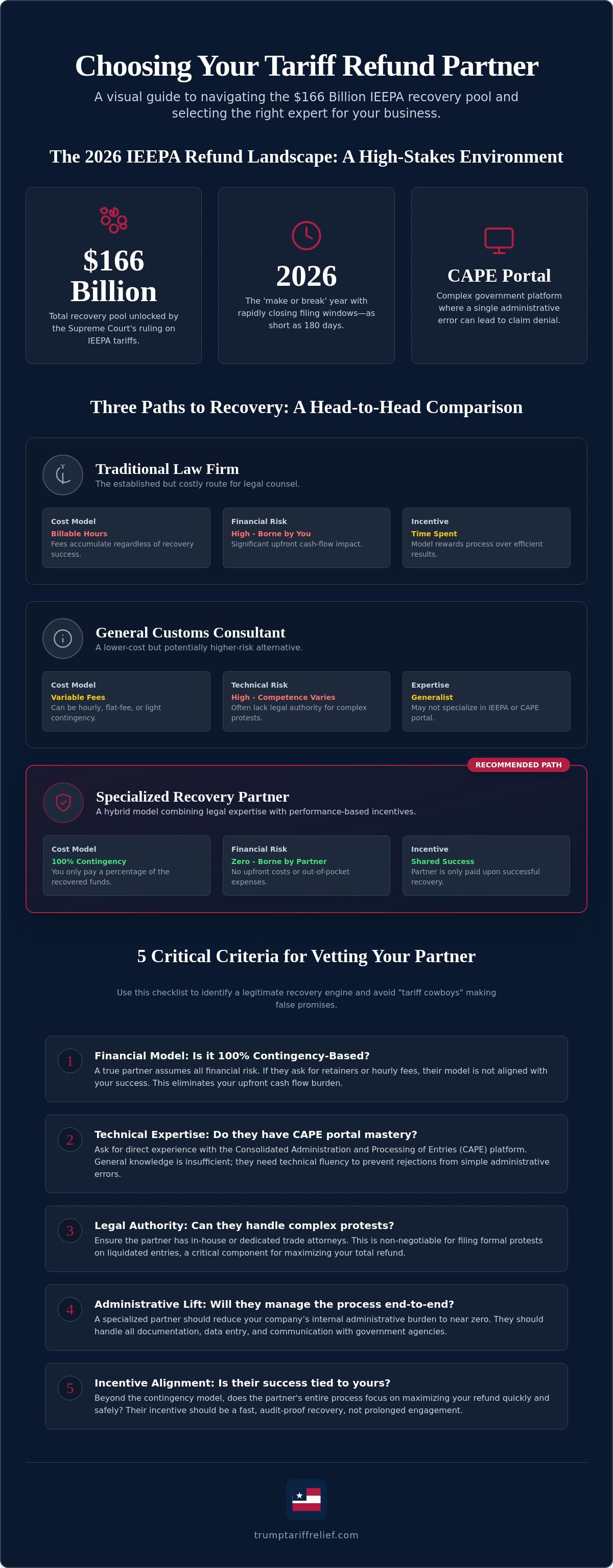
Most importers view the recovery process as a choice between two extremes: the high-priced trade lawyer or the general customs consultant. This binary thinking often leads to unnecessary capital loss. Traditional law firms offer undeniable expertise, but their business model is built on billable hours, not necessarily the speed or efficiency of your recovery. On the other end, general consultants might offer lower fees, but they often lack the legal authority to handle the complex protests required for finally liquidated entries. The impact on businesses that choose the wrong partner can be devastating, resulting in either drained cash flow from legal fees or rejected claims due to technical incompetence. Deciding whether you should use a law firm or consultant for tariff refunds requires a clear understanding of where your entries sit in the liquidation cycle.
The real answer lies in a third category: the specialized recovery partner. This hybrid model combines the legal gravitas of trade attorneys with the performance-driven incentives of a consultancy. It's an approach designed to maximize your return while assuming all the operational and financial risk. Specialized firms like Trump Tariff Relief utilize trade lawyers to ensure every filing is audit-proof, but they operate on a results-only basis. This ensures that you aren't paying for the privilege of filing; you're paying for the success of the recovery.
When a Law Firm is Overkill
Roughly 95% of IEEPA claims are purely administrative. The process involves navigating the CAPE portal and ensuring documentation aligns with CBP standards. Hiring a law firm for these tasks often leads to the "hourly trap." With specialized attorneys often billing hundreds of dollars per hour, a complex case can generate over $200,000 in legal fees before you see a single refund check. This can consume a massive portion of your recovered capital. Contrast this with a specialized IEEPA recovery approach that focuses on streamlined filing rather than accumulating billable hours.
The Risks of General Customs Consultants
The potential for $166 billion in refunds has attracted "tariff cowboys," which are firms with no legal standing or specific IEEPA track record. These consultants often lack the technical depth to manage the ACE and CAPE portals correctly. Improper documentation doesn't just risk a rejected claim; it can trigger future CBP audits that cost your business far more than the original tariff. A thorough eligibility assessment is your first line of defense against these risks. Ultimately, the question of whether you should use a law firm or consultant for tariff refunds is solved by choosing a partner that offers the legal protection of an attorney with the risk-free financial model of a consultant. A simple preliminary assessment can clarify your position without committing any capital.
Analyzing the Financials: Hourly Fees vs. Contingency Models
For most importers, the hesitation to pursue an IEEPA claim isn't about eligibility; it's about the fear of an unpredictable legal bill. When you evaluate whether you should I use a law firm or consultant for tariff refunds, the most significant differentiator is how each partner handles financial risk. Traditional law firms typically operate on an hourly billing cycle, where trade attorneys can command $500 or more per hour. In complex tariff recovery cases, which often span multiple years and involve millions of data points, these hourly fees can easily exceed $200,000 before a single refund is authorized by CBP. This model forces your business to gamble its own capital on a process with no guaranteed outcome.
The specialized recovery model eliminates this barrier by shifting the risk from the importer to the partner. By operating on a 100% contingency basis, the partner's incentives are perfectly aligned with your success. They only profit when you recover your capital. Beyond the headline hourly rates, law firms often include "hidden" costs that drain your budget, such as administrative fees for document processing, specialized research hours, and filing costs for each individual protest. A contingency partner absorbs these operational expenses, allowing you to treat the recovery as a pure balance sheet improvement rather than a line-item expense.
The Math of a Contingency Claim
The math of a contingency claim is straightforward and protective. The success fee is calculated as a fixed percentage of the actual capital recovered from the U.S. Treasury. This means your business can pursue its full share of the $166 billion pool without a dedicated litigation budget or board-level approval for legal spend. It's a performance-based partnership where the recovery engine does the heavy lifting, and if no refund is secured, the client pays zero. This structure ensures that only viable, audit-proof claims are moved forward, as the partner has no interest in pursuing losing cases at their own expense.
Audit Protection and Long-term Risk
While a "cheap" consultant might offer lower percentage fees, they often lack the technical and legal depth to provide long-term protection. If CBP denies a claim due to poor documentation or incorrect entry mapping, the cost to fix that error through formal litigation can be astronomical. Specialized partners provide audit-proof documentation that stands up to federal scrutiny, protecting your business from future clawbacks or penalties. You can see how this zero-risk process ensures your recovery is both maximized and permanent by reviewing how it works. Ultimately, the right partner doesn't just find the money; they ensure you keep it.
5 Critical Vetting Criteria for Your Recovery Partner in 2026
The surge in IEEPA recovery opportunities following the February 2026 ruling has flooded the market with service providers. Many importers find themselves paralyzed by the question, should I use a law firm or consultant for tariff refunds, while deadlines loom. Selecting a partner based on brand name alone is a mistake. You need a specialized engine capable of processing thousands of entry lines with surgical precision. To protect your capital and ensure a successful filing, evaluate your potential partner against these five non-negotiable criteria.
- Specific IEEPA Track Record: General trade experience isn't enough. Ask if they've successfully recovered duties under the International Emergency Economic Powers Act, which carries different legal requirements than standard Section 301 protests.
- Technical Integration: With the CAPE portal launch in April 2026, your partner must demonstrate direct experience navigating this specific interface. If they're still relying on legacy ACE templates, they'll likely miss the phased deadlines for liquidated entries.
- Data Integrity: Errors in entry numbers or HTS codes trigger automatic rejections. Ensure your partner uses automated validation tools to handle high-volume data without clerical mistakes.
- Legal Standing: Administrative filing is only half the battle. Your partner must have internal or partner counsel to handle formal protests and potential litigation in the U.S. Court of International Trade.
- Transparency: A legitimate partner provides a clear, written tariff recovery guide that outlines every step of the process, from assessment to the final payout.
Red Flags to Avoid
Be wary of "tariff cowboys" who guarantee 100% success rates or demand upfront "administrative fees." In the 2026 landscape, a results-oriented partner should assume the financial risk. To verify the credentials of these high-stakes partners, some organizations utilize a corporate private investigator NYC to conduct thorough due diligence before entering into agreements. Another red flag is the generalist broker who "also does" refunds. These firms often lack the specialized legal depth to handle entries that have been finally liquidated for more than 180 days. If they won't sign a clear, 100% contingency agreement, they aren't confident in their ability to win your case.
The Documentation Litmus Test
The right partner takes over your customs documentation management entirely. Don't settle for a firm that merely provides templates for your internal team to fill out; this increases your administrative burden and the risk of error. Ask them directly: "Will you manage the actual filing in the CAPE portal, or just give me instructions?" A high-performing partner also calculates the accrued interest on your principal refund, which can add significant value to your total recovery. For an immediate review of your entries, you can request a preliminary eligibility assessment today.
Securing Your Recovery with Trump Tariff Relief
When businesses weigh whether they should I use a law firm or consultant for tariff refunds, they're typically searching for a partner that offers the security of a lawyer without the predatory billing of a traditional firm. Trump Tariff Relief was built to be that partner. We operate as a high-performing recovery engine, combining the technical precision of trade experts with the legal authority required to win complex protests. For companies that require specialized legal counsel for other international operations, you can discover Tosolini, Toniutti & Partners to assist with US-Italy cross-border business. Our mission is to restore the capital that was unlawfully collected from your balance sheet, and we do so with a clear, assertive promise: if we don't recover your money, you don't pay us a cent.
Our approach eliminates the "hourly trap" discussed earlier, shifting the entire financial burden away from your company. We recognize that the 2026 recovery landscape is unforgiving, with strict deadlines and a complex digital interface in the CAPE portal. By positioning ourselves as a specialized ally rather than a general consultancy, we provide the "teeth" necessary to challenge CBP decisions while maintaining the efficiency of a results-oriented business partner. We don't just provide templates; we provide a complete shortcut through a complex bureaucracy.
This philosophy of specialized administrative support extends to other critical business functions; for example, Admin316 provides full-scope 3(16) fiduciary administration to help employers reduce risk and simplify the compliance requirements of their retirement plans.
Our End-to-End Recovery Engine
We manage the entire lifecycle of your claim through a streamlined three-step process: Assessment, Documentation, and Filing. First, we conduct a comprehensive audit of your entries to identify every refundable dollar. Next, we handle the heavy lifting of documentation management, ensuring your data is audit-proof and formatted for the CAPE portal's strict requirements. Finally, our team manages the actual filing and follow-up with CBP until the funds are recovered. Our national reach allows us to support large-scale importers across all U.S. ports of entry. For organizations that also need to manage the legal complexities of a global workforce, the Law Offices of Peg Yang, P.C. provides specialized U.S. immigration legal services. Crucially, we possess the specialized knowledge required to distinguish China tariff refunds from the specific IEEPA claims targeted by the 2026 Supreme Court ruling. This distinction is vital for ensuring your claims are filed under the correct legal framework, preventing the administrative rejections that often plague generalist filings.
Start Your Zero-Risk Assessment Today
There is currently $166 billion in unlawfully collected duties waiting to be reclaimed. The U.S. Treasury will not proactively reach out to return this capital; it requires a bold, proactive stance from your leadership team. By choosing Trump Tariff Relief, you gain a specialized ally that assumes 100% of the financial and administrative risk. If you have questions about specific entry types or the 2026 timelines, our FAQ provides immediate clarity on the most common importer concerns. The 2026 recovery window is the final opportunity for many businesses to right this financial wrong. Don't let your capital expire in a government account. Contact our team today to initiate your preliminary eligibility assessment and secure the refund your business is legally owed.
Reclaiming Your Capital Before the 2026 Deadlines
The decision of how you navigate this $166 billion recovery pool determines whether you actually see a refund or simply accumulate more legal debt. When asking yourself, "should I use a law firm or consultant for tariff refunds," remember that the most effective partner is one who assumes the financial risk on your behalf. By prioritizing a 100% contingency-based recovery, you ensure that your partner is just as motivated as you are to secure every available dollar. This model aligns incentives perfectly, protecting your cash flow while pursuing justice for unlawfully collected duties.
For organizations that have already experienced significant financial strain due to these tariffs, the Law Offices of Matthew T. Desrochers, P.C. offers professional guidance on debt relief and restructuring to help stabilize your business.
Don't let administrative complexity or the fear of "tariff cowboys" prevent you from righting this financial wrong. Specialized IEEPA and Section 301 expertise is the only way to navigate the CAPE portal without triggering rejections or future audits. We eliminate the barriers of no upfront costs or hourly billing, providing a clear, assertive path to financial restoration. The 2026 window won't stay open forever, and your right to these funds will eventually expire. For guidance on managing your recovered wealth or to check out Tax Partners for insights on the tax implications of holding gold and precious metals, staying informed is key to long-term stability.
Take the first step toward reclaiming your capital by claiming your Free IEEPA Eligibility Assessment today. It's time to bring your money back where it belongs.
Frequently Asked Questions
Do I legally need a law firm to file an IEEPA tariff refund claim?
You don't legally require a law firm to submit an administrative claim through the CAPE portal. The Importer of Record has the authority to file directly or appoint an authorized agent to manage the process. However, if your entries are finally liquidated and require a formal protest, you need a partner with the legal standing to navigate the Court of International Trade. A specialized recovery partner provides this legal protection without the overhead of a traditional firm; for other professional legal needs, you can check out MZ-Law.
What is the difference between a customs broker and a tariff refund consultant?
A customs broker, such as Customs and Trade Logistics, focuses on your daily entry compliance and ongoing trade operations. In contrast, a tariff refund consultant focuses exclusively on the retroactive recovery of duties like the $166 billion IEEPA pool. While brokers ensure you don't break the law moving forward, specialized consultants audit your past entries to reclaim capital you've already paid. It's the difference between managing future costs and winning back past losses.
How much do law firms typically charge for tariff recovery services?
Traditional law firms typically bill by the hour, with trade attorneys often commanding rates between $300 and $600 per hour. In complex cases involving thousands of entries, these legal fees can accumulate into six figure expenses before a single refund is issued. This model places the entire financial risk on the importer. When evaluating should I use a law firm or consultant for tariff refunds, consider the impact of these upfront costs on your recovery.
Can a consultant handle a formal CBP protest if my claim is denied?
A general consultant lacks the legal standing to file formal protests once an entry is finally liquidated. However, a specialized recovery partner like Trump Tariff Relief maintains a team of trade and legal experts specifically for this purpose. If CBP denies an administrative claim, our team manages the escalation process through the formal protest system. This ensures your recovery doesn't stall simply because the paperwork becomes more litigious or technical; for those requiring specialized support in security and defense-related legal matters, you can discover עמנואל טראץ', עורך דין ונוטריון for professional guidance.
Is a contingency fee model better than an hourly rate for large claims?
A contingency fee model is superior for large claims because it eliminates the risk of paying for a failed recovery. Under an hourly model, a law firm gets paid regardless of whether you receive a refund check. A contingency agreement ensures your partner only profits if you do. This alignment of interests motivates the recovery engine to identify every eligible entry and fight for the maximum interest accrual on your behalf.
How do I know if a tariff refund consultant is legitimate?
Legitimacy is defined by a specific track record with IEEPA claims and a transparent fee structure. Avoid any firm that asks for upfront administrative fees or document processing costs. A legitimate partner assumes all the risk and only bills a success fee after the U.S. Treasury issues your refund. They should also provide a clear, written guide to the recovery process and demonstrate technical mastery of the CAPE portal interface.
Will hiring a consultant instead of a lawyer increase my risk of a CBP audit?
Hiring a specialized consultant does not increase your audit risk if they provide audit-proof documentation. In fact, a partner that focuses exclusively on IEEPA recovery often has more specialized knowledge than a general corporate lawyer. Our team ensures that every claim is backed by precise entry data and legal justifications that stand up to federal scrutiny. This protective approach ensures your refund is permanent and your compliance record remains spotless. For the tax and accounting professionals overseeing these high-stakes documentation processes, ensuring the security of sensitive client data is just as critical; read more about implementing a compliant Written Information Security Plan (WISP).
What happens if I hire a partner and they fail to recover my refund?
If you've signed a 100% contingency agreement, you pay zero if the recovery fails. This is the primary reason why businesses ask should I use a law firm or consultant for tariff refunds before committing to a partner. Our team absorbs all the costs of the assessment, documentation management, and filing. If the government denies the claim and all protest avenues are exhausted, your business loses nothing but the time spent on the initial assessment.
Ready to find out what your business may be owed?
Check My Eligibility