Phase I of the new CAPE system is already processing 63% of eligible entries, yet thousands of importers are still waiting for a green light that may never come before their legal rights expire. If you're feeling the internal pressure to recover capital lost to 2024 and 2025 tariffs, you aren't alone. The confusion between the April 2026 CAPE platform launch and strict legal statutes of limitations has left even seasoned trade professionals second-guessing their strategy. Missing the IEEPA tariff refund deadline isn't just a clerical error; it's a permanent forfeiture of your company's rightful capital.
You deserve a clear, no-nonsense path to reclaiming what was taken under tariffs the Supreme Court struck down in February. This guide provides the exact technical and legal milestones you must hit to secure your recovery before the 2026 filing window closes forever. We'll examine the 180-day protest window, the implications of the July 24, 2026, Section 122 surcharge expiration, and the specific steps to confirm your eligibility today. It's time to move from uncertainty to a structured, low-risk path toward financial restoration.
Key Takeaways
- Navigate the two-track deadline by aligning your filing strategy with both the technical CAPE portal window and the legal statute of limitations.
- Identify why the "Date of Liquidation" is your most critical metric, as the 180-day protest rule dictates the lifespan of every potential claim.
- Calculate the high cost of inaction and learn why standard customs brokers often miss the specialized eligibility requirements for these specific refunds.
- Execute a rigorous three-year audit and reconcile internal ERP data with CBP records to prepare an audit-ready submission that withstands scrutiny.
- Act before the IEEPA tariff refund deadline to ensure your business doesn't permanently lose access to capital from the invalidated 2024-2025 duties.
Understanding the IEEPA Tariff Refund Deadline in 2026
The IEEPA tariff refund deadline is the final barrier between your company and the restoration of capital seized under duties recently invalidated by the Supreme Court. Following the landmark ruling on February 20, 2026, which struck down these trade measures, 2026 has officially become the "Year of Recovery" for U.S. importers. However, this recovery is not automatic. The deadline represents a hard stop; once this window closes, any unclaimed funds revert permanently to the U.S. Treasury, leaving your balance sheet permanently scarred by 2024 and 2025 tariff payments.
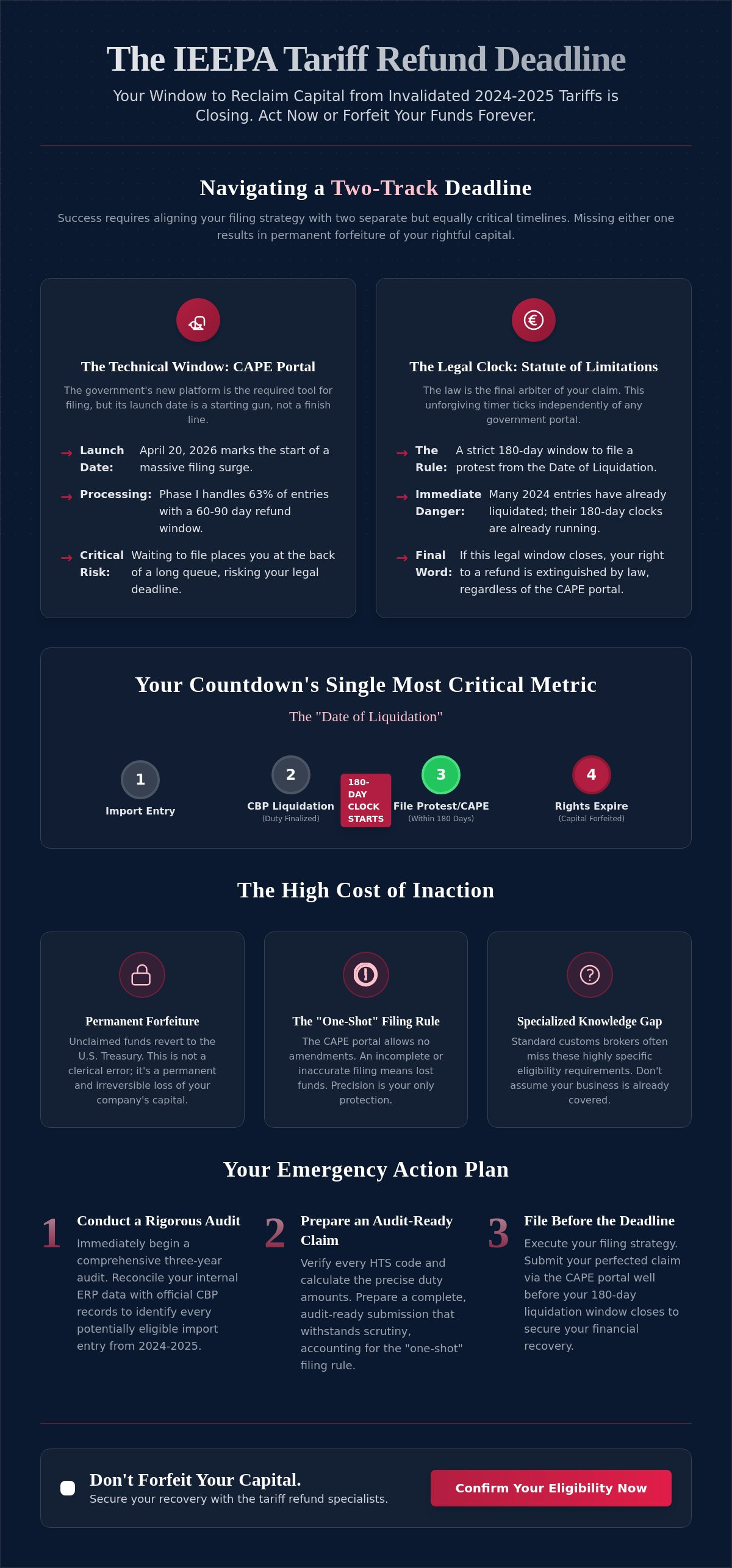
To successfully navigate this landscape, you must understand that you are facing a two-track deadline. There is the technical window managed through the new CAPE portal and the overarching legal statutes of limitations that govern customs protests. If you fail to align your filing strategy with both, you risk a technical rejection even if your claim is legally sound. For a deeper dive into why these specific duties were challenged, reviewing the International Emergency Economic Powers Act (IEEPA) provides essential context on the executive reach the Court eventually curtailed.
The CAPE Platform Launch: April 20, 2026
Customs and Border Protection (CBP) scheduled the launch of the Consolidated Administration and Processing Entries (CAPE) system for April 20, 2026. This launch marks the start of the final countdown for importers. Phase I of this system is designed to handle approximately 63% of all eligible entries, offering a streamlined 60 to 90 day refund processing window. Because this platform is the primary vehicle for administrative recovery, CBP expects a massive surge in filings immediately following the launch. Waiting even a few weeks to organize your data could place your claims at the back of a very long line, potentially pushing your resolution past critical fiscal milestones.
Legal Statute of Limitations for Tariff Protests
While the CAPE portal is the tool, the law is the clock. The standard legal window for a protest is 180 days from the date of liquidation. The Supreme Court ruling accelerated the need for action because it triggered a massive re-liquidation order from the Court of International Trade. If your entries have already liquidated, that 180-day timer is ticking right now. Relying on a generic three-year statute of limitations is a dangerous strategy for large-volume importers. If the liquidation becomes final and you haven't filed a protest or a CAPE declaration, your right to recover those specific duties vanishes. You can learn more about how these timelines interact by visiting our guide on how IEEPA refunds work. Success requires moving faster than the bureaucracy; it requires an immediate audit of every entry from the last 24 months.
Statutes of Limitations: Why Your Claim Window is Closing
The 180-day rule is the most unforgiving component of the IEEPA tariff refund deadline. While the CAPE portal launch provides a technical avenue for recovery, it doesn't override the fundamental statute of limitations for customs violations and administrative protests. Every single import entry is governed by its specific "Date of Liquidation." This is the moment U.S. Customs and Border Protection (CBP) finalizes the duty assessment. Once that date passes, a 180-day countdown begins. If you fail to file a protest or a CAPE declaration within this window, the liquidation becomes final, and your right to a refund is extinguished by law.
Firms with entries dating back to 2023 and 2024 face the most immediate risk of expiration. Many of these entries have already liquidated, meaning the window to right the wrong of these invalidated duties is likely in its final days. The legal precedents set in early 2024, which culminated in the February 2026 Supreme Court ruling, created a temporary opportunity for re-liquidation. However, this isn't an open-ended invitation. You need to understand the IEEPA ruling to gauge your specific risk level, especially if your standard customs broker hasn't flagged these expiring entries for you.
The "One-Shot" Filing Rule
Precision is your only protection when filing through the CAPE portal. CBP has made it clear that they won't allow amendments once a CAPE declaration is submitted. This "one-shot" rule means that if you fail to include every eligible HTS code or miscalculate the duty amounts, you're leaving capital on the table that can't be recovered later. The risk of under-claiming is high for companies with complex supply chains and poor documentation management. You must ensure your initial submission is audit-ready and comprehensive; there are no second chances in this administrative process.
Tolling Agreements and Legal Extensions
Many importers ask if the IEEPA tariff refund deadline can be extended through tolling agreements. As of June 2026, the administrative path through CAPE remains rigid. While specialized trade counsel can help navigate the nuances of the March 4, 2026, Court of International Trade (CIT) orders, these legal maneuvers are designed to protect claims near expiration, not to provide a general delay. The CIT has ordered CBP to liquidate unliquidated entries without IEEPA duties, but for those already final, the 180-day protest is your only shield. To ensure your documentation is prepared before these clocks run out, consider a professional eligibility assessment to identify every dollar at risk.
The Financial Risk of Missing the IEEPA Filing Window
The financial risk of missing the IEEPA tariff refund deadline is measured in missed opportunities and diminished shareholder value. For many U.S. importers, the "Cost of Inaction" is a heavy burden. If your company paid significant duties during the 2024 and 2025 period, a delay in filing isn't just a clerical oversight; it's a direct hit to your working capital. These funds represent capital that should be fueling R&D, debt reduction, or market expansion. In a high-interest environment, allowing millions of dollars to sit in the U.S. Treasury interest-free is a strategic failure that can impact your corporate balance sheet for years to come.
You cannot rely on your standard customs broker to bridge this gap. Most brokers operate on high-volume, low-margin models that prioritize current compliance over historical recovery. This "Broker Gap" exists because standard brokerage services don't include the forensic audit capabilities required to identify and reconcile every eligible entry. While your broker handles the day-to-day movement of goods, they're likely not tracking the specific nuances of the 2026 recovery window. Reclaiming this capital requires a specialized partner who views your tariff payments as a recoverable asset rather than a sunk cost.
Common Misconceptions About Automated Refunds
The most dangerous myth circulating in the trade community is that CBP will automatically issue checks for all invalidated tariffs. This is false. The reality is that the burden of proof rests entirely on the importer. You must proactively file via the CAPE portal with verified, audit-ready data. Many firms will realize they missed the IEEPA tariff refund deadline only after the portal closes, at which point the legal right to those funds is permanently forfeited. There is no "auto-pilot" for recovery; if you don't ask for your money back with the correct documentation, the government will keep it.
The Impact of "List 3" and "List 4a" Timelines
Specific Section 301 lists carry different exposure levels and expiration dates. Prioritizing your claims based on the oldest eligible entries is essential to ensure no capital is lost to the clock. The Court of International Trade has provided critical clarity on the two-year statute of limitations for IEEPA claims, which creates a staggered expiration for different entries. You must categorize your entries by list and liquidation date to build a filing queue that protects your most vulnerable assets first. If you're unsure which of your imports fall under these categories, you should check our FAQ for specific list eligibility. Identifying these discrepancies early is the only way to secure a full recovery before the window shuts.
Emergency Preparation: How to File Before the Deadline
The complexity of the IEEPA tariff refund deadline requires more than just awareness; it demands an emergency response protocol. If your internal teams haven't yet initiated a forensic review of 2024 and 2025 entries, you're already behind the curve. Reclaiming capital from invalidated duties is a technical race against a closing window. To ensure your company doesn't forfeit its rightful recovery, follow this five-step emergency preparation plan:
- Step 1: Conduct a comprehensive 3-year lookback audit of every Section 301 duty payment made since 2023.
- Step 2: Reconcile your internal ERP data against CBP ACE portal records. Discrepancies here are common and can lead to immediate claim rejection if not resolved before filing.
- Step 3: Verify every HTS code against the specific categories invalidated by the February 20, 2026, Supreme Court ruling. Accuracy at this stage prevents "under-claiming."
- Step 4: Consolidate your findings into an "audit-ready" package. The CAPE portal expects structured data that mirrors CBP’s internal logic.
- Step 5: Execute the filing through a specialized recovery partner. Technical errors in the submission process are often irreversible under the "one-shot" filing rule.
Don't leave your financial restoration to chance. You can start your professional eligibility assessment now to identify every at-risk entry before the clock runs out.
Required Documentation for a Crisis-Proof Claim
Your claim is only as strong as your paper trail. The essential list for a successful recovery includes Entry Summaries (CBP Form 7501), commercial invoices, and definitive proof of duty payment. If you're dealing with older entries from early 2024, you might find that some documentation is missing or incomplete. In these cases, you must identify secondary evidence, such as bank transmission records or broker statements, to substantiate the claim. For a detailed breakdown of what CBP requires, review our Required Documents for IEEPA Tariff Refund checklist.
ACE Portal Access and CAPE Declaration
The technical infrastructure of the recovery process is just as critical as the legal basis. You must ensure that your Trade Account Owner (TAO) status is active and that your credentials are current well before the IEEPA tariff refund deadline. Activating the CAPE module within your ACE account is a multi-step process that can be hindered by administrative delays. Historical data shows that technical glitches in the ACE portal often peak during the final 48 hours of a major filing deadline. By securing your portal access today, you avoid the system bottlenecks that will inevitably occur as thousands of importers rush to file at the last minute.
Secure Your Recovery with Trump Tariff Relief
The complexities of the CAPE portal and the unforgiving nature of the 180-day protest window leave no room for administrative trial and error. At Trump Tariff Relief, we specialize in bridging the gap between historical duty payments and successful capital restoration. While general customs brokers focus on moving your current freight, our team operates as a forensic recovery engine. We possess the specific technical expertise required to navigate the IEEPA-specific nuances that often lead to claim rejections. By choosing a specialized partner, you ensure that every eligible HTS code and entry is identified, reconciled, and filed with audit-ready precision.
Our "Hands-Off" recovery process is designed to remove the burden from your internal teams. We manage the entire lifecycle of the claim, from the initial 3-year lookback audit to the final submission in the CAPE module. We handle the heavy lifting of documentation management and CBP reconciliation, allowing your leadership to focus on core operations while we secure your "found capital." This level of specialized focus consistently delivers higher recovery rates because we understand the bureaucratic roadblocks that standard brokerage models simply aren't equipped to handle.
Why a Success-Fee Model Protects Your Business
We believe in a partnership built on performance. Our contingency-based model means we don't get paid unless you recover your capital. This approach eliminates the risk of upfront legal costs and the unpredictability of hourly billing that often accompanies trade litigation. Our interests are perfectly aligned with yours; our team is incentivized to find every eligible dollar buried in your 2024 and 2025 entry records. For a comprehensive look at how we maximize these returns, read our IEEPA Tariff Refund Recovery: The 2026 Guide.
The Final Deadline Warning
The clock is not your ally. Once the 2026 window closes, the opportunity for IEEPA recovery is gone for good. The U.S. Treasury will permanently absorb any unclaimed funds, and the legal pathways to those duties will be sealed. You have a fleeting opportunity to right this financial wrong and restore significant capital to your balance sheet. Don't let technical glitches or broker inaction cost your company millions. Start your Free Tariff Eligibility Assessment today to confirm your status before the IEEPA tariff refund deadline expires. It's time to act with professional urgency; contact Trump Tariff Relief to beat the deadline and secure your recovery.
Take Command of Your Tariff Recovery
The path to financial restoration is clear, but it's rapidly narrowing. You've seen how the interaction between the CAPE portal launch and the 180-day protest rule creates a high-stakes environment where timing is everything. Missing the IEEPA tariff refund deadline means leaving millions in unrecoverable capital on the table; capital that belongs on your balance sheet, not in the government's coffers. Success requires a forensic approach to your 2024 and 2025 entry data to ensure every eligible dollar is captured before the technical windows shut.
You don't have to navigate this administrative maze alone. Trump Tariff Relief provides the specialized IEEPA legal and trade expertise needed to manage the entire process, from the initial audit to final filing. Our contingency-based model ensures our interests are perfectly aligned with yours: we don't get paid unless you recover your capital. It's time to right the wrong of these invalidated duties with a partner who takes on the risk and the heavy lifting. Secure your company's financial future by acting while the window is still open.
Secure Your IEEPA Refund Before the Deadline – Start Your Free Assessment
Frequently Asked Questions
What is the absolute final IEEPA tariff refund deadline in 2026?
The IEEPA tariff refund deadline isn't a single calendar date but a rolling series of expirations tied to the 180-day protest window. Every entry has its own "Date of Liquidation" that starts the clock. If you miss this six-month window from the time CBP finalizes your entry, your legal right to a refund is extinguished. You must monitor each entry individually to ensure no capital is lost to the passage of time.
Can I still file for a refund if my customs broker says it is too late?
Don't assume your customs broker has the final word on your eligibility. Brokers typically focus on current freight movement rather than the forensic audit required for historical recovery. Many importers find that a specialized assessment identifies eligible entries that a standard broker overlooked. If your broker claims it's too late, it's often because they lack the specialized legal tools to challenge entries near their expiration date.
Is there a difference between the CAPE platform launch and the legal deadline?
There is a critical distinction between the technical launch and the legal statute of limitations. The CAPE system launched on April 20, 2026, to facilitate processing, but it doesn't extend your legal rights. While the portal is the vehicle for your claim, the 180-day rule for administrative protests remains the governing law. You must align your technical filing with these legal milestones to avoid a procedural rejection.
What happens if I miss the IEEPA filing window?
Missing the filing window results in the permanent forfeiture of your company's capital. Once the IEEPA tariff refund deadline passes for a specific entry, those funds revert to the U.S. Treasury and cannot be recovered through any future legal or administrative action. This represents a direct loss to your balance sheet and shareholder value. Acting before the window closes is the only way to prevent this one-time opportunity from vanishing.
Can I amend my IEEPA refund claim after the deadline passes?
You cannot amend your claim once the CAPE declaration is submitted. CBP operates under a "one-shot" filing rule for these specific refunds. If your initial submission contains errors or omits eligible HTS codes, you won't have a second chance to correct it. This makes the preparation of an audit-ready documentation package essential. Every detail must be verified before you hit submit to ensure a full recovery.
How far back can I go in my records to claim IEEPA refunds in 2026?
Your recovery strategy should involve a comprehensive three-year lookback at all Section 301 duty payments. While the focus is on the 2024 and 2025 tariffs struck down by the Supreme Court, auditing records back to 2023 ensures you identify every potentially eligible entry. Reconciling this historical data with current CBP records is the only way to identify discrepancies that could lead to a successful claim before the filing window shuts.
Are all Section 301 tariffs eligible for the 2026 refund deadline?
No, the 2026 refund window only applies to the specific categories of tariffs invalidated by the February 20, 2026, Supreme Court ruling. Many Section 301 duties remain in place and are not subject to refund. You must conduct a technical HTS code verification to distinguish between valid duties and those that are now recoverable. Misidentifying these categories in your filing can lead to immediate rejection and wasted administrative effort.
How long does it take to receive the refund after the filing deadline?
Valid IEEPA refunds are typically processed within 60 to 90 days after a successful CAPE Declaration is accepted by CBP. This expedited window is a result of the new automated systems implemented in Phase I of the CAPE rollout. However, this timeline only applies to claims that are filed correctly and backed by audit-ready documentation. Any errors in the initial submission can lead to significant delays or a complete denial of the refund.
Ready to find out what your business may be owed?
Check My Eligibility