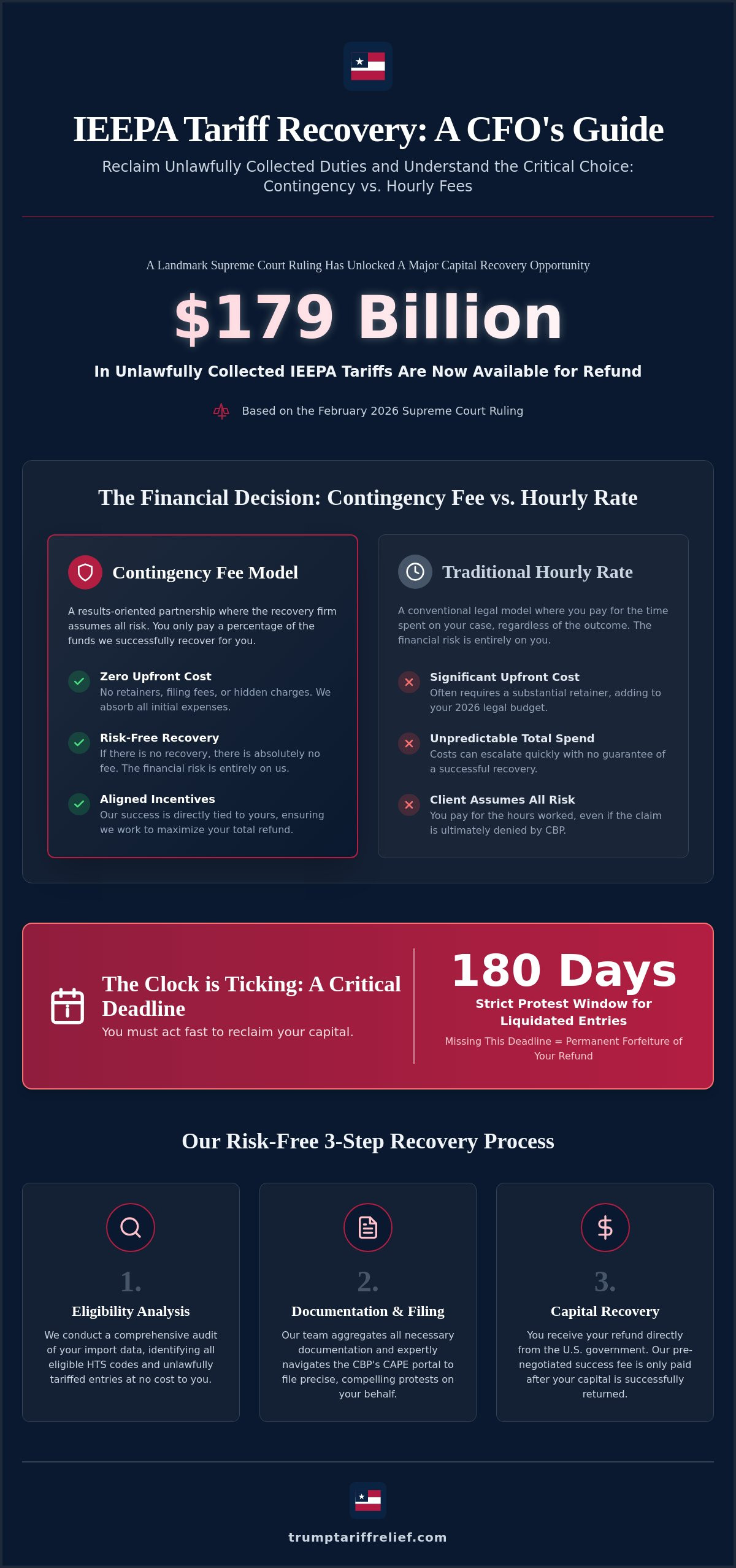
The U.S. government is currently holding up to $179 billion in unlawfully collected IEEPA tariffs, and for many CFOs, the immediate challenge is reclaiming that capital without escalating their legal spend. You've already seen significant liquidity tied up in duties that the Supreme Court's February 2026 ruling deemed illegal. Now, as the critical 180 day protest deadlines approach for liquidated entries, your firm faces a pivotal strategic choice regarding a contingency fee vs hourly rate for tariff recovery.
It's frustrating to watch your hard earned capital sit in a federal portal while your internal teams are already stretched thin by the administrative burden of customs audits. You're right to be cautious about throwing good money after bad by committing to unpredictable billable hours. This guide compares the financial risks and rewards of these two billing models to help you maximize your IEEPA tariff refund. We will examine how a results oriented partnership can navigate the CBP's new CAPE portal and secure your restoration with zero upfront cost and minimal operational disruption.
Key Takeaways
- Understand why the 2026 Supreme Court ruling transformed previously lost tariff expenses into immediate capital recovery opportunities for your balance sheet.
- Evaluate the financial impact of a contingency fee vs hourly rate for tariff recovery to determine which model best protects your firm from unnecessary legal risk.
- Discover how the contingency model shifts the entire administrative and financial burden of IEEPA filings onto external experts, ensuring a "no recovery, no fee" outcome.
- Learn the specific process for identifying eligible HTS codes and aggregating the necessary documentation for a successful CBP refund claim.
- Position your company to meet critical 180 day protest deadlines through specialized recovery services that prioritize speed and bureaucratic precision.
The IEEPA Recovery Opportunity: Why 2026 is a Critical Year
The financial landscape for U.S. importers shifted fundamentally on February 20, 2026. On that day, the Supreme Court issued a landmark 6-3 ruling that stripped the executive branch of its perceived authority to unilaterally impose tariffs under the International Emergency Economic Powers Act (IEEPA). This decision didn't just change future policy; it retroactively classified billions of dollars in collected duties as unlawful. For your business, what was once a "sunk cost" of doing business has been transformed into a recoverable asset waiting on your balance sheet. The challenge now is determining the most efficient path to reclamation, specifically weighing a contingency fee vs hourly rate for tariff recovery to ensure you aren't paying more to recover your money than necessary.
The Supreme Court and IEEPA
The core of the legal battle centered on whether the president could bypass Congress to implement trade barriers indefinitely. The Court ruled that while IEEPA grants broad powers during national emergencies, it does not provide a blank check for permanent taxation. This ruling effectively opened a massive refund window for tariffs collected between February 2025 and February 2026. The Penn Wharton Budget Model estimates the total pool of recoverable funds at approximately $175 billion. For a deeper look at the legal mechanics behind this victory, visit our IEEPA Explained page.
The 2026 Deadline Factor
Time is the greatest enemy of your recovery. On April 20, 2026, U.S. Customs and Border Protection (CBP) launched the Consolidated Administration and Processing of Entries (CAPE) portal to streamline claims, but the administrative hurdles remain steep. Importers must navigate a strict 180 day protest window for liquidated entries. If you miss this window, the law considers your right to a refund forfeited. When evaluating a contingency fee vs hourly rate for tariff recovery, you must consider which model provides the speed and specialized focus required to beat these clocks. Ultimately, the tariff refund statute of limitations is the most significant barrier to recovery. Every month of internal deliberation or slow legal drafting risks permanent forfeiture of your capital.
It is vital to distinguish between standard Section 301 duties and these specific IEEPA impacted tariffs. While Section 301 duties on many goods remain in place, the IEEPA "surcharges" applied to List 3 and List 4a goods are the primary targets for restoration. Many CFOs are now adopting a contingency fee model to fund these audits. This approach allows companies to aggressively pursue their refunds without adding a single dollar of "new" legal spend to the 2026 budget. You've already paid the government once; there's no reason to pay a law firm by the hour just to ask for it back.
Understanding the Contingency Fee Model for Tariff Recovery
The decision between a contingency fee vs hourly rate for tariff recovery often hinges on who carries the financial burden if a claim is denied. In a contingency arrangement, the recovery firm assumes 100% of the risk. This model adheres to the established rules governing contingency fees, where compensation is tied exclusively to a successful outcome. It creates a powerful incentive alignment; our team only profits when your company successfully reclaims its capital. This "righting a wrong" atmosphere ensures that every HTS code and entry summary is scrutinized with the same intensity you'd expect from an internal audit, but without the internal drain on resources.
Zero Upfront Costs Explained
Traditional legal engagements often require a significant retainer before the first document is even filed. Trump Tariff Relief operates on a different philosophy. We absorb all initial research expenses, data analysis costs, and filing fees associated with your IEEPA claim. This approach eliminates the need for a dedicated legal budget or complex internal CAPEX approvals. By removing these financial barriers, we allow mid-sized firms to access the same high-level trade expertise typically reserved for massive corporations with "Big Law" budgets. You can learn more about our streamlined process for risk-free recovery to see how we handle the heavy lifting.
The Mechanics of a Success Fee
A tariff refund success fee is a pre-negotiated percentage of recovered duties paid only upon successful government refund. This fee applies only to the final disbursement issued by the U.S. Treasury. Unlike hourly firms, we don't bill separately for administrative overhead, travel, or clerical work. If the government doesn't issue a check, you don't owe a cent. This transparency is codified in our engagement letters, ensuring that the "No Win, No Fee" promise is a contractual reality, not just a marketing slogan. It's a straightforward calculation that keeps your recovery off-balance-sheet until the moment the capital returns to your accounts.
Efficiency is the cornerstone of this partnership. Because our revenue is tied to your results, we prioritize speed and accuracy in every interaction with the CBP bureaucracy. This motivation is what separates a specialized consultancy from a general practice law firm, making the contingency fee vs hourly rate for tariff recovery debate a matter of strategic risk management. If you're ready to see how much capital your firm can reclaim without an upfront investment, you should start your preliminary eligibility assessment today. We handle the complexity so you can focus on running your business while we secure your restoration.
Contingency Fee vs. Hourly Rate: The Financial Comparison
Choosing a contingency fee vs hourly rate for tariff recovery isn't just a legal preference; it's a fundamental decision about risk allocation. When you hire a traditional firm on an hourly basis, your company assumes 100% of the financial downside. You pay for research, drafting, and administrative back-and-forth regardless of whether the U.S. Treasury ever sends a check. For the CFO, this turns a potential recovery into an unpredictable liability. In contrast, the contingency model allows you to treat the recovery as an off-balance-sheet asset. You only record the cost once the cash is in hand.
Traditional firms are paid for effort, while contingency firms are paid for results. This distinction becomes critical when facing multi-year CBP appeals. An hourly firm has no financial disincentive to prolong a case; the more complex the bureaucracy becomes, the more they bill. This creates the "billable hour trap." A "successful" recovery of $151,000, which is the average burden for many small businesses, might be entirely eclipsed by legal fees that reached six figures during the process. You shouldn't have to win the battle only to lose the recovery to your own counsel.
The Hidden Costs of Hourly Legal Teams
Beyond the hourly rate, traditional counsel often charges for "onboarding" and "learning the case" on your dime. They may lack the specialized trade-data infrastructure required to parse thousands of HTS codes across years of entry summaries. You might also face direct expenses like the $400 Court of International Trade filing fee and various administrative surcharges. With top-tier partners at major firms now billing as much as $4,000 per hour, a single month of intense litigation can drain your budget before a single dollar is recovered. These costs accumulate even if the claim is ultimately denied by the government.
The Contingency Advantage in Trade Law
Performance-based models prioritize speed of execution. Because our revenue depends on your check arriving, we have every reason to utilize our proprietary technology to file claims accurately and instantly. You gain access to specialized trade experts without the $1,500 per hour price tag common in general corporate law. This model democratizes trade justice. It allows you to fight for your refund with the same firepower as a Fortune 500 company without the upfront capital requirements. Check our How It Works page for a complete breakdown of our performance-based structure.
The decision between a contingency fee vs hourly rate for tariff recovery ultimately comes down to your tolerance for wasted capital. We take on the heavy lifting and the risk, projecting an image of competence and protective strength for your brand. By choosing a result-driven partner, you ensure that the primary beneficiary of the Supreme Court's ruling is your company, not your law firm. We value efficiency over fluff, ensuring that your path toward resolution is as streamlined as possible.
Evaluating Your Eligibility and Potential Recovery
Reclaiming your capital requires more than just a general understanding of the law; it demands a precise audit of every shipment that entered the country during the contested period. When weighing the contingency fee vs hourly rate for tariff recovery, the deciding factor for most CFOs is the complexity of this data audit. While an hourly firm might bill you for the weeks it takes to parse your records, a results-oriented partner uses specialized trade-data infrastructure to identify opportunities instantly. This process is methodical, moving from high-level code identification to the granular verification of every dollar paid.
- Step 1: Identifying HTS codes. We isolate the Harmonized Tariff Schedule (HTS) codes specifically impacted by the IEEPA legal challenge. This ensures you aren't wasting resources on non-refundable Section 301 duties.
- Step 2: Aggregating Entry Summaries. Your recovery lives within CBP Form 7501. We gather these historical documents to build a comprehensive map of your overpayments.
- Step 3: Calculating recovery value. We provide a transparent look at your potential gross refund compared to the net recovery after the success fee. This allows you to see the financial benefit of a contingency fee vs hourly rate for tariff recovery before committing to the filing.
- Step 4: Professional submission. Once the data is verified, we submit your claim for a specialized tariff refund assessment to ensure every requirement of the 2026 Supreme Court ruling is met.
The Role of Customs Documentation
Organized data is the difference between a fast refund and a government rejection. Since the launch of the CAPE portal on April 20, 2026, the CBP has tightened its standards for evidence. We manage the required documents for IEEPA tariff refund on your behalf, focusing specifically on Entry Type 01 (Consumption) and Entry Type 11 (Informal) classifications. If your documentation is categorized incorrectly, the portal may flag your claim for an audit, delaying your restoration by months or years. Our team ensures your data mapping is bulletproof before it ever hits a government server.
Common Pitfalls in Self-Filing
The most dangerous trap in the refund process is the strict 180 day protest window for liquidated entries. Missing this deadline by a single day results in the permanent forfeiture of your capital. Many internal teams attempt to self-file, only to realize their data mapping doesn't align with the CBP's new digital requirements. Professional verification ensures claims meet the rigorous standards of the latest trade court rulings. Without this specialized oversight, you risk triggering a broader customs audit rather than securing a refund. If you value efficiency over administrative fluff, you should start your claim assessment today to lock in your priority status before the next wave of deadlines passes.
Partnering with Trump Tariff Relief for Risk-Free Recovery
The administrative burden of customs bureaucracy shouldn't distract you from the core mission of your business. Our "We-Do-The-Work" philosophy is designed to act as an engine for your recovery, allowing your internal teams to remain focused on growth while we navigate the complexities of the CBP. We take on the heavy lifting; from the initial data scrub to the final defense of your claim. This partnership ensures that your path to restoration is paved by experts who understand that your time is just as valuable as the capital we are reclaiming. By choosing a result-driven ally, you convert a massive regulatory headache into a streamlined financial win.
It's vital to recognize that IEEPA recovery requires a different skillset than general customs brokerage. While your current broker is essential for ongoing compliance and daily entries, they aren't built for the high-stakes litigation and retroactive auditing required by the 2026 Supreme Court ruling. We function as a specialized advocate, using proprietary technology to parse years of data and identify the exact surcharges eligible for restoration. This specialized focus is why the debate over a contingency fee vs hourly rate for tariff recovery is so lopsided; our motivation is perfectly aligned with your success because we don't profit until you do.
The Trump Tariff Relief Difference
We've developed proven strategies specifically for manufacturing, retail, and technology importers who were hit hardest by the 2025-2026 surcharges. Our partnership is built on shared success, not billable hours or open-ended retainers. You gain direct access to trade experts who navigate the CAPE portal and communicate with CBP officials daily. We don't just file paperwork; we build a bulletproof case for your refund, ensuring that your company stands at the front of the line as the government continues to distribute the billions in remaining unlawfully collected funds. It's a low-risk, high-reward model that prioritizes your balance sheet over our billable clock.
Initiate Your Free Assessment
Reclaiming your capital doesn't require a massive upfront investment or a months-long feasibility study. You can start the process in under five minutes with zero financial commitment. During your preliminary eligibility consultation, our team will review your HTS codes and entry volumes to provide a clear estimate of your potential restoration. We value transparency and efficiency, giving you a "no-nonsense" look at your recovery options before any contracts are signed. This is the smartest way to manage the contingency fee vs hourly rate for tariff recovery decision; you get the expertise without the invoice. Don't let the 2026 window close on your capital. Reclaim your capital with a risk-free assessment today.
Secure Your Recovery Before the 2026 Deadlines Pass
The window to reclaim your capital is narrowing, and the strategic choice between a contingency fee vs hourly rate for tariff recovery will define the success of your 2026 balance sheet. You've seen how the Supreme Court's ruling turned illegal duties into recoverable assets, but without swift action, these funds will remain in government accounts forever. Traditional hourly firms demand budget for effort; however, our model demands results for payment.
We act as your expert-led IEEPA recovery specialists, absorbing all documentation and filing costs so you face zero upfront financial risk. Our partnership ensures that you only pay if we win, shifting the entire bureaucratic burden from your internal team to our seasoned trade advocates. It's time to restore what's rightfully yours and turn these regulatory overcharges back into working capital. Get a Free Tariff Eligibility Assessment and take the first step toward a risk-free restoration today. You've already paid the government once. Let's make sure you don't pay again just to get your own money back.
Frequently Asked Questions
What exactly is a tariff refund success fee?
A tariff refund success fee is a pre-negotiated percentage of the actual capital recovered from the U.S. Treasury. It's the core component of the contingency fee vs hourly rate for tariff recovery debate because it ensures the consultant is only paid after you receive your refund. This model eliminates the risk of paying for legal effort that doesn't result in a check. Administrative costs and filing fees are typically absorbed by the recovery firm.
Is the IEEPA tariff refund program legitimate?
The recovery of IEEPA tariffs is a legitimate administrative process mandated by the Supreme Court's February 20, 2026 decision. This ruling deemed specific surcharges collected between 2025 and 2026 unlawful. To facilitate these claims, U.S. Customs and Border Protection launched the CAPE portal on April 20, 2026. It's a formal legal path to financial restoration, not a discretionary rebate or a temporary tax loophole.
How much can my business expect to recover in 2026?
Your recovery amount depends entirely on the volume of List 3 and List 4a goods imported during the contested period. While individual results vary, research indicates that small businesses paid an average of over $151,000 in these specific duties. With the total pool of recoverable capital estimated at up to $179 billion, many CFOs find that these "sunk costs" represent a significant and immediate injection of liquidity.
What happens if my tariff refund claim is denied?
If your claim is denied, you owe nothing under a contingency-based agreement. This is the primary advantage of a contingency fee vs hourly rate for tariff recovery; the specialist firm absorbs all research, data mapping, and filing expenses. You don't risk throwing good money after bad on legal fees for an unsuccessful protest. This structure places the entire financial burden of failure on the experts, not your balance sheet.
How long does the IEEPA recovery process typically take?
The timeline for recovery varies based on whether your entries are liquidated or unliquidated. The government has moved aggressively since the February ruling, issuing $81 billion in refunds as of July 14, 2026. While some claims are processed through the CAPE portal in a few months, complex cases involving formal protests can take longer. We prioritize efficient data mapping to ensure your capital returns as quickly as possible.
Can I file for a tariff refund if my company is small or mid-sized?
Small and mid-sized importers are fully eligible and often have the most to gain from these refunds. You don't need a massive internal legal department to navigate the IEEPA process. A contingency partnership democratizes access to elite trade expertise, allowing your firm to challenge CBP decisions without the upfront cost of a traditional law firm. If you paid the duties, you have a right to the restoration.
What documents are required to start a success-fee based claim?
The primary document required is the CBP Form 7501, also known as the Entry Summary. We also need your specific HTS codes and entry dates to verify eligibility under the Supreme Court ruling. Our team handles the heavy lifting of aggregating this data from your records or your broker. Providing these documents allows for a precise calculation of your potential gross refund and your net recovery after the success fee.
Is there a deadline for filing an IEEPA tariff refund claim?
Strict deadlines apply to every claim. For liquidated entries, you must file a protest within 180 days of the liquidation date. Unliquidated entries typically allow for a Post-Summary Correction within 300 days of the entry date. Given that many 2025 entries reached their 180 day limit in June and July of 2026, the need for immediate filing is critical to avoid the permanent forfeiture of your capital.
Ready to find out what your business may be owed?
Check My Eligibility