The Department of Justice's May 29, 2026 motion has effectively ended the hope for automatic, universal refunds for IEEPA tariffs. While many importers wait for a passive payout, current data reveals that CBP is rejecting between 15% and 19% of claims. Understanding the common reasons for ieepa refund denial is no longer a simple compliance exercise; it's a critical financial necessity. If your business remains on the sidelines, you're risking your portion of the estimated $166 billion the government owes to trade partners.
You've likely felt the frustration of watching liquidated entries get caught in a bureaucratic stalemate while the government fights to retain your capital. It's a complex, high-stakes environment where waiting for a universal settlement could cost your business millions in lost recovery. This article will explain how the government appeal impacts your specific eligibility and why proactive action is the only path to securing your maximum refund. We'll examine the distinction between liquidated and unliquidated entries, the implications of the Learning Resources ruling, and the clear timeline for restoring your capital before the recovery window closes on February 3, 2027.
Key Takeaways
- Understand how the DOJ appeal of the universal injunction has shifted the burden of action onto importers, making active litigation a requirement for many.
- Distinguish between unliquidated and liquidated entries to identify which portions of your tariff recovery are at the highest risk of being blocked.
- Learn how to navigate the most common reasons for ieepa refund denial by performing a rigorous documentation audit before the filing window closes.
- Identify the critical legal deadlines through February 2027 that dictate when your window for capital restoration will permanently expire.
- Discover how to leverage a contingency-based recovery model to manage complex CIT filings and CBP documentation without incurring upfront legal costs.
Understanding the DOJ Appeal of the Universal IEEPA Refund Order
The IEEPA refund appeal is a strategic legal move designed to prevent billions in automatic payouts to non-litigant importers. Following the Supreme Court’s landmark ruling in Learning Resources, Inc. v. Trump on February 20, 2026, the Department of Justice (DOJ) moved quickly to protect federal reserves. On May 29, 2026, the DOJ filed a motion to limit the Court of International Trade’s (CIT) universal injunction, arguing that the government shouldn't be forced to issue automatic refunds to companies that never filed their own individual lawsuits. This appeal effectively halts the momentum of universal restoration, forcing businesses to prove their eligibility through active participation rather than passive waiting.
The Universal Injunction vs. Importer-Specific Orders
The CIT originally issued a mandate requiring U.S. Customs and Border Protection (CBP) to refund all duties collected under the International Emergency Economic Powers Act (IEEPA). However, the DOJ’s counter-argument is built on a technicality of administrative law: they claim CBP lacks the authority to reliquidate entries that are already "final" without a specific court order for each importer. This distinction has created a two-tiered system for American businesses. Those who joined the litigation early are seeing their claims validated, while others are discovering that a lack of individual court standing is one of the most common reasons for ieepa refund denial in the current landscape. If your entries have already liquidated, the government is betting that you won't take the legal steps necessary to reopen them.
The Billions at Stake in the Appeal
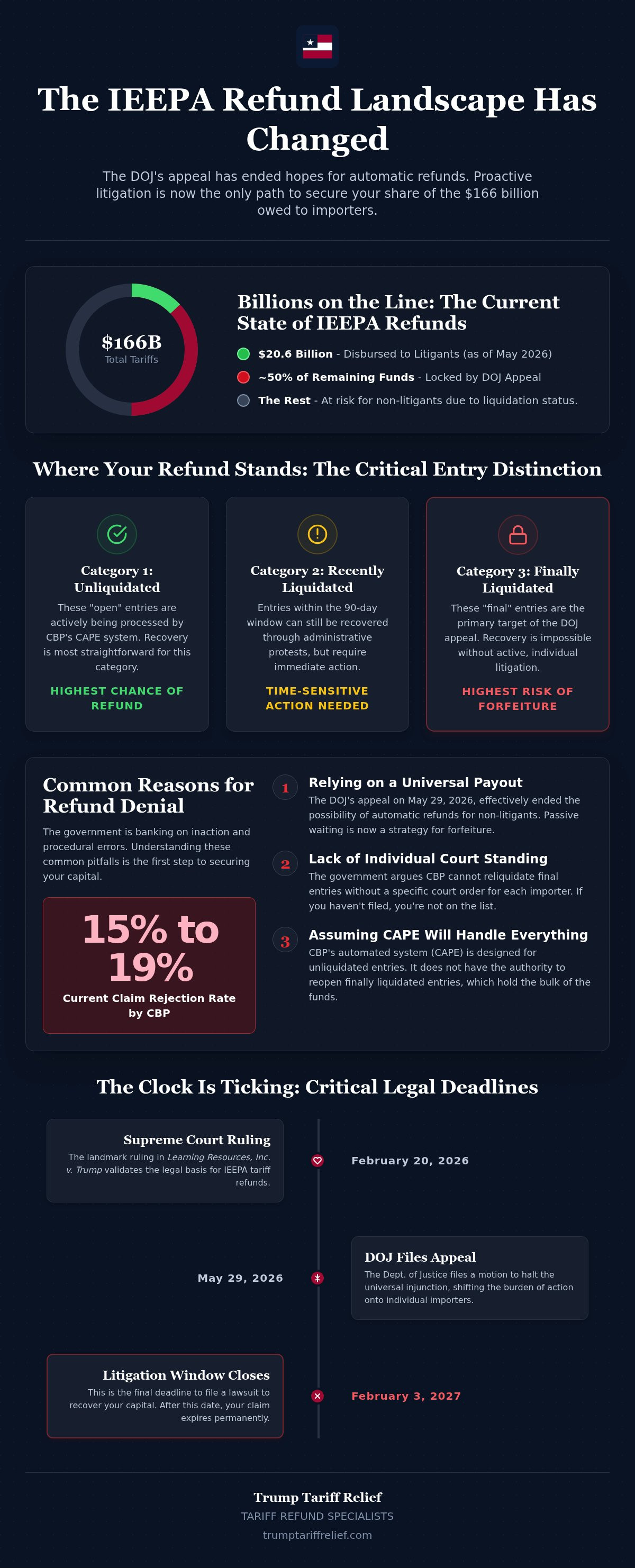
The scale of this recovery is unprecedented, with an estimated $166 billion in total IEEPA tariffs collected since the program began. While CBP has disbursed approximately $20.6 billion as of May 2026, nearly half of the remaining funds are currently locked behind this appeal process. The government is incentivized to delay; every claim that isn't filed before the February 2027 litigation deadline is money they get to keep. You can learn more about the IEEPA ruling and how it impacts your specific industry, but the core reality remains the same: the DOJ's appeal has turned a "universal" win into a targeted legal battle. Failing to account for these shifting legal requirements is among the common reasons for ieepa refund denial that catch importers off guard, resulting in millions of dollars in lost capital for those who don't act before the window closes.
Liquidated vs. Unliquidated Entries: Where Your Refund Stands
Liquidation is the point of no return in customs administration. It's the moment U.S. Customs and Border Protection (CBP) officially closes the books on an import entry, making the assessment of duties final and binding. For importers seeking recovery, your path to a refund depends entirely on where your entries sit within the liquidation timeline. As the government moves to protect its coffers, the distinction between these categories has become the primary filter for eligibility.
Your IEEPA refund claims generally fall into one of three distinct categories:
- Category 1: Unliquidated Entries. These are "open" entries where the final duty has not yet been set. They are the primary focus of current processing efforts.
- Category 2: Recently Liquidated. Entries within the 90 day voluntary reliquidation window are still reachable through administrative protests.
- Category 3: Finally Liquidated. These entries are "final" in the eyes of the law. They represent the largest portion of the $166 billion owed and are the central target of the DOJ's appeal.
The CAPE System and Automatic Processing
CBP launched the Customs Automated Processing Environment (CAPE) to manage the massive influx of refund declarations. While Phase 1 of CAPE has validated nearly 69% of claims, it's designed to handle the "low hanging fruit" of unliquidated entries. Relying on this automated system to catch older imports is one of the most common reasons for ieepa refund denial. CAPE does not possess the inherent authority to reopen finally liquidated entries. If you assume the government will eventually find and fix these older records for you, you're likely to be disappointed. Proactive intervention is the only way to ensure these entries aren't permanently excluded from the recovery pool.
Why Finally Liquidated is the New Legal Battleground
The government uses "finality" as a legal shield. Under the International Emergency Economic Powers Act, the executive branch exercised broad authority to impose these tariffs, but now the DOJ argues that CBP cannot reliquidate final entries without a specific, individual court order. This creates a high barrier for non-litigants. The current appeal seeks to stay refunds for anyone in this category who hasn't filed a suit. Failing to recognize that your liquidated entries require a different legal strategy is another of the common reasons for ieepa refund denial that we see. To protect your capital, you must understand how it works when moving from administrative claims to formal litigation before the February 2027 deadline.
The Risk of Inaction: Why Universal Refunds Are No Longer Guaranteed
The most dangerous assumption an importer can make is that the court's ruling guarantees an automatic check in the mail. While the Supreme Court's decision in Learning Resources was a massive victory, it's not a self-executing payout. If you're waiting for a universal settlement, you're falling into a procedural trap. The DOJ's current appeal isn't just about the legality of the tariffs; it's a strategic attempt to limit who actually gets paid. By contesting the universal nature of the injunction, the government is effectively filtering out passive businesses. This passivity has become one of the most common reasons for ieepa refund denial, as companies fail to recognize that their right to capital restoration is tied to their status as an active litigant.
There's a significant risk that the DOJ will win a "stay" on the current refund order. If granted, this stay would halt all disbursements for years while the appeal winds through the higher courts. Historically, the government uses these pauses to let claims expire. Non-litigants are the most vulnerable here. Even if a stay is issued, those with active filings in the Court of International Trade (CIT) may be exempt, allowing their recovery to proceed while others are frozen. You must understand the tariff refund statute of limitations: Don’t miss the deadline, because once that window shuts, no court ruling can reopen it.
The Two-Year Statute of Limitations
Under 28 U.S.C. § 2636, importers have a strict two-year window to file suit. For many IEEPA claims, the clock began ticking the moment the duties were paid or liquidated. This means that waiting for the DOJ appeal to conclude is a terminal strategy. If the appeal takes three years and your statute of limitations expires in two, you've lost your right to recover even if the government eventually loses the case. The statute of limitations is an absolute bar to recovery regardless of the appeal’s outcome. Missing this hard deadline is among the common reasons for ieepa refund denial that no amount of legal expertise can fix after the fact.
The DOJ’s Strategy of Exhaustion
The government isn't just fighting the law; they're fighting the clock. By leveraging procedural delays and filing for stays, they're counting on "exhaustion" to reduce the total $166 billion payout pool. Passive importers are essentially self-disqualifying by not filing formal actions. Every month your capital remains in the government's hands is a month of lost opportunity costs and unrecovered interest. Acting now isn't just about legal compliance; it's about reclaiming the liquidity your business needs to remain competitive in a high-stakes trade environment.
Common Reasons for IEEPA Refund Denial and How to Avoid Them
Technicalities and clerical errors are the primary weapons used by the government to keep your capital. With CBP rejection rates currently sitting between 15% and 19%, your documentation must be flawless to survive the review process. Missing documentation, incorrect HTS codes, and missed filing deadlines are the most common reasons for ieepa refund denial. To protect your business from these avoidable setbacks, you need a systematic approach to recovery that addresses the specific requirements of the CAPE system and the Court of International Trade.
To secure your recovery, follow this four step protocol:
- Step 1: Conduct an immediate audit of all IEEPA tariffs paid since 2018 to identify every eligible entry.
- Step 2: Segregate entries by liquidation status to identify which capital is at risk of being blocked by the DOJ appeal.
- Step 3: Secure all necessary customs documentation, specifically your CBP Form 7501 and Form 301.
- Step 4: Engage a specialist to file a protective suit or formal protest before your specific statute of limitations expires.
By taking these steps, you move from a passive observer to an active claimant. You can see how the recovery process works in detail to ensure your internal team is aligned with these requirements.
Gathering the Necessary Evidence
Your CBP Form 7501, or Entry Summary, is the foundational document for any recovery claim. It provides the definitive proof of the duties paid and the specific HTS codes used. If you don't have these records on hand, you must act quickly. Many customs brokers purge their digital and physical records after five years, meaning data for 2018 and 2019 imports is already disappearing. Incomplete entry data is one of the common reasons for ieepa refund denial that effectively ends a claim before it reaches a judge. Use our required documents for IEEPA tariff refund checklist to audit your files today.
Filing a Protective CIT Action
A protective filing in the Court of International Trade is the only way to stop the statute of limitations clock. While a protest can address recent entries, a formal summons in the CIT is necessary for finally liquidated entries. This legal action creates an individual claim that exists independently of the DOJ’s broader appeal. If the government wins a stay on universal refunds, importers with active litigation remain in a much stronger position to receive their payouts. Individual litigation is the only appeal-proof way to secure a refund order that the government cannot easily ignore. To begin your recovery without the burden of upfront legal fees, you should partner with a contingency-based specialist who manages the administrative heavy lifting for you.
Navigating the IEEPA Appeal with a Contingency-Based Partner
Mastering the labyrinth of federal trade law requires more than just awareness; it demands a dedicated engine for recovery. Trump Tariff Relief assumes the entire administrative and legal burden on your behalf, ensuring you remain the beneficiary while we handle the heavy lifting. We understand that technical errors and filing mistakes are among the common reasons for ieepa refund denial, which is why our specialists manage every detail of the CIT filing and CBP documentation process. By positioning ourselves as your high-performing ally, we remove the friction of bureaucracy and provide a direct path to the capital the government has unlawfully withheld.
Why Contingency is the Superior Strategy for Tariff Recovery
Traditional legal models often require mid-sized importers to drain their remaining liquidity on hourly billing before a single dollar is recovered. This creates a significant financial barrier to entry, effectively pricing many businesses out of the justice they deserve. Our No Recovery, No Fee promise flips this dynamic. Since our success is directly aligned with your refund, we're motivated to maximize the total recovery amount rather than simply clocking billable hours. We take on the financial risk, allowing you to pursue finally liquidated entries that might otherwise be abandoned due to high legal costs. This partnership ensures that professional guidance is accessible to every eligible importer, regardless of their current cash flow.
Your Path to Capital Restoration
Restoration begins with a precise calculation of your total exposure. Our team of trade experts navigates the CIT and CBP systems daily, identifying opportunities that standard customs brokers often overlook. Given that nearly half of the $166 billion in collected duties is currently contested by the DOJ appeal, the window for action is narrow. We provide a comprehensive eligibility assessment to determine your potential for recovery before the next procedural milestone or the February 2027 litigation deadline. Don't let administrative complexity become one of the common reasons for ieepa refund denial for your firm. You can get your free IEEPA refund assessment today to secure your place in the recovery pool and begin the process of financial restoration.
Secure Your Capital Before the DOJ Appeal Finalizes
The DOJ's strategic appeal has transformed the IEEPA refund landscape from a universal mandate into a targeted legal battle. Waiting for a passive payout is no longer a viable business strategy, especially for finally liquidated entries that the government is fighting to protect. By understanding the common reasons for ieepa refund denial, such as missing documentation and expired statutes of limitation, you can take the necessary steps to safeguard your recovery. Proactive litigation is the only certain path to ensuring your business isn't left behind when the final window for capital restoration shuts on February 3, 2027.
Don't let government bureaucracy or high legal fees block your path to financial restoration. Our contingency-based recovery model provides expert CIT litigation management and no-risk eligibility verification, moving the heavy lifting off your desk. We're committed to righting this wrong and returning the capital your business needs to thrive. Secure your IEEPA refund assessment now and take the first step toward reclaiming what's yours. It's time to turn these regulatory challenges into a significant financial victory for your company.
Frequently Asked Questions
What is the current status of the IEEPA refund appeal?
The DOJ filed a motion on May 29, 2026, to appeal the universal injunction originally granted by the Court of International Trade. This legal maneuver seeks to prevent U.S. Customs and Border Protection from being forced to issue automatic refunds to all importers. Currently, the government is focusing on limiting payouts specifically for finally liquidated entries, making individual legal standing a critical requirement for capital recovery.
Does the appeal mean I won’t get my refund automatically?
No, the era of universal, automatic refunds has effectively ended with the DOJ’s appeal. While the court initially ordered broad relief, the government now argues that only importers who have filed specific lawsuits or formal protests are eligible for reliquidation. Failing to file an individual claim is one of the most common reasons for ieepa refund denial, as passive importers are being excluded from current disbursement phases.
How long do I have to file a claim for IEEPA tariffs?
Importers must navigate two critical windows. First, only duties paid between February 1, 2025, and February 23, 2026, qualify for recovery. Second, the hard deadline to begin litigation in the Court of International Trade is February 3, 2027. If you miss this date, your right to recover these funds expires permanently, regardless of the eventual outcome of the government's broader appeal process or any future court rulings.
What is the difference between liquidated and unliquidated entries?
Unliquidated entries are those where the final duty assessment hasn't been completed by Customs; these are currently the easiest to recover via the CAPE system. Liquidated entries are finalized transactions where the books are closed. The DOJ appeal specifically targets these finalized entries, arguing that they cannot be reopened without a court order, which is why liquidated capital requires more aggressive legal intervention to unlock the stuck funds.
Can I still recover tariffs if my customs broker no longer has the records?
Yes, recovery is still possible even if your broker has purged their records. While many brokers delete data after five years, we specialize in customs documentation management to help retrieve or reconstruct necessary entry summaries. Identifying missing data early is vital because incomplete records are among the common reasons for ieepa refund denial that can halt your recovery before it even begins or reaches a judge's desk.
What happens if the government wins the IEEPA appeal?
If the DOJ's appeal is successful, it could permanently bar non-litigants from recovering duties on finally liquidated entries. The government would likely only be required to pay companies that had active, individual cases pending in court. This outcome would effectively lock billions of dollars in federal reserves, leaving passive importers with no legal recourse to reclaim their unlawfully paid tariffs. Taking action now protects your business against this specific outcome.
Is there any upfront cost to file an IEEPA refund claim with Trump Tariff Relief?
There are absolutely no upfront costs when you partner with Trump Tariff Relief. We operate strictly on a contingency fee basis, which means we only receive a percentage of the refund if we successfully recover your capital. This model removes the financial risk of high hourly legal fees and ensures that our team of trade experts is fully motivated to maximize your total recovery amount through the entire process.
How much money is typically recovered in an IEEPA refund suit?
The total amount recovered depends entirely on the volume of IEEPA duties your business paid during the eligible window. With a total federal debt of $166 billion owed to importers, individual recoveries can range from tens of thousands to several million dollars. We provide a no-risk eligibility assessment to determine your specific recovery potential and identify all qualifying entries before you commit to the formal filing or litigation process.
Ready to find out what your business may be owed?
Check My Eligibility