
Over $128 billion in IEEPA tariff refunds are currently available for recovery, but for many businesses, the path to reclaiming that capital feels like a minefield of technical barriers. You're likely feeling the pressure of the 2026 deadlines while trying to decode complex CBP jargon like CAPE declarations and ACE portal requirements. It's exhausting to manage your daily operations while worrying that a single clerical mistake could disqualify your claim. Utilizing a professional managed tariff refund process isn't just about convenience; it's about ensuring your business doesn't leave millions on the table due to administrative friction or missed windows.
We understand that the shift to digital, automated systems can feel more like a hurdle than a help, especially with the constant threat of filing scams and evolving phase requirements. This guide is designed to cut through the noise and provide you with a definitive roadmap for IEEPA recovery in 2026. You'll learn exactly how the phased rollout affects your specific entries and how to secure your electronic payments through the ACH system. By the end of this article, you'll have the confidence to move forward with a strategy that removes the heavy lifting from your internal teams and puts your capital back where it belongs.
Key Takeaways
- Understand the legal mechanism behind IEEPA recovery and why recent court rulings have unlocked a multi-billion dollar restoration window for importers.
- Learn how a professional managed tariff refund process streamlines ACE portal filings and ensures your CAPE declarations are technically compliant.
- Identify the essential documentation, including precise HTS codes and entry numbers, required to successfully navigate a CBP refund audit.
- Master the 2026 timeline and the strict three-year statute of limitations that governs your eligibility for capital recovery.
- Discover how to delegate the complexities of customs documentation management to expert advocates, allowing your team to focus on core operations.
What is the IEEPA Tariff Refund Process?
The IEEPA refund process is the official mechanism for importers to reclaim duties paid under specific trade remedies. It functions as a federal capital recovery opportunity for US-based importers in 2026, providing a direct path to restore liquidity lost to unlawful tariff impositions. For businesses in high-volume sectors like manufacturing, retail, and technology, this managed tariff refund process addresses the billions of dollars paid in Section 301 List 3 and 4A duties. These specific categories were identified as having been implemented without proper administrative adherence, creating a legal obligation for the government to return the funds to the rightful owners.
The Legal Catalyst for Refunds
This recovery window didn't open by accident. It's the result of landmark litigation in the U.S. Court of International Trade and the Supreme Court, which challenged the executive branch's use of the International Emergency Economic Powers Act (IEEPA). The courts found that the government exceeded its authority when it expanded tariffs beyond initial timelines. Unlike standard duty drawbacks, which rely on the export of goods to trigger a refund, IEEPA recovery is based on the inherent illegality of the initial tax. It's a restoration of rights rather than an incentive program. You can find more details in our IEEPA Explained resource to see how these specific legal precedents impact your current eligibility status.
Why the CBP is Involved
While the courts mandated the return of these funds, the U.S. Customs and Border Protection (CBP) acts as the administrative engine. They don't just hand out checks; they require a rigorous, technical filing to validate every claim against their database. CBP uses the Consolidated Administration and Processing of Entries (CAPE) system to manage these requests across all U.S. ports of entry. This means every entry must be matched against historical data and submitted through the ACE portal. Because the CBP requires precise CAPE Declarations, a professional managed tariff refund process is often the only way to ensure entries aren't rejected for technicalities. It's a national program, but the burden of proof rests entirely on the importer to demonstrate that their specific entries fall under the court's protection. With approximately $128 billion in anticipated refunds as of 2026, the administrative scrutiny for each filing is understandably intense.
The Official CBP Step-by-Step Filing Process
Recovering your capital requires more than just submitting a request. It's a rigid, multi-stage operation within the Automated Commercial Environment (ACE). The official CBP roadmap involves five distinct phases that leave no room for error. First, you must execute an exhaustive search of your historical data to isolate eligible entries. Second, you must access the ACE portal to prepare the necessary documentation. Third, you'll file a CAPE Declaration for each eligible group. Fourth, your team must monitor the CSMS for validation status or requests for information. Finally, you'll receive and reconcile the validated refund check from the U.S. Treasury. Utilizing a managed tariff refund process ensures that instead of filing thousands of individual protests, you're submitting a unified claim for validation that meets every technical requirement.
Navigating the ACE Portal and CAPE Declarations
A CAPE Declaration is essentially your business's formal demand for restoration. Think of it as a bulk reconciliation tool that groups your eligible entries into a single, actionable filing. For the Trade Account Owner (TAO), the responsibility is immense. The TAO must ensure that every data point matches CBP records exactly. Any discrepancy in entry numbers or dates leads to an immediate, automated rejection. Unlike other customs processes, there's often no recourse for simple clerical errors made during the initial submission. This high-stakes environment is why many importers prefer delegating the technical filing to specialized experts who understand the managed tariff refund process inside and out.
Post-Filing: Validation and Issuance
Filing is only half the battle. Once your CAPE Declaration is in the system, you must monitor the Customs Systems Messaging Service (CSMS) for status updates. In 2026, valid refunds are generally issued via ACH within 60 to 90 days of declaration acceptance. However, don't mistake "validated" for "guaranteed." CBP maintains the right to audit these claims even after the funds hit your account. It's vital to distinguish these from other trade actions, which is why Simplifying the CBP Process with Trump Tariff Relief focuses specifically on the IEEPA-specific recovery rules that differ from standard Section 301 duties. CBP handles reconciliation in phases, meaning entries flagged for reconciliation or those involving antidumping duties may face longer scrutiny.
The final stage is the reconciliation of the U.S. Treasury check. You must verify that the refund includes the correct interest, calculated from the date the duty was originally paid. If you're concerned about the technical burden of the ACE portal or the risk of an audit, consider a preliminary eligibility assessment to see how much capital you're actually owed before the 2026 windows close.
Critical Documentation for Successful CBP Claims
Success in the CBP process depends entirely on the integrity of your underlying customs documentation. If your data is fragmented, your claim is dead on arrival. CBP's automated validation systems require precise entry numbers, dates of importation, and the exact HTS codes used during the initial entry. In 2026, incomplete or mismatched data remains the primary reason CBP denies IEEPA refund requests. A managed tariff refund process acts as a filter; it ensures every data point is scrubbed for accuracy before it ever hits the ACE portal.
Essential Evidence Checklist
Your recovery project is only as strong as its paper trail. To survive a CBP audit or a CAPE validation check, you must provide a comprehensive evidence package for every entry. This isn't just about showing you imported goods; it's about proving you paid the unlawful surcharge. You should review our frequently asked questions for specific formatting requirements. The mandatory items include:
- Entry Summary (CBP Form 7501): This is the foundational document that identifies the duty paid and the HTS classification.
- Commercial Invoices and Packing Lists: These verify the nature of the goods and the transaction value.
- Proof of Duty Payment: CBP will not issue an ACH refund without verified evidence that the funds were actually settled with the Treasury.
Importers should archive these records for at least five years to protect against post-issuance audits. If you can't produce a clean 7501 form today, you'll struggle to win your recovery tomorrow.
Verifying Claim Legitimacy
The scale of the $128 billion recovery pool has unfortunately attracted bad actors. CBP has issued multiple warnings regarding fraudsters and phishing scams targeting importers with "guaranteed" refund offers. Identifying a legitimate recovery partner requires looking for transparency and expertise rather than high-pressure sales tactics. A trustworthy firm will never ask for upfront consulting fees; they operate on a contingency basis where their success is tied directly to your check. You can see how a professional managed tariff refund process identifies legitimate opportunities through a preliminary assessment. If a provider cannot explain the specific legal distinction between IEEPA and Section 301, they likely lack the trade-legal expertise required for this high-stakes capital recovery.
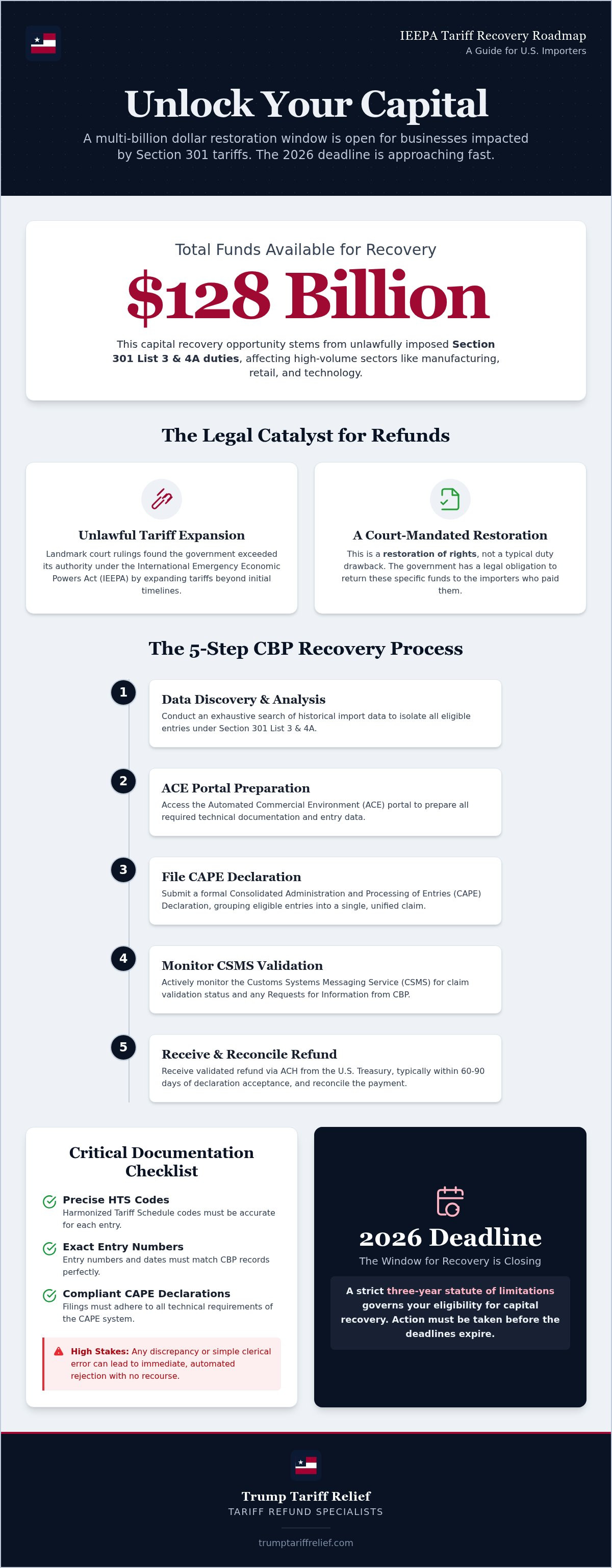
Deadlines and the 2026 Statute of Limitations
The clock is ticking on your right to reclaim capital. The window for IEEPA tariff recovery is governed by a strict Tariff Refund Statute of Limitations that leaves no room for procrastination. For the vast majority of importers, the three-year window from the date of liquidation is the critical threshold. If you miss this date, your legal right to the refund expires permanently. Wait-and-see strategies don't just delay your recovery; they often result in the total loss of reclaimable capital. Engaging a managed tariff refund process early ensures your entries are flagged and filed before these legal barriers shut the door on your restoration.
Calculating Your Filing Window
Many business owners confuse the Date of Entry with the Date of Liquidation. While the entry date is when your goods arrived, the liquidation date is when CBP finalizes the duty assessment. Usually, this happens about 314 days after entry, but it can be extended for years. To know if you're still eligible, check your records for any entries dated between 2021 and 2024. If your liquidation occurred within the last 36 months, you're in the "green zone" for filing. If you're approaching that three-year mark, you need to act now. Once that 1,095-day clock runs out, the Treasury keeps your money regardless of how unlawful the initial tariff was. Don't assume your broker has this handled; many standard brokerage agreements don't cover historical IEEPA audits.
Why 2026 is the Decisive Year
We are currently at the peak of the recovery cycle. The volume of eligible claims is reaching its highest point in 2026 as more companies realize they've been overcharged. This surge has a direct impact on the CBP administrative arm. As more businesses file CAPE Declarations, the processing queues within the ACE portal are lengthening. Late filers risk being caught in massive administrative backlogs that could delay payments well beyond the standard 90-day window. A managed tariff refund process bypasses the common errors that cause manual reviews, keeping your claim in the fast lane. The Treasury's interest payments are also a factor, but they only matter if your claim is filed before the statute expires. Don't let your capital get stuck behind a wave of late-stage filings.
The complexity of these timelines is exactly why businesses are moving away from DIY filing. You need to secure your place in the queue before the 2026 deadlines pass. Request a preliminary assessment today to confirm your remaining eligibility window and protect your right to recovery.
Simplifying the CBP Process with Trump Tariff Relief
Trump Tariff Relief removes the technical and legal burden of the CBP process, transforming a high-stakes administrative obstacle into a predictable restoration of your capital. We act as your specialized advocate within the trade-legal ecosystem, managing the entire lifecycle of your claim from the initial audit to the final electronic payment. By deploying a professional managed tariff refund process, your business avoids the common pitfalls that lead to automated rejections in the ACE portal. We don't just file paperwork; we provide a comprehensive engine for capital recovery that prioritizes your bottom line.
The Managed Recovery Advantage
The DIY approach in the ACE portal is fraught with risk. If you attempt to navigate CAPE declarations without deep specialized knowledge, you're likely to overlook eligible entries or trigger an audit with mismatched data. Our trade experts possess the "insider" perspective required to identify every reclaimable dollar, including entries that standard brokerage software often misses. When CBP issues a Request for Information (RFI), our team handles the response directly, ensuring that technical inquiries don't stall your progress. You can see the full breakdown of our methodology by reviewing how it works to understand the depth of our documentation management.
Efficiency is our primary metric. While an internal team might spend months decoding CBP technical jargon, our experts move with the speed and precision required to meet the 2026 deadlines. We categorize your entries, validate your HTS codes, and manage the CAPE system on your behalf, allowing your staff to focus on core operations rather than historical customs audits. This partnership shifts the burden of proof from your shoulders to ours, ensuring that your recovery is handled by a steady, experienced hand. If you haven't yet audited your 2021 through 2024 entries, you're likely sitting on significant dormant capital.
Start Your Zero-Risk Assessment
Our partnership is built on a foundation of total transparency and shared success. We operate on a contingency-fee model, which means we only get paid when you receive your validated refund check from the U.S. Treasury. This "no success, no fee" structure removes all financial barriers to entry, making the decision to pursue your IEEPA restoration entirely risk-free. If there's no refund, there's no cost to your business. This alignment of interests ensures that we're highly motivated to maximize your claim amount while maintaining the highest standards of legal compliance.
The 2026 windows are closing, and the administrative queues at CBP are only getting longer. You don't have to navigate this landscape alone. We invite you to start with a preliminary eligibility check to see exactly which of your entries qualify for restoration under the current court mandates. It's a straightforward process designed to give you immediate clarity on your potential recovery. Reclaim your capital today with Trump Tariff Relief and let our experts handle the heavy lifting of your IEEPA recovery.
Secure Your Restoration Before the 2026 Window Closes
The path to reclaiming your capital is legally clear but administratively complex. With over $128 billion in anticipated refunds, the government is prepared to restore what was unlawfully taken, provided your documentation survives the scrutiny of the CAPE validation system. The three-year statute of limitations is a non-negotiable barrier; waiting even a few weeks could mean the permanent forfeiture of your restoration rights. You've paid the price for these unlawful duties, and now the window to right that wrong is rapidly narrowing.
Implementing a managed tariff refund process is the most effective way to bypass the technical friction of the ACE portal and secure your electronic payment without internal strain. Trump Tariff Relief offers a partnership built on professional strength and shared success. We provide expert-led documentation management and direct navigation of the CBP system on a contingency-fee basis. You don't pay a cent unless we win your recovery. It's time to reclaim your capital and put those funds back into your growth strategies.
Get a Free IEEPA Eligibility Assessment today to confirm your status and protect your business's bottom line. You've already done the hard work of building your business; let us handle the heavy lifting of your recovery. Your restoration is waiting.
Frequently Asked Questions
Is the IEEPA tariff refund process legitimate?
The IEEPA refund process is a court-mandated federal program resulting from a Supreme Court decision that found certain tariffs unlawful. It's a legitimate capital restoration mechanism managed by U.S. Customs and Border Protection. As of August 4, 2026, the government has already issued approximately $100 billion in refunds to eligible importers. While the process is real, businesses should always verify partners to avoid phishing scams targeting trade data.
How long does it take for CBP to process a tariff refund?
Valid refunds are generally issued within 60 to 90 days after CBP accepts your CAPE Declaration. This timeline depends on the accuracy of your data and whether your entries require additional manual review. Payments are issued electronically through the Automated Clearinghouse system. If your documentation is incomplete or contains errors, the processing queue can lengthen significantly as CBP staff must request and verify additional evidence.
Can I file for a tariff refund without a customs broker?
While an Importer of Record with ACE Portal access can technically file, the technical complexity makes DIY attempts risky for most businesses. Most importers prefer a managed tariff refund process to ensure every entry is scrubbed for accuracy before submission. Errors in the ACE portal often lead to immediate claim rejections without a clear path for appeal. A specialized firm handles the heavy lifting, preventing administrative delays.
What is a CAPE Declaration in the ACE portal?
A CAPE Declaration is the official digital filing used to group and submit eligible entries for IEEPA recovery. It stands for Consolidated Administration and Processing of Entries. This tool allows your business to process bulk refunds rather than filing thousands of individual protests. It requires precise technical data, including entry numbers and specific HTS codes, to match CBP’s internal records for automated validation and payment approval.
What happens if CBP denies my IEEPA refund claim?
If CBP denies a claim, it's usually due to data discrepancies or missing documentation like Entry Summary Form 7501. You'll receive a notification through the Customs Systems Messaging Service explaining the rejection. Depending on the reason, you may have a short window to provide corrected evidence. However, if the denial happens after the statute of limitations has expired, you may lose the right to that specific capital recovery permanently.
Are there upfront fees for filing a tariff refund through a consultant?
No, Trump Tariff Relief operates on a strict contingency-fee basis. This means there are no upfront costs, hourly billing, or hidden consulting packages to purchase. We only generate revenue by taking a percentage of the actual refund amount successfully recovered for your business. This mechanism ensures you face zero financial risk while pursuing the restoration of your capital, as we only get paid when you win.
How much money can my business expect to recover?
Your recovery amount depends on the total Section 301 List 3 or 4A duties you paid during the eligible periods. As of mid-2026, approximately $128.68 billion in total refunds were anticipated across the manufacturing, retail, and technology sectors. By conducting a preliminary assessment, we can identify your specific eligible entries and calculate the potential restoration value, including interest accrued from the original date the duty was paid.
What is the deadline for filing an IEEPA refund in 2026?
The deadline is governed by a strict three-year statute of limitations from the date of liquidation. Because many entries from the 2021 through 2024 period are reaching this threshold throughout 2026, immediate action is required. Once an entry passes the 1,095-day mark since its liquidation, your legal right to reclaim that capital is permanently lost. Don't let the administrative backlog prevent you from securing your restoration before it's too late.
Ready to find out what your business may be owed?
Check My Eligibility