
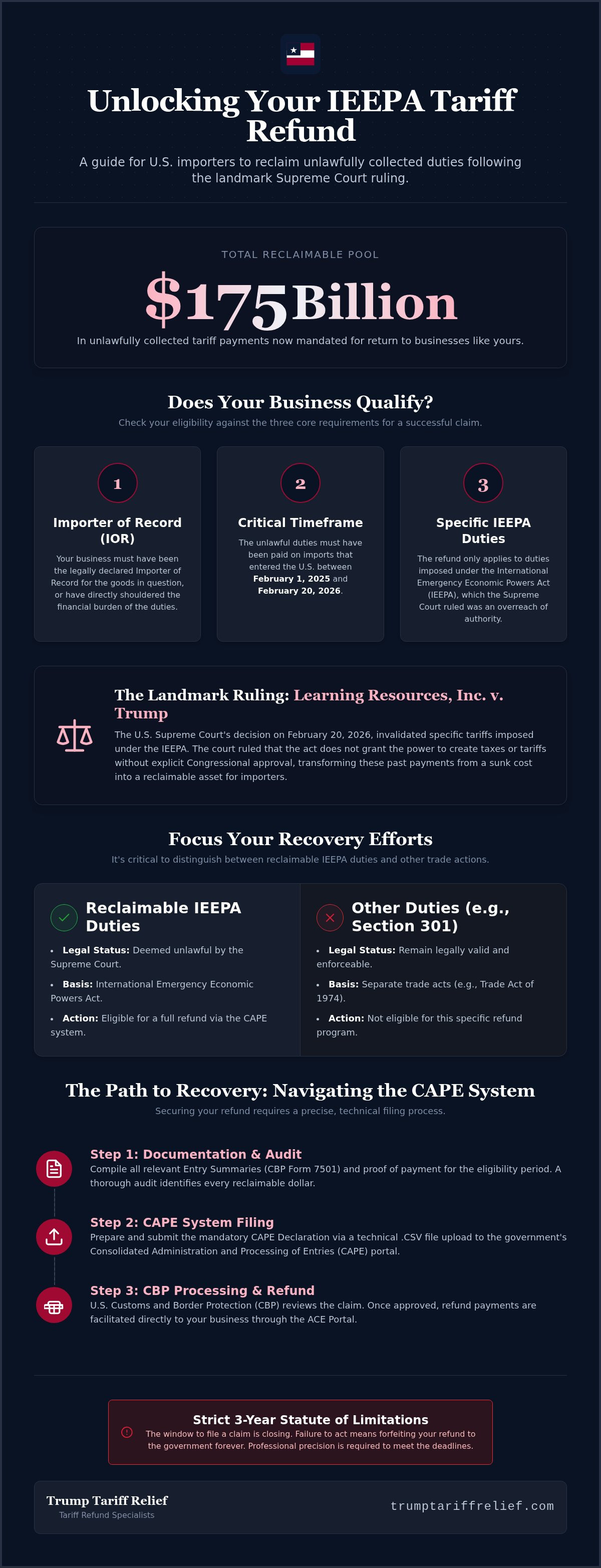
Up to $175 billion in unlawful tariff payments is currently sitting in government accounts, waiting for businesses to reclaim what is rightfully theirs. Following the Supreme Court's ruling in Learning Resources, Inc. v. Trump, the legal landscape for importers has shifted overnight. Determining your tariff refund eligibility is no longer just a matter of compliance; it's a high-stakes financial opportunity that requires immediate action. If your business acted as the Importer of Record between February 1, 2025, and February 20, 2026, you're likely sitting on a significant reclaimable asset that the government is now mandated to return.
It's frustrating to face the complex ACE and CAPE filing systems, especially when the clock is ticking on a strict three year statute of limitations. You've already paid the price for these unlawful duties, and the thought of navigating more bureaucracy can feel like an exhausting burden. We're here to change that narrative. This guide details the specific criteria for IEEPA recovery and explains how Trump Tariff Relief handles the heavy lifting of documentation. You'll learn exactly how the CAPE Declaration process works and how to secure your share of this recovery before the window for 2026 filings closes for good.
Key Takeaways
- Understand how the Supreme Court's landmark ruling invalidated specific duties and unlocked up to $175 billion in potential reimbursements for U.S. importers.
- Determine your specific tariff refund eligibility by identifying if your business served as the Importer of Record during the critical 2025-2026 window.
- Distinguish between reclaimable IEEPA duties and other trade actions like Section 301 to ensure your recovery efforts are focused on the correct filings.
- Learn the technical requirements of the CAPE system, including how to prepare the mandatory .CSV declarations and Entry Summaries for a successful claim.
- Discover why a contingency-based recovery model removes financial risk while ensuring your claims are filed accurately before the strict statute of limitations expires.
The Landmark Ruling: Understanding the IEEPA Tariff Refund Opportunity
On February 20, 2026, the legal landscape for American importers underwent a seismic shift. The U.S. Supreme Court ruled in Learning Resources, Inc. v. Trump that the executive branch exceeded its authority by imposing specific trade duties. This decision effectively invalidated billions of dollars in payments, transforming a sunk expense into a reclaimable financial asset. We are looking at a recovery pool of up to $175 billion that must be returned to the private sector. Your tariff refund eligibility depends primarily on whether you were the Importer of Record during the contested period between February 2025 and February 2026.
An IEEPA refund isn't a government gift; it's a court-ordered restoration of capital. These refunds represent the return of duties paid on specific imported goods under a mandate the court has now deemed unlawful. However, this opportunity isn't indefinite. The three year statute of limitations is already ticking, and the window to file is closing. If you don't act to reclaim these funds now, they'll remain in government coffers forever. This is a high-stakes moment for your balance sheet that demands professional precision.
The Role of the International Emergency Economic Powers Act
The International Emergency Economic Powers Act (IEEPA) was designed to give the President broad authority to regulate international commerce during national emergencies. For years, it was used to implement aggressive trade restrictions. The legal challenge succeeded because the Supreme Court clarified that while IEEPA allows for regulation, it doesn't grant the power to impose taxes or tariffs without explicit Congressional approval. The International Emergency Economic Powers Act serves as the legal basis for these refunds because the Supreme Court determined it lacks the statutory authority to impose trade duties. This distinction is critical for businesses trying to categorize their past duty payments.
The 2026 Refund Landscape: What has Changed?
The federal government was forced to respond to the ruling by opening the Consolidated Administration and Processing of Entries (CAPE) system. This portal, launched in phases starting April 20, 2026, is the primary mechanism for recovery. U.S. Customs and Border Protection (CBP) is now facilitating these payments through the ACE Portal, but the process is highly technical. You can find more details on our IEEPA Explained page. Phase 1 addressed unliquidated entries, while Phase 2, launched on June 29, 2026, expanded the scope to include entries flagged for Reconciliation where no entry had yet been filed. This administrative shift means that verifying your tariff refund eligibility is the first step toward reclaiming significant capital. The system is live, the money is available, and the path to recovery is finally open.
Defining Tariff Refund Eligibility: Does Your Business Qualify?
Determining your tariff refund eligibility requires more than a review of bank statements. It requires a precise audit of customs documentation to ensure your business holds the legal standing required by U.S. Customs and Border Protection (CBP). While the Supreme Court ruling on IEEPA opened the floodgates for recovery, the government established strict guardrails on who can collect. The 'Direct Pay' rule is a significant hurdle. You must prove your business was the entity that bore the financial weight of the duties. If you cut the check to CBP, or to a broker who then paid CBP, the law is on your side.
In specific cases, a consignee may still qualify even if they aren't the primary IOR. This typically occurs when the consignee has a direct financial interest in the goods and can demonstrate they were the ultimate party responsible for the duty payment. This nuance is where many DIY filings fail. They often overlook the secondary documentation that proves the transfer of duty liability. Trump Tariff Relief specializes in identifying these complex eligibility scenarios to ensure no reclaimable dollar is left behind.
The Importer of Record (IOR) Requirement
The legal definition of an Importer of Record is the entity responsible for ensuring imported goods comply with all local laws and for paying assessed duties. To verify your status, you must examine your CBP Form 7501, also known as the Entry Summary. If your business name appears in the 'Importer of Record' field, you're in a strong position for recovery. If a customs broker paid the duty on your behalf, your tariff refund eligibility remains intact as long as you reimbursed them for the specific IEEPA duty. You can learn more about our assessment process to see how we verify these documents.
Sectors with High Eligibility Rates
Certain industries were hit harder by the now-invalidated IEEPA trade actions. Manufacturers often paid heavy duties on raw materials and industrial components that are now eligible for reclamation. Retailers and distributors, who saw profit margins eroded by tariffs on consumer electronics, stand to recover significant capital. Technology firms are also prime candidates, particularly those importing hardware components that fell under the IEEPA umbrella between February 2025 and early 2026. These sectors represent the largest portion of the recovery pool due to their high volume of daily entries.
Navigating the Maze: IEEPA vs. Section 301 and Other Duties
Importers often face a tangled web of duties. While the CAPE portal is the current "gold rush" for IEEPA, you shouldn't ignore Section 301 or 232. IEEPA was struck down by the Supreme Court; however, Section 301 (China) and Section 232 (Steel/Aluminum) operate under different statutory authorities. Your tariff refund eligibility for IEEPA doesn't automatically mean your 301 duties are refundable through the same portal. The government relies on these distinctions to minimize their payout. By siloing the CAPE portal for IEEPA entries only, they create a hurdle for businesses that have paid a variety of duties over the last year. Trying to force other claims through this system will lead to immediate rejection.
The maze is real. Complexity breeds error. If you file for the wrong category, you risk a permanent rejection of your claim. Most businesses don't have the internal trade expertise to audit thousands of entries for multiple tariff types. That is where we step in. Trump Tariff Relief provides the specialized navigation required to separate these duties and ensure your recovery path is clear and compliant.
Section 301 List 3 and List 4a Updates
The status of Section 301 remains a separate legal battleground. While the IEEPA ruling is a definitive victory, the litigation surrounding China-specific tariffs for List 3 and List 4a is ongoing in 2026. Trump Tariff Relief manages these tracks simultaneously. We ensure your IEEPA recovery moves through the CAPE system while your 301 interests are protected through traditional protest channels. In 2026, the strategy is about timing. While IEEPA refunds are being processed within 60 to 90 days of validation, Section 301 claims require a more patient, long-term approach. You can explore the full details in our guide on How to Get Money Back from China Tariffs. We handle the bifurcated filing process so you don't have to manage two separate legal teams.
Why Mixed-Duty Entries Require Professional Audit
Mixed-duty entries are the most common source of missed capital. If a single shipment contains items subject to both IEEPA and Section 232, the documentation becomes a minefield. You must isolate the specific IEEPA portions for the CAPE declaration. Errors here lead to "double-dipping" accusations or conflicting protests that can freeze your entire recovery. Our audit doesn't just look at the total paid. We scrutinize the HTS codes and the specific entry dates to match them against the court-mandated windows. A professional Tariff Refund Assessment is the only way to verify tariff refund eligibility across multiple categories. We perform a cross-category audit to ensure every dollar is accounted for. This precision prevents administrative delays and maximizes your total return.
Claims and Compliance: Preparing Your Documentation for the CAPE System
Transitioning from identifying your tariff refund eligibility to actually securing your capital requires a meticulous approach to data management. The government doesn't simply hand back funds; it demands a high level of technical compliance through the Consolidated Administration and Processing of Entries (CAPE) system. To initiate a claim, you must submit a CAPE Declaration. This is a .CSV file that lists every entry for which you're requesting a refund. Precision is non-negotiable here. A single typo in an entry number or a miscalculated duty amount can lead to an immediate rejection or an indefinite delay in the validation process.
CBP acts as the final arbiter of your data. Once your declaration is uploaded through the ACE Portal, the agency begins a validation phase where they match your submitted entries against their internal records. If your documentation is flawless, you can expect your refund to be issued within 60 to 90 days following this validation. However, many businesses find themselves stuck in "Additional Review" because their internal records don't perfectly align with CBP's historical data. Trump Tariff Relief takes on this administrative burden by performing a pre-submission audit, ensuring your data is "CBP-ready" before it ever hits the portal.
The Essential Documentation Checklist
Your recovery is only as strong as your paper trail. You'll need to gather specific records for the impacted period to support your CAPE filing. The primary document is CBP Form 7501 (Entry Summary), which provides the legal record of the duty paid. You should also have Form 3461 (Entry/Immediate Delivery) on hand for verification. Beyond these customs forms, you must provide proof of payment. This typically includes bank records or ACH transfer confirmations that prove your business actually bore the cost. For answers to common questions regarding record retention, you can visit our FAQ page.
Enrolling in the ACE Portal
To access the CAPE system, your business must have an active account in the Automated Commercial Environment (ACE) Portal. This is the primary interface for all trade-related interactions with the government. If you haven't already done so, you should set up your electronic refund (ACH) information within the portal. This ensures that once your claim is approved, the funds are deposited directly into your account rather than waiting for a paper check. Technical hurdles are common, particularly when handling large datasets or unliquidated entries. We specialize in Customs Documentation Management to bypass these system errors and keep your recovery on track. You can request a documentation audit today to ensure your ACE account is properly configured for the CAPE rollout.
Maximizing Recovery: The Advantage of Contingency-Based Tariff Relief
The administrative burden of a CAPE filing is often the biggest barrier to recovery. While your tariff refund eligibility may be clear on paper, the technical execution required to satisfy CBP often results in rejected claims for those who attempt a DIY approach. We operate on a 'Zero-Risk' model that shifts the entire burden of proof from your shoulders to ours. This isn't just about filing paperwork; it's about conducting a forensic audit of your trade history to ensure every eligible dollar is recovered. By outsourcing the heavy lifting to Trump Tariff Relief, you ensure that your internal teams stay focused on core operations while we fight the bureaucracy on your behalf.
Our approach is built on a "we-do-the-work" narrative. We don't just tell you what to do; we execute the entire recovery strategy. This includes identifying every impacted entry, preparing the technical .CSV declarations, and managing the validation process until the funds are in your account. This level of partnership is designed for high-performing businesses that value efficiency and results over complex administrative hurdles.
Contingency vs. Hourly: A Business Case
Traditional legal models often require upfront retainers and hourly fees that drain your cash flow before a single dollar is returned. This creates a financial barrier that prevents many businesses from even starting the process. Our contingency-fee structure eliminates this risk. We only get paid when you receive your refund. This aligns our interests perfectly; we're motivated to secure the maximum possible recovery because our success is tied directly to yours. Specialized trade expertise is far more effective than general corporate counsel in these matters. We understand the nuances of the CAPE system and the specific HTS code triggers that CBP looks for during validation. You can review our full process on our How It Works page for complete transparency.
The Final Window: Why You Cannot Afford to Wait
The clock is the greatest enemy of your recovery. The three year statute of limitations is a hard deadline. For entries made in early 2025, the window for reclamation is already starting to close. Once that deadline passes, the government's obligation to return your capital expires permanently. Every day of delay is a day closer to losing a significant financial asset. We provide the speed and precision necessary to beat these external deadlines. A Free Eligibility Assessment is the only logical next step to protecting your capital and confirming your tariff refund eligibility before time runs out. Secure your refund and right this financial wrong by partnering with Trump Tariff Relief today.
Secure Your Financial Restoration Before the Window Closes
The Supreme Court ruling has transformed a trade burden worth up to $175 billion into a significant capital recovery opportunity. However, the administrative complexity of the CAPE system remains a formidable barrier for most businesses. Validating your tariff refund eligibility is the essential first step in a high-stakes process that requires absolute technical precision. Between auditing mixed-duty entries and managing the ACE portal requirements, the margin for error is razor-thin. The three year statute of limitations is already ticking, and every day of delay brings you closer to a permanent loss of these assets.
Trump Tariff Relief is your high-performing partner in this recovery effort. We take on the heavy lifting of documentation and filing through our specialized management of the CAPE system. Our model is strictly contingency-based; you only pay if we win. With deep expertise in both IEEPA and Section 301, we provide the steady hand needed to navigate this bureaucracy. Claim Your No-Risk Tariff Eligibility Assessment today to protect your capital. It's time to reclaim what is yours and move forward with confidence.
Frequently Asked Questions
Is the China tariff refund real or a scam?
The refund opportunity is entirely legitimate and stems from the February 20, 2026, Supreme Court ruling in Learning Resources, Inc. v. Trump. This landmark decision found that certain duties imposed under the International Emergency Economic Powers Act were unauthorized. While Section 301 China tariffs are a separate legal matter, the IEEPA refunds are actively being processed through the government's CAPE system. It's a court-mandated restoration of capital for businesses that paid these unlawful duties.
How long do I have to file for an IEEPA tariff refund before the deadline?
You generally have a three year window from the date of entry to file a claim. Because the contested duties began in early 2025, many businesses are reaching the end of their tariff refund eligibility for their oldest shipments. The government doesn't issue reminders for these deadlines. If you don't submit your CAPE Declaration before the statute of limitations expires, your right to reclaim that capital is permanently forfeited.
What is the difference between a duty drawback and a tariff refund?
Duty drawback is a standard customs program where you receive a refund for duties paid on goods that are later exported or destroyed. In contrast, the current IEEPA refund is a legal remedy for duties that were collected unlawfully on goods remaining in the United States. While drawback requires proof of export, this refund only requires proof that you paid the unauthorized IEEPA duties as the Importer of Record during the 2025-2026 period.
Can small businesses qualify for tariff refunds, or is it only for large corporations?
Eligibility is determined by your status as the Importer of Record, not the size of your company. Small and medium-sized enterprises often have significant tariff refund eligibility because they were forced to absorb these costs into their margins. Whether you imported a single container or thousands, the law requires the government to return unauthorized payments. We help businesses of all sizes navigate the CAPE system to ensure their claims are filed with professional precision.
What happens if I don't have all my original import documentation?
Missing paperwork shouldn't stop your recovery efforts. Trump Tariff Relief specializes in Customs Documentation Management and can often assist in retrieving entry data directly through the Automated Commercial Environment (ACE) portal. We use your historical filing data to reconstruct the necessary Entry Summaries and Form 7501 records. As long as the government has a record of your payment, we can typically build a compliant CAPE Declaration to secure your refund.
How long does it take for the government to process an IEEPA refund check?
Once your CAPE Declaration is validated by U.S. Customs and Border Protection, the standard processing window is 60 to 90 days. The speed of your payment depends heavily on the accuracy of your initial filing. Errors in entry numbers or HTS codes can trigger an "Additional Review" status, which extends the timeline indefinitely. Our team ensures your data is audited before submission to minimize these administrative delays and accelerate your capital restoration.
Can I file for a refund if my customs broker already closed the entry?
Yes, you can still file. The CAPE system was specifically designed to handle entries regardless of their liquidation status. Even if an entry is "closed" or liquidated, the Supreme Court ruling provides a legal path to reopen that specific duty payment for reimbursement. You don't need your original broker's permission to move forward. We take over the management of the filing process to ensure these liquidated entries are included in your recovery.
What are the success fees for professional tariff recovery services?
Trump Tariff Relief operates exclusively on a contingency-fee basis. This means there are no upfront consulting packages, hourly retainers, or hidden filing fees. We take on all the financial risk of the audit and submission process. Our revenue is generated as a percentage of the actual refund we successfully recover for your business. If we don't win your case and secure your refund check, you don't owe us anything for our services.
Ready to find out what your business may be owed?
Check My Eligibility