
Approximately $20 billion has already been returned to importers as of June 2026, yet over $100 billion in unconstitutional IEEPA duties still sits in government accounts. If your business is currently sidelined by the administrative complexity of the CAPE system, your most pressing concern is likely how long does a tariff refund take before the capital is actually restored to your balance sheet. The Supreme Court has already ruled in your favor; now, the challenge is navigating a bureaucratic process that is as rigid as it is rewarding.
We recognize the frustration of trying to forecast cash flow while facing a 2026 statute of limitations and a multi-phased rollout in the Automated Commercial Environment (ACE). This article provides a clear roadmap of the IEEPA recovery timelines, detailing the exact phases of the CAPE declaration process. You will discover how to avoid the specific documentation errors that trigger manual reviews and learn the requirements for securing the 6% interest owed on your duties. By understanding the 60 to 90 day processing window, you can move from financial uncertainty to a successful, high-stakes recovery.
Key Takeaways
- Master the multi-stage IEEPA refund cycle to understand why most payments are issued within 60 to 90 days of an accepted CAPE declaration.
- Pinpoint exactly how long does a tariff refund take by aligning your filing strategy with the specific 2026 phased rollout in the ACE portal.
- Eliminate the documentation bottlenecks and HTS code discrepancies that trigger manual reviews and stall multi-million dollar recoveries.
- Ensure your recovery includes the approximately 6% interest mandated by the court by verifying your electronic payment registration before the statute of limitations expires.
- Leverage a contingency-based partnership to navigate the complex bureaucratic landscape without incurring upfront costs or administrative overhead.
The Reality of the IEEPA Refund Clock in 2026
The clock on your capital recovery didn't start the day the Supreme Court issued its landmark ruling; it starts the moment you submit a verified CAPE declaration. Many importers mistakenly view the process as a single waiting period, but it's actually a complex, multi-stage cycle governed by the Court of International Trade (CIT). The CIT actively supervises the payout schedule to ensure federal compliance, which adds layers of oversight to an already crowded system. The IEEPA tariff refund is a formal legal recovery process that typically involves a 6-to-18 month window from initial filing to the final disbursement of funds.
Understanding how long does a tariff refund take requires looking past the government's 60-day estimates and recognizing the administrative reality. While Phase 1 of the CAPE system launched in April 2026 to handle unliquidated entries, the sheer volume of claims has created a significant bottleneck. If you aren't prepared for the specific verification steps required by the Automated Commercial Environment (ACE), you're not just waiting; you're falling behind.
Why the Refund Process Isn’t Instant
Instant gratification doesn't exist in the world of federal trade litigation. Customs and Border Protection (CBP) must verify every byte of entry data against existing ACE portal records to prevent fraudulent claims. With over 56,000 U.S. importers already registered for refunds as of April 2026, the administrative backlog is substantial. This volume means that even a minor discrepancy in your filing can push your claim from the "fast track" into a manual review pile that adds months to your wait time.
The legal foundation for these claims rests on the International Emergency Economic Powers Act (IEEPA), which grants the executive branch specific trade authorities. Because the Supreme Court found the application of these powers overreached in this instance, the government is now required to return billions. However, they won't do so without exhaustive verification of your specific HTS codes and liquidation dates. CBP is currently processing approximately $127 billion in registered refunds, and they are prioritizing accuracy over speed.
The 3-Year Window: Why Delaying Your Filing is Dangerous
The "waiting time" is often less critical than your "starting time" because of the looming 2026 statute of limitations. For imports brought in between 2023 and 2025, the window to capture these funds is closing rapidly. If you don't file before the deadline, the right to reclaim those duties vanishes regardless of the court's ruling. Your filing date directly dictates your position in the government’s processing queue; those who hesitate are effectively volunteering to be the last in line for the capital currently earmarked for recovery. You can learn more about the IEEPA ruling and how it impacts your specific timeline to ensure you don't miss this fleeting opportunity for financial restoration.
Breaking Down the CAPE Declaration Processing Phases
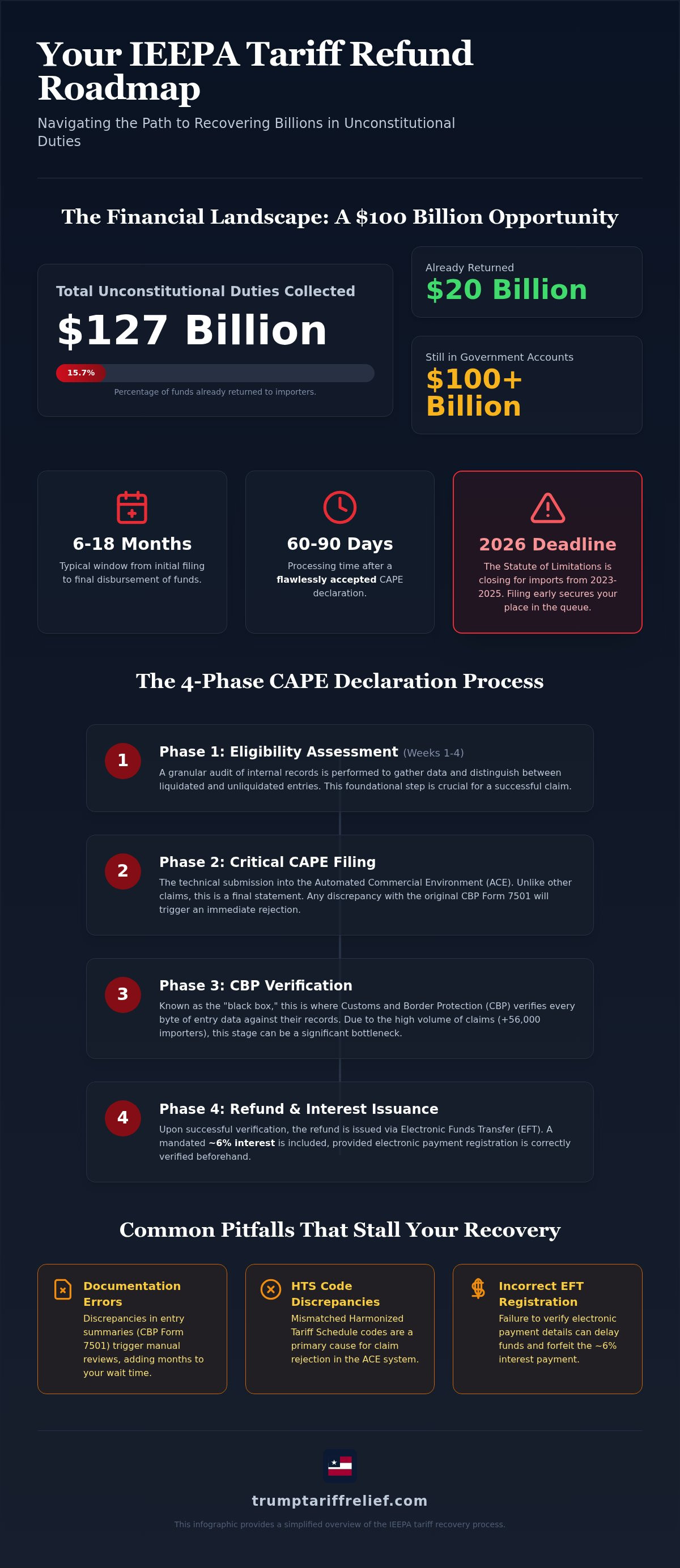
The recovery of your unconstitutional duties follows a rigid, four-stage lifecycle. While the court has mandated the return of these funds, the administrative burden falls entirely on the importer of record. If you're wondering how long does a tariff refund take, the answer depends on how quickly you navigate these sequential gates. The process is not a simple request; it's a technical submission into the Consolidated Administration and Processing of Entries (CAPE) system that requires absolute precision.
Phase 1 (Weeks 1-4) involves a granular eligibility assessment. You must audit your internal records to distinguish between entries liquidated within the last 180 days and those currently unliquidated. This data gathering is the foundation of your claim. Phase 2 is the actual submission of the CAPE declaration. Phase 3 is the verification period, often called the "black box" because visibility into CBP's internal queue is limited. Finally, Phase 4 is the issuance of the refund via electronic funds transfer. You can see how our recovery process streamlines these technical hurdles to accelerate your timeline.
Phase 2: The Critical CAPE Filing
The CAPE filing in the Automated Commercial Environment (ACE) is a technical threshold where most unguided claims fail. Unlike standard duty drawback claims that allow for periodic adjustments or retrospective amendments, a CAPE declaration is a final statement of recovery. Once submitted, the system locks the entry data. Any discrepancy in your original "Entry Summary" (CBP Form 7501) will trigger an immediate rejection. Accuracy here is non-negotiable; if your HTS codes or duty amounts don't match the ACE records perfectly, you're looking at months of manual appeals. According to CBP's official guidance, the electronic filing must be precise to qualify for the streamlined processing windows currently available in 2026.
Phases 3 & 4: From Verification to Capital Recovery
After filing, you enter the verification phase. As of August 2026, U.S. Customs estimates a 60 to 90 day window for claim validation, though the sheer volume of the 56,000 registered importers can extend this. During this time, the agency reconciles your declaration against their internal ledgers. If approved, your status in ACE transitions to "Ready for Disbursement." The reconciliation phase is where the final refund amount is solidified, including the court-mandated interest of approximately 6%. Because all payments are now issued via Automated Clearing House (ACH) to U.S. bank accounts, having an active and verified account on file is essential for final capital restoration. If your business needs to audit its eligibility before the next phase begins, you should consult with a specialist at Trump Tariff Relief to ensure your documentation is airtight.
Factors That Delay Your Tariff Recovery
The primary reason importers experience extended wait times is not a lack of federal liquidity, but the poor quality of the data submitted. When evaluating how long does a tariff refund take, you've got to account for the friction created by incomplete or inaccurate Customs documentation. If your Harmonized Tariff Schedule (HTS) codes or entry dates don't align perfectly with the ACE portal’s historical records, your claim is instantly flagged for manual review. This intervention can transform a standard 90-day window into a 12-month administrative ordeal.
A significant surge in fraudulent filings has also forced Customs and Border Protection (CBP) to implement more rigorous screening protocols. With over 56,000 registrants seeking a share of the $127 billion in unconstitutional duties as of April 2026, any suspicious data point triggers an automatic audit. This "scam warning" isn't just about security; it's a practical bottleneck that slows down legitimate claims for everyone. For more clarity on specific filing hurdles, review these Common IEEPA filing questions.
The Burden of Documentation Accuracy
Verifying every "Entry Summary" (CBP Form 7501) is a high-stakes forensic audit, not a simple clerical task. If you filed protests to preserve your rights for tariffs liquidated more than 80 days ago but within the 180-day window, those protests must be correctly linked to your CAPE declaration. Many businesses struggle because digital records from 2023 or 2024 have been archived or lost. Without these records, proving eligibility for Phase 2 of the rollout becomes nearly impossible. A single missing digital file can stall a multi-million dollar recovery indefinitely.
External Factors: Government Budgets and Court Rulings
External forces also dictate the pace of restoration. Federal budget cycles can influence the liquidity of duty disbursement accounts, potentially slowing payments during fiscal transitions. The Court of International Trade (CIT) remains an active supervisor, occasionally issuing clarifications on payout protocols that require CBP to pause and recalibrate their systems. Importers who take a "set it and forget it" approach often find their claims stuck in a status loop. Active management is the only way to ensure your capital isn't sidelined by shifting regulatory winds. Success requires a partner who understands that the government’s timeline is only as fast as your last submission.
How to Accelerate Your Tariff Refund Claim
The government's processing window is a fixed variable, but your internal preparation is the only lever you can pull to shorten the cycle. If you are focused on how long does a tariff refund take, you must recognize that speed is a byproduct of precision. A "clean" submission that matches the Automated Commercial Environment (ACE) records on the first pass bypasses the manual review queues that currently sideline thousands of claims. To move your capital from a federal ledger back to your balance sheet, you need a proactive strategy that anticipates bureaucratic friction before it occurs.
Acceleration requires more than just filing a form; it requires a forensic approach to your trade data. You must ensure all ACE Trade Account information is active and updated, particularly your Automated Clearing House (ACH) details. If the government attempts to issue an electronic funds transfer to an inactive account, your recovery could be delayed by several months while the error is resolved. Monitoring the Cargo Systems Messaging Service (CSMS) for real-time timeline shifts is also essential for staying ahead of new procedural requirements as the CAPE system evolves.
Step 1: The Pre-Filing Audit
Every entry from 2023 through 2025 must be scrutinized to identify every eligible duty payment. This isn't a task for general accounting; it requires a deep understanding of the specific Section 301 litigation that triggered these refunds. You must meticulously cross-reference every HTS code against the specific List 3 and List 4A exclusions to ensure total alignment with the court’s mandate. By creating a verified data set before you ever touch the ACE portal, you eliminate the discrepancies that lead to immediate rejections. This level of preparation ensures that when Customs agents review your CAPE declaration, they find a perfect mirror of their own records.
Step 2: Professional Documentation Management
The learning curve for CAPE declarations is steep and the stakes are high. Using experts who handle Customs Documentation Management daily provides a significant tactical advantage. These specialists understand the nuances of the ACE system and can ensure your filing is "audit-proof" from day one. By leveraging our specialized recovery process, you remove the administrative burden from your internal team and place it in the hands of seasoned navigators who speak the language of CBP. This specialized oversight is the most effective way to compress the timeline and secure your funds without the risk of a technical default. To begin your recovery without the stress of bureaucratic delays, request a preliminary assessment today and let our team identify your total eligible duties.
Strategic Recovery: Why a Contingency Partner Speeds Up Results
The question of how long does a tariff refund take is often answered by how much friction you remove before your filing hits the ACE portal. While the government’s internal 60 to 90 day verification window is a fixed variable, the months of preparation and data reconciliation that precede it are not. Most administrative delays occur because internal teams or general customs brokers lack the forensic tools to align thousands of entries with the specific requirements of the CAPE system. By the time an error is identified, the recovery timeline has already doubled.
Our contingency-based model is designed to eliminate this specific bottleneck. Because we only receive compensation when your capital is successfully restored, our interests are perfectly aligned with yours to ensure the fastest possible disbursement. We take on the heavy lifting of documentation management and data verification, allowing your team to focus on core operations while we navigate the federal bureaucracy. This "we-do-the-work" narrative isn't just about convenience; it's a tactical choice to move your claim to the front of the queue through technical precision.
The High Stakes of 2026 Filings
The window for reclaiming millions in Section 301 China tariffs is closing as the 2026 statute of limitations approaches. This isn't a standard administrative task that your daily customs broker is equipped to handle. Most brokers focus on moving goods across borders today, not performing forensic audits on duty payments from three years ago. An IEEPA recovery specialist understands the nuanced legal distinctions between different entry categories that generalists often overlook. Trump Tariff Relief prioritizes your claim by ensuring every HTS code and liquidation date is "audit-proof" before submission, preventing the manual flags that stall legitimate recoveries for months.
Taking the First Step Without Financial Risk
Reclaiming significant capital shouldn't require increasing your current operational expenses. Our "no upfront cost" promise ensures that you can pursue a multi-million dollar recovery without budget approval hurdles or financial risk. We provide a streamlined path from initial assessment to final disbursement, handling the complex communication with CBP so you don't have to. When you partner with us, you aren't just filing a claim; you're deploying a sophisticated engine of recovery that understands exactly how long does a tariff refund take and how to compress that timeline through expert intervention.
The first step in righting this financial wrong is a preliminary assessment of your trade data. We identify every eligible entry and calculate your total potential recovery, including the court-mandated interest. You can get your free tariff eligibility assessment today and secure your position in the 2026 recovery queue before the statute of limitations expires. Don't let your capital sit in a government account when it could be fueling your business's growth.
Secure Your Restored Capital Before the 2026 Deadline
Navigating the CAPE system requires more than just patience; it requires forensic precision. We've explored how the 60 to 90 day processing window only applies to clean filings and why the 2026 statute of limitations makes immediate action mandatory. By understanding how long does a tariff refund take, you can move past the uncertainty of federal backlogs and focus on strategic reinvestment. The capital you paid under unconstitutional duties belongs back on your balance sheet, but it won't arrive without a proactive defense of your rights.
Our expert IEEPA legal and trade team handles the comprehensive documentation management required to bypass bureaucratic stalls. Because we operate on a contingency-based model, our interests are perfectly aligned with your success. You don't have to navigate this technical landscape alone or risk an administrative rejection that sidelines your funds for another year. We take on the heavy lifting and the risk, ensuring your claim is audit-proof from the moment it enters the ACE portal.
Start your no-risk IEEPA refund assessment now to identify every dollar your business is owed. The window for reclaiming these duties is closing fast, but with the right partner, you can secure your recovery with confidence. Let's get your capital back where it belongs.
Frequently Asked Questions
How long does it take for CBP to process an IEEPA refund?
U.S. Customs and Border Protection typically processes an IEEPA refund within 60 to 90 days once they accept your CAPE declaration. This timeline assumes your submission is flawless and matches internal ACE records perfectly. However, the phased rollout that began in April 2026 has created a queue of over 56,000 importers. If your claim is flagged for a compliance review, the window can extend significantly beyond the standard three-month estimate.
Is there a deadline to file for a China tariff refund in 2026?
Yes, the 2026 statute of limitations serves as a hard deadline for most China tariff recovery claims. While the Supreme Court ruled the duties unconstitutional, you must proactively file to reclaim your capital before the window closes. Importers who miss the specific windows for Phase 1 or Phase 2 processing risk losing their rights entirely. Acting now is the only way to ensure your business is included in the $127 billion registered for payment.
What is a CAPE declaration and how does it affect my timeline?
A CAPE declaration is the technical filing submitted through the Automated Commercial Environment (ACE) portal to consolidate and process duty refunds. It replaces the old entry-by-entry protest model for IEEPA claims. Because an accepted declaration starts the 60 to 90 day payment clock, its accuracy is the most critical factor in determining how long does a tariff refund take. Errors in this digital filing can sideline your recovery for several months.
Can I speed up my tariff refund by filing a protest?
Filing a protest doesn't technically speed up the government's internal processing, but it's essential for preserving your rights on older entries. For tariffs liquidated more than 80 days ago but within a 180-day window, a protest ensures you remain eligible for the refund. Without this strategic step, those specific duties may be excluded from your final recovery amount. We manage these protests as part of our comprehensive documentation management to protect your capital.
What happens if my IEEPA refund claim is rejected?
If your claim is rejected, it typically moves into a manual review queue that adds substantial time to your recovery. Most rejections stem from mismatched HTS codes or entry summary data in the ACE portal. Because the CAPE system is relatively new, a single error can trigger a technical default. Our team performs a forensic audit before every filing to ensure your claim is audit-proof and protected from these common bureaucratic delays.
How much does it cost to hire a tariff recovery consultant?
Hiring a specialized recovery partner through our firm involves no upfront costs or administrative fees. We operate on a contingency-based model, which means our compensation is tied directly to the capital we successfully recover for your business. This approach removes the financial barrier to entry and ensures our interests are perfectly aligned with yours. We take on the administrative risk so you can pursue a multi-million dollar recovery without increasing expenses.
Do I need my original import documents to get a refund?
You don't necessarily need every physical paper document, but you must have access to your digital "Entry Summary" (CBP Form 7501) data. Customs reconciles your CAPE declaration against their internal ledgers in the ACE portal. If your internal records from 2023 or 2024 have been lost or archived, it becomes difficult to verify eligibility for Phase 2 processing. Having a clean, verified data set is vital for a successful and fast recovery.
Is the IEEPA tariff refund process different from duty drawback?
Yes, the IEEPA recovery process is distinct from duty drawback. Duty drawback applies to tariffs paid on goods that are subsequently exported or destroyed. In contrast, the IEEPA refund is a court-mandated restoration of duties ruled unconstitutional by the Supreme Court. While drawback is a standard trade program, the IEEPA timeline is governed by the Court of International Trade and includes a mandated interest rate of approximately 6% on your duties.
Ready to find out what your business may be owed?
Check My Eligibility