
The federal government is currently holding billions of dollars in overpaid duties that rightfully belong back in the operational budgets of American automotive manufacturers. For too long, these costs were viewed as an unavoidable burden. Recent landmark rulings have shifted the landscape, creating a massive opportunity to secure a tariff refund for automotive parts that were previously thought to be unrecoverable. If your business has been importing components under the weight of IEEPA or Section 232 duties, you're likely entitled to a significant restoration of capital that can be reinvested into your 2026 operations.
It's understandable if you feel overwhelmed by technical jargon and the looming statute of limitations. You've worked hard to build your business, and the thought of high legal fees for a "maybe" is a risk you shouldn't have to take. We're here to provide a different path. This guide clarifies the confusion between different tariff sections and provides a clear roadmap for eligibility. You'll learn exactly how to assess your claim and initiate a low-risk recovery process that puts your money back where it belongs; in your company's growth.
Key Takeaways
- Understand how recent Supreme Court rulings have opened a time-sensitive window to reclaim capital through 2026.
- Learn the specific criteria and HTS codes required to successfully secure a tariff refund for automotive parts under IEEPA and Section 232.
- Distinguish between direct cash refunds for importers and the CAPE program’s 3.75% MSRP offsets for U.S.-based manufacturers.
- Discover the essential audit steps to aggregate proof of duty payments and ensure your documentation meets strict federal requirements.
- Explore how a contingency-based recovery model eliminates financial risk by handling the heavy lifting of documentation and filing.
The 2026 Automotive Tariff Landscape: Why Refunds are Available Now
The International Emergency Economic Powers Act (IEEPA) has served as the legal foundation for sweeping trade restrictions, but recent legal challenges have exposed significant regulatory overreach. For automotive importers, this means that millions of dollars in duties paid under these executive actions are now eligible for reclamation. We're seeing a fundamental shift where the burden of proof has moved from the importer to the government. This environment creates two distinct opportunities for financial recovery: direct cash refunds for past duty payments and MSRP offsets for ongoing manufacturing operations. Securing a tariff refund for automotive parts isn't just about compliance; it's about reclaiming capital that was collected without proper legal justification.
The Ford Class-Action Precedent
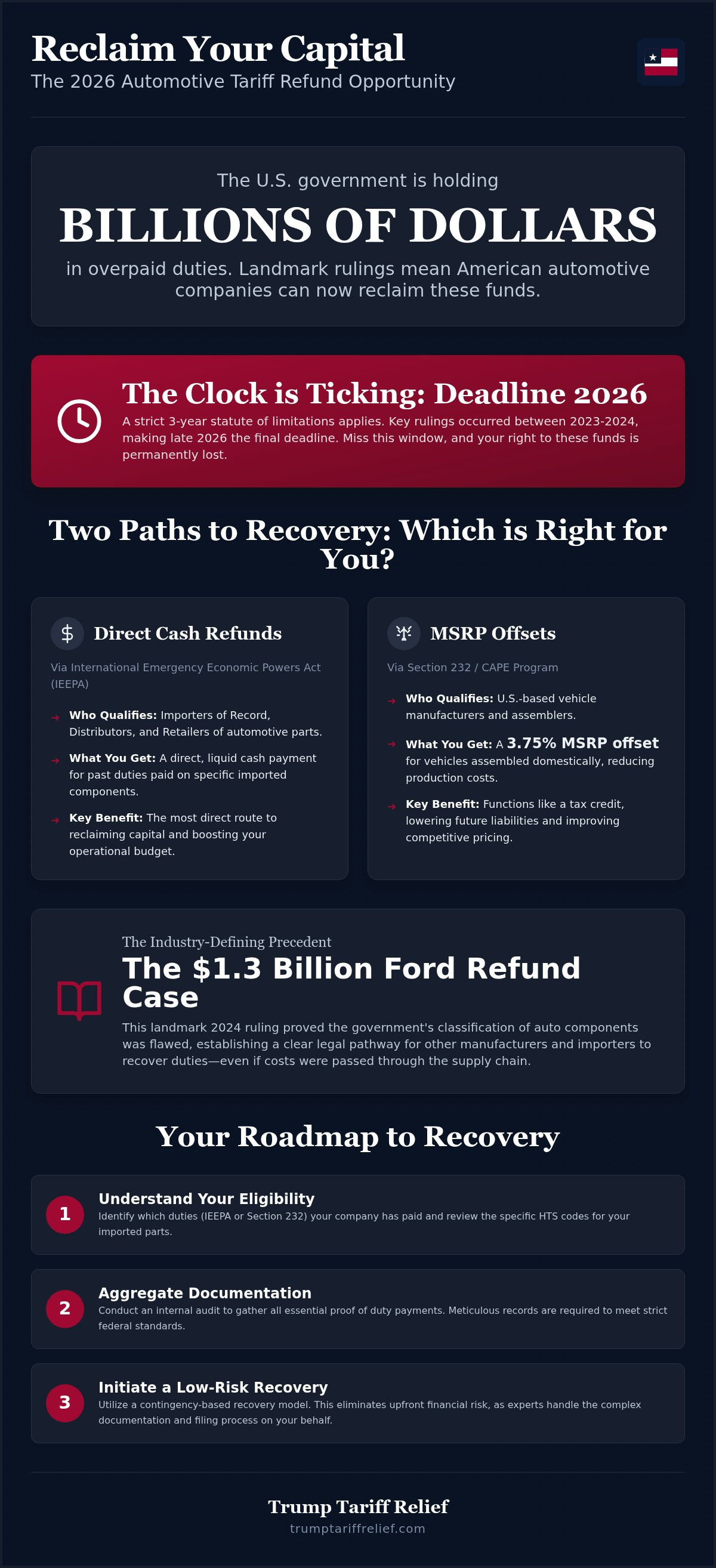
The $1.3 billion Ford refund case serves as the definitive precedent for the entire industry. This landmark victory proved that the government’s classification of certain automotive components was legally flawed, forcing a massive redistribution of capital back to the private sector. The ruling, finalized in 2024, established that companies can recover duties even if those costs were originally passed on through the supply chain. This means even mid-tier manufacturers and distributors have a legitimate pathway to recovery. If your firm acted as the importer of record during the contested periods, the law is now on your side to demand a full restoration of those funds. It's a matter of professional justice to ensure these passed-on costs don't remain in government coffers.
Statute of Limitations: The 3-Year Window
Urgency is the defining factor of the current landscape. The U.S. Customs and Border Protection (CBP) operates under a strict 3-year window for filing formal protests. Because the primary rulings that triggered these refund opportunities took place between 2023 and 2024, the clock is ticking toward a final expiration in late 2026. If you fail to file before this deadline, your right to these funds vanishes permanently. Many firms wait for a "perfect" moment that never comes, only to find the window has slammed shut. Understanding how these IEEPA-based claims work is the first step toward ensuring your capital doesn't become a permanent government donation. Waiting until the final months of 2026 is a high-stakes gamble that rarely pays off in the world of federal bureaucracy.
The current state of automotive tariffs is no longer a static expense. It's a dynamic pool of potential liquidity. By identifying whether your entries fall under Section 232 or IEEPA, you can categorize your recovery strategy effectively. The goal is to move from a position of financial loss to one of strategic reinvestment. Successful reclamation of these funds allows your business to pivot from defensive accounting to aggressive operational growth. Don't let the complexity of the 2026 landscape deter you from what's rightfully yours.
Direct Refunds vs. Section 232 Offsets: Which Do You Qualify For?
Understanding the distinction between a direct refund and an operational offset is critical for any business looking to secure a tariff refund for automotive parts. While both pathways aim to return capital to the industry, they target different entities within the supply chain and deliver value in distinct ways. Importers of record typically look toward the IEEPA pathway for liquid capital, whereas domestic manufacturers leverage Section 232 programs to reduce future liabilities or offset current production costs. Categorizing your business correctly is the first step toward a successful recovery strategy.
The Bureau of Industry and Security Section 232 Investigations have long governed the landscape of national security tariffs, but the introduction of the CAPE (Competitive Automotive Production Effort) program has changed the math for U.S. manufacturers. This program offers a 3.75% MSRP offset for vehicles assembled within the United States. Unlike a cash refund, these offsets function more like a tax credit, reducing the overall financial burden of production. For supply chain importers who aren't the final manufacturers, benefits often come through manufacturer-granted offsets where the prime assembler shares the credit with their tier-one and tier-two suppliers.
The IEEPA Cash Refund Pathway
The most direct route to liquidity for distributors and retailers is the IEEPA-based claim. This pathway targets duties paid on parts imported from specific regions, most notably China, under executive orders that have since been challenged or narrowed by the courts. Because this process results in a literal check from the U.S. Treasury, it's often the most lucrative option for businesses that don't have domestic assembly lines. You can explore the technical details in our guide on how IEEPA Explained impacts your specific import history. It’s a cash-in-hand solution that provides immediate reinvestment capital for your 2026 operations.
Section 232 MSRP Offsets for Manufacturers
For vehicles assembled in the U.S. between 2025 and 2026, Proclamation 10925 serves as the governing authority for MSRP-based offsets. Eligibility isn't limited to the giant OEMs; parts suppliers can also capture this value through a rigorous "Supply Chain Identification" process. By proving your components are essential to the final domestic product, you can negotiate a portion of the 3.75% offset. This requires meticulous documentation and a clear understanding of how your HTS codes fit into the broader assembly. If you're unsure where your business fits in this complex hierarchy, a preliminary eligibility assessment can quickly clarify your path to recovery.
Ultimately, the choice between seeking a cash refund or an MSRP offset depends on your role in the automotive ecosystem. Importers of record have the strongest case for IEEPA cash, while domestic assemblers should focus on the CAPE program’s structural benefits. Both paths require a sophisticated approach to documentation to ensure no capital is left on the table. Choosing the right mechanism now prevents the permanent loss of funds as we approach the 2026 deadlines.
Eligibility Assessment for Automotive Importers
Determining your standing for a tariff refund for automotive parts begins with a single, non-negotiable question: are you the Importer of Record (IOR)? The IOR is the entity legally responsible for the documentation and payment of duties at the time of entry. In the eyes of U.S. Customs, this status serves as the gatekeeper for all recovery efforts. If your company’s name and bond are attached to the entry summary, you hold the legal right to protest those payments and demand a restoration of capital. Without this designation, your path to recovery typically requires a partnership with the actual IOR to facilitate a joint claim.
A successful assessment also requires a granular look at how your parts are utilized after they cross the border. There is a sharp distinction between components destined for "Use in Assembly" versus those intended for "Retail Sale" or the aftermarket. Importers focused on the aftermarket often find a more direct route through IEEPA cash refunds. Conversely, those supplying parts for domestic vehicle assembly must navigate a more integrated process involving manufacturer offsets. To streamline this process, a professional Tariff Refund Assessment can identify which specific regulatory bucket your imports fall into before you commit resources to a filing.
Common Eligible Automotive Components
The vast majority of successful claims center on a specific set of Harmonized Tariff Schedule (HTS) codes, particularly those under Heading 8708. We frequently identify high recovery potential in engines, transmissions, lighting systems, and electronic control units (ECUs). These parts were heavily impacted by Section 301 "List 3" and "List 4a" duties, which the courts have increasingly found were implemented through an overextension of executive authority. While China-sourced components are the primary targets for IEEPA-based cash recovery, Mexico-built parts typically bypass these specific duties but remain vital for calculating the domestic value content required for Section 232 MSRP offsets. Identifying the intersection between your HTS codes and these specific lists is the only way to quantify your total eligible capital.
The Manufacturer-Supplier Link
If you are a Tier 1 or Tier 2 supplier, your eligibility may be tied to the actions of your manufacturing partners. It's essential to determine if an OEM has already filed for a Section 232 offset that covers your specific imports. In these scenarios, your company must be "decremented" against the manufacturer’s total offset to ensure compliance and prevent double-recovery. This verification process is a critical safeguard; filing a claim for the same duties already covered by an OEM offset can trigger audits and delays. We focus on auditing these links to ensure your claim is both accurate and protected from regulatory pushback. Transparency between suppliers and manufacturers is the best way to maximize the recovery pool for everyone involved.
How to File a Tariff Refund Claim for Auto Parts
Securing a tariff refund for automotive parts is not a matter of simply asking for your money back; it’s a rigorous legal process that demands a methodical, four-step strategy. Your first priority is conducting a comprehensive audit of all automotive import entries from 2023 to 2026. This involves cross-referencing thousands of data points against current eligibility lists to ensure no capital is overlooked. Once the audit is complete, you must aggregate irrefutable proof of duty payment and HTS code classifications. The third step involves choosing the correct filing mechanism. You’ll typically use a formal Protest for entries that have already liquidated, whereas a Post-Summary Correction (PSC) is the standard for entries still in the liquidation pipeline. Finally, you must submit the claim to the correct governing body. CBP handles the majority of IEEPA-related claims, while the Department of Commerce oversees specific manufacturing offsets.
Critical Customs Documentation Management
Effective customs documentation management is the backbone of a successful recovery. You'll need a complete set of records for every claim, including the Entry Summary (CBP Form 7501), commercial invoices, and the Bill of Lading. For those pursuing Section 232 MSRP offsets, you must also provide documentation verifying the vehicle's suggested retail price to justify the 3.75% credit. Missing even a single invoice can derail an entire filing. You can find a detailed list of what's required in our Required Documents for IEEPA Tariff Refund guide. If you find the documentation phase daunting, our team can handle the heavy lifting for you.
Avoiding Common Filing Mistakes
Precision is your best defense against government rejection. Mismatched HTS codes are the most frequent cause of claim denial in the automotive sector. If the code on your original entry doesn't perfectly match the code cited in the refund ruling, CBP will likely reject the filing without a second look. Additionally, incomplete supply chain tracing is a fatal error. You must be able to prove the origin and final use of the parts to satisfy the "Use in Assembly" requirements mentioned in previous sections. A single oversight in your tracing can lead to an immediate government rejection, permanently locking away capital that belongs in your business. We recommend a preliminary eligibility assessment to ensure your data is bulletproof before submission.
Maximizing Recovery with Professional IEEPA Consultants
Managing the intricate layers of federal trade bureaucracy is a task few automotive firms are equipped to handle internally. While previous sections outlined the eligibility and filing requirements, the actual execution often stalls due to a lack of specialized resources. This is where professional IEEPA consultants become an essential partner. We don't just provide advice; we take on the entire burden of recovery. Using proprietary software, we scan your historical import data to identify every possible tariff refund for automotive parts that your internal teams might have overlooked. It's a no-nonsense approach designed to bypass the friction of government red tape and secure your capital efficiently.
There's a significant emotional and ethical component to this work. For years, businesses paid duties that were later found to be legally flawed. Reclaiming this capital is a matter of righting a wrong. You shouldn't be penalized for the government's regulatory overreach. Our mission is to restore that capital to your balance sheet, allowing you to reinvest in your workforce and operations. We act as your bold advocate, ensuring the government is held accountable for every dollar of overpaid duty.
The Contingency Fee Advantage
Traditional trade lawyers often operate on an hourly basis, charging you for every phone call and email regardless of whether you actually see a refund. This model adds more financial risk to an already complex situation. In contrast, our contingency-fee model aligns our success directly with yours. We operate on a "no success, no fee" guarantee, which means we handle the heavy lifting of documentation and filing without any upfront costs. This structure protects your cash flow and ensures that seeking a recovery is a zero-risk proposition. You can learn more about how we streamline this in our How It Works guide.
Getting Started: The Preliminary Assessment
The window for 2026 recovery is closing faster than most realize. Because of the strict statute of limitations discussed earlier, waiting even a few months can result in the permanent loss of eligible funds. We've designed our preliminary eligibility check to be as low-friction as possible. We analyze your IOR status and HTS codes to provide a clear picture of your recovery potential without disrupting your daily operations. This initial assessment is the catalyst for moving from a position of loss to one of financial restoration. Schedule your free automotive tariff eligibility assessment today.
Reclaim Your Capital Before the 2026 Deadlines
The window to reclaim overpaid duties is narrow, but the path to recovery is clearer than ever. You now have the legal precedent and the technical roadmap to distinguish between IEEPA cash pathways and Section 232 MSRP offsets. Securing a tariff refund for automotive parts is a matter of professional justice that allows you to move funds from government accounts back into your operational budget. We've established that the legal landscape favors those who act decisively before the statute of limitations expires.
Our team brings specialized expertise in IEEPA and Section 232 claims, providing end-to-end management of all customs documentation and government filings. Because we operate on a contingency-based model, you only pay when you win; we take on the risk so you don't have to. This ensures a zero-risk partnership where we do the heavy lifting while you focus on your company's growth. Don't let your rightful capital remain in federal hands when the mechanism for restoration is ready for you to use. It's time to right the wrong of illegal tariffs and reinvest in your future.
Claim Your Automotive Tariff Refund Now
Frequently Asked Questions
Can my automotive parts business still claim a refund for tariffs paid in 2024?
Yes, your business can absolutely claim refunds for duties paid in 2024. While standard customs protests have a shorter window, the landmark rulings related to IEEPA overreach have established a 3-year statute of limitations for these specific claims. Since 2024 falls well within this lookback period, these entries represent a significant portion of your eligible capital. We recommend starting your audit now to ensure these entries are fully documented before they age out.
What is the difference between a Section 232 rebate and an IEEPA refund?
The primary difference lies in the legal mechanism and the beneficiary. Section 232 offsets are typically 3.75% MSRP credits designed for U.S. manufacturers who assemble vehicles domestically. An IEEPA refund is a direct cash restoration for importers of record who paid duties on parts from specific regions like China. While one reduces future tax liability, the other returns overpaid cash directly to your balance sheet for immediate reinvestment.
Do I need a lawyer to file a tariff refund claim for my company?
While you aren't legally required to hire a lawyer, the complexity of customs documentation management makes professional assistance vital. Filing a tariff refund for automotive parts involves navigating specific HTS codes and federal protest procedures that are prone to error. Consultants specialized in trade recovery handle the heavy lifting of bureaucracy without the high hourly costs associated with traditional corporate legal firms, ensuring your claim is accurate and compliant.
How long does it take for the U.S. government to process an automotive tariff refund?
Processing times vary based on the specific program and the volume of claims currently being handled by CBP or the Department of Commerce. Generally, you can expect a timeline of several months to a year from the initial filing to the final treasury check or offset approval. Working with an expert team ensures your documentation is error-free, which prevents the lengthy delays caused by government requests for additional information or clarification.
Are parts imported from Mexico eligible for the IEEPA refund program?
No, parts imported from Mexico generally don't fall under the IEEPA-based duty programs that were challenged in court. These refunds specifically target duties paid under Section 301 and other executive actions focused on specific trade regions like China. However, Mexico-built components are still critical for calculating the domestic value content required to qualify for Section 232 MSRP offsets for U.S.-assembled vehicles. Understanding these regional distinctions is essential for a successful recovery strategy.
What happens if the manufacturer I supply has already claimed an offset?
If your manufacturing partner has already secured a Section 232 offset, your imports must be "decremented" against their total claim. This prevents double-recovery on the same components. It's essential to coordinate with your OEM partners to verify whether your specific HTS codes were included in their filing. We help suppliers navigate these manufacturer-supplier links to ensure your recovery efforts are compliant and that you aren't leaving money on the table unnecessarily.
Is there an upfront cost to start the tariff recovery process with a consultant?
No, our model is built on a contingency basis, meaning there are no upfront fees or consulting packages to purchase. We only receive a portion of the recovery once you successfully reclaim your capital. This approach ensures a zero-risk partnership for your business, as we take on all the documentation and filing costs while you retain your current cash flow. It's a high-reward strategy that aligns our incentives with your success.
What is the deadline for filing an automotive tariff refund claim in 2026?
The deadline depends on the specific date of entry and the 3-year statute of limitations triggered by recent rulings. For many businesses, the window for 2023 and 2024 entries will begin to close permanently throughout 2026. Because the filing process requires an extensive audit and documentation phase, waiting until the final months of the year is a high-stakes gamble. It's better to initiate your assessment now to secure your place in the queue.
Ready to find out what your business may be owed?
Check My Eligibility