
Nearly $166 billion was collected under IEEPA authorities before the Supreme Court's landmark 2026 ruling, yet billions of dollars remain unclaimed in the U.S. Treasury. If your business imported goods between February 2025 and February 2026, you've likely felt the weight of these unlawful duties on your bottom line. It's natural to feel skeptical about the legitimacy of a government refund or overwhelmed by the technical complexity of the CAPE portal's latest phases. You aren't alone in fearing the strict three-year statute of limitations or the administrative burden of filing.
We understand that navigating federal bureaucracy feels like a high-stakes gamble with your time. However, these IEEPA tariff refund case studies demonstrate that recovery is not just possible; it's being achieved by hundreds of thousands of importers right now. By examining real-world recovery strategies, you'll discover how a specialized, contingency-fee approach removes the financial risk and manages the documentation heavy lifting for you. We'll break down the specific steps successful firms took to secure their certifications before the looming February 2027 deadlines, giving you the confidence to begin your own eligibility assessment today.
Key Takeaways
- Understand the legal foundation of the $166 billion refund opportunity following the landmark 2026 Supreme Court decision.
- Analyze IEEPA tariff refund case studies to identify the specific recovery strategies used by importers to reclaim millions in unlawful duties.
- Determine how to handle "finally liquidated" entries that fall outside standard protest windows by leveraging CAPE Phase 3 legal requirements.
- Learn how a contingency-fee partnership removes financial barriers, allowing you to pursue recovery without any upfront capital or documentation risk.
- Recognize the immediate urgency of the February and April 2027 CIT deadlines to ensure your claim is filed before the statute of limitations expires.
The $166 Billion Opportunity: Understanding the IEEPA Refund Landscape
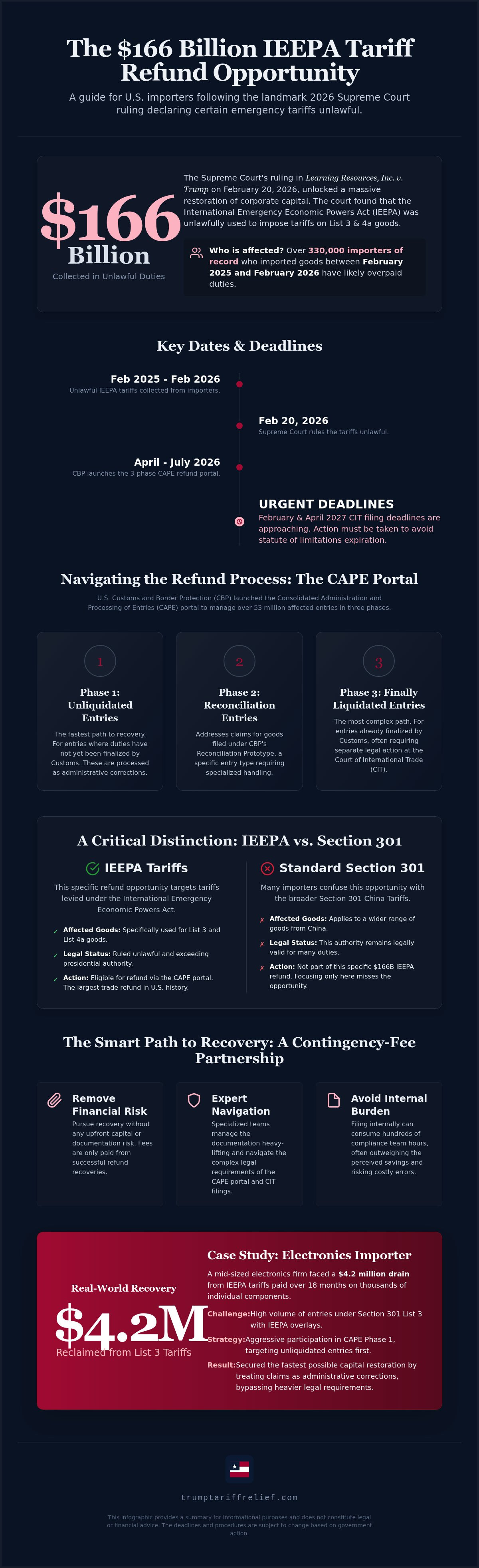
The February 20, 2026, Supreme Court decision in Learning Resources, Inc. v. Trump didn't just clarify trade law; it unlocked a $166 billion restoration of corporate capital. The Court ruled that the International Emergency Economic Powers Act (IEEPA) does not permit the executive branch to impose tariffs indefinitely under the guise of an emergency. This ruling transformed billions of dollars in paid duties from a standard cost of business into an unlawful overpayment. On March 4, 2026, the Court of International Trade (CIT) ordered U.S. Customs and Border Protection to begin the refund process. While the federal government is currently appealing these orders to protect the Treasury's liquidity, the mandate for recovery remains in place. For your company's 2026 balance sheet, this represents a significant opportunity to reclaim liquidity that was previously considered lost.
Why the IEEPA Ruling is Different from Section 301
Many importers confuse these refunds with the broader Section 301 China tariffs. While Section 301 remains a valid authority for many duties, the IEEPA was specifically used to bypass statutory limits for List 3 and List 4a goods. These specific duties, collected between February 1, 2025, and February 23, 2026, were found to exceed the President's delegated power. This distinction is critical for IEEPA tariff refund case studies; businesses that focus solely on Section 301 often miss the specific IEEPA-backed claims that offer the highest recovery potential. It isn't just a minor technicality. These are currently the largest trade-related refunds in U.S. history, impacting over 330,000 importers of record.
The CAPE System: CBP's Infrastructure for Billions
To manage the massive volume of over 53 million affected entries, CBP launched the Consolidated Administration and Processing of Entries (CAPE) portal. The recovery process moves through three distinct phases. Phase 1, launched April 20, 2026, focuses on unliquidated entries where the duty hasn't yet been finalized by Customs. Phase 2 launched on June 29, 2026, for reconciliation entries, while the complex Phase 3 followed in late July 2026 to address finally liquidated entries. If your entries are already liquidated, the path to recovery is more technical and often requires separate legal action at the CIT. You can Learn how IEEPA works to better categorize your own entry types within this system. Analyzing IEEPA tariff refund case studies shows that companies moving early in Phase 3 have the best chance of meeting the strict February 4, 2027, deadline for fentanyl-related IEEPA claims.
Case Study 1: Electronics Importer Reclaims Capital from List 3 Tariffs
A mid-sized electronics firm recently faced a $4.2 million financial drain from IEEPA tariffs paid over an 18-month period. This scenario is a cornerstone of IEEPA tariff refund case studies because it illustrates how quickly capital can be reclaimed when a business acts immediately after a court mandate. The firm's primary challenge was the sheer volume of entries; they imported thousands of individual components under Section 301 List 3, many of which were subject to the unlawful IEEPA overlays. Their strategy focused on aggressive participation in CAPE Phase 1, targeting unliquidated entries to secure the fastest possible capital restoration.
Navigating Phase 1 and Phase 2 Integration
Unliquidated entries provide the fastest path to recovery because they haven't yet been finalized by Customs. By utilizing the ACE Portal to identify every entry with a "liquidated" status of "no," the electronics firm's recovery team could file claims that CBP processed as administrative corrections rather than complex legal disputes. List 3 was particularly vulnerable to the IEEPA ruling because the government utilized emergency authorities to impose duties that bypassed the strict statutory time limits originally established under Section 301. This strategic focus allowed the firm to bypass the heavy documentation requirements that typically slow down Phase 3 filings.
The Pros and Cons of Internal Filing vs. Professional Recovery
While some firms attempt to handle filings internally, the hidden cost of compliance team hours often outweighs the perceived savings. Electronics importers face intense scrutiny on HTS codes because their products often sit on the border of multiple tariff lists. A single documentation error can lead to a CBP rejection, potentially forfeiting a claim worth hundreds of thousands of dollars. Professional recovery experts take on this risk, ensuring that every line item matches the rigorous standards set by the 2026 CIT orders. If you're concerned about the complexity of your own data, you can view our recovery process to see how we handle the heavy lifting.
The result for this electronics firm was transformative. Within the first 90 days following the Supreme Court ruling, they successfully recovered $1.8 million in duties plus interest. This rapid infusion of liquidity allowed the company to stabilize its supply chain and offset the 12.5% Section 301 tariffs that took effect in late July 2026. Their success proves that a proactive approach to IEEPA tariff refund case studies is the most effective way to turn a legal victory into a financial one.
Case Study 2: Industrial Manufacturer and the Phase 3 Lawsuit Requirement
Industrial manufacturers often face the most complex recovery paths due to the long-term nature of their import cycles. In one of the most instructive IEEPA tariff refund case studies, a heavy machinery manufacturer identified $6.5 million in potential refunds but hit a wall: over 70% of their entries were already "finally liquidated." Because these entries fell outside the standard 180-day protest window and the initial CAPE Phase 1 timeframe, the automated refund path was blocked. To secure their capital, the firm had to move beyond administrative filings and initiate a formal protective action at the Court of International Trade (CIT).
The Critical Nature of Finally Liquidated Entries
An entry is considered "finally liquidated" when CBP has finalized the duty calculation and the legal window to protest has closed. For many industrial firms, this status acts as a trap. The federal government is currently taking a hardline stance, often excluding non-litigants from Phase 3 disbursements. This makes understanding the Statute of Limitations for IEEPA Claims essential for every importer of record. Without a timely CIT filing, those liquidated entries effectively become a permanent donation to the U.S. Treasury. The machinery manufacturer realized that their internal compliance team couldn't bridge this legal gap alone, necessitating a partnership with experts who specialize in CIT litigation.
The Power of Protective Filings
A protective filing serves as an insurance policy for your balance sheet. It preserves your right to recover funds even if appellate court rulings fluctuate or the government attempts to narrow the scope of the Supreme Court's mandate. This manufacturer recognized that "waiting and seeing" was a dangerous strategy that could lead to a permanent loss of rights once the February 4, 2027, deadline passes. While Phase 3 disbursements were targeted for late July 2026, eligibility depends on having an active legal claim for entries that are no longer unliquidated. By filing early, the manufacturer successfully protected their $6.5 million claim. This case proves that IEEPA tariff refund case studies involving liquidated entries require a more assertive legal posture than those involving active entries. By leveraging a contingency-fee model, the manufacturer was able to launch this CIT action without any upfront legal costs, shifting the financial risk to the recovery experts.
Case Study 3: Retailer Recovery and the Contingency Fee Advantage
Retailers often operate on razor-thin margins. A $1.2 million overpayment isn't just a line item; it's often the difference between expansion and stagnation. In this scenario, a mid-market consumer goods retailer identified a massive recovery opportunity but lacked the upfront capital to hire traditional trade counsel. They needed a partner prepared to take the risk. By analyzing IEEPA tariff refund case studies, the retailer realized that the contingency-fee model offered a path to restoration without any immediate budget impact. Trump Tariff Relief performed a comprehensive audit, identifying eligible entries that the retailer's internal team had overlooked, specifically within the complex List 3 categories.
Why Contingency Fees Align with Retailer Interests
The primary barrier for mid-market firms is the fear of throwing good money after bad. Traditional legal fees can quickly spiral, especially when dealing with the shifting requirements of the CAPE system. A contingency-based approach removes this obstacle entirely. You only pay a "Success Fee" once the refund is physically in your corporate bank account. This model forces the recovery partner to be both efficient and accurate; if they don't win, they don't get paid. This alignment of interests ensures that your documentation is handled with the highest level of professional care. Professional audits frequently uncover "lost" money because they look beyond simple HTS codes to the underlying legal triggers of the 2026 Supreme Court ruling.
Avoiding the 'Scams' While Securing Expert Help
The scale of the $166 billion refund has unfortunately attracted fraudulent solicitations. Legitimate trade consultants don't ask for upfront "processing fees" or "registration costs." You should look for a partner with a transparent process and a verified Tariff Refund Assessment. This assessment should provide a clear roadmap of your eligibility before any filings are made. A seasoned partner will manage every stage, from HTS data aggregation to final Treasury disbursement. This allows your internal team to focus on core operations while recovery experts handle the bureaucratic heavy lifting. This case study proves that even with tight margins, you can reclaim what's yours by choosing a partner that shares the risk. You can start your recovery assessment today to quantify your potential refund without any financial risk.
Executing Your Strategy: Your Path to IEEPA Recovery in 2026
The transition from identifying a loss to receiving a Treasury check requires a methodical, high-stakes execution strategy. As established in the previous IEEPA tariff refund case studies, successful recovery isn't the result of government generosity; it's the result of precise documentation and timely legal action. To secure your portion of the $166 billion pool, your organization must follow a rigorous five-step roadmap designed to navigate the complexities of the CAPE system and the Court of International Trade.
- Step 1: Conduct a comprehensive tariff eligibility assessment to quantify the exact dollar amount of your claim.
- Step 2: Aggregate historical customs documentation, including entry summaries and HTS data, to build a verifiable audit trail.
- Step 3: Categorize your entry history to determine which CAPE phases apply, distinguishing between unliquidated, reconciliation, and finally liquidated entries.
- Step 4: Execute the necessary CIT filings or CAPE declarations before the strict 2027 deadlines expire.
- Step 5: Monitor the disbursement process actively and respond to CBP inquiries to prevent administrative delays.
The Trump Tariff Relief Process
Our "No Upfront Cost" approach is designed to remove the financial friction that prevents many mid-market firms from pursuing justice. We understand that your internal teams are already stretched thin, which is why our trade experts handle the documentation heavy lifting on your behalf. From the initial audit to the final government filing, we act as your assertive advocate within the bureaucracy. This contingency-fee partnership ensures that we only succeed when you do, aligning our expertise with your financial restoration. You can see how the recovery process works to understand the specific milestones we manage during your claim's lifecycle.
The 3-Year Deadline is Approaching
The statute of limitations is the single biggest threat to your corporate capital. While the Supreme Court has ruled these tariffs unlawful, that ruling doesn't stop the legal clock. For entries involving fentanyl-related IEEPA tariffs, the CIT filing deadline is February 4, 2027. For reciprocal IEEPA tariffs, you must act by April 5, 2027. The 2026 filing window represents a final, non-negotiable opportunity to reclaim corporate capital before the statute of limitations permanently bars all IEEPA claims. If you wait for the government to reach out to you, you'll likely miss these critical dates. The most successful IEEPA tariff refund case studies all share one common trait: the importer started their assessment process immediately rather than waiting for the final months of the eligibility window.
Secure Your Restoration Before the 2027 Deadlines
The 2026 Supreme Court ruling has fundamentally shifted the trade landscape, turning years of tariff overpayments into a massive capital recovery opportunity. As these IEEPA tariff refund case studies prove, whether you're dealing with active unliquidated entries or complex liquidated Phase 3 claims, a proactive stance is the only way to ensure your company isn't left behind. The $166 billion pool is being disbursed now, but the window to file at the Court of International Trade is closing rapidly. You've already paid the price of these unlawful tariffs; now it's time to collect the reward of recovery.
Don't let administrative complexity or the fear of upfront legal fees prevent you from reclaiming what's rightfully yours. Our team provides expert management of complex CIT and CAPE filings with a clear contingency-based model: you only pay if we win. This means there are no upfront legal or consulting fees to start your restoration. Take the first step toward financial restoration and Request Your Free IEEPA Tariff Refund Assessment today. You have a right to this capital, and we have the expertise to help you win it back.
Frequently Asked Questions
Is the IEEPA tariff refund legitimate or a scam?
The refund is completely legitimate. It's based on the February 20, 2026, Supreme Court ruling in Learning Resources, Inc. v. Trump. The Court found the executive branch exceeded its authority under the International Emergency Economic Powers Act. Since then, over $100 billion has already been certified for disbursement. Beware of any firm asking for upfront fees; legitimate recovery specialists operate on a contingency basis.
What is the difference between Section 301 and IEEPA tariffs?
Section 301 tariffs are trade-based duties, while IEEPA tariffs are rooted in national emergency powers. The 2026 ruling specifically invalidated the use of IEEPA to impose tariffs on List 3 and List 4a goods. Not every Section 301 duty is refundable. Only duties paid between February 1, 2025, and February 23, 2026, under the specific IEEPA overlay are eligible for restoration to your company's balance sheet.
Do I really need to file a lawsuit at the CIT to get my refund?
For many importers, a CIT lawsuit is a non-negotiable requirement. While CAPE Phase 1 handles active entries, "finally liquidated" entries that are past the 180-day protest window require a formal protective action at the Court of International Trade. These IEEPA tariff refund case studies show that litigation is often the only way to preserve your rights against the strict three-year statute of limitations that governs these federal claims.
How much does it cost to use a tariff recovery service?
Legitimate recovery partners use a contingency-fee model. This means there are no upfront costs, legal retainers, or consulting fees for your business. The recovery expert takes on the entire financial risk of the documentation and filing process. You're only responsible for a fee once the refund and the applicable interest are successfully recovered and deposited into your corporate bank account.
When is the final deadline to file an IEEPA refund claim?
You must act before the legal clock runs out. For entries involving "fentanyl" IEEPA tariffs on goods from China, Mexico, or Canada, the deadline is February 4, 2027. For "reciprocal" tariff entries, the deadline is April 5, 2027. These dates are non-negotiable. If you haven't filed your case at the CIT by these specific deadlines, your right to reclaim those millions is permanently lost.
How long does it take to actually receive the refund check?
Disbursement speeds depend on your entry status. As of late July 2026, the Treasury has already disbursed billions of dollars to proactive importers. Unliquidated entries processed through CAPE Phase 1 are typically resolved within a few months. However, liquidated entries or those caught in Phase 3 legal actions may take longer. Interest continues to accrue at rates of 5% to 6% per annum while your claim is pending.
Can I file for a refund myself through the ACE portal?
You can technically file yourself, but the technical burden is significant. Successful IEEPA tariff refund case studies demonstrate that professional management is usually more efficient. Filing requires aggregating 18 months of HTS data and navigating the CAPE portal's shifting requirements. A single documentation error can lead to a final rejection from CBP. Using an expert ensures the heavy lifting's done correctly while you focus on core business operations.
What happens if the government wins its appeal in the Federal Circuit?
If the government wins an appeal, it could stop all future automated refunds. That's why filing a protective CIT action is vital right now. A lawsuit secures your specific claim, making it much harder for the government to claw back or deny your refund based on future appellate changes. Acting during the current window of opportunity is the only way to safeguard your company's financial interests.
Ready to find out what your business may be owed?
Check My Eligibility