
The dismissal of the HMTX Industries case might feel like a final door slamming shut on your capital, but the reality of the section 301 court case refund landscape in 2026 is far more lucrative than the headlines suggest. While the Supreme Court's stance on certain China tariffs remains rigid, a massive 166 billion dollar opening has emerged through IEEPA-based recovery. You've likely spent years watching tariffs erode your margins, waiting for a legal breakthrough that felt like it might never come. It's exhausting to manage the uncertainty of trade wars while your hard-earned capital sits in federal accounts.
Discover why the 2026 Supreme Court decision isn't the end of the road and how specialized IEEPA pathways can still secure your business a significant refund. We'll explore the transition from Section 301 litigation to the CAPE system's successful disbursements, the strict three year statute of limitations you must beat, and the exact steps to reclaim your funds without upfront financial risk. This is about more than just paperwork; it's about righting a financial wrong and restoring the liquidity your operations deserve.
Key Takeaways
- Recognize that the June 2026 SCOTUS denial of the HMTX case is not the final word for importers seeking to reclaim lost capital.
- Discover how the IEEPA framework provides a viable alternative for a section 301 court case refund, specifically targeting duties paid on List 3 and List 4A goods.
- Pinpoint your eligibility for substantial recoveries if your business operates within the manufacturing, retail, or technology sectors and paid duties during the specified windows.
- Understand the critical three year statute of limitations and the specific customs documentation required to secure your filing before the legal window closes forever.
- Learn why a contingency based recovery model eliminates upfront financial risk while professional advocates manage the heavy lifting of complex federal bureaucracy.
The Section 301 Court Case: Understanding the 2026 Supreme Court Ruling
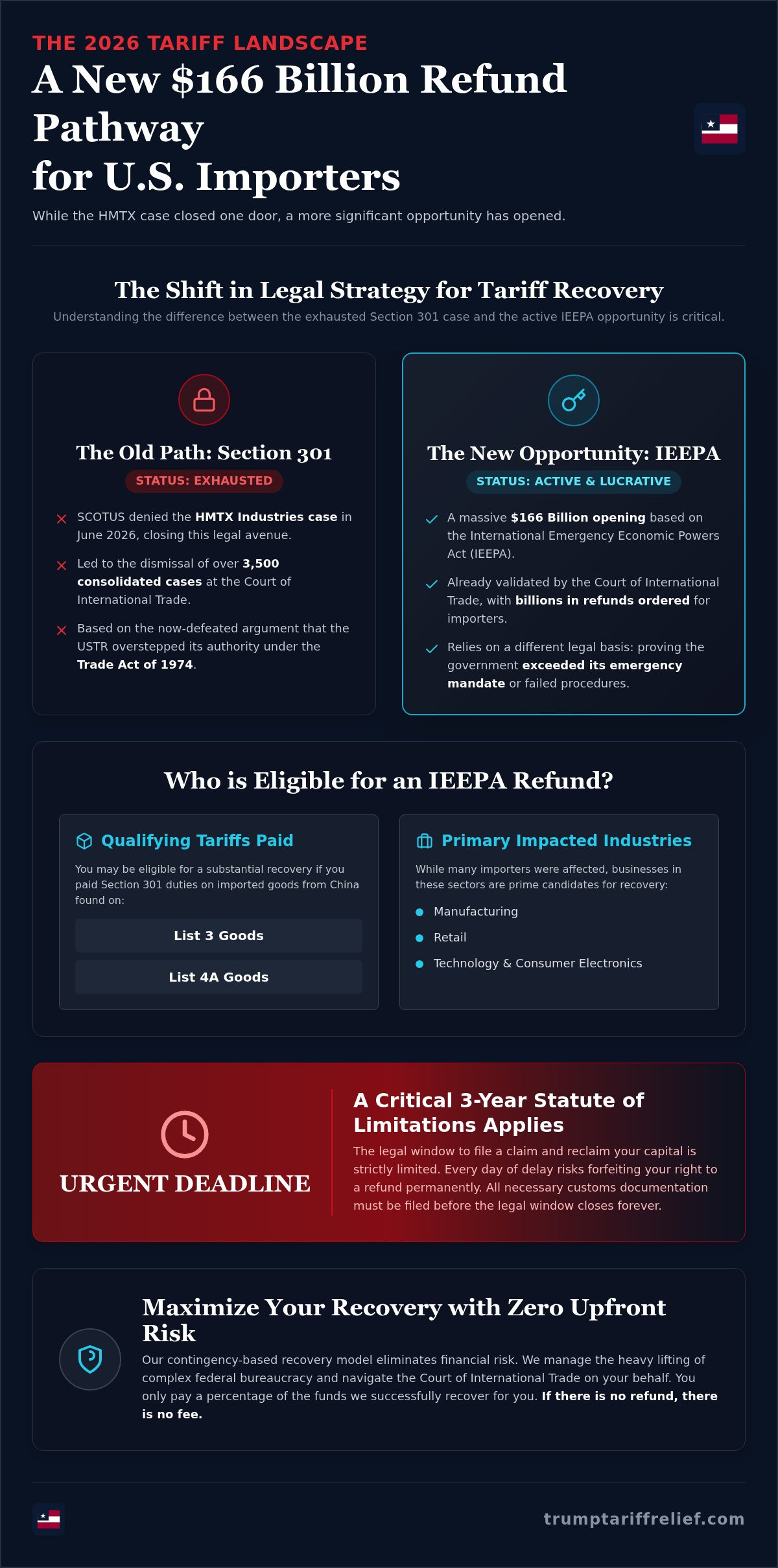
On June 15, 2026, the legal landscape for thousands of American importers shifted permanently. The Supreme Court of the United States denied certiorari in the landmark case of HMTX Industries LLC v. United States, a move that effectively neutralized the most significant challenge to the government's tariff authority in decades. This decision didn't just affect a single litigant; it triggered the immediate dismissal of over 3,500 consolidated cases previously stalled at the Court of International Trade. If your business was holding out for a section 301 court case refund based on the argument that the USTR overstepped its statutory power, that specific door is now locked. The ruling confirms that the executive branch maintains broad discretion under Section 301 of the Trade Act of 1974 to modify trade actions in response to foreign retaliation.
What the HMTX Ruling Means for Your List 3 and 4A Payments
List 3 and List 4A were the primary focus of this multi-year litigation because they represented the most aggressive expansion of duties on Chinese imports, covering everything from consumer electronics to industrial components. The core of the legal petition argued that the USTR lacked the authority to implement these specific lists because they weren't direct responses to the original "unfair trade practices" investigation. However, the Federal Circuit maintained that the USTR acted within its rights to "modify" existing actions when faced with China's own retaliatory tariffs. For businesses, this means the 'test case' strategy is officially dead. You can't simply wait for a global settlement to arrive under the Trade Act of 1974 framework. The capital you've sunk into these duties will not be returned through the HMTX legal theory, making it essential to pivot toward alternative recovery mechanisms that remain legally viable.
The 'exhausted' vs 'active' legal pathways in 2026
It's vital to separate the legal arguments that are exhausted from those that remain active. The Supreme Court's refusal to hear the HMTX case closed the chapter on procedural challenges regarding how the USTR timed and justified its China tariffs. This does not, however, invalidate claims built on different statutory foundations. While the section 301 court case refund pathway under the 1974 Act is largely considered a dead end, the emergence of IEEPA-based recovery and the recent challenges to 2026 forced-labor tariffs represent the new frontier for trade litigation. These pathways rely on entirely different legal precedents and remain unaffected by the HMTX dismissal. As of mid-2026, traditional Section 301 litigation regarding the original China tariffs has reached a definitive dead end, forcing a strategic shift toward specialized recovery frameworks.
IEEPA vs. Section 301: The New Legal Pathway for Tariff Refunds
While the HMTX ruling felt like a definitive defeat for many importers, it only addressed one specific statutory challenge. The International Emergency Economic Powers Act (IEEPA) provides an entirely different legal basis for a section 301 court case refund through a distinct procedural lens. IEEPA isn't just another trade law; it's a high-stakes emergency power that, when misapplied, creates a clear path for capital restoration. The Court of International Trade (CIT) has already validated this route, ordering billions in refunds for importers who were caught in the crossfire of procedural overreach between February 2025 and February 2026. This pathway offers a fresh start for businesses that felt abandoned by the 2026 SCOTUS decision, shifting the focus from Trade Act limitations to the strict boundaries of executive emergency authority.
The Legal Mechanism of an IEEPA Refund Claim
The difference between IEEPA and Section 301 hinges on the scope of executive authority. While the USTR has broad powers to modify trade actions, those powers aren't infinite. A thorough legal analysis of the Section 301 court case reveals that most failed arguments focused on the Trade Act's flexibility. In contrast, IEEPA claims succeed by proving the government exceeded its emergency mandate or failed to follow the strict notice-and-comment procedures required by law. Recent CIT orders have confirmed that when these procedural boundaries are crossed, the duties collected are technically unauthorized. This shift in legal theory has transformed IEEPA from a niche statute into the primary engine for reclaiming seized capital.
Why IEEPA is the strongest remaining tool for capital restoration
Data from July 2026 shows the massive scale of this opportunity. Approximately $166 billion in IEEPA duties have been ordered for refund by the Court of International Trade. Unlike standard protests that often get buried in administrative delays, these claims are being processed through the CBP's CAPE system. For the 330,000 importers who paid these duties, the window for action is narrow but the potential recovery is absolute. You can Learn more about how IEEPA works and why it bypasses the hurdles that stalled previous litigation. In the current regulatory climate, filing under IEEPA is a strategic necessity for any firm that paid duties between 2025 and early 2026. If you're unsure if your entries qualify, you should request a preliminary assessment to identify your total refundable exposure before the statute of limitations expires.
Determining Eligibility: Which Importers Can Still Claim a Refund?
Identifying whether your business qualifies for a section 301 court case refund requires a precise look at your customs entry history rather than a broad assumption based on the HMTX dismissal. Eligibility isn't universal; it's a specialized filter applied to approximately 330,000 importers who paid duties between February 2025 and February 2026. If your firm operates in the manufacturing, retail, or technology sectors, you likely carried the heaviest burden of these costs. The current recovery window focuses on those who maintained active litigation status or filed valid protests against the overreach of emergency powers during that critical twelve month period. It's about verifying that your capital was seized under a specific procedural error that the courts have now recognized as refundable.
To verify your standing, you must cross-reference your Harmonized Tariff Schedule (HTS) codes against the IEEPA recovery umbrella. This isn't just a matter of checking if you imported from China. It's a technical verification of whether those specific entries were categorized under the executive actions that the Court of International Trade recently invalidated. Many businesses mistakenly believe that because their Section 301 protests were tied to the 2018 lists, they're now ineligible. This is a costly misconception. The IEEPA pathway creates a new eligibility tier for duties paid more recently, regardless of your previous status in the original 2018 litigation.
List 3 and List 4A: The Primary Targets for Recovery
List 3 and List 4A remain the central focus of these refund claims because they encompassed the broadest range of industrial and consumer goods. From complex circuit boards and auto components to furniture and apparel, these lists hit the supply chains of nearly every major American industry. These categories represent the largest potential for capital restoration because the duties were often applied at 25 percent, creating a massive pool of refundable assets. Understanding the nuance of these lists is vital to your claim. You can find a detailed breakdown in our Tariff Refund Assessment: A Guide to IEEPA Eligibility and Recovery to see how your specific goods align with the current court orders.
The Importance of a Professional Eligibility Audit
Internal accounting teams are built for compliance, not for identifying obscure regulatory recovery opportunities. They often miss eligible payments because they don't have the specialized "insider" view of how IEEPA and Section 301 lists overlap. A professional Tariff Eligibility Assessment goes beyond a simple spreadsheet review. It involves a deep dive into your 7501 forms and entry summaries to identify every cent that falls under the refundable criteria. This process eliminates the risk of "list overlap" errors where entries are misfiled under the wrong legal theory, which can lead to an immediate rejection by CBP. Relying on an expert audit ensures that you aren't leaving millions on the table simply because of a documentation technicality.
The IEEPA Refund Claim Process: Timelines and Documentation
The path to a successful recovery is methodical and unforgiving. While the high-profile section 301 court case refund litigation dominated the news cycle, a more precise administrative process was being refined for IEEPA claims. Securing your refund involves four non-negotiable stages. First, you must gather every 7501 form and entry summary relevant to your claim, as these documents serve as the primary evidence of your financial loss. Second, you have to verify the three year statute of limitations for each specific entry, accounting for various liquidation dates. Third, your team must draft a legal argument that specifically addresses IEEPA procedural failures rather than the Trade Act grievances that were dismissed by SCOTUS. Finally, you have to manage a multi-year processing timeline that involves both the Court of International Trade and U.S. Customs and Border Protection. This final stage is often the most taxing, as it requires persistent oversight to ensure your certified refunds aren't lost in the Treasury's disbursement backlog.
The 3-Year Deadline: Why Your Window is Closing Fast
The three year statute of limitations operates on a rolling basis, meaning every day you delay could result in the permanent loss of refundable capital. For many businesses, 2026 represents a cliff year where the eligibility window for significant List 3 and List 4A payments will expire. If you don't file before the three year anniversary of your entry's liquidation, the government keeps your money regardless of the court's stance on IEEPA. This isn't a hypothetical risk; it's a hard legal boundary that CBP enforces without exception. These deadlines are particularly dangerous for high-volume importers who may have thousands of entries liquidating at different times. You can read more about these high-stakes timelines in our Tariff Refund Statute of Limitations: The Critical Deadlines for IEEPA Claims.
Essential Documentation for a Successful Filing
Success in this process hinges on the integrity of your paperwork. Entry summaries and proof of payment are the only evidence the CIT accepts to substantiate a claim of overpayment. Most DIY attempts fail because of poor Customs Documentation Management; a single missing 7501 form or a clerical error on an entry summary can invalidate an entire filing. We act as the heavy lifter in this process, organizing and verifying thousands of lines of data to ensure your submission is bulletproof. You can See our process for managing your claim and learn how we remove the administrative burden from your internal team.
Don't let your capital remain in federal accounts simply because of a missed deadline or a missing form. Contact Trump Tariff Relief today to begin your documentation audit before your window of opportunity closes.
Maximizing Your Recovery: Why a Contingency-Based Strategy Wins
The pursuit of a section 301 court case refund has historically been a costly endeavor for importers, often involving massive retainers and unpredictable hourly billing. Many businesses are still reeling from the sunk costs of the HMTX litigation, where legal fees continued to mount even as the chances of success dwindled. This financial friction often prevents companies from pursuing legitimate recovery pathways like IEEPA. A contingency based strategy changes the power dynamic entirely. It aligns our interests with yours; we don't profit unless we successfully reclaim your capital from the federal treasury. This approach isn't just a service model; it's a partnership built on the confidence that your claim is valid and recoverable.
Our firm takes on the role of the heavy lifter, managing the intersection of complex trade law, data analytics, and federal bureaucracy. While your internal team focuses on scaling operations and navigating the 2026 market, we handle the exhaustive Customs Documentation Management required by the CIT. We leverage specialized proprietary technology to audit your entry summaries, identifying every refundable dollar that your previous brokers or accountants likely overlooked. By absorbing the technical and administrative burden, we ensure that your path to restoration is streamlined and professional.
Success Fee vs. Hourly Billing: A Financial Comparison
Traditional legal firms operate on a model that prioritizes billable hours over actual outcomes. In the context of trade litigation, this often results in a situation where the legal costs exceed the potential refund for mid sized importers. When you partner with us, we absorb all upfront costs associated with the CIT filing and the mandatory IEEPA Tariff Refund Recovery documentation. This removes the barrier to entry for businesses that have already been strained by years of aggressive tariff policies. Our contingency model ensures that your pursuit of capital restoration carries zero financial risk, as we only collect a fee once your refund is successfully disbursed.
Getting Started with Trump Tariff Relief
Initiating your recovery doesn't require a complex onboarding process or a financial commitment. The first step is a preliminary Tariff Eligibility Assessment where we review your high level import data to determine your total refundable exposure. During this initial documentation review, we identify which of your List 3 and List 4A entries fall within the active IEEPA recovery window. We provide a transparent breakdown of your potential refund, allowing you to make an informed decision without any pressure or hidden costs. The 2026 statute of limitations is a firm deadline, and every day of inaction is a day your capital remains out of reach. Get your free tariff refund assessment today and secure the capital your business has earned.
Secure Your Capital Before the 2026 Window Closes
The June 2026 Supreme Court decision finalized the exhaustion of Trade Act challenges, but it didn't erase the billions in duties paid under procedurally flawed emergency powers. While the HMTX dismissal felt like a final blow, your path to a section 301 court case refund has simply evolved into a more specialized legal strategy. IEEPA based recovery is now the primary engine for restoring liquidity to your business. You've already carried the weight of these tariffs for years; there's no reason to let your capital sit in government accounts when a clear recovery pathway exists.
Success requires precision in documentation and an aggressive approach to the three year statute of limitations. We act as your specialized partner, managing the entire lifecycle of your claim from the initial audit to the final government check. Because we operate on a contingency basis, you only pay if we win. This eliminates the financial risk and allows you to focus on growth while we handle the heavy lifting of federal bureaucracy. It's time to right this financial wrong and reclaim what belongs to your firm. Claim your IEEPA tariff refund assessment now; no upfront costs. Your business has waited long enough for justice; let's secure your recovery together.
Frequently Asked Questions
Is the China tariff refund real after the 2026 SCOTUS ruling?
Yes, the opportunity for recovery is very much alive, though the legal mechanism has changed. The SCOTUS ruling on HMTX only closed the door on Trade Act arguments. In February 2026, a separate Supreme Court ruling validated refunds for IEEPA duties. Over $128 billion in potential refunds have already been accepted for processing. Your business can still reclaim significant capital if you pivot to the IEEPA framework before the rolling deadlines expire.
What is the difference between Section 301 and IEEPA tariff refunds?
The primary difference lies in the statutory authority used to collect the duties. Section 301 is based on the Trade Act of 1974, while IEEPA refers to the International Emergency Economic Powers Act. The Court of International Trade specifically invalidated duties collected under IEEPA between February 2025 and February 2026. This means even if your Section 301 arguments were dismissed, you can still secure a refund based on IEEPA procedural overreach.
How long do I have to file a Section 301 court case refund claim?
Importers generally have three years from the date of liquidation to file a claim. This rolling deadline makes 2026 a high stakes year for those who paid duties on List 3 and List 4A goods. If you fail to act within this three year window, your right to a section 301 court case refund through the IEEPA pathway is permanently forfeited. Immediate action is required to audit your documentation and secure your filing status.
Which companies are eligible for an IEEPA tariff refund?
Eligibility is concentrated among the 330,000 importers in the manufacturing, retail, and technology sectors that paid duties during the 2025 to 2026 window. You must have imported goods categorized under List 3 or List 4A. Because the recovery hinges on specific procedural errors, your entries must be cross referenced against the court's invalidated lists. A professional assessment is the only way to verify if your specific HTS codes fall under the current refund umbrella.
How much does it cost to hire a tariff recovery consultant?
Hiring a specialized recovery partner should not cost your business anything upfront. We operate on a contingency fee basis, meaning we only receive payment if we successfully recover your capital. This model removes the financial barrier to entry and ensures we are motivated to maximize your refund. We handle the complex documentation and the multi year government filings, while you maintain your liquidity for daily operations and growth.
What happens if my Section 301 case was already dismissed by the CIT?
A dismissal in the consolidated Section 301 litigation doesn't automatically disqualify you from an IEEPA refund. Since IEEPA is a distinct legal pathway with different procedural requirements, many entries dismissed under the HMTX ruling remain eligible for recovery under IEEPA. We specialize in navigating these technical distinctions to find capital that others have written off. You should have your entries re audited to identify if they qualify for this active recovery route.
How long does the IEEPA refund process typically take?
The IEEPA refund process is a multi year administrative journey that moves from the Court of International Trade to CBP’s CAPE system. While the court has already ordered billions in refunds, the disbursement phase involves certifying over 53 million customs entries. Most importers can expect the process to take several months once their documentation is submitted. We provide the persistent oversight necessary to ensure your claim doesn't stall in the federal disbursement backlog.
Do I need a customs broker or a specialized consultant for this claim?
Customs brokers focus on compliance and daily entries, but they rarely have the specialized legal expertise required for a section 301 court case refund. Reclaiming duties through the CIT requires a deep understanding of IEEPA precedents and complex documentation management. We act as your advocate, managing the high stakes legal filings that brokers typically avoid. Our specialized focus ensures that every eligible entry is identified and pursued with the necessary professional authority.
Ready to find out what your business may be owed?
Check My Eligibility