
Did you know that $166 billion in overpaid duties is currently sitting in government accounts, waiting to be reclaimed by over 330,000 American businesses? You've likely heard whispers of this massive recovery opportunity and dismissed it as just another china tariff refund scam. It's a natural reaction; after years of trade volatility and aggressive enforcement, the idea of the government handing back capital feels like a fantasy. You're right to be cautious, especially when your working capital is on the line and the fear of triggering a CBP audit feels very real.
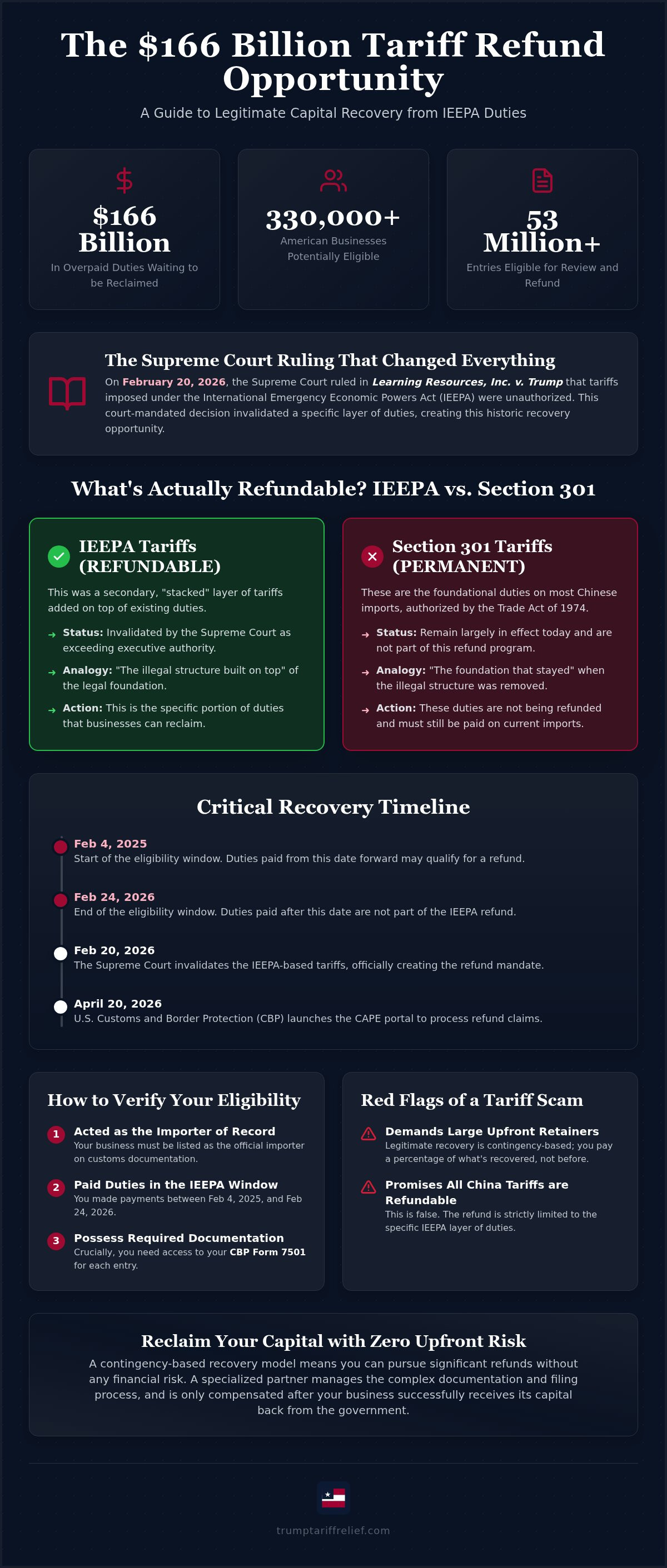
The legal landscape shifted on February 20, 2026, when the Supreme Court ruled in Learning Resources, Inc. v. Trump that IEEPA-based tariffs were unauthorized. This landmark decision didn't just suggest a change; it invalidated a specific year of duty collections. You'll discover the legal reality behind these refunds and learn how your business can legitimately reclaim its capital without any upfront financial risk. We'll clarify exactly which duties qualify, distinguish them from permanent Section 301 tariffs, and outline a high-stakes path to restoration that keeps your business protected.
Key Takeaways
- Understand the 2026 Supreme Court ruling that invalidated IEEPA-based tariffs, opening a significant window for business capital recovery.
- Learn to distinguish between predatory trade schemes and the legitimate IEEPA recovery process to avoid falling victim to a china tariff refund scam.
- Identify the crucial differences between standard Section 301 duties and refundable IEEPA tariffs to accurately assess your potential claim value.
- Discover the specific documentation required, including CBP Form 7501, to verify your eligibility as an Importer of Record.
- Explore how a contingency-based recovery model allows you to pursue significant refunds with zero upfront financial risk to your organization.
Understanding the Supreme Court’s IEEPA Ruling
On February 20, 2026, the legal framework governing international trade underwent a seismic shift. The Supreme Court's decision in Learning Resources, Inc. v. Trump didn't just suggest a policy change; it struck down a specific category of duties as unconstitutional. This ruling invalidated tariffs imposed under the International Emergency Economic Powers Act (IEEPA), a law originally intended for national security emergencies, not for stacking permanent economic duties on top of existing trade barriers.
Because this recovery opportunity involves billions of dollars, the term china tariff refund scam has surfaced frequently in trade circles. It's vital to understand that this isn't a political promise or a campaign slogan. It's a court-mandated restoration of capital. 2026 is the critical year for recovery due to several key factors:
- Ruling Date: The Supreme Court invalidated the tariffs on February 20, 2026.
- Eligibility Window: Refunds apply to duties paid between February 4, 2025, and February 24, 2026.
- Portal Launch: CBP opened the CAPE portal for processing on April 20, 2026.
If you imported goods during this window, the government is legally required to return the specific IEEPA portions of those duties. Rolling deadlines for liquidated entries are already passing, making immediate action a necessity for any business looking to reclaim its tied-up capital.
The Distinction Between IEEPA and Section 301
Many importers find themselves confused by the overlapping layers of trade law. Most Chinese imports are subject to duties authorized by Section 301 of the Trade Act of 1974, which remains largely in effect today. The IEEPA duties were a secondary, "stacked" layer of tariffs that the courts eventually found to exceed executive authority. To put it simply: Section 301 is the foundation that stayed, while IEEPA was the illegal structure built on top of it. This specific legal overreach is the catalyst for the current $166 billion refund pool. Learn more about the IEEPA ruling to see how these distinctions impact your specific HTS codes.
Why This Ruling Changed the Import Landscape
This judicial intervention represents a historic pivot from unlimited executive trade power toward strict judicial oversight. For years, businesses accepted rising costs as an unavoidable reality of global logistics. Now, the tide has turned. With over 53 million entries eligible for review, millions in capital are being unlocked for US-based importers who acted as the Importer of Record during the effective period. This isn't just about a one-time check; it's about correcting a regulatory error that tied up your working capital for over a year. The opportunity for recovery is massive, but it requires a precise, documentation-heavy approach to navigate the government's new CAPE portal effectively.
Why Business Owners Are Skeptical: Scam vs. Reality
Importers are understandably wary. For years, the trade environment has been defined by rising costs and complex regulations. When a firm promises to recover six or seven figures in paid duties, it often triggers the same internal alarm as a china tariff refund scam. This skepticism is a healthy defense mechanism. Predatory consultants often flood the market after major legal shifts, offering "guaranteed" results without understanding the specific HTS Chapter 99 classifications that define actual eligibility. They capitalize on the confusion surrounding the $166 billion in available refunds, making the legitimate recovery process sound like a fantasy.
The reality is that U.S. Customs and Border Protection (CBP) has established a formal, structured process for these refunds via the Consolidated Administration and Processing of Entries (CAPE) portal. This isn't a loophole or a political favor. It's a mandatory government response to a Supreme Court mandate. However, CBP doesn't just hand out checks automatically. Every entry must be meticulously verified against the unconstitutional IEEPA window. A legitimate partner acts as your advocate, managing this high-stakes documentation to ensure your claim isn't rejected for technical errors.
Red Flags of Tariff Refund Scams
Distinguishing between a legitimate recovery opportunity and a fraudulent scheme requires a critical eye. Avoid any firm demanding large upfront retainers or filing fees. Legitimate recovery is based on results, not administrative overhead. Be wary of promises that all China tariffs are refundable. While the IEEPA layer was struck down, the foundational legal basis for Section 301 tariffs remains intact for the vast majority of goods. A firm that fails to distinguish between these two legal authorities is likely misleading you about your actual recovery potential.
The Hallmarks of a Legitimate Recovery Service
A trustworthy partner operates with total transparency and zero financial risk to your business. They should provide a clear breakdown of which entries qualify under the 2025 to 2026 window and which do not. Legitimate services leverage trade attorneys and customs experts to navigate the CAPE portal's complexities. Most importantly, they align their interests with yours through a contingency-fee model. This ensures they only get paid after you've successfully recovered your capital. If you're unsure where your business stands, you can review how the recovery process works to see the specific steps involved in a professional filing.
Section 301 vs. IEEPA: What is Actually Refundable?
Navigating the technical distinction between various trade laws is where most businesses get lost. It's also where the term china tariff refund scam often originates. Skeptics argue that since Section 301 tariffs remain in place, no refunds are possible. They're half right. While the foundational Section 301 duties continue to affect billions in trade, the secondary IEEPA stack that began in early 2025 was the specific layer the Supreme Court dismantled. You aren't reclaiming all China tariffs; you're reclaiming the specific, unconstitutional surcharge added on top of them.
To understand what's refundable, you must look at the stacking effect. Starting February 4, 2025, the government added a supplemental duty to goods already covered under Section 301. This primarily targeted products on List 3 and List 4a. If your business imported electronics, textiles, or consumer goods found on these lists during the invalidated window, you likely overpaid. The right to reclaim this capital belongs strictly to the Importer of Record (IOR) listed on the customs entry. If you weren't the IOR, you don't have the legal standing to file a claim, regardless of who ultimately bore the cost in the supply chain.
Identifying Refundable HTS Classifications
Success in recovery depends on an entry-by-entry analysis of your customs data. You cannot simply look at your total duty spend and guess the refund amount. Legitimate claims require identifying specific HTS Chapter 99 classifications that denote IEEPA surcharges. Standard accounting software often misses these nuances because it aggregates duties into a single "tax and tariff" line item. Professional recovery requires a deep dive into your CBP Form 7501 records to isolate the refundable portions from the permanent ones. You can see how the recovery process works to understand the data points required for a successful filing.
The Role of AD/CVD and Other Exclusions
Anti-dumping and countervailing duties (AD/CVD) add another layer of complexity to your refund total. If your goods are subject to AD/CVD, the math changes, but the eligibility for an IEEPA refund usually remains. Similarly, having a Section 301 exclusion doesn't necessarily negate your IEEPA claim. In many cases, businesses that were already exempt from Section 301 were still erroneously charged the IEEPA surcharge. This complexity is why some assume any mention of a refund is a china tariff refund scam, yet the legal precedent is clear. For a detailed breakdown of these variables, consult our 2026 Recovery Guide to see how AD/CVD impacts your specific bottom line.
How to Verify Your Business’s Eligibility
Confirming your eligibility is the most effective way to distinguish a legitimate recovery opportunity from a china tariff refund scam. While fraudulent offers rely on vague promises, the path to a real refund is paved with specific customs data. If your business imported goods from China between February 4, 2025, and February 24, 2026, you likely have capital waiting to be reclaimed. Following a structured verification process ensures you don't leave money on the table or waste time on ineligible entries.
- Step 1: Identify your status as the Importer of Record (IOR). You must be the legal entity that paid the duties to CBP. If you purchased goods DDP (Delivered Duty Paid), the refund rights typically belong to your supplier or broker.
- Step 2: Aggregate your Entry Summaries (CBP Form 7501). Collect every 7501 form for entries liquidated or filed within the 2025 to 2026 window. These documents are the primary evidence for your claim.
- Step 3: Filter for China-origin goods subject to IEEPA surcharges. Look specifically for the supplemental Chapter 99 duties that were "stacked" on top of standard Section 301 tariffs.
- Step 4: Cross-reference with the IEEPA statute of limitations. Verify the liquidation dates for each entry. Claims must be filed within specific regulatory windows, often 180 days post-liquidation for protests, or within the CAPE portal's phased rollout schedule.
- Step 5: Perform a preliminary audit. Calculate the total value of the IEEPA-specific surcharges paid to estimate your total recovery potential before beginning the formal filing.
Required Documentation for a Successful Claim
Precision is mandatory when dealing with CBP's CAPE portal. You'll need more than just a summary of costs; successful claims require accurate commercial invoices and packing lists that match your entry summaries exactly. Digital record-keeping has become the key to faster government processing in 2026. If your records are disorganized, you risk significant delays or outright rejection. For a deeper dive into the technical requirements, read our Tariff Refund Assessment: A Guide to IEEPA Eligibility and Recovery.
The 3-Year Deadline: Why You Must Act Now
The window for recovery is not permanent. Customs law operates on strict, rolling deadlines; once an entry's protest window or CAPE eligibility phase expires, that capital becomes unrecoverable forever. Many businesses wait for a "final" announcement that never comes, only to find their 2025 entries have already aged out of the system. In the high-stakes environment of 2026, every week of delay represents a permanent loss of eligible capital. You can request a preliminary eligibility assessment today to secure your place in the recovery queue before your deadlines expire.
Reclaiming Your Capital Through Contingency-Based Recovery
Pursuing a significant refund shouldn't introduce new financial risk to your balance sheet. The prevalence of the china tariff refund scam has made many Importers of Record hesitant to engage with trade consultants, and rightfully so. Traditional legal models often require high hourly fees for speculative claims, leaving businesses to pay for the "attempt" regardless of the outcome. A contingency-based recovery model eliminates this barrier by aligning our interests directly with yours. We only succeed when you successfully recover your capital, creating a high-stakes partnership rooted in performance rather than administrative billables.
Trump Tariff Relief manages the complex bureaucratic heavy lifting required to navigate the CAPE portal and the subsequent CBP verification phases. By avoiding upfront legal retainers, your business can pursue the restoration of its working capital without depleting current cash reserves. In the competitive landscape of 2026, reclaiming these overpaid duties serves as a strategic injection of capital that can be reinvested into growth, inventory, or R&D. We position ourselves as your specialized ally, navigating the technicalities of IEEPA while you focus on your core operations.
The Trump Tariff Relief Process
Our methodology is designed for maximum efficiency and minimum client interruption. The journey moves from an initial eligibility assessment to the final issuance of a Treasury check. Our trade experts handle every CBP inquiry, documentation request, and technical hurdle that arises during the filing process. We don't just submit forms; we advocate for the full value of your claim, ensuring that every refundable entry is accounted for and defended against government scrutiny. If you have specific concerns about the timeline or documentation, you can Read our Frequently Asked Questions to see how we address complex import scenarios.
Next Steps: Securing Your Preliminary Assessment
The first step toward financial restoration is a zero-cost preliminary assessment. This phase allows our team to review your data and estimate your total recovery value before any formal agreements are signed. During the documentation review, we'll identify exactly which 2025 to 2026 entries are eligible and flag any potential roadblocks in your filing. This transparent approach ensures you have a clear understanding of the opportunity before moving forward. The closing deadline for IEEPA claims is approaching rapidly, and entries that aren't protested or filed within their specific windows will be lost forever. Secure your assessment now to ensure your business doesn't leave its rightful capital in government accounts.
Reclaim Your Rightful Capital Before Deadlines Expire
The Supreme Court's invalidation of IEEPA surcharges has created a narrow but massive window for financial restoration. You've learned that while Section 301 duties remain, the supplemental layers added in 2025 are legally refundable. Success depends on acting before rolling liquidation deadlines pass and entries become unrecoverable forever. Precision in your documentation is the only way to ensure your claim is accepted by CBP.
While it's wise to stay alert for any china tariff refund scam, the $166 billion recovery pool is a court-mandated reality. Our specialized IEEPA recovery experts provide a national service for U.S. importers, managing the entire documentation process from assessment to filing. Because we operate on a contingency-fee basis, we only get paid if you do. This eliminates financial risk and ensures our interests are perfectly aligned with your recovery. We handle the heavy lifting so you can focus on your core business.
Don't let your working capital remain tied up in government accounts. Get Your Free IEEPA Tariff Refund Assessment Today and take the first step toward reclaiming what your business is legally owed. You've navigated the challenges of the trade war; now it's time to collect the reward.
Frequently Asked Questions
Is the China tariff refund a real government program?
Yes, the IEEPA tariff refund is a legitimate legal reality resulting from the Supreme Court's February 20, 2026, ruling in Learning Resources, Inc. v. Trump. This decision invalidated billions in unauthorized duties collected between early 2025 and 2026. While skepticism is common due to the prevalence of the china tariff refund scam, this specific recovery is processed through U.S. Customs and Border Protection's official CAPE portal. It's a mandatory restoration of capital for eligible Importers of Record.
How much money can my business actually recover?
The total recovery amount depends entirely on the volume of IEEPA-specific surcharges your business paid during the invalidated window. An estimated $166 billion in total duties was collected from over 330,000 businesses across the country. Some large-scale importers have already confirmed recoveries ranging from $20 million to nearly $40 million. A professional assessment isolates these specific HTS Chapter 99 surcharges from your standard duties to provide a precise estimate of your business's tied-up capital.
What is the difference between IEEPA and Section 301 tariffs?
Section 301 tariffs are foundational trade duties that remain largely in effect for Chinese imports today. In contrast, IEEPA duties were a supplemental, "stacked" layer of surcharges that the Supreme Court declared unconstitutional in 2026. Only the portion of your payments attributed to IEEPA is refundable. Understanding this distinction is critical for any business looking to verify its eligibility and avoid misleading claims that suggest all China-related duties can be reclaimed through this process.
Do I need a lawyer to file a tariff refund claim?
You aren't strictly required to hire a lawyer, but navigating the CAPE portal and CBP's documentation requirements is incredibly complex. Many businesses partner with specialized recovery experts who utilize trade attorneys to ensure every entry is filed correctly. This professional oversight helps prevent technical rejections and ensures your claim withstands government scrutiny. Leveraging experts allows your internal team to focus on daily operations while seasoned professionals manage the high-stakes bureaucratic heavy lifting.
How long does it take for the government to issue a refund check?
CBP generally anticipates issuing valid IEEPA refunds within 60 to 90 days after a successful CAPE Declaration is accepted. However, this timeline depends on the accuracy of your documentation and the specific phase of the portal's rollout. Entries that require additional manual review or involve complex AD/CVD variables may take longer. Working with a recovery partner ensures your documentation is audit-ready, which typically accelerates the approval process and minimizes the frequency of government inquiries.
What is a contingency-based recovery fee?
A contingency-based recovery fee means you face zero upfront costs or hourly legal bills during the filing process. The service provider's compensation is calculated as a percentage of the actual refund they successfully recover for your business. This model is a powerful tool against the china tariff refund scam because it aligns the consultant's interests with yours. If the firm doesn't secure a refund check from the U.S. Treasury, you don't pay for the service.
Is there a deadline for filing an IEEPA tariff refund claim?
There isn't a single, fixed deadline for all claims because each customs entry has its own rolling deadline based on its liquidation date. Generally, businesses have 180 days from the date of liquidation to file a protest. However, the CAPE portal operates on a phased rollout schedule that may offer different windows. Because expired entries become unrecoverable forever, performing an immediate eligibility assessment is the only way to protect your right to reclaim capital.
Will filing for a refund trigger a customs audit of my business?
Filing a legitimate refund claim through the CAPE portal is a standard administrative process, not an automatic trigger for a full-scale audit. However, CBP will review the specific entries included in your declaration to verify their accuracy. This is why meticulous documentation management is essential. By ensuring your commercial invoices and packing lists match your HTS classifications perfectly, you demonstrate compliance and reduce the likelihood of the government requesting a more intrusive records review.
Ready to find out what your business may be owed?
Check My Eligibility