
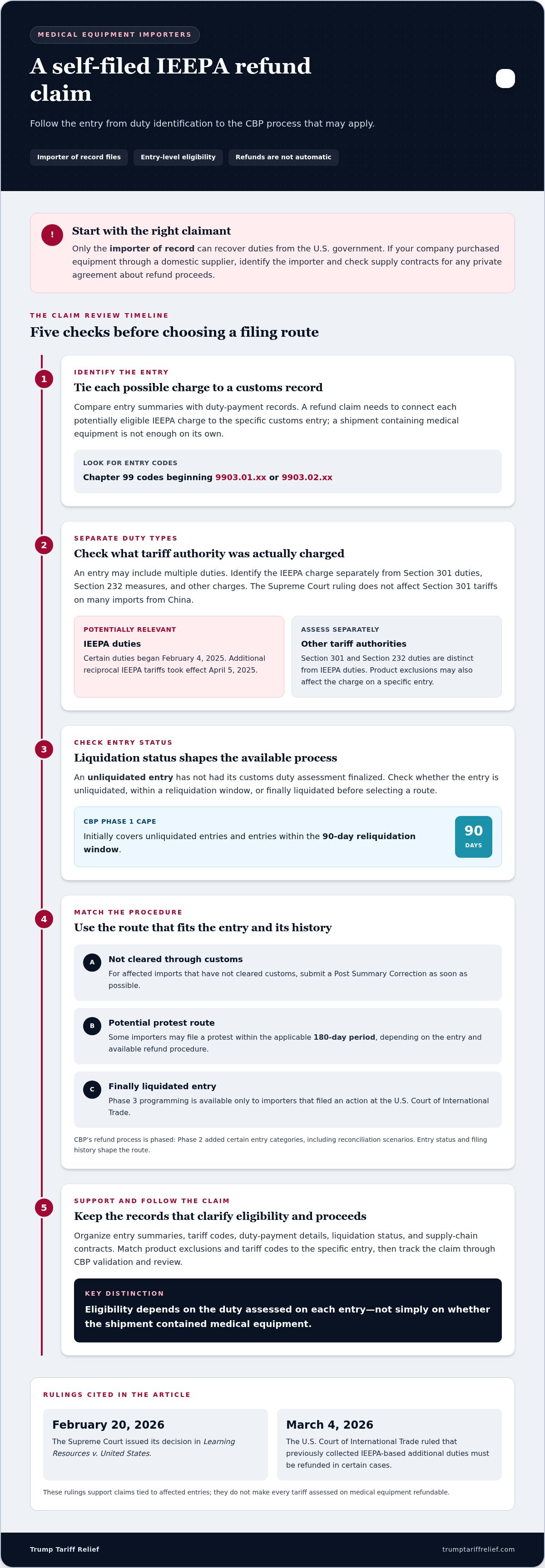
You can file an IEEPA refund claim yourself, but filing is only one part of recovery. A tariff refund for medical equipment importers depends on eligible entries and accurate records, and only the importer of record can recover duties from the U.S. government. CBP’s Phase 1 CAPE process initially covers unliquidated entries and entries within the 90-day reliquidation window.
If you’re weighing whether to handle a tariff refund claim in-house, the key question is whether you can identify the right entries and manage the filing details, not simply whether a refund process exists. Refunds aren’t automatic, and missing or inaccurate entry information can complicate recovery.
This guide explains which IEEPA duties may qualify, how CBP reviews claims, and which import and supply-chain records to track. You’ll also learn when self-filing may be practical and when specialized eligibility assessment and documentation support can help move a claim forward.
Key Takeaways
- You can file a refund claim yourself, but first identify the importer of record and determine which entries qualify for the available process.
- Review tariff codes and entry dates to distinguish potentially refundable IEEPA duties from other tariffs that follow different rules.
- Understand how CAPE validation and review affect a claim, and track its status through the refund process.
- Organize entry records, payment details, and supply-chain contracts to support eligibility review and clarify who may have an interest in recovered duties.
Can I file an IEEPA refund claim myself?
Yes. An importer of record can pursue an IEEPA refund claim without hiring a representative. The work still involves identifying potentially eligible customs entries, checking their status, and filing through the applicable process.
IEEPA Refund Eligibility
IEEPA refund eligibility concerns duties imposed under the International Emergency Economic Powers Act. This distinction matters because a medical equipment entry may include several types of duties, while only the relevant IEEPA charges are at issue.
Certain IEEPA duties began on February 4, 2025. The federal powers used to impose those duties became central after the Supreme Court issued its decision in Learning Resources v. United States.
Eligibility depends on the duty assessed on each entry, not simply on whether a shipment contained medical equipment. Separate tariff authorities and product exclusions can affect which charges applied.
Unliquidated Entry Eligibility
An unliquidated entry is one whose customs duty assessment has not been finalized. Its status matters because CBP’s Phase 1 CAPE process initially covers unliquidated entries and entries within the 90-day reliquidation window.
Check the entry’s liquidation status before deciding which refund route applies. A medical-device shipment still awaiting liquidation may fall within Phase 1, while a finalized entry requires attention to its applicable procedure and deadlines.
Some importers may file a protest within the applicable 180-day period, depending on the entry and available refund procedure, according to U.S. Customs and Border Protection. The entry’s status and available process determine the next step.
Identifying Eligible Customs Entries
Entry identification means matching customs records to IEEPA duties paid on specific imports. This matters because a refund claim must connect each potentially eligible charge to its entry.
Compare entry summaries and duty records, including Chapter 99 tariff codes beginning with 9903.01.xx or 9903.02.xx. For example, an importer can separate an IEEPA charge from a Section 301 duty on the same equipment shipment.
The importer of record is the party that can claim duties from the U.S. government. If your company bought equipment through a domestic supplier, identify the importer of record and review your supply contracts for any private agreement about refund proceeds.
Section 301 tariffs are distinct from IEEPA duties, and the Supreme Court ruling does not affect Section 301 tariffs on many imports from China. Product exclusions may affect whether a particular duty applied, so match the exclusion and tariff code to the specific entry rather than treating every medical product alike.
Which IEEPA tariffs may qualify for refunds?
Potential eligibility depends on the tariff authority, entry record, and applicable refund procedure, not medical-device status alone. A tariff refund for medical equipment importers may include eligible IEEPA duties, while other charges must be assessed separately.
Potential IEEPA Duty Refunds
Potential IEEPA duty refunds are repayments of eligible charges collected under the emergency statute. They matter to medtech firms because one entry can include IEEPA and other duties. Additional reciprocal IEEPA tariffs took effect on April 5, 2025, expanding potential refund eligibility, according to U.S. Customs and Border Protection. PwC estimated U.S. That estimate is industry-wide, not an individual importer’s projected recovery.
Refunds of Unlawful Duties
Refunds of unlawful duties are repayments sought for charges imposed under IEEPA authority that courts rejected. On February 20, 2026, the Supreme Court issued its decision in Learning Resources v. United States. On March 4, 2026, the U.S. Court of International Trade ruled that previously collected IEEPA-based additional duties must be refunded in certain cases. These rulings support claims tied to affected entries, not every tariff assessed on medical equipment.
Which U.S. tariffs apply to imported medical equipment and devices? Rates and duties depend on product classification and country of origin; reported medical-device tariff rates range from 10% to 50%. Section 232 covers an investigation into medical devices, including equipment, consumables, and personal protective equipment. Section 301 duties affect many imports from China. These authorities are distinct from IEEPA duties.
Can importers recover tariffs on medical equipment imported from China? They may seek refunds for eligible IEEPA duties, but Section 301 duties on many Chinese imports are not covered by the Supreme Court ruling. The Harmonized Tariff Schedule classification and Chapter 99 entry codes help distinguish duty types. Product exclusions can affect which charges applied. To pursue a tariff refund for medical equipment importers, identify the duties and codes associated with each entry.
How are medical devices classified under the U.S. Harmonized Tariff Schedule, and what duty rates apply? Classification depends on product characteristics and tariff provisions; the applicable rate also depends on origin and additional measures. Match the HTS classification and Chapter 99 codes on each entry to the duties actually paid.
What are the CBP deadlines and procedures for protesting or correcting tariff charges? For affected imports that have not cleared customs, submit a Post Summary Correction as soon as possible. Some importers may file a protest within the applicable 180-day period, depending on the entry and available procedure.
Refunds proceed in phases: Phase 2 added certain entry categories, including reconciliation scenarios. Phase 3 programming for finally liquidated entries is available only to importers that filed an action at the U.S. Court of International Trade. Entry status and filing history shape the route.
Review the IEEPA tariff framework to distinguish potentially refundable duties from separate tariff measures.
CBP review and refund processing times
CBP reviews IEEPA refund declarations through its CAPE system, checking entry data before processing refunds. Track both the review status and electronic payment setup.
CBP Claim Review
CBP claim review is the validation and processing of entries included in a CAPE Declaration. An entry may fail validation or need further review before a refund is issued.
CAPE validated 25.1 million entries for refund processing, while 5.02 million failed validation testing. CBP also accepted approximately $128.68 billion in potential and certified refunds for processing. These figures show why importers should reconcile declaration data against entry records, including tariff codes, liquidation status, and amounts paid.
Refund Processing Times
Refund processing time runs from CBP’s acceptance of a CAPE Declaration through review and payment. CBP expects to process many valid requests within approximately 60 to 90 days after acceptance.
A processing estimate is not a promise for every claim. Validation issues, entry status, and declaration completeness can affect progress. Eligible refunds may be bundled and include interest, so compare the payment detail with the entries covered.
Payment is electronic. The Electronic Refunds Interim Final Rule was published in the Federal Register on January 2, 2026, and a February 2026 rule requires electronic tariff refund payments. CBP stopped issuing paper refund checks on February 6, 2026. Importers should therefore maintain access to the appropriate electronic refund setup and monitor the payment account connected to their customs activity.
Refund proceeds can also raise contractual questions. The importer of record receives duties from the U.S. government, but supply-chain contracts may give another party a private right to a share. If you bought medical equipment and paid a supplier’s tariff-related surcharge, review the contract and coordinate with the importer of record. That private arrangement does not replace CBP’s administrative refund process.
Keep the CAPE declaration, validation results, entry-level records, and payment notices together. If an entry fails validation, compare its data with the underlying customs documents and identify the discrepancy before relying on the projected processing window. Supreme Court decisions concerning the International Emergency Economic Powers Act prompted the refund process, but separate measures, including Section 232, remain distinct from IEEPA claims.
Documentation and tariff exposure tracking
Build an entry-level record linking each medical equipment shipment to its customs declaration, duty payment, and supporting documents. A complex supply chain can separate the importer of record from the company that ultimately absorbed the tariff cost.
Start with CBP entry summaries, matching each entry to commercial invoices, packing lists, proof of payment, and declared tariff codes. Record the product description, country of origin, importer of record, entry status, and duty types. Separating IEEPA charges from other tariffs helps identify amounts relevant to the refund process.
Track the timeline and legal basis for tariffs imposed on each shipment. For example, distinguish duties imposed under emergency economic powers from charges assessed under another tariff authority. Record when an administration announced a measure and when it took effect, then link those details to the entry and its supporting documents. This creates a defensible audit trail instead of a broad estimate based on supplier pricing.
- Entry data: Keep entry numbers, dates, product descriptions, HTS classifications, Chapter 99 codes, and liquidation status together.
- Payment evidence: Match duty amounts to customs records, broker statements, and accounting entries.
- Supply-chain records: Preserve purchase orders, supplier invoices, and contracts showing who paid or absorbed tariff costs.
- Claim history: Save CAPE declarations, validation notices, correction records, and payment updates from CBP.
For indirect exposure, compare a supplier invoice before and after a tariff surcharge, and keep the contract explaining how the charge was passed through. Request supply-chain contracts from the seller as part of due diligence. Contract terms may give another party a private right to a share of refund proceeds, even though the importer of record claims duties from the government.
Keep one exposure tracker that connects those documents and records unresolved discrepancies, such as a tariff code that differs between an invoice and entry summary. If aligning entry data and supporting files is difficult, review how refund recovery works.
Trump Tariff Relief: IEEPA Tariff Refund Recovery
Trump Tariff Relief helps medical equipment importers assess potential IEEPA refunds, organize customs records, and manage the recovery process. Its Tariff Eligibility Assessment helps clarify which entries and duties may qualify, while Customs Documentation Management supports the records needed for review.
Turn to this support when your team has identified possible IEEPA charges but needs help connecting entry data, payment records, and filing requirements. Trump Tariff Relief manages IEEPA Tariff Refund Recovery on a contingency basis: no upfront cost, and payment is only a percentage of funds successfully recovered. Refund outcomes cannot be guaranteed.
For a focused review of your potential claim and supporting records, contact Trump Tariff Relief.
Turn your entry review into a clear next step
A tariff refund for medical equipment importers is more than a customs task. It can affect financial forecasts, supplier discussions, and how your organization records recovered duties. Aligning these teams around the same entry-level records can help keep a refund review connected to commercial agreements.
Trump Tariff Relief offers IEEPA Tariff Refund Recovery, Tariff Eligibility Assessment, and Customs Documentation Management. These services support the connected work of assessing entries, organizing records, and pursuing recovery. The right next step depends on your role in the import transaction and the documentation available.
Bring your questions and relevant import records into a focused discussion, then decide how to proceed with a clearer view of your claim. Contact Trump Tariff Relief to discuss your situation and take the next step with confidence.
Frequently Asked Questions
How do I know whether my imports qualify?
Start by determining whether an entry includes duties imposed under IEEPA, then identify the importer of record and the entry’s status. A shipment containing diagnostic equipment may have multiple tariff charges, so the product category alone does not establish eligibility. Compare entry data with duty assessments and payment records, separating IEEPA charges from duties imposed under other authorities.
What does the filing process look like?
The importer or its authorized representative submits the applicable refund filing with entry information through the available CBP process. CBP then validates the declaration and processes accepted entries. If filing data conflicts with the underlying entry record, the discrepancy may need to be addressed before processing continues. Keep records of the submission, notices, corrections, and payment status to track the claim through review.
Why aren't refunds automatic?
CBP must connect duties paid to specific entries and determine whether each entry fits the refund process. For example, a company ledger may show a tariff payment, while the customs entry identifies a different importer of record or duty type. A refund goes to the importer of record, not automatically to a buyer that absorbed a supplier surcharge. Contract terms may separately govern private sharing.
Are medical equipment imports eligible for tariff refunds or duty drawback?
Medical equipment may be part of an eligible IEEPA refund claim, but eligibility applies to the relevant duties and entry, not the medical label. Duty drawback is a separate filing route, not an automatic substitute for an IEEPA refund. The right approach depends on the duty, import transaction, and supporting records. Don’t treat unrelated tariff charges as refundable IEEPA duties.
How can importers claim refunds for tariffs paid on medical equipment?
The importer of record can identify affected entries, match each duty charge to its customs record, and submit the applicable filing through CBP’s process. If your medical equipment company bought through a distributor, first establish which entity acted as importer of record. Trump Tariff Relief offers IEEPA Tariff Refund Recovery on a contingency basis, with payment only as a percentage of funds successfully recovered.
What documents and product classification details are needed to support a refund claim?
Gather entry summaries, commercial invoices, transportation documents, and duty statements, then link each document to the relevant shipment and entry. Include the product description, model or part identification, country of origin, and declared tariff classifications. If an invoice description differs from the customs entry, keep product specifications or related records that explain the difference. Preserve contracts covering tariff surcharges or refund proceeds.
Ready to find out what your business may be owed?
Check My Eligibility