
The tariff refund for footwear importers centers on duties imposed under the International Emergency Economic Powers Act (IEEPA), not the base footwear duties that existed before 2025. According to U.S. Customs and Border Protection, importers can file a protest for tariffs liquidated within 180 days. Eligibility depends on the entry and the tariff involved, so identifying the right claims is the first step.
Footwear businesses need more than a broad promise of relief: they need to know which country-specific imports may qualify, what records support a claim, and how the refund process works. This guide explains how to assess imports from China, Vietnam, Indonesia, India, and other sourcing countries, what to expect from processing and ACH payments, and how industry advocacy fits alongside individual claims.
Relief advocacy can shape the wider policy landscape, but recovering duties also requires careful attention to entry-level details. The steps ahead show how to separate potentially eligible tariffs from duties that remain outside this refund path, organize supporting records, and understand the practical route from claim to payment.
Key Takeaways
- Separate potentially refundable IEEPA duties from base footwear duties so your claim focuses on the right tariff category.
- Organize entry summaries, including CBP 7501 forms or broker reports, to connect footwear shipments with duties paid.
- Prepare for electronic refund processing by ensuring payment details and entry records are in order; application issues can affect timing.
- Track footwear-industry relief advocacy, but assess your own entries and claim documentation as a separate path to recovery.
Which tariffs are being refunded?
The refund path concerns tariffs imposed under the International Emergency Economic Powers Act (IEEPA), not every footwear duty. Start by separating those charges from base footwear duties that existed before 2025, which are outside this refund path.
Start with the importer of record named on each customs entry. A broker’s payment record can support the review, but it doesn’t replace identifying the importer and matching the payment to the entry. If tariff costs were passed to customers, any downstream share depends on the parties’ agreement and follows the importer’s receipt of a refund.
Legal limits matter: only the covered IEEPA tariffs are in scope, and protests face a filing window. Importers can file a CBP protest for tariffs liquidated within 180 days, according to U.S. Customs and Border Protection. Entries outside that window require a different eligibility analysis.
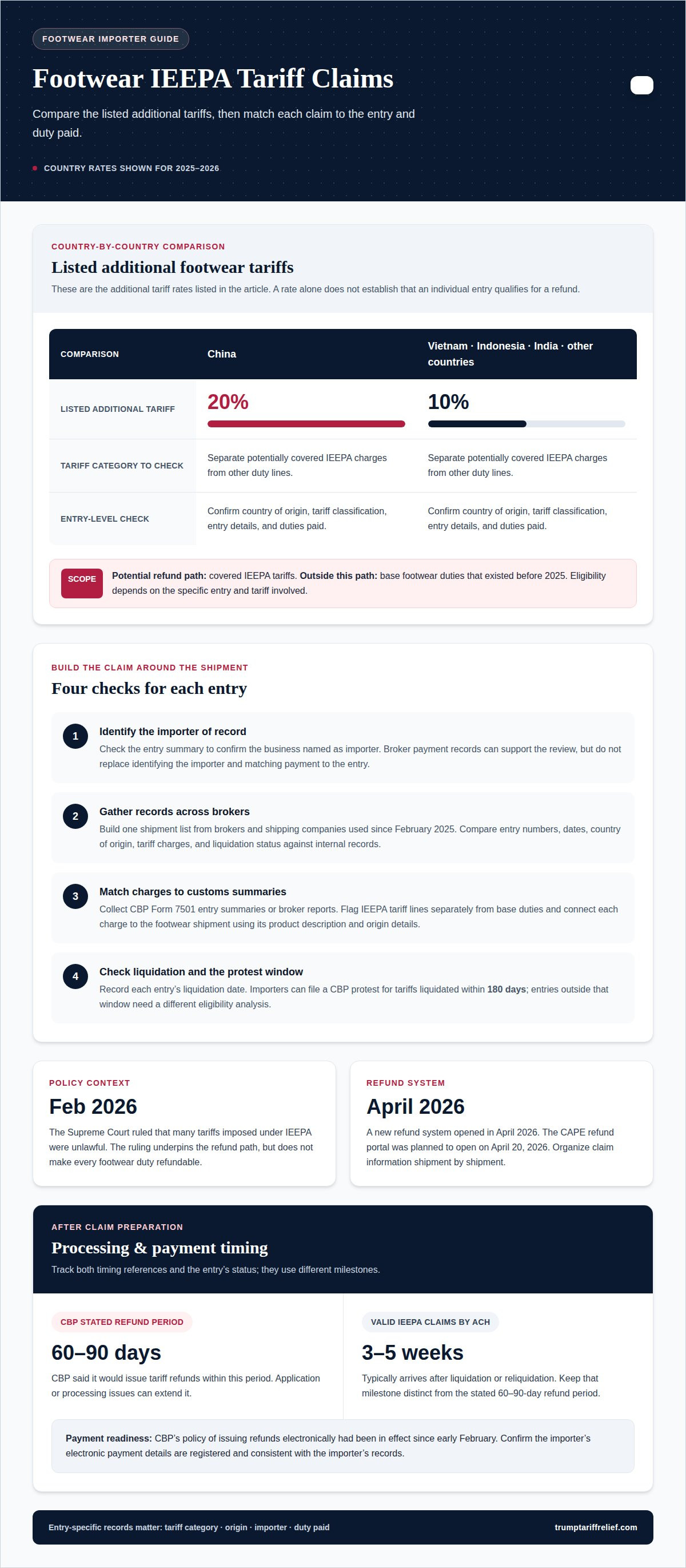
- Identify the importer of record. Review each entry summary and confirm which business appears as importer. If a customs broker filed entries or remitted duties, reconcile its reports with the importer’s own payment and accounting records. This keeps the claim connected to the correct entry and party.
- Gather records across brokers. Build one shipment list from every broker and shipping company used since February 2025. Compare entry numbers, dates, country of origin, tariff charges, and liquidation status. A gap between broker reports and internal records can obscure eligible entries.
- Match charges to customs summaries. Collect CBP Form 7501 entry summaries or broker reports, then flag the IEEPA tariff lines separately from base duties. Use footwear product descriptions and country-of-origin details to connect each charge to the shipment.
- Check the protest window and filing route. Record liquidation dates for each entry, then prioritize entries approaching the 180-day limit. For footwear customs resources, review CBP ACE refund information and the relevant entry documents; use those records to support accurate protests and identify which tariffs you may recover.
Refund claims for Chinese, Vietnamese, Indonesian, and Indian footwear
- Sort entries by country and tariff type. For 2025-2026, the listed additional tariff was 20% for footwear made in China and 10% for footwear from Vietnam, Indonesia, India, and other countries. Separate those IEEPA charges from other duty lines. Country of origin and tariff classification help distinguish potentially covered charges from unrelated duties.
- Connect the claim to the Supreme Court ruling. In February 2026, the Supreme Court ruled that many tariffs imposed under the International Emergency Economic Powers Act were unlawful. That ruling underpins the refund path, but it doesn’t make every duty on footwear refundable. Match each shipment’s entry and tariff charge to the covered category before preparing a request.
- Prepare ACE entry information shipment by shipment. The CAPE refund portal was planned to open on April 20, 2026, and a new refund system opened in April 2026. Organize the claim around each shipment. Assemble the entry details, duty amounts, importer information, and supporting customs records, then reconcile them against the customs broker’s reports before entering claim information.
- Confirm payment registration and records. CBP ACE refund information covers electronic refund processing. Check that the importer’s payment details are registered for electronic payment and align with the claimant’s records. Keep a clear connection between each shipment, its country, tariff classification, and duty paid. Missing or conflicting entry information can slow review or complicate reconciliation.
- Assess any proposed sale of a refund claim carefully. Before transferring an expected refund claim, identify the entries involved, the importer connected to them, and whether the refund has been received. A buyer should review supporting ACE and broker records and define how later adjustments or disputes will be handled. Assignment paperwork alone does not establish that the underlying duties qualify. For a clearer view of the IEEPA tariff refund process, compare the claim against the tariff category and shipment documentation.
Refund processing timelines and ACH payments
- Separate claim submission from payment timing. The refund process includes claim preparation, CBP review, liquidation or reliquidation, and payment. CBP said it would issue tariff refunds within 60 to 90 days. Application or processing issues can extend that period, so track each entry’s status and keep its supporting records together.
- Track the entry’s liquidation status. Record whether each claim relates to an entry awaiting liquidation or one already liquidated. Valid IEEPA claims typically arrive by ACH 3 to 5 weeks after liquidation or reliquidation. That timing uses a different reference point from the stated 60-to-90-day refund period, so note both milestones.
- Prepare electronic payment details. CBP’s policy of issuing tariff refunds electronically had been in effect since early February. Confirm that the importer’s payment information is set up for electronic refunds, then compare the payment destination against the importer’s records. A mismatch can create an avoidable payment issue after claims have been reviewed.
- Reconcile claims against duties paid. Match each shipment’s entry number and duty amount to the refund request. For example, compare the ACE claim data with the customs broker’s statement and the importer’s accounting record. Resolve differences before submission, since incomplete or inconsistent application information can extend processing.
- Monitor any grouped refund processing. CAPE is intended to let importers receive IEEPA tariff refunds with interest in one electronic payment, rather than entry by entry. Keep a claim-level record even when processing is grouped. That lets finance teams trace the total payment back to individual entries and distinguish covered emergency economic powers duties from reciprocal or other tariffs.
- Keep a dated payment log. For each claim, record submission, review, liquidation or reliquidation, and ACH receipt dates. Use that timeline to identify where a delay occurs and to reconcile the refund against duties initially paid. Keep CBP notices and broker correspondence with the matching entry file.
Footwear tariff relief advocacy
- Track industry advocacy separately from refund claims. The February 2026 Supreme Court ruling addressed many tariffs imposed under the International Emergency Economic Powers Act. Footwear groups have also pressed government officials for broader relief. Advocacy may influence policy, but it doesn't replace entry-level refund steps. Keep individual claim records moving while following the wider effort.
- Follow formal requests to the administration. A congressional letter urging footwear and apparel tariff relief followed an industry Lobby Day in May 2026. In July 2026, another letter urged the Trump administration to act. Track the date, requested relief, and affected products in each communication. Those details show whether an advocacy effort addresses your sourcing and tariff exposure.
- Watch trade-policy comments as well as congressional action. July 2026 comments urged the U.S. Trade Representative to provide footwear tariff relief. Compare each request with the tariffs affecting your entries. A proposal aimed at future tariff rates may differ from relief concerning IEEPA tariffs already paid, so keep those issues distinct in internal reporting.
- Monitor replacement measures from the government. The administration sought to reinstate most tariffs through other legal mechanisms, including a temporary 15% tariff on most countries under Section 122 of the 1974 Trade Act. Track announcements by legal basis, affected country, and effective period. A new section or authority can change future import costs without automatically resolving earlier refund claims.
- Use advocacy signals to inform decisions, not delay action. Importers across the United States filed thousands of lawsuits with the Court of International Trade seeking tariff refunds. That activity underscores the scale of the dispute, but each company still needs to assess its own entries and deadlines. For an organized review of potential IEEPA recovery, review the refund recovery process alongside your advocacy tracking.
Trump Tariff Relief: IEEPA Tariff Refund Recovery
Trump Tariff Relief helps footwear importers assess and pursue potential IEEPA tariff refunds. If your records span multiple customs brokers or sourcing countries, its Tariff Eligibility Assessment can help identify entries for review. Customs Documentation Management organizes supporting records, while IEEPA Tariff Refund Recovery manages the process through government filings.
The service is contingency-based: there is no upfront cost, and Trump Tariff Relief is paid only as a percentage of funds successfully recovered. This no-win, no-fee approach can suit importers seeking help with eligibility review, documentation, and claims without managing each step internally. Refunds are not guaranteed.
If you’re ready to review your footwear entries and supporting records, contact Trump Tariff Relief to discuss the next step.
Turn tariff review into a business decision
Recovering duties is not only a customs task. It can affect cash planning, supplier discussions, and how your finance team records past import costs. Give one internal owner responsibility for coordinating trade, finance, and procurement, so decisions about records and potential recovery stay aligned.
A tariff refund for footwear importers may also raise questions about who ultimately bore the cost. Keep relevant purchase terms, customer pricing decisions, and tariff records together. This context can help your business assess the commercial implications of a recovery while keeping future duties separate from earlier claims.
The next step is a focused review of your import records and recovery options. Trump Tariff Relief offers IEEPA Tariff Refund Recovery, Tariff Eligibility Assessment, and Customs Documentation Management to support that work. If you’re ready to discuss your situation, contact Trump Tariff Relief. A clear review can help your team move forward with purpose.
Frequently Asked Questions
How do the refunds work?
Refunds return eligible duties after the claim and associated entry information are reviewed and processed. For IEEPA claims, the CAPE process is intended to combine eligible amounts into one electronic payment with interest, rather than paying entry by entry. Keep a reconciliation showing each shipment, the duty originally paid, and the amount requested. That record helps your finance team match a deposit to the underlying claims.
Which footwear importers are eligible for tariff refunds?
A tariff refund for footwear importers depends on the importer, the tariff charged, and the entry records, not simply on selling footwear or sourcing from a particular country. Importers named on entries with potentially eligible IEEPA duties can have those entries assessed for recovery. For example, a business importing shoes should distinguish potentially eligible IEEPA charges from base footwear duties and other tariff lines.
Can importers get refunds for tariffs paid under IEEPA or other challenged tariffs?
Potential IEEPA refunds relate to tariffs imposed under the International Emergency Economic Powers Act. A challenge involving another tariff authority does not automatically place that duty in the same refund process. Identify the legal basis shown for each charge, then group entries by tariff type. This distinction helps avoid treating Section 232 duties or other challenged measures as IEEPA claims without a separate basis.
What is the deadline to file a U.S. customs duty refund claim?
The deadline depends on the claim procedure and entry status. For a protest involving a liquidated entry, importers can file within 180 days, according to U.S. Customs and Border Protection. A Post-Summary Correction generally has a different timing window, while duty drawback has its own filing period. Record each entry’s status and relevant dates, because one deadline should not be assumed to govern every recovery route.
How do footwear importers request a tariff refund from U.S. Customs and Border Protection?
To pursue a tariff refund for footwear importers, identify the entries and duties involved, then submit the applicable request through the relevant CBP process. The CAPE system processes IEEPA requests shipment by shipment, so organize each shipment’s entry details before filing. Confirm the importer’s electronic payment information is ready, and retain submission records and notices. Maintain a reconciliation connecting each entry to the claimed duty.
What documents and entry data are needed to claim a footwear tariff refund?
Gather entry summaries, including CBP Form 7501, commercial invoices, transportation documents, duty statements, and customs broker reports. For each shipment, capture the entry number, importer of record, country of origin, tariff classification, duties paid, and liquidation status. Compare broker records with internal accounting before filing. An entry summary and duty statement together can help connect the assessed tariff to your business’s payment record.
Ready to find out what your business may be owed?
Check My Eligibility