
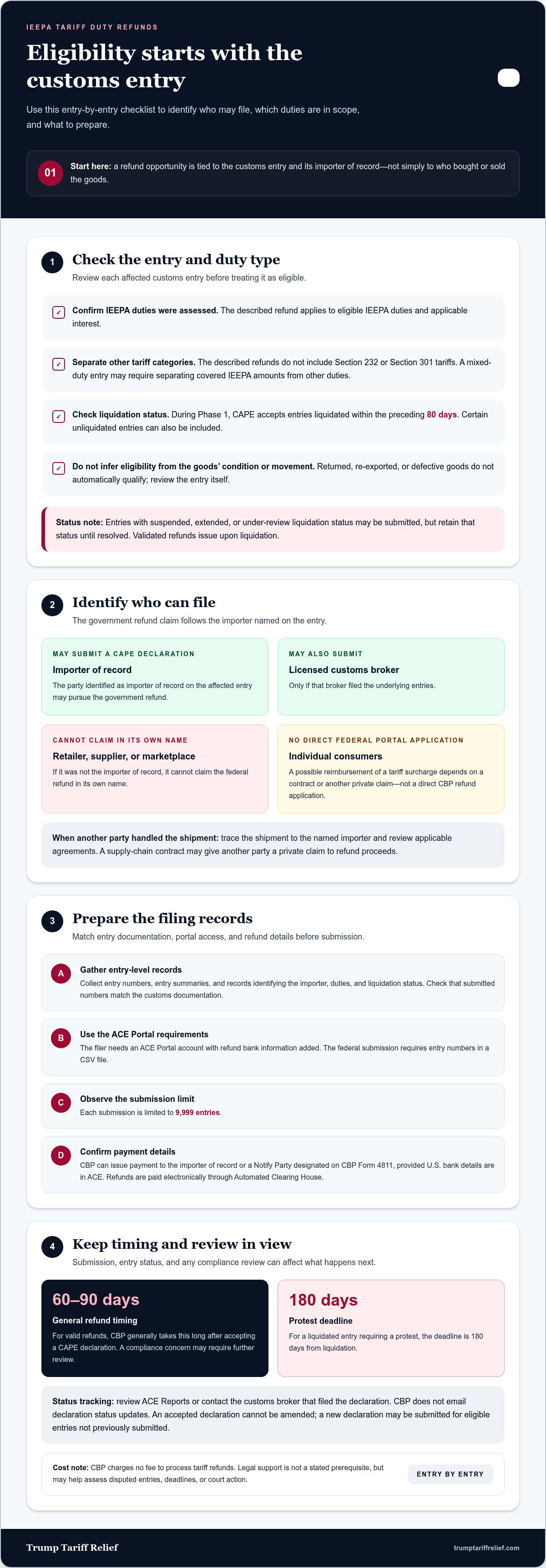
The refund opportunity is tied to the customs entry, not simply to who sold or bought the goods. A tariff refund for consumer goods importers may be available when an entry carries IEEPA duties: during Phase 1, CBP accepts CAPE declarations for entries liquidated within the preceding 80 days. Only the importer of record or the licensed customs broker that filed the entries may submit a CAPE declaration.
If you’re looking into a tariff refund for consumer goods importers, the key question is whether your business was the importer of record on entries with eligible IEEPA duties. This guide explains how eligibility is assessed, what records to gather, and how to organize potential recoveries for financial reporting and tax review.
Key Takeaways
- Separate IEEPA duties from other tariff categories: U.S. Customs and Border Protection says the described refunds do not include tariffs imposed under Section 232 or Section 301.
- Start eligibility review with the customs entry and identify the importer of record; that role determines who can pursue a government refund.
- Organize entry records and refund banking details before using CBP’s refund process, and track declaration status through the appropriate account reports.
- Assess how a recovery could affect financial statements, taxes, and supply-chain agreements before treating the funds as available cash.
Importers Continue to Eye IEEPA Tariff Refunds - What Should You Know?
CBP launched Phase 1 of its CAPE IEEPA duty refund process on April 20, 2026. For valid refunds, CBP generally takes 60-90 days after accepting a CAPE declaration, unless a compliance concern requires further review. Timing depends on acceptance and any additional examination.
Scope matters. According to U.S. Customs and Border Protection, the described refunds do not include tariffs imposed under Section 232 or Section 301. CBP includes interest on eligible IEEPA duties, generally calculated from deposit or estimated payment through liquidation or reliquidation. A mixed-duty entry may require separating covered IEEPA amounts from other duties.
Returned, re-exported, or defective goods do not automatically qualify for an IEEPA refund. Review each customs entry to confirm whether IEEPA duties were assessed and whether the entry may qualify for recovery. The goods’ later condition or movement alone does not establish eligibility.
Refunds are based on eligible IEEPA duties and applicable interest, not necessarily every tariff amount on an entry. For example, if an entry includes IEEPA and Section 232 duties, the described refund excludes the Section 232 portion. Partial recovery can reflect which duties qualify and the entry’s liquidation status.
The legal and administrative process has moved beyond a court ruling. In February 2026, the U.S. Supreme Court struck down sweeping tariffs imposed under the International Emergency Economic Powers Act. On March 4, 2026, the Court of International Trade ordered eligible entries liquidated or reliquidated without IEEPA duties, while CBP’s CAPE program processes refund declarations.
For a liquidated entry requiring a protest, the deadline is 180 days from liquidation, according to the Office of the Law Revision Counsel, U.S. House of Representatives. CBP charges no fee to process tariff refunds, but compliance review can affect timing. A customs attorney is not a stated prerequisite; legal support may help assess disputed entries, deadlines, or court action.
Supplier agreements or other supply-chain contracts may give another party a private claim to refund proceeds, even though the government refund is pursued by the importer of record. For shipments handled by a carrier, identify the importer of record and review the entry documents and relevant contracts. A carrier’s refund filing does not mean every importer follows the same process.
Importer-of-record eligibility for tariff refunds
A tariff refund for consumer goods importers depends on the customs record, not simply on who bought or sold the goods. For a government refund claim, the importer of record is the party that can pursue recovery of duties. Identify that entity on each affected entry before preparing a filing. A retailer, supplier, or marketplace that was not the importer of record cannot claim the federal refund in its own name.
During Phase 1, CAPE accepts entries liquidated within the preceding 80 days. Certain unliquidated entries can also be included. Entries with suspended, extended, or under-review liquidation status may be submitted, but retain that status until resolved; validated refunds issue upon liquidation. Match each entry’s liquidation status to the applicable phase criteria before submission.
Only the importer of record or the licensed customs broker that filed the entries may file a CAPE declaration. The filer needs an ACE Portal account with refund bank information added. CBP can issue payment to the importer of record or a Notify Party designated on CBP Form 4811, provided U.S. bank details are in ACE.
Prepare entry numbers and supporting customs records together. The federal ACE Portal submission requires entry numbers in a CSV file, and each submission is limited to 9,999 entries. Entry summaries and records identifying the importer, duties, and liquidation status help reconcile which entries belong in the filing. Check that submitted numbers match the customs documentation.
Individual consumers cannot apply through the federal portal. If a consumer paid a tariff surcharge to a retailer, any possible reimbursement depends on the parties’ contract or another private claim, not a direct CBP refund application. Consumers can keep invoices, supplier price notices, purchase orders, and tariff correspondence as evidence of downstream charges.
If your supply-chain business was not the importer of record, trace each shipment to the named importer and review the applicable agreement. The records needed for a tariff refund for consumer goods importers can also help distinguish a government claim from a contractual right to share proceeds. A broker may file only if it filed the underlying entries, so don’t assume a broker can submit on a business’s behalf.
CBP refund contacts
To check a CAPE declaration’s status, review ACE Reports or contact the customs broker that filed it. CBP does not email declaration status updates, so don’t wait for an inbox notice before following up. Have the declaration details and affected entry numbers ready when asking the filer to review the report.
Start with the party that submitted the declaration. If your licensed customs broker filed on your behalf, ask the broker to review ACE Reports and explain any displayed status or request for action. If your business filed, sign in to its ACE Portal account and review the relevant reports. This directs the inquiry to the records associated with the filing.
Before contacting the filer, gather the CAPE declaration reference, entry numbers, and any CBP notice related to those entries. Compare the reported status with your customs records. If an eligible entry was omitted, a new declaration may be submitted for eligible entries not previously submitted. An accepted declaration cannot be amended, so identify the omission clearly.
Payment setup is another practical checkpoint. IEEPA duty refunds are paid electronically through Automated Clearing House, and refund bank information must be added to the ACE Portal account used by the Importer of Record or filing broker. Confirm that the account information is current, then distinguish a payment issue from a declaration-status question.
The scale helps explain the need for organized follow-up. As of April 14, 56,497 importers had registered for electronic payment and were eligible for $127 billion in refunds, including interest. CBP also said more than 330,000 importers paid about $166 billion on more than 53 million shipments.
The underlying action followed the president’s use of the International Emergency Economic Powers Act. If you’re pursuing a government refund, focus questions on the CBP filing record rather than general questions about emergency economic powers. Keep a written log of the date, entry numbers, report reviewed, and response received. This helps your team track unresolved items and clarify the next internal step.
Financial statement and tax impacts
A tariff refund can affect how a company reports import-related costs, cash, and recovery claims. Create an entry-level schedule showing duties paid, the IEEPA portion claimed, interest, filing status, and cash received. Keep the customs records that support each amount, so your finance team can trace reported recoveries to the relevant shipment and claim.
Track amounts by status instead of treating a pending claim as cash. Keep submitted claims, accepted declarations, refunds issued, and unresolved entries in separate categories. When a payment arrives through the portal, reconcile the deposit against the entry schedule and record any interest separately. This gives management a clearer view of estimated recovery and funds received.
Tax analysis also needs a documented trail. Keep the original duty payment record, refund calculation, CBP correspondence, and date the funds arrive. Then assess how the recovery relates to the company’s earlier treatment of the duties and interest. Don’t treat a forecast as a final amount; keep estimates separate until the government issues payment.
The International Emergency Economic Powers Act dispute also creates downstream questions. For retailers and suppliers, compare any reimbursement or price adjustment with invoices and contract terms. More than 80 customer lawsuits had been filed over tariff-related prices, but none had been certified as class actions.
The Supreme Court ruling and later refund claims may affect financial disclosures, budgets, and cash planning. Document assumptions, explain changes between an estimate and an issued amount, and retain approvals for any customer or supplier payment. A refund tied to duties imposed under emergency economic powers should remain traceable to the relevant entry and supporting records.
To organize the records supporting a claim, review the IEEPA refund recovery process and map each entry to its financial treatment.
Trump Tariff Relief: IEEPA Tariff Refund Recovery
Trump Tariff Relief helps businesses assess and pursue IEEPA tariff refunds through its IEEPA Tariff Refund Recovery offering. Turn to the team when you need to determine whether your entries may qualify and organize the documentation needed for a claim. A Tariff Eligibility Assessment reviews the recovery opportunity, while Customs Documentation Management supports the records and filing process.
The service is contingency-based: there are no upfront costs, and Trump Tariff Relief is paid only a percentage of funds successfully recovered. There is no win, no fee. Gather your entry records and identify the importer of record to support an informed eligibility assessment.
Contact Trump Tariff Relief to discuss your IEEPA tariff refund recovery.
Turn the Refund Review Into a Clear Next Step
A tariff refund for consumer goods importers is more than a filing task. It can affect cash planning, supplier discussions, and the records your team uses for future decisions. Set a clear internal process: assign responsibility, keep supporting documents together, and record how each recovery decision affects your books and commercial relationships.
That preparation can also help your finance, operations, and procurement teams work from the same facts. If you have questions about your entries or recovery options, Trump Tariff Relief can assess eligibility and help identify the documentation needed for the next step.
Trump Tariff Relief works with businesses pursuing IEEPA tariff recovery. Contact Trump Tariff Relief to discuss your situation and take the next step with a clearer plan.
Frequently Asked Questions
Trump administration launches tariff refund portal: Who is eligible?
Businesses that were the importer of record for entries with eligible IEEPA duties may qualify to pursue refunds through CBP’s CAPE process. The portal is not a consumer refund application. A licensed customs broker may file only if it filed the underlying entries. For example, a retailer that imported goods directly should review its own entry records rather than assume its supplier can claim on its behalf.
What About Older or Different Entries?
Entries outside Phase 1’s current 80-day liquidation window may need a different route or later guidance. CBP hasn’t released detailed guidance for entries outside that window, historical filings, or more complex cases. For an already liquidated entry, a protest deadline may matter: according to the Office of the Law Revision Counsel, U.S. House of Representatives, the deadline is 180 days from liquidation. Track each entry’s liquidation date and status.
Which shipments currently qualify?
Phase 1 covers entries with eligible IEEPA duties that were liquidated within the preceding 80 days. Certain unliquidated entries can also be included, including entries with suspended, extended, or under-review liquidation status. Those entries retain their status until resolved, and validated refunds are issued upon liquidation. Check the entry’s duty type and liquidation status; a shipment’s product category alone doesn’t establish qualification.
Which U.S. tariffs on consumer goods are eligible for refunds?
The described refund process concerns duties imposed under the International Emergency Economic Powers Act (IEEPA), not every tariff charged on consumer goods. According to U.S. Customs and Border Protection, the described refunds exclude tariffs imposed under Section 232 or Section 301. Review the entry documentation to distinguish IEEPA duties from other charges. If an entry includes multiple tariff types, only the covered portion belongs in this refund claim.
Who can claim a tariff refund: importer of record, customs broker, or consumer?
The importer of record is the party eligible to pursue recovery of duties from the government. A customs broker may submit a CAPE declaration only if it filed the entries. Consumers cannot apply through the federal portal. A consumer or downstream buyer seeking reimbursement from a seller must rely on any applicable private contractual claim, supported by records such as invoices, surcharge notices, and purchase orders.
How do U.S. importers request a refund of duties paid to CBP?
The importer of record, or the broker that filed its entries, submits a CAPE declaration through the ACE Portal. Prepare eligible entry numbers in a CSV file; each submission is limited to 9,999 entries. The filer needs an ACE Portal account with refund bank information, because payment is electronic through ACH. After acceptance, monitor declaration status in ACE Reports rather than waiting for an email update.
Ready to find out what your business may be owed?
Check My Eligibility