
A tariff refund for construction materials does not automatically go to the contractor that absorbed higher prices. In the United States, refunds for qualifying IEEPA duties go to the business that paid the tariffs to U.S. Customs and Border Protection, typically the importer of record or a broker. Whether any recovered amount reaches a construction project depends on the contract and how the tariff cost moved through the supply chain.
That distinction matters when owners, contractors, suppliers, and manufacturers all have a stake in the same materials. The party that paid the duty may have a customs refund claim, while contract terms determine whether credits or adjustments are passed on to other project participants.
This guide explains how construction agreements address tariffs and refunds, which records help connect duties to project costs, and who may qualify to recover funds. It also explains why a refund for imported materials differs from relief related to tariffs that remain in effect on specific goods.
Key Takeaways
- Contract language can determine whether tariff costs or later refunds affect the project price, so identify the clauses governing taxes, rebates, and adjustments.
- A refund generally goes to the party that paid the duty, not automatically to the contractor or project owner that bore higher material costs.
- Connect tariff charges to invoices, purchase orders, and project records to clarify how a potential recovery could move through the supply chain.
- Importer-of-record details and customs records help establish potential eligibility; an eligibility assessment can help organize the recovery path.
Are Tariffs or Tariff Refunds Contemplated in Construction Contracts?
Construction contracts may address tariff costs, but refund rights depend on customs records and contract terms. Distinguish the party that paid the duty from the project that absorbed its cost.
Refund Claim Documentation
Refund documentation is the record linking a customs entry, its duty payment, and the imported goods. Match importer-of-record details with entry summaries, including CBP Form 7501, plus shipment, invoice, and transaction records. These documents help support review of valuation, tariff classification, and country of origin. For contractors, connecting supplier invoices or purchase orders to project materials clarifies which charges may relate to an import claim.
Claimant Eligibility and IEEPA Claims
Eligibility generally depends on who paid the duty to U.S. Customs and Border Protection. In the United States, companies that directly paid tariffs to U.S. Customs and Border Protection (CBP), typically importers of record or brokers, are the parties eligible to receive tariff refunds directly. IEEPA claims concern qualifying duties collected under the International Emergency Economic Powers Act. A contractor’s project claim for a credit is separate from the importer’s customs refund claim.
Materials, Origins, and Trade Programs
Material, origin, and trade program affect which duty was charged, so they matter when identifying an eligible entry. A refund is tied to qualifying duties, not simply to buying imported construction materials. The White House states that a 50% Section 232 tariff applies to steel and aluminum imports. That tariff is distinct from IEEPA duties, so the material alone doesn’t establish eligibility. Review the entry’s origin and tariff basis alongside the contract’s treatment of cost changes.
Qualifying Materials and Tariff Codes
Qualifying materials are those listed on entries with duties eligible for refund, as determined from customs classification and entry details. No single construction-material list or tariff code makes every purchase refundable. CBP may review valuation, classification, and origin. Match the code on the entry summary to the imported goods and duty charged; a project invoice alone does not establish that an entry qualifies.
Filing timing depends on entry status and the applicable refund process. CAPE Phase 1 covers unliquidated entries and entries liquidated within a limited window. Refund calculations start with qualifying duties paid on eligible entries; project credits remain a separate contract question. Mismatched importer details, classification, origin, or supporting records can undermine a claim. Contract terms also matter: A102 Article 9 allocates trade discounts, rebates, and refunds to the owner, while A133 Article 8 contains similar terms.
Tariff and refund provisions in construction contracts
Contract language determines whether tariffs change the contract price, who bears the charge, and who receives a later refund. Article 9 of A102 assigns trade discounts, rebates, refunds, and surplus-material proceeds to the owner. Article 8 of A133 contains similar terms that may address tariff cancellations or refunds affecting a project. These provisions matter when owners, contractors, and suppliers treat the same import cost differently.
At signing, contractors are advised to include a price-escalation provision. It can establish how documented cost changes affect pricing and which records support an adjustment. Section 3.6 of A201 addresses sales, consumer, use, and similar taxes legally enacted by bid time or the end of negotiations, even if not yet effective. Section 7.6.2 of A102 treats certain sales, use, or similar taxes as reimbursable expenses. Article 6 of A133 allows parties to designate how changes in the work adjust pricing.
Indirect recovery may involve sales and use tax, not just customs duties. In many states, those taxes apply to purchase prices that include tariffs, so a retroactive tariff refund may create a separate tax-refund opportunity. For project owners evaluating comprehensive capital asset costs and specialized property tax incentives, engineeredtaxservices.com provides expertise in engineering-based tax studies. In supplier discussions, connect each tariff charge to a specific invoice, purchase order, or schedule of values. These records help establish whether the cost reached the project and support a request for a credit or price adjustment.
Distinguish IEEPA duties from other charges. The Supreme Court’s February ruling in Learning Resources v. Trump addressed the International Emergency Economic Powers Act and the President’s authority to impose broad tariffs without congressional approval. It does not make every border charge imposed by an administration refundable. For example, a 25% tariff on kitchen cabinets, furniture, and vanities remains in effect until Jan. 1, 2027. Review the contract’s escalation, refund, and change provisions alongside the duty involved. For help understanding the IEEPA refund process, consider how an eligibility assessment may fit your records.
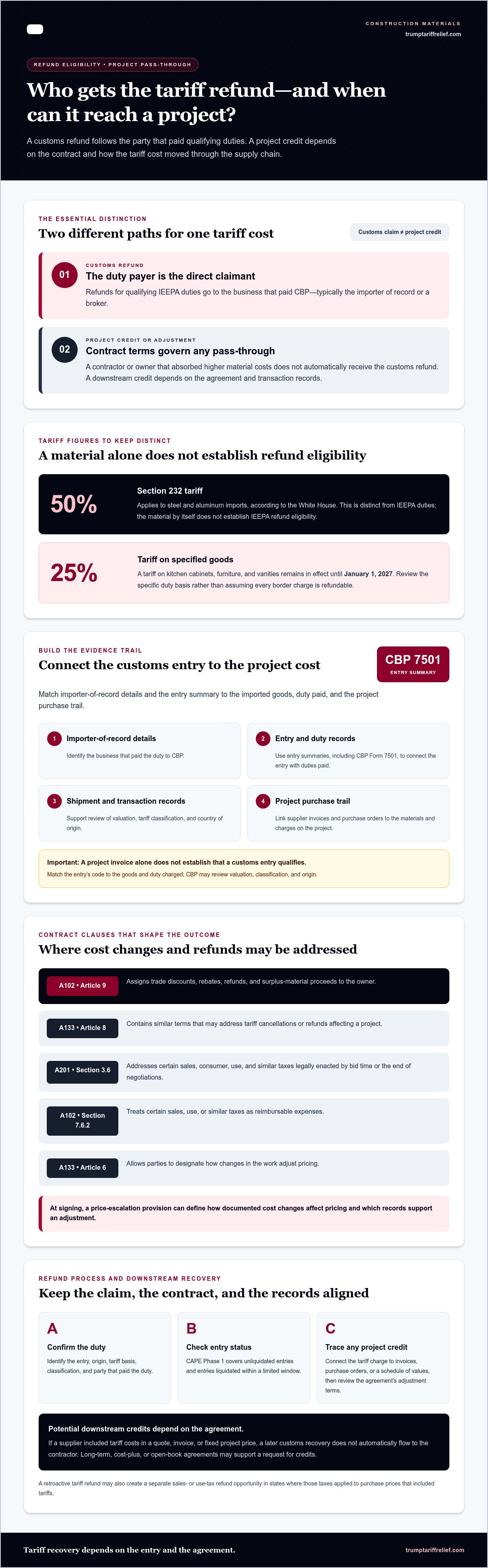
Whether refunds may flow down the construction supply chain
A customs refund follows the party that paid qualifying duties, while a project credit follows the contract. If an importer, manufacturer, or supplier included tariff costs in its price, the contractor does not automatically receive the customs refund. The funds may flow downstream through a credit or adjustment if the contract supports it. Paying more for materials alone does not make a buyer eligible to recover duties.
Trace the charge through each transaction. An importer may pay duties at the border, then sell goods to a manufacturer or distributor. The supplier may include the expense in a quote, invoice, or fixed project price. If the supplier later recovers duties, customers may seek credits, particularly under long-term, cost-plus, or open-book agreements. The contract’s refund, rebate, and cost-adjustment terms help determine whether such a request has a basis.
Base the discussion on project records, not a general claim about tariff costs. Match a supplier invoice to the purchase order and schedule of values, then identify the material and project. Request an adjustment tied to recovered duties and the contract terms. The Associated General Contractors of America cautioned builders that refunds were unlikely for materials purchased during the past year, while noting possible near-term relief in material costs after the ruling. Refund recovery and lower future prices are separate outcomes.
State and local tax treatment can create another path. In many states, sales and use tax includes tariffs in the purchase price, so a retroactive tariff refund may create a related tax-refund opportunity. Keep that potential tax issue distinct from a federal customs refund. More than 60% of builders surveyed by NAHB reported higher costs due to tariffs, underscoring the supply-chain impact. But a supplier’s recovery, a project credit, and a tax adjustment each depend on different records and terms. Map each charge to its payer, invoice, and contract before evaluating where recovery may flow.
Potential eligibility for tariff refunds
Potential eligibility starts with the customs entry, not the project invoice. A business may have a direct claim if it paid qualifying duties to CBP, typically as the importer of record or through a broker. For a tariff refund for construction materials, the payment record matters more than the project’s purchase price. A contractor that paid a supplier must distinguish its commercial exposure from the customs claimant’s position.
The legal basis matters as much as the material. The Supreme Court’s February decision in Learning Resources v. Trump held that the International Emergency Economic Powers Act did not authorize broad-based tariffs without explicit congressional approval. The decision concerns IEEPA duties, not every duty affecting construction imports. A Section 232 charge or another trade-program duty doesn’t become an IEEPA refund simply because the material was imported. Identify the tariff authority recorded on each entry before assessing a potential claim.
The Consolidated Administration and Processing of Entries system, known as CAPE, was announced April 20, 2026. Phase 1 covers unliquidated entries and entries liquidated within a limited window. Eligibility therefore depends partly on entry status, not solely on when a contractor bought materials. The import file should identify the importer, entry status, duties paid, and applicable tariff program. If a supplier passed the cost into contract pricing, its invoice alone doesn’t establish direct customs eligibility.
To assess a tariff refund for construction materials, reconcile entry summaries, CBP Form 7501, and transaction records. Confirm which business appears as importer of record, then match each duty to its tariff authority and entry. Keep supplier invoices and project schedules separate: they may support a downstream credit discussion, but don’t replace customs records. A tariff eligibility assessment can help sort potential claim categories and organize supporting documentation.
Potentially eligible duties are IEEPA duties recorded on qualifying entries; Section 232 and other trade-program duties do not become IEEPA refunds simply because the materials were imported. No specific construction materials or tariff codes are identified, so eligibility depends on the tariff authority recorded for each entry.
Trump Tariff Relief: IEEPA Tariff Refund Recovery
Trump Tariff Relief helps businesses assess potential IEEPA duty recovery and manage supporting customs documentation. If your company paid duties directly, a Tariff Eligibility Assessment can help identify relevant entries and claim records. IEEPA Tariff Refund Recovery supports the refund process, while Customs Documentation Management organizes supporting materials.
Trump Tariff Relief works on a contingency basis: there are no upfront costs, and payment is only a percentage of funds successfully recovered. This no-win, no-fee model may suit businesses considering a claim while keeping resources focused on operations. It does not change who customs records identify as the duty payer or guarantee that an entry qualifies.
To assess your records and potential recovery path, contact Trump Tariff Relief to discuss the next step.
Turn Your Records Into a Clear Recovery Path
Start with a focused review of the records behind your import costs. A tariff refund for construction materials begins by connecting customs entries to duties paid, then separating those amounts from supplier charges and project pricing. This helps your team set realistic expectations and identify records that still need organizing.
Trump Tariff Relief offers Tariff Eligibility Assessment, Customs Documentation Management, and IEEPA Tariff Refund Recovery for businesses evaluating potential claims. An assessment can clarify which entries merit further review, while organized documentation supports the recovery process. The aim is to turn scattered invoices and entry records into a documented claim path. Recovery depends on entry eligibility and supporting records.
Take the next step with a focused review of your potential claim. Contact Trump Tariff Relief to discuss your records and recovery path. A clear starting point can help your team move forward with confidence.
Frequently Asked Questions
Are Construction Companies Eligible to Receive Refunds?
A construction company may qualify if it paid eligible import duties directly. Eligibility for a tariff refund for construction materials depends on the customs entry and duty, not simply on who absorbed higher project costs. A builder that imported equipment under its own importer-of-record details has a different claim position from a property owner who only paid a construction invoice. Project contracts may separately address credits.
What Documentation Should You Gather?
Gather customs entry summaries, including CBP Form 7501, commercial invoices, shipment records, and duty statements. Keep importer-of-record details with the relevant transaction records so each entry can be matched to the goods and duties paid. For project purchases, retain supplier invoices and purchase orders separately. Those records can help trace project expenses, while customs documents support review of the underlying import transaction.
When Should Businesses Expect a Refund?
Businesses should track claim processing and entry status rather than assume a fixed payment date. CBP has started processing refunds, and CAPE Phase 1 covers unliquidated entries and entries liquidated within a limited window. Keep the filing details and supporting records organized as the claim proceeds. Payment timing depends on the processing path and the entry’s status, so it can differ across claims.
Are construction material tariffs currently eligible for refunds in the United States?
Some duties may qualify, but a material’s use on a construction project does not establish refund eligibility. For a tariff refund for construction materials, the duty recorded on the import entry matters. The Supreme Court ruling addressed qualifying tariffs imposed under IEEPA, not every tariff affecting construction goods. Duties under material-specific trade measures require separate analysis of the tariff authority and entry involved.
Who can claim a refund: importers, contractors, builders, or property owners?
Whether a business can claim a customs refund directly depends on its role in the import transaction and who paid the duties. A contractor, builder, or property owner that paid a supplier usually cannot claim the duty from CBP solely because it bore the expense. A separate route may be a project credit, depending on contract terms and whether the supplier recovers the charge.
How do I file a tariff refund claim with U.S. Customs and Border Protection?
Identify the importer and relevant entries, then assemble entry summaries, duty records, invoices, and shipment details. CBP’s CAPE Phase 1 covers unliquidated entries and entries liquidated within a limited window. Match each entry to its duty and status before preparing the filing. Organized records help connect the claim to the underlying import transaction and clarify which entries fall within the applicable processing phase.
Ready to find out what your business may be owed?
Check My Eligibility