Refunds are already reaching toy importers. Toy Association members began receiving U.S. IEEPA tariff refunds in their bank accounts as of May 11, and the initial refunds appeared to relate to imports brought into the United States in early March 2025. A tariff refund for toy importers is a real recovery opportunity, but eligibility depends on the specific imports and the claim behind them.
If your business paid IEEPA duties on toys, the key questions are which entries may qualify, how refund processing works, and whether interest may be included. A shipment’s product category alone doesn’t establish the outcome; the tariff payments and entry documentation matter when assessing a claim. The U.S. Supreme Court struck down the emergency tariffs in February, but turning that ruling into a recovery requires careful review of import records and refund procedures. This guide explains the eligibility factors, outlines the steps toy importers can take, and clarifies how refunds and interest may apply, so you can assess the opportunity with a clear view of what comes next.
Key Takeaways
- Assess potential eligibility by matching the tariff paid to the relevant import entries and supporting customs records.
- Use the refund process to organize entry details and documentation before pursuing recovery.
- Understand how interest may relate to a refund and which payment records can help establish the amount.
- Separate IEEPA duties from other tariffs on toy imports; the tariff’s legal basis affects whether it may be refundable.
Eligibility for refunds
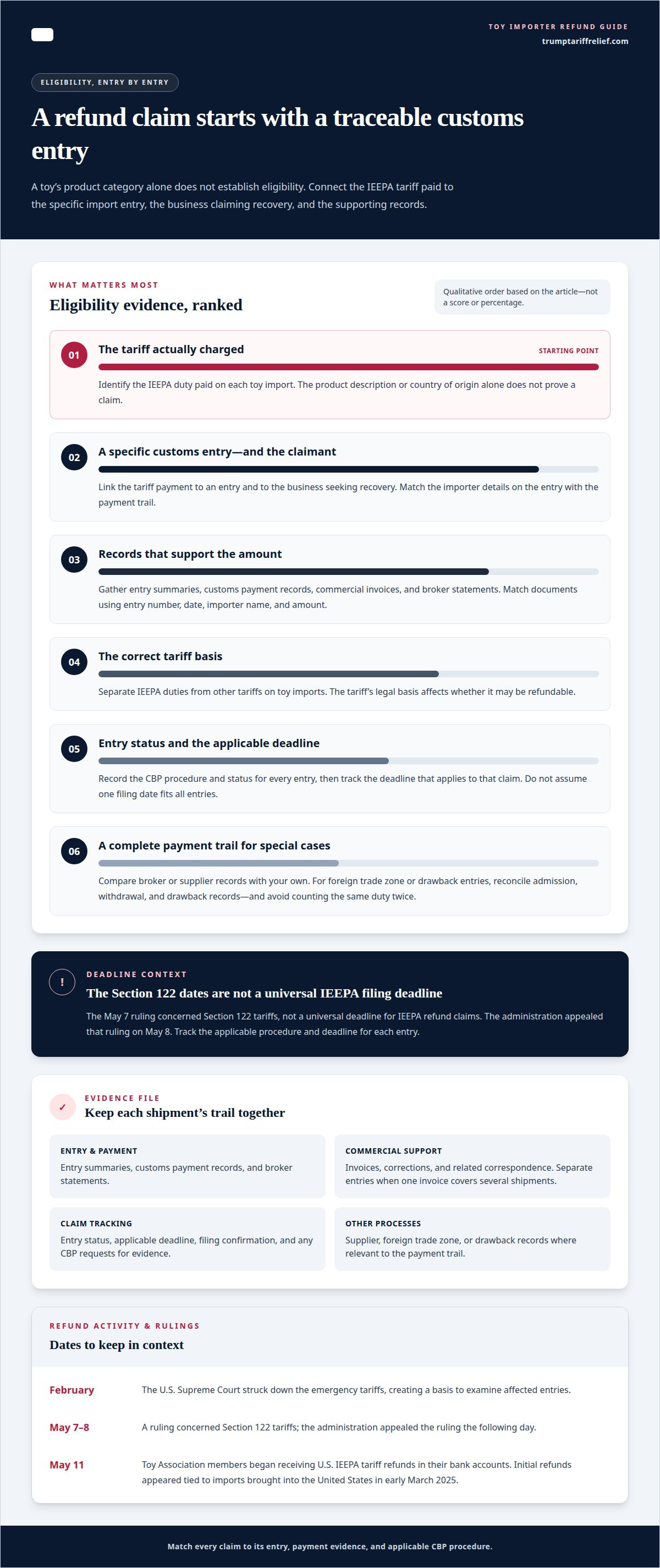
Eligibility starts with the tariff actually charged on each toy import, not the product category alone. The U.S. Supreme Court struck down the emergency tariffs in February, creating a basis for importers to examine affected entries. A claim should connect the tariff payment to a specific customs entry and the business seeking recovery. A toy shipment’s country of origin or description alone doesn’t establish that connection.
Gather entry summaries, customs payment records, commercial invoices, and any broker statements showing how duties were assessed and paid. Match each document by entry number, date, importer name, and amount. If an invoice covers several toy shipments, separate the entries so each claimed tariff can be traced to the relevant import. Keep amendments and related correspondence with the supporting file.
There is no single filing date that should be assumed for every entry. Record the applicable CBP procedure and each entry’s status, then track the deadline that applies to that claim. The May 7 ruling concerned Section 122 tariffs, not a universal filing deadline for IEEPA refund claims; the administration appealed that ruling on May 8.
Paying through a customs broker does not, by itself, establish who should pursue a refund. Compare the importer details on the customs entry with the broker’s payment statement and your own records. If a supplier arranged the import, trace the entry and payment documents before treating a price increase as a tariff payment you can claim.
If an entry involved a foreign trade zone or drawback, reconcile it with the zone admission, withdrawal, and drawback records. These documents help distinguish the tariff payment tied to an import from amounts handled through another process. Avoid counting the same duty twice, and retain records showing how each shipment was treated.
- Match each toy entry to its tariff and payment evidence.
- Track the deadline and status for every entry separately.
- Use broker, supplier, zone, and drawback records to establish the payment trail.
IEEPA tariff refunds for toy importers
U.S. toy importers can pursue refunds for qualifying IEEPA duties through the applicable Customs refund process. Toy Association members began receiving refunds in their bank accounts as of May 11; initial payments appeared tied to imports from early March 2025. Those payments show that recovery is moving, but each importer still needs to connect its claim to its own entries.
Build the claim around the customs entry and tariff payment, then follow the applicable CBP filing process. Organize the work into clear steps:
- Identify toy entries with IEEPA duties and match each one to its payment record.
- Reconcile entry details against invoices, broker statements, and any corrections.
- Submit the claim through the applicable CBP refund process and retain its confirmation.
- Track the claim against the entry records and respond to any request for supporting evidence.
Accuracy matters. If the claimed amount does not match the entry or payment records, CBP may question the claim, delay processing, or adjust the amount. A review or audit is not itself a penalty. Keep a clear record trail, avoid duplicate claims, and ensure each shipment and duty payment is represented correctly. Supporting questions with documents is more reliable than relying on estimates.
For status, use the CBP refund process and compare claim updates with your submission and payment records. By April 9, 56,497 importers had completed the steps needed to receive electronic refunds, covering $127 billion. Those completed registrations represented more than three-quarters of the total eligible refunds. Keep the entry identifiers and filing confirmations together so you can match any update to the correct claim. A clear refund recovery process also helps organize the work from documentation through filing.
Refunds and interest
Review the duties paid separately from any interest included in a refund. Tie the principal amount to each customs entry, then compare the refund decision with the amount originally paid. Do not estimate interest using an assumed rate. The applicable calculation depends on the governing refund process and how it treats the specific payment.
For each toy shipment, reconcile the entry record, duty payment, and refund calculation. If the refund notice lists principal and interest separately, record each amount separately. If it gives only a total, compare that figure with the payment history and any accompanying CBP explanation. This can help identify a short payment, an omitted entry, or a calculation discrepancy.
Entry and payment dates help establish the history of each claim. Preserve the original customs records and the dates shown on refund notices, deposits, and claim correspondence. If a deposit covers several entries, match the transaction to the claim details before recording the recovery in your books, where accounting support from CJ Business Solutions, LLC can help ensure accurate reconciliation and reporting. Do not treat a deposit as a final reconciliation for each entry.
- List each entry, its IEEPA duty payment, and the refund amount shown.
- Separate principal from interest wherever CBP identifies both.
- Match deposits to claim records and note any unmatched entries.
- Retain notices and payment evidence with the corresponding customs file.
CBP’s CAPE system is intended to process up to $166 billion in tariff refunds. That scale makes careful reconciliation valuable: a large processing system doesn’t replace shipment-level records. Review each toy entry against the decision and payment details, and preserve questions about missing interest or mismatched amounts for follow-up through the claim process. A clean comparison helps distinguish the duty recovery from any interest actually calculated.
Which U.S. tariffs on imported toys are refundable?
For toy imports, the tariff’s legal basis matters more than the product label. The U.S. Supreme Court struck down the emergency tariffs in February, creating a basis for examining IEEPA duties paid on affected entries. That ruling doesn’t make every charge on a toy shipment refundable. Separate each duty by its authority and entry record before identifying potential recovery.
Section 122 duties require a different analysis. On May 7, the U.S. Court of International Trade ruled in a 2-1 decision that struck down the 10% tariffs imposed under Section 122 of the Trade Act of 1974. The Trump Administration appealed on May 8. That ruling blocked enforcement only on imports where the named plaintiffs were importers of record. It did not provide a nationwide injunction. A toy importer’s entry therefore can’t be treated as covered just because the goods faced the same rate.
Check each customs entry for the tariff authority and amount paid. If the record shows IEEPA duties, assess it under the emergency-tariff refund process. If it shows Section 122 duties, distinguish the importer’s position from the named plaintiffs and account for the appeal. Keep other tariff charges separate; they don’t become IEEPA refunds simply because they appear on the same shipment paperwork.
- IEEPA: identify emergency-tariff payments on each entry.
- Section 122: note the 10% rate, ruling, appeal, and limited plaintiff scope.
- Other authorities: keep distinct duties separate from the IEEPA refund review.
The administration may pursue tariffs under Section 232 of the Trade Expansion Act of 1962, citing national security purposes, and under Sections 201 and 301 of the 1974 Trade Act. Those authorities are distinct from the emergency tariffs struck down in February. For a focused review of the IEEPA basis, consult this IEEPA tariff explanation as you sort entries.
Trump Tariff Relief: IEEPA Tariff Refund Recovery
Trump Tariff Relief helps toy importers assess potential IEEPA refunds and pursue recovery. Its Tariff Eligibility Assessment reviews whether import records support a claim, while Customs Documentation Management organizes the paperwork for the process. If your records show IEEPA duties on toy entries, this support can help turn scattered entry and payment files into an organized claim.
Through IEEPA Tariff Refund Recovery, Trump Tariff Relief manages eligibility review, documentation, and government filings. The service is contingency-based: there is no upfront cost, and payment is only a percentage of funds recovered. This no win, no fee approach may suit importers seeking help with a complex filing without paying in advance. Refund outcomes are not guaranteed, and eligibility depends on the specific import history and supporting documents.
To discuss your toy import records and possible next steps, contact Trump Tariff Relief.
Put Your Import Records to Work
Turn the refund question into a defined internal task. Assign someone to gather the relevant import and payment records, keep the supporting files together, and note any gaps. This gives your team a clearer basis for deciding what to do next, rather than leaving a potential tariff refund for toy importers as an unresolved accounting question. Eligibility depends on the importer’s records and the specific entries.
A focused review can also help finance, purchasing, and customs teams work from the same shipment history. Keep the analysis tied to the records, and do not treat every tariff charge as part of one claim. This makes the next steps more deliberate as the refund process moves forward.
For help assessing your situation and pursuing a recovery claim, contact Trump Tariff Relief. A clear starting point can help your team move forward with confidence.
Frequently Asked Questions
Are toy importers eligible for tariff refunds in the United States?
Toy importers may qualify when their entries include eligible IEEPA duties and they can support a claim with records. Start by comparing the importer identity and tariff details on the customs entry with the payment record. A toy retailer that bought goods domestically from a distributor, rather than importing them, should distinguish its purchase costs from duties it paid as the importer.
What tariff refund programs or court rulings apply to toy imports?
IEEPA refund claims concern duties imposed under the emergency tariff measures struck down by the U.S. Supreme Court in February. The separate Section 122 ruling does not create a blanket refund program for all toy importers: on May 7, the U.S. Court of International Trade issued a 2-1 decision striking down the 10% tariffs, with relief limited to imports where named plaintiffs were importers of record.
How are toy tariff refunds calculated, including duties, interest, and fees?
Start with the IEEPA duties paid on eligible toy entries, using customs records to total the amounts claimed. Interest is separate; the refund determination establishes whether it is included and how much. Do not assume a rate or calculate interest from the duty total alone. Keep broker, supplier, and other service charges separate from the tariff amount unless the refund determination specifically includes them.
What are the deadlines and time limits for filing toy tariff refund claims?
There is no single filing deadline to assume for every entry. Check the applicable CBP procedure and each entry’s status, then track the deadline for that claim; the May 7 Section 122 ruling did not set a universal IEEPA refund deadline.
Ready to find out what your business may be owed?
Check My Eligibility