
A tariff refund for pharmaceutical importers depends first on entry status. Phase one of the IEEPA refund process is limited to certain unliquidated entries and certain entries within 80 days of liquidation. Separately, importers who submitted a valid Importer of Record number by July 30, 2026, as part of Phase 3 of CAPE may qualify for refunds on certain finally liquidated entries.
For pharmaceutical businesses, the challenge is not simply identifying duties paid. Regulated supply chains and distributor records can make it harder to connect import entries, product movements, and the party entitled to pursue recovery. A broad tariff ruling does not automatically make every shipment eligible.
This guide explains how entry status shapes potential eligibility, how distributor records support a review, and how reconciliation, drawback claims, and interest calculations affect potential recovery. You’ll learn which records matter, how to organize them by entry, and how the specific facts of an import shape the claims process.
Key Takeaways
- Map each shipment to its importer of record and distributor documentation so the party pursuing recovery can be identified.
- Reconcile entry records against duties paid to flag possible overpayments and assemble supporting documentation.
- Separate IEEPA duties from other tariff exposure, and account for the distinct pressures of regulated pharmaceutical supply chains.
- Review how drawback claims and interest calculations could affect the recovery picture before moving forward.
Refund eligibility for liquidated and unliquidated entries
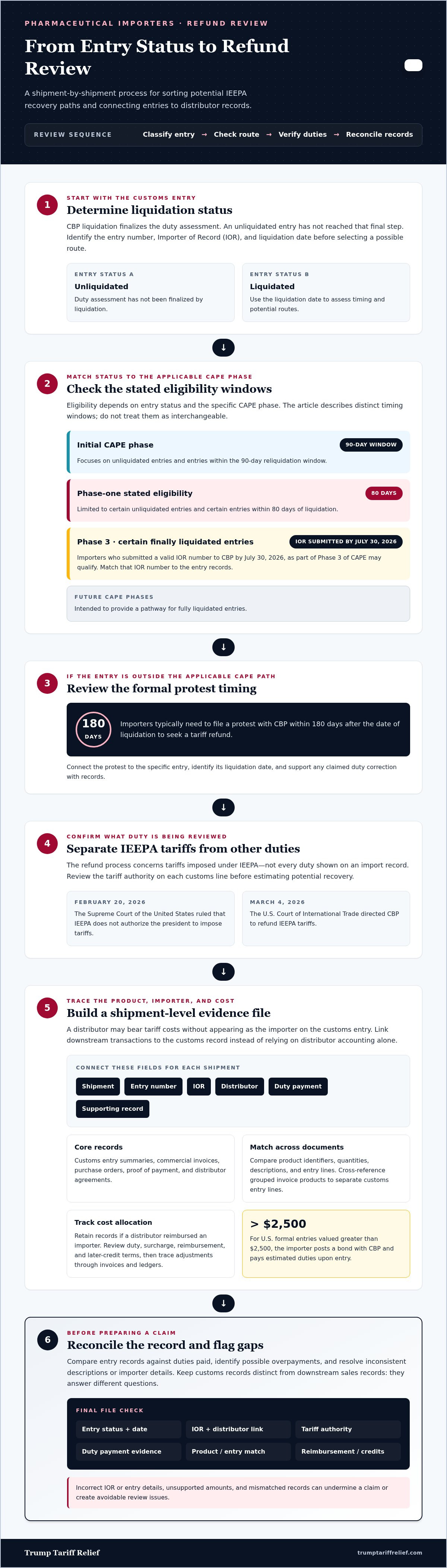
Eligibility turns first on whether U.S. Customs and Border Protection (CBP) has liquidated the entry. Liquidation finalizes the duty assessment; an unliquidated entry has not reached that final step. CBP’s initial CAPE phase focuses on unliquidated entries and entries within the 90-day reliquidation window. Phase-one eligibility is also limited to certain unliquidated entries and certain entries within 80 days of liquidation. These are distinct stated windows, so classify each entry by its status and applicable CAPE phase.
The program concerns tariffs imposed under the International Emergency Economic Powers Act (IEEPA), not every duty shown on an import record. The Supreme Court of the United States ruled on February 20, 2026, that IEEPA does not authorize the president to impose tariffs. On March 4, 2026, the U.S. Court of International Trade directed CBP to refund IEEPA tariffs. A pharmaceutical entry may therefore warrant review if it includes IEEPA duties, but the tariff authority and entry status still matter.
For certain finally liquidated entries, Phase 3 may provide another route. Importers who submitted a valid Importer of Record number to CBP by July 30, 2026, as part of Phase 3 of CAPE may qualify. Future CAPE phases are intended to provide a pathway for fully liquidated entries. Match the importer number to entry records, then identify the phase and status applying to each shipment.
For entries outside the applicable CAPE path, a formal customs protest may be relevant. Importers typically need to file a protest with CBP within 180 days after the date of liquidation to seek a tariff refund. Identify the liquidation date, connect the protest to the entry, and support the claimed duty correction with records.
A denied claim can leave duties unrecovered, while incorrect Importer of Record or entry details can undermine it. A review may examine whether entry data, tariff authority, and supporting documents align. Keep records consistent and correct discrepancies before filing. Unsupported amounts or mismatched importer details can create avoidable review issues.
Distributor tariff exposure and documentation
Pharmaceutical distributors may bear tariff costs without appearing as the importer on the customs entry. Start by identifying the Importer of Record (IOR) for each shipment. Then compare entry information with distributor invoices and payment records. This distinguishes the party named in the customs record from businesses that may have absorbed costs through their transactions.
For U.S. formal entries valued greater than $2,500, the importer posts a bond with U.S. Customs and Border Protection (CBP) and pays estimated duties upon entry. That means distributor-level accounting alone may not show which duties CBP assessed. Connect each shipment to its entry number, IOR, product description, and duty payment. If a distributor reimbursed an importer, retain records showing the amount and transaction.
Build a shipment-level file that follows the product through each handoff. Useful records include customs entry summaries, commercial invoices, purchase orders, proof of payment, and distributor agreements. Match product identifiers and quantities across documents. For example, if an invoice groups several pharmaceutical products but an entry lists separate lines, retain a cross-reference linking each product to its entry line. Resolve inconsistent descriptions before calculating potential exposure.
Contract terms also affect the financial picture. Review clauses covering duties, tariff surcharges, reimbursement, and later credits. A distributor may have paid a surcharge that the importer later recovers, so track any adjustment through the relevant invoices and ledgers. Keep customs records separate from downstream sales records: they answer different questions about entry and cost allocation.
Use a reconciliation table to flag missing links: shipment, entry number, IOR, distributor, duty payment, and supporting record. This makes gaps visible before a claim is prepared and helps prevent attributing one company’s entry to another. For a structured customs documentation review, organize records by entry first, then connect distributor transactions to them.
Tariffs affecting pharmaceutical imports
Pharmaceutical importers must separate IEEPA duties from other tariff treatment. The Supreme Court of the United States ruled on February 20, 2026, that IEEPA does not authorize the president to impose tariffs. That ruling concerns tariffs imposed under IEEPA; it doesn’t automatically erase every duty on a pharmaceutical entry. Review each customs line for its tariff authority before estimating potential recovery.
The U.S. Bureau of Industry and Security describes a separate product-specific pathway that provides a zero tariff rate for certain eligible pharmaceutical categories. These include specialty categories, orphan-designated drugs, fertility drugs, gene therapies, and products tied to urgent U.S. health needs. This pathway concerns tariff treatment, not an automatic refund of duties already paid. Identify the product category and applicable treatment, then distinguish that review from an IEEPA refund claim.
Do state-specific rules or FDA requirements affect federal tariff refunds for pharmaceutical imports? State rules and FDA requirements concern separate compliance obligations. A federal tariff refund review focuses on duties assessed on the customs entry. FDA compliance records, for example, may help identify a product, but they don’t replace customs entry details or establish which tariff authority applied.
HTS classification, country of origin, and trade agreements affect tariff analysis by showing how a product was declared and which treatment applied. Compare the entry’s classification and origin with product and supplier records. Then separate IEEPA duties from other assessed duties and any preferential treatment shown on the entry. A changed classification or origin assumption can alter the duty calculation, but it doesn’t make every duty an IEEPA tariff eligible for reimbursement.
For each pharmaceutical product, preserve a clear chain of records: product description, declared origin, HTS classification, entry line, and tariff authority. If a shipment includes both an IEEPA charge and another duty, isolate the amounts rather than treating the full assessment as refundable. This review helps distinguish potential IEEPA recovery from ongoing tariff exposure and product-specific zero-rate treatment.
How do importers identify and verify tariff overpayments on pharmaceutical entries?
Verifying a tariff refund for pharmaceutical importers starts with reconciling U.S. Customs and Border Protection (CBP) entry records against duty payments, line by line. Match each pharmaceutical entry to its entry summary, payment evidence, product description, declared origin, and tariff authority. This helps identify whether a payment corresponds to an IEEPA duty or another charge. A general-ledger total alone won’t show which entry or tariff line produced the amount.
Next, compare the amount assessed with the amount paid and the entry’s current status. Flag differences, duplicate records, and entries whose tariff authority needs review. For each flagged line, retain the calculation and supporting records. If an entry includes several products, trace each one to its own line rather than applying an assumed rate across the shipment.
Reconciliation should connect customs records with distributor invoices and credits. A distributor’s surcharge may differ from the duty paid to CBP, so keep those amounts separate. Record whether a drawback claim or another recovery has already been requested or received. This distinction matters when calculating a tariff refund for pharmaceutical importers because the same duty should not be counted twice.
Calculate potential interest separately from the duty principal. Preserve entry and payment dates, refund or adjustment records, and the calculation method. Relevant dates and claim treatment shape the interest calculation, so don’t combine an estimate with verified duty overpayment.
Keep an audit trail linking each adjustment to its source record. A reconciliation schedule can capture the entry number, product line, tariff authority, assessed duty, payment evidence, and discrepancy. Label each item as supported, unresolved, or excluded, with a brief reason. Before pursuing a tariff refund for pharmaceutical importers, use these records to distinguish documented exposure from assumptions. An organized entry-level eligibility review can turn the records into a clear recovery analysis.
Trump Tariff Relief: IEEPA Tariff Refund Recovery
Trump Tariff Relief helps businesses assess potential IEEPA duty recovery and manage supporting customs documentation. If pharmaceutical entry records show possible IEEPA duties, its Tariff Eligibility Assessment can identify entries for further review. Its IEEPA Tariff Refund Recovery service manages the recovery process, including documentation and government filings.
For importers, the practical next step is to bring entry records, duty payment information, and relevant distributor documents together for review. Trump Tariff Relief works on a contingency-fee basis: there are no upfront costs, and payment is only a percentage of funds successfully recovered. No refund outcome is guaranteed.
To learn how the recovery process works for your records, visit Trump Tariff Relief’s recovery process.
Turn your entry review into a clear next step
Sound recovery decisions start with usable records, not a rushed estimate. Bring customs and accounting teams together around one question: can each potential overpayment be traced to a specific entry and supported by consistent documentation? This shared view can help prioritize entries for review and prevent unresolved records from being mistaken for recoverable amounts.
A tariff refund for pharmaceutical importers can involve more than customs data. Distributor transactions, product records, and internal reconciliation all affect how clearly a business can present its position. If your team has identified possible IEEPA exposure but needs help moving from records to a recovery review, Trump Tariff Relief can assist. Each entry’s facts determine its potential eligibility.
Contact Trump Tariff Relief to discuss your records and move forward with greater clarity.
Frequently Asked Questions
How Does This Affect Pharma Companies?
Pharmaceutical companies must assess tariff recovery alongside product-specific tariff treatment. Regulated supply chains may not adjust as quickly as others, so tariff exposure can persist while sourcing or distribution plans change. The U.S. Bureau of Industry and Security described a zero tariff rate pathway for certain eligible categories, including orphan-designated drugs, fertility drugs, and gene therapies. That treatment is separate from reviewing duties already paid.
What should importers consider when evaluating tariff refund filings?
Importers should ensure their records connect each claim to the business and entries involved. A useful starting package includes basic company information, estimated tariff payments, import regions, and available customs records. Also identify who can explain discrepancies across finance, trade, and distribution records. Trump Tariff Relief keeps business information confidential and never shares it without explicit consent.
Why Are Companies Able to Receive Tariff Reimbursements?
Potential reimbursement stems from the legal treatment of IEEPA tariffs, not simply from a company’s decision to request repayment. The Supreme Court ruled that IEEPA doesn’t authorize the president to impose tariffs, and the U.S. Court of International Trade directed CBP to refund IEEPA tariffs. Those developments create a recovery pathway, while entry status, applicable procedures, and supporting records shape an individual claim.
Are pharmaceutical importers eligible for U.S. tariff refunds?
Some pharmaceutical importers may qualify if their customs entries include covered IEEPA duties and meet applicable administrative requirements. Eligibility is assessed at the entry level, not from the company’s industry label alone. For example, a distributor that paid a surcharge should distinguish that commercial payment from the customs duty paid by the Importer of Record. Documentation and filing status help determine who can pursue recovery.
Which U.S. tariffs on pharmaceutical imports can be refunded?
The refund process discussed here concerns tariffs imposed under IEEPA. It does not mean every duty on a pharmaceutical shipment is refundable. Review each entry line to distinguish IEEPA charges from other tariff treatment, including any applicable product-specific zero-rate pathway. Eligibility for a particular tariff rate and potential recovery of previously paid IEEPA duties are separate questions that require distinct records.
What are the deadlines for requesting refunds of U.S. import duties?
For a formal protest, importers typically have 180 days after liquidation. CAPE criteria also depend on entry status and phase: the initial phase focuses on unliquidated entries and entries within the 90-day reliquidation window, while phase one is limited to certain unliquidated entries and entries within 80 days of liquidation. For certain finally liquidated entries, Phase 3 required a valid Importer of Record number by July 30, 2026.
Ready to find out what your business may be owed?
Check My Eligibility