
How much of your company's liquidity is currently sitting in a government account, trapped by a tariff that the U.S. Supreme Court has already ruled unlawful? Since the landmark decision on February 20, 2026, over 330,000 importers have found themselves eligible to reclaim a share of an estimated $166 billion in overpaid duties through performance based tariff recovery. You're likely skeptical of refund claims that sound too good to be true, especially when tight cash flow makes the prospect of high hourly legal bills feel like a gamble you simply can't afford to take.
It's a valid concern, but shifting the financial burden away from your balance sheet and onto the experts changes the recovery equation entirely. This article explains how a specialized contingency model eliminates the risk of reclaiming your IEEPA refunds while maximizing your business liquidity. We'll examine the immediate impact of the Supreme Court ruling, the critical 180 day protest deadlines, and how a risk-free partnership can help you recover millions in overpaid duties without a single upfront dollar.
Key Takeaways
- Understand how performance based tariff recovery shifts the financial risk from your business to trade experts, ensuring you only pay when a refund is successfully secured.
- Learn the streamlined two-step process for identifying qualifying imports and conducting a documentation audit to maximize your claim's total value.
- Discover why results-oriented advocacy provides a more capital-efficient alternative to traditional hourly legal billing for complex IEEPA claims.
- Identify the critical deadlines within the 2026 recovery window and the strict 180-day statutory limit for protesting liquidated entries.
- Gain a clear path to restoring business liquidity through a specialized partnership that handles the heavy lifting of federal trade bureaucracy.
What is Performance Based Tariff Recovery?
Performance based tariff recovery is a results-driven service model where trade consultants are compensated only after successfully reclaiming overpaid duties from the U.S. government. For years, the standard approach to trade litigation involved high hourly legal bills that accrued regardless of whether a refund was ever secured. This traditional model often left businesses hesitant to challenge punitive duties, fearing the cost of the fight would outweigh the potential recovery. By contrast, a performance-based partnership shifts the entire financial risk away from the importer. If there's no recovery, there's no fee.
The Evolution of Tariff Recovery Services
While traditional customs brokerage focuses on the daily compliance of moving goods across borders, specialized recovery firms operate as forensic investigators. The landscape changed dramatically on February 20, 2026, when the U.S. Supreme Court ruled that the International Emergency Economic Powers Act (IEEPA) doesn't grant the executive branch the authority to impose tariffs. This decision transformed billions of dollars in collected duties into a massive pool of potential refunds. You can find more detail on how this ruling impacts your specific entries at our IEEPA explained resource. Because the stakes involve an estimated $166 billion in contested funds, performance based tariff recovery has become the industry standard. It ensures that recovery experts are motivated to move quickly, accurately, and aggressively against federal trade bureaucracy.
Why Importers Prefer the Contingency Model
The primary advantage of the contingency model is the immediate preservation of corporate capital. CFOs don't need to carve out a new budget line item or seek board approval for speculative legal expenses. The service effectively funds itself out of the recovered capital. This alignment of incentives is critical; your consultant only wins when your business wins big. It eliminates the "sunk cost" fear that plagues traditional litigation, where companies often feel pressured to keep paying fees to justify previous expenditures. Instead, you gain a high-performing partner that takes on the heavy lifting of eligibility assessments and documentation management. This model transforms a complex legal challenge into a straightforward opportunity for financial restoration, allowing you to focus on core operations while experts handle the recovery of your trapped liquidity.
How the Contingency Model Works for IEEPA Claims
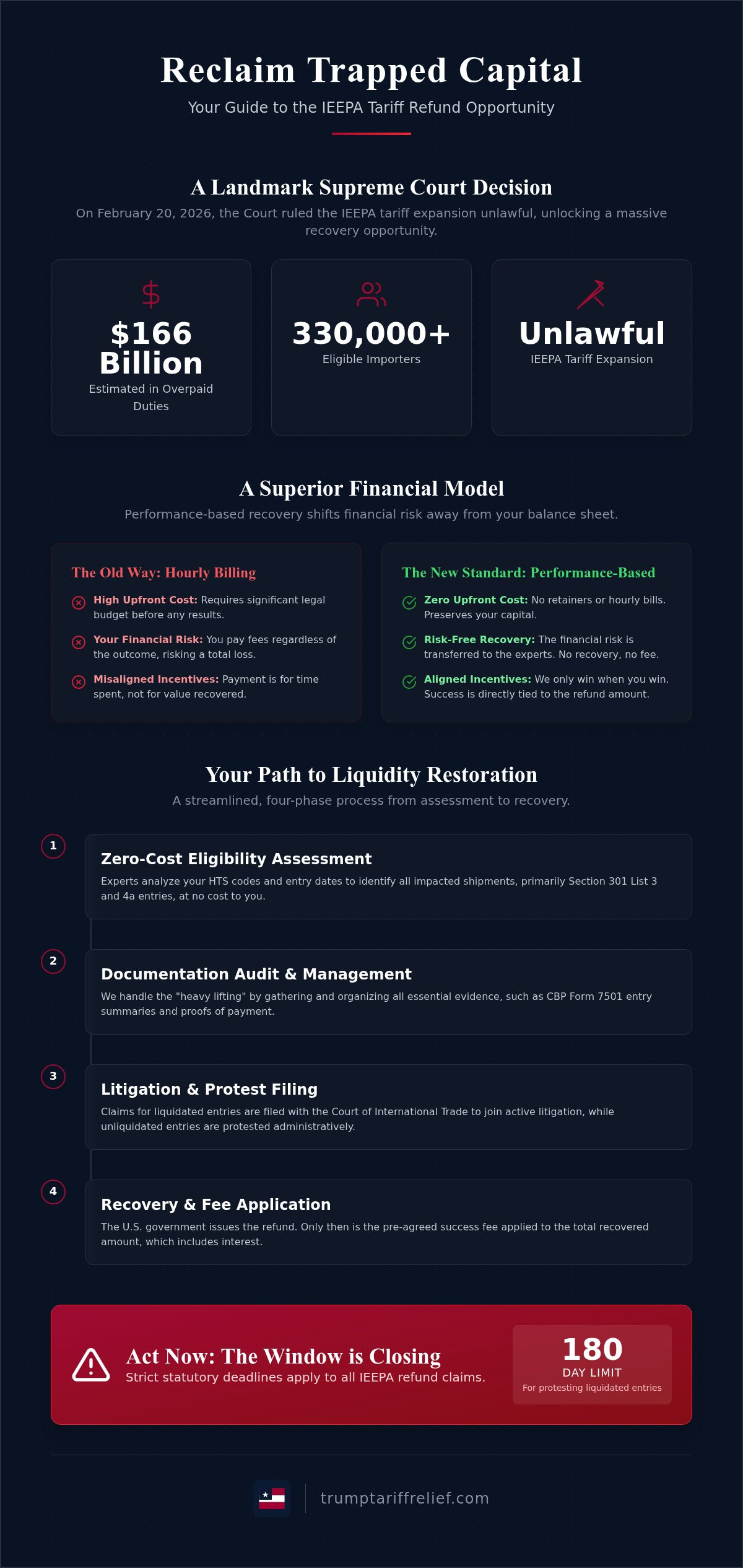
The transition from recognizing a financial injustice to actually reclaiming capital requires a methodical, multi-stage pipeline. A performance based tariff recovery model functions as a risk-transfer mechanism, where the specialist handles the administrative and legal complexities. This process is divided into four distinct phases designed to move from initial identification to final liquidation of the overpaid funds.
First, the initial eligibility assessment filters through your import history to isolate entries impacted by the unlawful IEEPA expansion. This focuses primarily on Section 301 List 3 and List 4a entries. Second, a documentation audit gathers the essential evidence, including CBP Form 7501 entry summaries and verified proofs of payment. Third, the filing phase involves active litigation or administrative protests, depending on the entry's status. Finally, the recovery phase concludes when the U.S. government issues the refund through the CAPE system, at which point the success fee is applied to the interest-bearing total.
Phase 1: The Zero-Cost Assessment
The first step is a surgical analysis of your HTS codes and entry dates. Experts identify which shipments fall under the specific categories affected by the February 20, 2026, Supreme Court ruling. This isn't a surface-level scan; it's a deep dive into your historical data to ensure no potential refund is left on the table. By analyzing the timing of your liquidations, we can determine whether a standard protest or a lawsuit in the Court of International Trade is necessary. You can start this process by requesting a Tariff Refund Assessment to clarify your specific recovery potential.
Phase 2: Management and Filing
Once eligibility is confirmed, the focus shifts to customs documentation management. This is the "heavy lifting" phase where specialists organize millions of data points across thousands of entries. Precise legal framing is mandatory here. Because the path to recovery for finally liquidated entries currently requires active litigation, your claim must be filed with the Court of International Trade to join the 3,700 lawsuits already pending. This ensures your entries are processed through the CBP’s CAPE system. For a more granular look at the mechanics, you can review the IEEPA refund claim process. If you want to see how these steps apply to your business, our team can provide a preliminary eligibility review to get started.
Performance Fees vs. Hourly Consulting: A Financial Comparison
Choosing between traditional hourly consulting and a results-driven model is more than a budgetary decision; it's a strategic choice about who carries the risk. Traditional legal retainers require you to pay for "effort," meaning every phone call, research memo, and filing generates a bill regardless of whether a check is ever issued. In contrast, performance based tariff recovery is built on the principle of shared success. Under this model, your business only pays a percentage of the actual funds recovered, effectively turning the service into a self-funding mechanism that protects your bottom line. You can learn more about how this risk-free structure integrates with our process on our how it works page.
The risk profile of these two approaches couldn't be more different. Hourly billing creates a financial downside where you could potentially spend tens of thousands of dollars only to have a claim denied due to technicalities. A contingency-based partnership offers a 0% financial downside for the importer. Because firms operating on success fees only profit when you do, they are naturally selective. They won't take on a case unless they are confident in a successful outcome, providing you with an implicit vetting of your claim's legitimacy before you ever sign a contract.
The Hidden Costs of Traditional Legal Retainers
Billable hours often incentivize bloated processes and administrative delays. When a firm is paid by the hour, there is little motivation to streamline the documentation audit or expedite the filing process. You might find yourself paying for exhaustive research into HTS codes that ultimately don't qualify for a refund. This creates a high Total Cost of Ownership (TCO) for your recovery project, as the upfront investment grows while the eventual payout remains uncertain. For many businesses managing tight quarterly budgets, this uncertainty is a barrier that prevents them from reclaiming millions in overpaid duties.
Maximizing ROI with Success-Based Recovery
Success-based models democratize access to elite trade expertise. Small and medium-sized enterprises (SMEs) can leverage the same high-level legal advocacy as global corporations without the hurdle of a massive retainer. While some may view a success fee as a cost, it is actually a fraction of the capital that would otherwise remain lost to the government. By shifting the financial burden to the specialist, performance based tariff recovery transforms a burdensome legal expense into a high-yield, revenue-generating event for your company. This ensures that every dollar recovered contributes directly to your liquidity and operational growth instead of being drained by upfront consulting costs.
The 2026 Opportunity: Why the IEEPA Window is Closing
The February 20, 2026, Supreme Court decision didn't just declare a legal victory; it ignited a high-stakes countdown for every importer who paid IEEPA-authorized duties. While the ruling confirms that the government overstepped its authority, it doesn't mean the refund process is automatic or indefinite. For many businesses, 2026 represents the "now or never" year because of strict statutory limitations that govern how and when you can challenge a tariff. If your entries have liquidated, you're facing a rolling 180-day window to file a formal protest. Missing this cutoff for a single entry means that specific refund is likely gone forever.
The Supreme Court's stance has clarified the government's obligation to return these funds, but the burden of action remains entirely on the importer. With approximately $166 billion in total IEEPA tariffs collected, the government isn't going to volunteer these payments. You must actively claim them. Using a performance based tariff recovery model ensures that your partner is as motivated by these rolling deadlines as your CFO is, providing a safeguard against administrative oversight.
Statutes of Limitations and Filing Deadlines
There's a critical technical difference between a standard administrative protest and a broader IEEPA claim. While the 180-day protest window (CBP Form 19) is the immediate priority for entries that are just now liquidating, entries that were "finally liquidated" more than 90 days ago often require active litigation in the U.S. Court of International Trade. Waiting for "clearer guidance" or for the government to simplify the process is a dangerous strategy that could cost your company millions. You can review the specific dates that apply to your entries in our guide to the Tariff Refund Statute of Limitations. Protecting your right to a refund now is the only way to ensure you're included in the eventual payout, even as the courts continue to deliberate on the final distribution mechanics.
The Logistics of Speed in Recovery
Documentation gathering is the most common bottleneck in the recovery process. With over 53 million individual entries impacted nationwide, the sheer volume of data is staggering. Many firms underestimate the time required to pull CBP Form 7501 entry summaries and verify proof of payment across years of import history. Specialized consultants play a vital role here by expediting the audit process through automated data extraction and forensic accounting. To prepare, you should review the required documents for IEEPA tariff refund. Speed isn't just about efficiency; it's about liquidity. Every day your capital remains with the government is a day it isn't working for your business. Secure your place in the 2026 recovery window today by initiating your eligibility assessment before more deadlines pass.
Securing Your Refund with Trump Tariff Relief
Our approach at Trump Tariff Relief is built on a single, uncompromising principle: we don't get paid unless you win. This no-nonsense methodology is designed to dismantle the barriers trade bureaucracy places between your business and its rightful capital. While generalists may offer broad customs advice, we provide surgical focus on financial restoration. We act as your protective strength against government overreach, ensuring that the administrative burden of the IEEPA ruling falls on our shoulders, not your balance sheet. Our commitment to transparency means you'll have a clear view of the process from the initial audit to the final interest-bearing payout.
Trust is the most valuable currency in trade litigation. By utilizing a performance based tariff recovery model, we align our success directly with yours. This isn't just about filing paperwork; it's about righting a financial wrong with professional confidence. If your company has been squeezed by punitive duties, you deserve a partner that treats your recovery with the same urgency as a high-stakes business transaction. We provide the elite expertise required to navigate federal systems without the bloated costs associated with traditional legal retainers.
The Trump Tariff Relief Advantage
We aren't a general customs brokerage or a corporate law firm with a revolving door of billable hours. We specialize exclusively in IEEPA recovery. This laser-like focus means our team of "insider" experts understands the labyrinthine pathways of the Court of International Trade and the CBP's CAPE system with unmatched precision. We value efficiency over fluff, stripping away the academic jargon to deliver high-performing results. When you partner with us, you gain a specialized mentor who has seen every bureaucratic hurdle and knows exactly how to bypass it. We position our firm as the active engine of your recovery, allowing you to remain the beneficiary of a streamlined, professional process.
Start Your Preliminary Assessment Today
The onboarding process is intentionally designed to minimize your operational friction. Because we operate exclusively on a performance based tariff recovery model, we take on the entirety of the financial risk. You get the reward of restored liquidity without the headache of upfront costs, hourly billing, or "sunk cost" fears. This is the ultimate trust-builder for importers who have been skeptical of refund claims in the past. To begin the process of reclaiming your capital, you can Request Your Performance-Based Eligibility Assessment today. Our team is prepared to move quickly to meet the strict 2026 deadlines, transforming your historical overpayments into immediate, actionable business capital.
Restore Your Corporate Liquidity Today
The window to reclaim overpaid IEEPA duties is currently open, but the rolling 180-day protest deadlines mean it's closing for specific entries every single day. With billions of dollars in potential refunds at stake, the only real risk to your bottom line is inaction. By leveraging a performance based tariff recovery model, you can bypass the burden of hourly legal fees and focus entirely on restoring your company's liquidity. It's time to shift the financial weight of trade litigation away from your balance sheet.
Our expert IEEPA analysis is built on recent Supreme Court precedents, ensuring your claims are framed with maximum legal authority. We provide a dedicated team of trade advocates who manage the entire filing process from initial audit to final payout. Because we operate exclusively on a contingency-fee basis, we only get paid if you win. This ensures our incentives are perfectly aligned with your success and financial restoration. Take control of your financial future before the 2026 opportunity window shuts. Start Your Risk-Free Tariff Recovery Assessment and let us do the heavy lifting to reclaim what you're owed. Your capital belongs in your business, not with the government.
Frequently Asked Questions
Is performance based tariff recovery really free to start?
Yes, performance based tariff recovery is entirely free to start because it operates on a contingency basis. You won't face any upfront costs, hourly legal bills, or administrative fees during the assessment or filing phases. The service provider assumes the full financial risk of the project, ensuring that your business liquidity remains protected while the claim is processed through federal channels.
What percentage do tariff recovery firms typically charge as a success fee?
Success fees vary across the industry and are typically calculated as a portion of the total duties and interest recovered from the government. While specific rates depend on the complexity and volume of the entries, these fees are only payable after the refund is successfully secured. This ensures the recovery process is self-funding and eliminates any out-of-pocket expenses for your firm.
Can I file for an IEEPA refund if I already used a customs broker?
Yes, you can absolutely file for a refund even if you currently work with a customs broker for ongoing shipments. Brokers focus on daily compliance and entry clearance, whereas recovery experts specialize in retroactive litigation and forensic audits. These services are complementary; your broker handles the present while a specialist navigates the legal complexities of reclaiming past IEEPA overpayments.
What happens if my IEEPA tariff refund claim is denied?
If your claim is denied, you owe nothing to the recovery firm. The contingency model protects you from the financial downside of a failed claim, as the consultant absorbs all costs related to documentation and legal preparation. This "no-win, no-fee" structure is designed to build trust and ensure that only claims with a high probability of success are pursued.
How long does the performance-based recovery process take in 2026?
The timeline in 2026 varies based on whether your entries are currently liquidated or require active litigation in the Court of International Trade. While the initial eligibility assessment can be completed quickly, the actual government payout through the CAPE system may take several months. Your recovery partner manages this entire lifecycle, providing updates as the government processes the high volume of IEEPA refunds.
Is the China tariff refund real or is it a scam?
The opportunity for a refund is legitimate and follows the Supreme Court's February 20, 2026, ruling that the IEEPA doesn't authorize these specific tariffs. However, you should be wary of any party requesting upfront fees or claiming to be CBP. Genuine recovery services operate on success-based models and never ask for payment before the government has issued your refund check.
What documents do I need for a performance-based assessment?
To begin an assessment, you typically need to provide CBP Form 7501 entry summaries and verified proof of payment for the impacted duties. These documents allow experts to identify Section 301 List 3 and List 4a entries that qualify under the IEEPA ruling. A specialized consultant will handle the heavy lifting of auditing these files to ensure every eligible dollar is included in your claim.
Can manufacturers and retailers both use performance-based recovery?
Both manufacturers and retailers are eligible for recovery if they were the importer of record for goods subject to Section 301 tariffs. Whether you imported raw materials for production or finished goods for retail, the legal basis for the refund remains the same. Performance based tariff recovery is a scalable solution that works for companies of all sizes across various sectors of the global supply chain.
Ready to find out what your business may be owed?
Check My Eligibility