
Approximately $166 billion in corporate capital is currently sitting in government accounts that, by law, belongs back on your balance sheet. Following the Supreme Court’s February 2026 ruling that IEEPA tariffs were imposed without authority, the window to secure an IEEPA court case refund has officially opened. You’ve likely felt the sting of these unlawful duties on your bottom line for months, and the persistent confusion between Section 301 and IEEPA eligibility only adds to the frustration. It’s a classic case of administrative inertia standing between your business and its rightful assets.
We understand that the fear of missing filing deadlines or getting bogged down in complex customs documentation is a significant barrier to recovery. This article provides a clear, high-stakes narrative on how to reclaim your capital, ensuring you don't leave money on the table due to government delays. We'll examine the three phases of the CAPE system, explain why finally liquidated entries require a specific court order, and show how a contingency-based model removes the financial risk from the recovery process. Your path to financial restoration starts with understanding the mechanics of this landmark ruling and moving quickly to secure your position.
Key Takeaways
- Understand why the Supreme Court’s 2026 ruling invalidated IEEPA tariffs, confirming that the executive branch exceeded its statutory authority in imposing these duties.
- Identify your eligibility window for an IEEPA court case refund, covering entries made between February 3, 2025, and February 24, 2026, regardless of your original plaintiff status.
- Discover how to bypass government delay tactics and administrative hurdles that currently stall the return of your seized capital.
- Follow a structured roadmap to inventory affected entries and compile the specific documentation required by U.S. Customs for a successful claim.
- Learn how a contingency-based model manages the heavy lifting of customs recovery without requiring upfront fees or financial risk.
The Supreme Court Ruling: Why IEEPA Tariffs Were Declared Unlawful
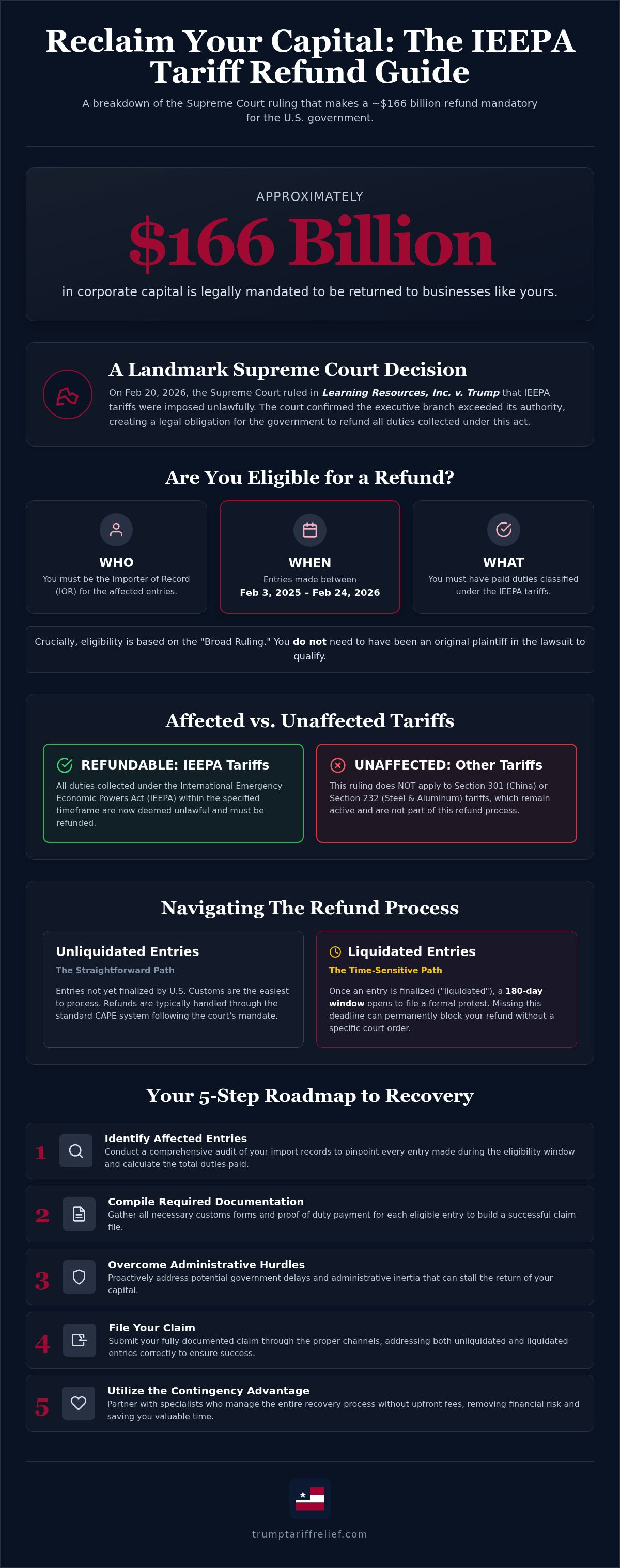
On February 20, 2026, the Supreme Court delivered a decisive blow to executive overreach in trade policy. In the landmark case Learning Resources, Inc. v. Trump, the court invalidated billions in duties collected under the International Emergency Economic Powers Act (IEEPA). The ruling confirmed that the President’s attempt to impose broad, global tariffs bypassed the specific statutory limits established by Congress. This isn't just a legal victory; it’s a financial catalyst that makes an IEEPA court case refund a mandatory obligation for the U.S. government.
It’s vital to distinguish these tariffs from other trade actions that may still affect your supply chain. While Section 301 duties on Chinese goods and Section 232 tariffs on steel and aluminum remain active, the IEEPA duties applied to entries between February 3, 2025, and February 24, 2026, are now officially unlawful. Following the Supreme Court’s decision, the Court of International Trade (CIT) issued a series of mandates in March 2026, ordering U.S. Customs and Border Protection (CBP) to begin the restitution process for the approximately $166 billion collected.
The Core Legal Precedent
The Supreme Court's decision centered on the principle that IEEPA cannot be used as a blank check for economic protectionism. The justices found that while the executive branch has broad power during national emergencies, that power doesn't extend to restructuring the nation’s trade economy through unilateral taxation. This ruling restores the balance of power, placing trade authority back in the hands of the legislature. For businesses, this means the government no longer has a legal right to hold the capital collected during that window. It’s a clear, constitutional directive for financial restoration.
Immediate Impact on Importers
Every importer of record who paid these duties now stands as a potential claimant. We’ve moved past the era of potential litigation into a phase of active refund processing. If your business imported goods during the affected period, you aren't just a bystander; you're a beneficiary of a broad ruling that applies to the entire trade community. To understand the full history of this legislative battle, you can visit our page on IEEPA Explained. Securing your return requires immediate action, specifically gathering the required documents for IEEPA tariff refund to ensure your claim is processed before administrative windows close.
Determining Your Eligibility: Who Qualifies for an IEEPA Refund?
Success in reclaiming your capital depends on understanding that the Supreme Court decision operates as a "Broad Ruling." You don't need to have been an active plaintiff in the original litigation to benefit from the IEEPA court case refund process. If your business paid duties on entries occurring between February 3, 2025, and February 24, 2026, you're likely eligible for restitution. This eligibility extends across all industries, making it imperative for every Importer of Record (IOR) to verify their financial exposure during this specific window.
The IOR holds the exclusive legal right to file for these refunds. Whether you're a multinational corporation or a small-to-medium enterprise (SME), the burden of initiation rests on your shoulders. Many smaller firms mistakenly assume that their customs broker will handle the recovery automatically. This is a dangerous misconception. To ensure no capital is left behind, your first step should be a comprehensive tariff refund assessment to identify every eligible entry and calculate the potential recovery value.
Unliquidated vs. Liquidated Entries
The administrative path to your refund is determined by the status of your entries. Unliquidated entries are those that U.S. Customs hasn't yet finalized; these are generally the most straightforward to process through the CAPE system. If your entries are liquidated, however, the clock is ticking. You typically have a 180-day window from the date of liquidation to file a formal protest. If this window closes without action, the liquidation becomes "final and conclusive," which can significantly complicate or even block your path to a refund. Identifying where your entries sit in this timeline is the difference between a successful recovery and a permanent loss.
Preserving Your Recovery Rights
Don't fall into the trap of assuming the government will proactively issue your refund. While the CBP guidance on IEEPA refunds outlines the technical steps for the CAPE system, it doesn't account for administrative errors or missed deadlines on the importer's end. Filing a protective protest remains a necessary safeguard for many businesses. You must actively monitor your Automated Commercial Environment (ACE) portal to track entry status and ensure your banking information is updated for ACH payments. This is a labor-intensive process, but it's the only way to guarantee your IEEPA court case refund isn't lost to bureaucracy. If you're unsure of your current standing, we recommend a preliminary eligibility check to secure your rights immediately.
The Federal Circuit Victory: Overcoming Government Delay Tactics
The path to your IEEPA court case refund became significantly clearer following a major procedural victory at the U.S. Court of Appeals for the Federal Circuit. In the wake of the high court's decision, the Justice Department attempted to stall the process by requesting a 90-day stay on remanding cases back to the Court of International Trade (CIT). On March 2, 2026, the Federal Circuit issued a unanimous order denying this stay, effectively stripping the government of its primary delay tactic. This ruling signals a profound "sense of urgency" from the judiciary, recognizing that billions in corporate capital have been unlawfully withheld.
The government’s strategy was transparent: they sought time to coordinate a defensive response. The Supreme Court ruling on IEEPA tariffs created a projected liability of up to $175 billion for the U.S. Treasury, prompting the DOJ to argue that the judiciary should wait for a "legislative solution" from Congress. The court flatly rejected this, confirming that the right to restitution is immediate and doesn't depend on future political negotiations. For importers, this means the administrative hurdles are finally falling, clearing the way for the remand to the CIT to accelerate the actual distribution of funds.
The 'Legislative Solution' Distraction
Waiting for a legislative fix is a high-risk strategy that serves only the government's interests. The DOJ’s push for a congressional intervention was a calculated attempt to move the goalposts. If importers had waited, many would have seen their claims pushed past the tariff refund statute of limitations, effectively forfeiting their right to recovery. The court’s refusal to grant a stay ensures that the legal timeline remains fixed, protecting your ability to file before these critical administrative windows close. It’s a reminder that in customs law, passivity is often rewarded with permanent financial loss.
Proceedings at the Court of International Trade (CIT)
With the cases now remanded, Judge Richard Eaton has taken a firm stance on enforcement. The CIT has begun issuing mandates to U.S. Customs and Border Protection (CBP) to proceed with the liquidation and reliquidation of entries without the unlawful IEEPA duties. Specifically, the "Atmus Filtration" order has set the standard for how these refunds will be processed for general importers. It directs CBP to treat the invalidated duties as if they never existed, requiring a full return of the principal plus interest. We’re now entering the implementation phase, where the "active engine" of recovery moves from the courtroom to the ACE portal. Understanding how these CIT orders apply to your specific HTS codes is the next essential step in securing your IEEPA court case refund.
The Recovery Roadmap: Essential Steps to Secure Your Refund
Securing your IEEPA court case refund requires more than just awareness of the law; it demands a rigorous administrative strategy. The government won't hand back $166 billion without a fight. You must transition from a passive observer to an active claimant by following a structured roadmap that addresses entry identification, documentation, and electronic payment setup. This process is the only way to bypass administrative inertia and ensure your capital returns to your balance sheet.
Inventory and Quantification
Start by conducting a comprehensive inventory of every entry subject to these unlawful duties. You should collaborate closely with your customs brokers to extract complete entry data from the ACE portal. This isn't a simple list; it's a strategic categorization. Group your entries by liquidation status to determine which require immediate protests and which can be handled through standard CAPE filings. By quantifying the total potential recovery, you can prioritize high-value claims and ensure your internal resources are focused where the financial impact is greatest. Don't leave this to chance; an incomplete inventory is essentially a gift to the Treasury.
Documentation and Substantiation
Precision is your greatest ally in this process. You must compile the required documents for IEEPA tariff refund, including commercial invoices, entry summaries (CBP Form 7501), and definitive proof of payment. CBP often uses technicalities to deny claims, so your files must be "audit-ready" from the outset. Professional customs documentation management prevents the processing bottlenecks that occur when data is missing or inconsistent. If your records aren't impeccable, you risk a denial that could take months or years to appeal.
Before submission, verify your entries for any underlying errors in HTS classification or valuation. A reliquidation triggers a full review of the entry; if errors are found, CBP could issue a "bill" for underpaid duties that offsets your refund. Finally, ensure your business is enrolled in the Automated Clearing House (ACH) through the ACE portal. The government has mandated electronic issuance for these funds, and missing banking details are currently holding up billions in approved payouts. If you want to bypass the heavy lifting and secure your capital quickly, request your free eligibility assessment today.
Partnering for Recovery: The Trump Tariff Relief Contingency Advantage
Reclaiming capital after the Supreme Court ruling isn't a matter of simply asking for a check. It's an aggressive administrative battle against a government that has every incentive to delay payouts. While earlier sections detailed the legal precedents and documentation requirements, the final hurdle is the execution of the claim itself. This is where many businesses falter, overwhelmed by the labor-intensive nature of customs bureaucracy. If your team is already managing complex supply chains, adding the burden of a massive customs audit is often unfeasible. Our team acts as the active engine for your IEEPA court case refund, managing the entire lifecycle of the claim from initial assessment to the final ACH deposit.
Why Contingency Beats Hourly Billing
Hourly billing models, often favored by large consulting firms, place the financial risk squarely on the importer. You pay for the time spent, regardless of whether a refund is ever secured. We reject this approach because it doesn't prioritize the results you need. Our contingency-based model ensures that our interests are perfectly aligned with yours. If we don't recover your capital, you don't pay a fee. This "No Upfront Cost" promise allows you to pursue a thorough tariff recovery for importers audit without depleting your current reserves. We only succeed when your refund hits your account, which motivates our team to identify every eligible dollar and fight for its return through every administrative obstacle.
Streamlining the Path to Restoration
Bypassing the steep learning curve of CIT mandates and CBP’s CAPE system is essential for meeting strict deadlines. Our specialized knowledge allows us to anticipate government delay tactics and navigate the specific requirements of each refund phase. We provide a shortcut through a system designed to be difficult, ensuring your documentation is audit-ready and your filing is prioritized. The window for recovery is finite. As the government continues to appeal and administrative deadlines approach, the speed of your response becomes your greatest asset. We aren't just filing paperwork; we're righting a financial wrong that has sidelined your capital for too long. Your next step is to schedule a preliminary assessment to secure your position before the administrative window closes for good. We take on the heavy lifting so you can focus on your core business operations while we secure your IEEPA court case refund.
Secure Your Capital Before the Administrative Window Closes
The Supreme Court has cleared the legal path; the only remaining obstacle is administrative bureaucracy. Whether your entries are unliquidated or already final, the 2026 court mandates provide a definitive mechanism for financial restoration. You don't need to be a legal expert to reclaim what's yours, but you do need to move quickly to avoid missing critical filing deadlines that could permanently forfeit your rights. Passivity in the face of government delay is a risk your business cannot afford to take.
We handle the heavy lifting of documentation and filing on a contingency basis, ensuring your business faces no upfront costs or financial risk. Our specialized team manages the complex CIT requirements for national importers, identifying every eligible dollar from the $166 billion pool and securing it through the CAPE system. You only pay if we win your refund, making this a low-risk partnership with high-stakes rewards. Now is the time to transition from an affected importer to a successful claimant before government delays become permanent barriers.
Get Your Free IEEPA Refund Eligibility Assessment today and let us secure your IEEPA court case refund while you focus on your core operations. Restoring your balance sheet is our priority, and we're ready to start the recovery process immediately.
Frequently Asked Questions
Is the IEEPA court case refund real or a scam?
The IEEPA court case refund is a legitimate legal restitution resulting from the Supreme Court’s February 20, 2026, ruling in Learning Resources, Inc. v. Trump. This decision invalidated billions in duties, confirming they were collected without proper statutory authority. While scammers often target businesses during large government payouts, this process is an official U.S. Customs and Border Protection action. You can verify your specific eligibility through the ACE portal or by partnering with a specialized trade consultancy.
How long does it take to receive an IEEPA tariff refund after filing?
Importers can generally expect to receive their funds within 60 to 90 days after U.S. Customs accepts their CAPE declaration. This timeline assumes your business has updated banking information in the ACE portal, as the government issues all payments via ACH. Delays typically occur if your entries are "finally liquidated," which may require a specific Court of International Trade order to process. Monitoring your claim’s status weekly is essential to ensure administrative hurdles don't stall your payment.
What is the difference between Section 301 and IEEPA refunds?
Section 301 tariffs target specific trade practices in China and remain active, while IEEPA duties were broad emergency measures declared unlawful by the Supreme Court in 2026. The IEEPA court case refund only applies to duties paid on entries between February 3, 2025, and February 24, 2026. It’s a common mistake to conflate these two categories, but eligibility for one doesn't guarantee the other. Identifying the specific statutory authority used for your entries is the first step in any recovery audit.
Can I still claim a refund if my customs broker didn't file a protest?
You can still claim a refund even if your broker didn't file a protest, provided your entries are unliquidated or fall within specific CAPE system phases. For entries liquidated more than 180 days ago, recovery is more complex and often requires a Court of International Trade order. Don't assume a lack of prior action disqualifies you. Many importers are successfully reclaiming capital through the new administrative pathways established after the 2026 mandate, bypassing traditional protest requirements entirely.
What happens if the government appeals the Supreme Court's IEEPA decision?
The government's appeal adds a layer of procedural uncertainty, particularly for importers who haven't filed their own lawsuits at the Court of International Trade. While the Supreme Court's decision is the law of the land, the DOJ uses appeals to delay the reliquidation of finally liquidated entries. This makes active documentation management essential for your business. Securing your claim now protects your rights and ensures you're positioned for payment as soon as these appellate hurdles are cleared.
Do I need to hire a lawyer to get my IEEPA tariff refund?
You don't strictly need a lawyer to file a standard CAPE declaration, but specialized expertise is vital for navigating the Court of International Trade mandates. Many businesses choose a consultancy like Trump Tariff Relief because we handle the complex administrative filings and documentation management without the high cost of legal retainers. We act as your advocate, managing the heavy lifting and ensuring your claim meets every technical requirement for successful processing by U.S. Customs and Border Protection.
What are the deadlines for filing an IEEPA refund claim in 2026?
The primary deadline for filing protests on liquidated entries is 180 days from the date of liquidation. Since the unlawful duties were collected through February 2026, many of these windows are closing rapidly. For unliquidated entries, the timeline is dictated by the CAPE system phases, with Phase 3 currently facing delays for non-litigants. You should perform an eligibility assessment immediately to ensure your inventory is cataloged before these administrative doors shut permanently for your business.
How much does it cost to use a tariff recovery service?
Trump Tariff Relief operates on a contingency-fee basis, which means there are no upfront costs or hourly consulting fees for your business. We only generate revenue by taking a percentage of the total refund amount we successfully recover for you from the U.S. government. This model aligns our success with yours and ensures you don't deplete your current reserves to chase a claim. It’s a low-risk way to restore your balance sheet without any initial financial exposure.
Ready to find out what your business may be owed?
Check My Eligibility