
Saving a few percentage points on service fees by filing your own IEEPA claim could be the most expensive mistake your compliance department makes this year. It's understandable that your internal teams, already burdened by shifting trade regulations, view self-filing as a straightforward way to protect the bottom line. You want your capital back, and you want it without the friction of outside intervention. But the risks of DIY tariff refund claim submissions are often invisible until the moment of rejection. With an estimated $170 billion in play, the margin for error has never been thinner.
In the high-stakes environment of 2026 customs enforcement, a single technical oversight in your CAPE declaration doesn't just delay your payment; it can trigger a comprehensive CBP audit that costs more than the refund itself. This article identifies the critical administrative and legal pitfalls of DIY tariff recovery so you can secure your IEEPA refund without inviting federal scrutiny. We'll break down the complex documentation standards required for successful restoration and show you how to navigate the Automated Commercial Environment without exposing your business to unnecessary risk.
Key Takeaways
- Differentiate between standard duty drawbacks and the unique legal requirements of the IEEPA Supreme Court ruling to ensure your claim meets the specific burden of proof.
- Pinpoint the technical data mismatches that represent the primary risks of DIY tariff refund claim submissions and lead to immediate rejection by CBP.
- Navigate the "One Shot" protest rule and the critical 2026 filing deadlines to prevent the permanent forfeiture of overpaid duties.
- Evaluate the true financial impact of diverting internal labor toward complex customs documentation versus utilizing a specialized recovery partner.
- Leverage a contingency-based model to restore capital with zero upfront costs while maintaining a protective barrier against federal audits.
The Complexity of IEEPA Claims: Why DIY is a High-Stakes Gamble
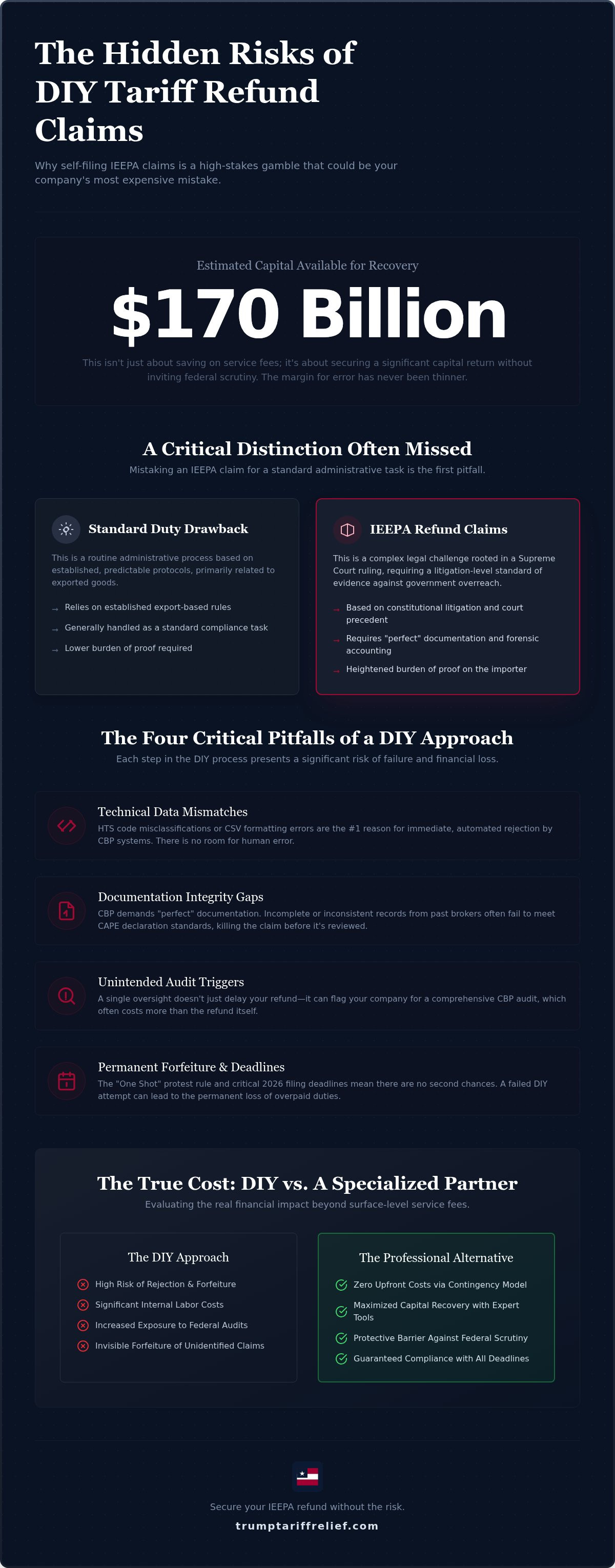
A DIY tariff refund claim is an attempt by an importer to recover overpaid duties without specialized legal or trade consultancy. While the prospect of saving on service fees is tempting, it's a strategy that often backfires. Many compliance departments mistake these claims for standard administrative tasks, but IEEPA recovery is a different beast entirely. Unlike the traditional Duty Drawback Program, which relies on established export-based protocols, IEEPA claims are rooted in constitutional litigation and specific Supreme Court precedents. The fundamental risks of DIY tariff refund claim submissions involve more than just paperwork; they involve the potential for permanent capital loss.
The 2026 regulatory environment has significantly increased the burden of proof on individual importers. U.S. Customs and Border Protection (CBP) now operates with heightened scrutiny, requiring a level of precision that internal teams rarely achieve. There's a massive "insider knowledge" gap that leaves money on the table. Internal departments often overlook eligible entries within List 3 and List 4a because they don't have the specialized tools to audit years of historical data. One of the primary risks of DIY tariff refund claim filings is this invisible forfeiture of capital that your team didn't even know was recoverable.
The Legal Catalyst: Beyond Simple Paperwork
The Supreme Court's ruling in Learning Resources, Inc. v. Trump on February 20, 2026, fundamentally changed the status of your paid duties. They're no longer just costs of doing business; they're recoverable assets. This shift moved the process from executive discretion to strict constitutional compliance. You're effectively litigating against the government's previous overreach. To navigate this successfully, you can learn more about the IEEPA explanation to see how these legal nuances dictate your eligibility and filing strategy.
The Administrative Burden of Proof
CBP expects "perfect" documentation for any IEEPA-related protest. In the current CAPE processing environment, there's no room for "close enough" submissions. A single mismatch in your entry numbers or a failure to align your CSV files with the ACE Portal requirements leads to an immediate rejection. Most internal teams lack the forensic accounting experience to ensure that every entry summary matches the commercial invoice, which is why DIY attempts so often trigger audits instead of checks.
Technical Minefields: Classification and Documentation Risks
CBP doesn't just review your claim; they audit your data. One of the most severe risks of DIY tariff refund claim attempts is the assumption that your historical data is ready for submission. In reality, Harmonized Tariff Schedule (HTS) code mismatches are the primary reason claims face immediate denial. If your internal team applies a code that doesn't perfectly align with the original entry or fails to match the specific Section 301 exclusions relevant to the IEEPA ruling, the entire filing is compromised. Automated systems used by CBP are designed to flag these inconsistencies instantly, leaving no room for human error.
HTS Misclassification and Forfeiture
Applying the wrong classification is a fast track to permanent forfeiture. CBP uses sophisticated automated systems to flag and reject inconsistent data across massive CSV uploads. If your filing suggests an exclusion that doesn't strictly apply to your product's 2026 status, you aren't just losing the refund; you're flagging your company for manual review. Precision is mandatory. You can review the Required Documents for IEEPA Tariff Refund Checklist to understand the level of detail required to survive this automated scrutiny.
The Documentation Integrity Gap
Maintaining data integrity across years of imports is a massive hurdle. Relying on old records from a previous customs broker is often a mistake. These records are frequently incomplete or formatted in ways that don't satisfy the current CAPE declaration requirements. Successful recovery requires professional Customs Documentation Management to reconstruct and verify every line item. Internal teams often provide too much irrelevant data, which slows the process, or too little evidence, which kills the claim. It's a full-time expert role that requires forensic attention to detail.
The Audit Trigger: An Unintended Consequence
Perhaps the most overlooked of the risks of DIY tariff refund claim filings is the "Audit Trigger." When you submit a claim, you're inviting CBP to look at your books. If your DIY filing contains technical errors, it suggests to the agency that your entire compliance department might be struggling. This can lead to a comprehensive customs audit that uncovers unrelated gaps in your trade history. Instead of restoring capital, you could end up facing heavy penalties. It's much safer to have an expert partner act as a protective barrier between your company and federal agents. If you want to see how a professional team manages this exposure, you can learn more about how it works to keep your business protected while recovering what you're owed.
The Financial Danger: Permanent Forfeiture and Statute of Limitations
In the world of trade compliance, there are no participation trophies. One of the most lethal risks of DIY tariff refund claim management is the "One Shot" rule. U.S. Customs and Border Protection (CBP) rarely allows for second chances or corrections once a formal protest is rejected. If your internal team miscalculates the duty amount or misidentifies entry numbers in the CAPE declaration, that capital isn't just delayed; it's permanently forfeited. A denied claim becomes a permanent loss on your balance sheet, and the opportunity to reclaim those funds vanishes forever.
There is also the recurring issue of "Partial Recovery." Internal teams, often overwhelmed by the sheer volume of data in List 3 and List 4a, frequently leave 30% to 40% of eligible funds on the table. They focus on the obvious entries but miss the nuanced classifications that a specialist would capture. When you're dealing with the scale of IEEPA refunds, that margin of error represents millions of dollars in lost liquidity. Professional oversight ensures that every dollar legally owed to your firm is identified and recovered before the window slams shut.
The Hard Stop: Statute of Limitations
Timing is your greatest adversary in 2026. The interaction between the 180-day protest window for liquidated entries and the broader court-mandated deadlines creates a narrow bottleneck. If your internal process lags, you risk "Administrative Laches," a legal principle where unnecessary delay results in the loss of your right to claim. You can find a detailed breakdown of these critical windows in our guide on Tariff Refund Statute of Limitations: The Critical Deadlines for IEEPA Claims. Missing these dates is a non-recoverable error.
The Audit Risk: Inviting CBP Scrutiny
Filing a claim is an invitation for federal oversight. A poorly prepared DIY submission acts as a red flag, potentially triggering a focused assessment of your entire import history. The financial impact of a full customs audit can easily dwarf the value of the refund you're seeking. One of the primary risks of DIY tariff refund claim filings is this unintended exposure. Expert filing acts as a "compliance shield," ensuring your documentation is legally bulletproof and does not highlight unrelated operational gaps to federal agents. It's about protecting your current operations while reclaiming your past overpayments.
Opportunity Cost: Calculating the Real Price of DIY
Many CFOs mistakenly categorize self-filing as a cost-saving measure. It's a false economy that ignores the massive drain on internal resources. When you calculate the risks of DIY tariff refund claim management, you must look beyond the service fee and account for the total labor investment. Diverting your finance or compliance team from their core duties to manage a forensic audit of historical entries is an expensive trade-off. Precision matters, and the cost of an internal error is far higher than any contingency fee.
Internal Resource Depletion
Quantifying the man-hours required for a 1,000-entry claim audit is sobering. It involves cross-referencing thousands of Entry Summaries against commercial invoices and HTS codes from years past. This isn't a side project for an analyst; it's a multi-month commitment. There's also the catastrophic risk of turnover. If your internal trade lead leaves mid-process, your recovery effort often grinds to a halt as the next person attempts to decipher complex spreadsheets. You can see how our streamlined process works to offload this burden entirely and keep your team focused on growth.
The Speed of Professional Recovery
Time is a financial variable that DIY teams often ignore. Professional filers use specialized software to accelerate the identification of eligible tariff lines, often seeing results 6 to 12 months faster than internal teams. This "Time to Cash" factor is critical for your capital restoration. Every month of delay represents a loss in the time-value of money. While your DIY claim sits in a CBP "incomplete" pile due to minor formatting errors, the government continues to hold your interest-free capital.
The internal rate of return (IRR) on your recovery effort drops every month the filing is delayed. A contingency-based specialist aligns their speed with your cash flow needs, ensuring that "filing readiness" is achieved in weeks rather than months. Speed is safety. By the time an internal team realizes they've missed nearly half of their eligible entries, a professional partner has already secured the refund. To protect your liquidity and ensure your firm isn't leaving money on the table, you should request a preliminary assessment today.
The Professional Alternative: Risk-Free Contingency Recovery
Navigating the risks of DIY tariff refund claim management often feels like a defensive battle against federal bureaucracy. You've already seen how technical classification errors and missed deadlines lead to permanent forfeiture. The professional alternative isn't just a service; it's a strategic hedge against these administrative failures. By partnering with Trump Tariff Relief, you transition from a position of vulnerability to one of protected advocacy. We manage the entire lifecycle, from the initial eligibility audit to the final CAPE declaration, ensuring your firm faces no upfront costs and zero risk of misfiling.
The zero-upfront-cost advantage is a powerful tool for compliance departments. It eliminates the need for complex budget approvals and allows the CFO to greenlight recovery efforts without financial downside. We provide the forensic accounting and legal expertise required to survive a CBP audit, acting as a protective barrier between your firm and federal agents. This partnership ensures that your recovery is managed with the same level of sophistication that the government uses to enforce its regulations. We take on the heavy lifting so your internal team can remain focused on your core business objectives.
Contingency vs. Internal Costs
A contingency-based model is the ultimate safeguard for corporate liquidity. When you compare the cost structures, paying a percentage of a won claim is significantly cheaper than paying a full-time salary for a claim that is ultimately lost or rejected by CBP. Our experts only receive a fee if you receive a check. This ensures that our motivation is tied directly to your success. Unlike internal projects that drain resources regardless of the outcome, our model is purely results-oriented. You can check our FAQ for contingency fee details to see how we structure our partnership for maximum client benefit.
Securing Your Financial Future Today
The 2026 calendar year represents a "now or never" window for IEEPA tariff restoration. As the statute of limitations for liquidated entries approaches, the time for internal deliberation has passed. You can initiate a preliminary eligibility assessment in under 10 minutes, allowing our team to scan your historical data for missed recovery opportunities. We identify the entries that DIY teams consistently overlook, ensuring you aren't leaving 30% to 40% of your capital on the table. One of the greatest risks of DIY tariff refund claim filings is the invisible forfeiture of funds your team simply didn't know were eligible. Secure your free tariff eligibility assessment today and ensure your capital is restored before the legal window closes forever.
Secure Your Capital Restoration Before the 2026 Window Closes
Reclaiming overpaid duties is a matter of financial justice, but the path to recovery is filled with administrative traps. The technical complexity of IEEPA filings and the unforgiving nature of CBP's 2026 deadlines leave no room for internal error. The risks of DIY tariff refund claim management aren't just limited to rejected paperwork; they include the potential for permanent capital loss and the danger of triggering a comprehensive customs audit. You shouldn't have to choose between financial restoration and regulatory safety.
Our expert team provides a protective barrier, managing the entire lifecycle of your claim with specialized legal and trade oversight. Because we operate on a contingency-based model, you only pay if we successfully recover your money. This eliminates budget friction and ensures our interests are perfectly aligned with your bottom line. Don't let your eligible capital become a permanent loss on your balance sheet. Get Your Free Tariff Eligibility Assessment today and take the first step toward reclaiming what's rightfully yours. It's time to restore your liquidity with confidence.
Frequently Asked Questions
What is the biggest mistake companies make when filing DIY tariff claims?
The most frequent error is submitting inconsistent data that doesn't align with the Harmonized Tariff Schedule (HTS) codes used in the original entries. These technical mismatches are primary risks of DIY tariff refund claim submissions because they trigger immediate rejection by CBP's automated systems. Internal teams often lack the forensic software needed to cross-reference thousands of line items across historical List 3 and List 4a entries, leading to an incomplete or inaccurate filing.
Can filing a tariff refund claim trigger a customs audit?
Yes, filing an improperly prepared claim is a common catalyst for a focused assessment or a full customs audit. When CBP identifies technical errors or classification inconsistencies in your submission, it suggests broader compliance gaps within your organization. A professional partner acts as a protective barrier by ensuring your documentation is legally bulletproof, which minimizes the chances of federal agents scrutinizing your entire import history or uncovering unrelated operational errors.
How much time does an internal team typically spend on a DIY claim?
Managing a 1,000-entry claim audit internally often requires hundreds of man-hours from your finance and compliance departments. This significant labor allocation diverts high-level talent from core business operations for several months. Professional filers use specialized forensic accounting tools to identify eligible tariff lines in a fraction of the time, typically accelerating the recovery process by 6 to 12 months compared to internal attempts that rely on manual spreadsheets.
What happens if our DIY IEEPA claim is rejected by CBP?
Rejection usually results in the permanent forfeiture of your overpaid duties due to the "One Shot" rule for administrative protests. CBP rarely allows importers to correct or resubmit a claim once a final decision is made on a protest. This makes the risks of DIY tariff refund claim filings particularly high, as a single administrative oversight can result in a permanent loss on your firm's balance sheet that cannot be recovered through later legal action.
Is there a deadline for filing IEEPA tariff refund claims in 2026?
Yes, the window for recovery is governed by strict statutory timelines, including a 180-day window for protests following the liquidation of an entry. In 2026, many of the entries affected by the IEEPA ruling are reaching their final administrative deadlines. If you fail to file before these dates expire, your right to reclaim those funds is legally extinguished. This creates a professional urgency to finalize your documentation before the statute of limitations closes.
Why wouldn’t my current customs broker handle this for me?
Most customs brokers specialize in ongoing logistical compliance and entry filing rather than historical forensic legal recovery. Reclaiming IEEPA refunds requires a deep understanding of specific Supreme Court precedents and the CAPE administrative process, which falls outside the scope of standard brokerage services. Brokers typically don't have the legal infrastructure or the forensic accounting software required to manage large-scale, contingency-based recovery projects that involve years of historical data.
How do contingency fees compare to the cost of internal labor for recovery?
Contingency fees are a risk-management tool that ensures you only pay for successful results, whereas internal labor is a guaranteed expense with no promised outcome. If an internal team spends months on a filing that is ultimately rejected, your firm has paid twice: once in salary costs and once in forfeited capital. A success-fee model eliminates budget friction for the CFO and aligns the consultant's speed and precision with your firm's cash flow needs.
Can we switch from a DIY approach to a professional consultant mid-process?
You can transition to professional management mid-process, provided your claim hasn't already been formally rejected by CBP. A specialist can perform a Tariff Eligibility Assessment to identify entries your internal team missed and verify the documentation integrity of your existing work. Salvaging a DIY attempt early is critical to avoid the permanent forfeiture that follows a poorly prepared filing. Professional intervention ensures your submission meets the rigorous standards required for successful restoration.
Ready to find out what your business may be owed?
Check My Eligibility