
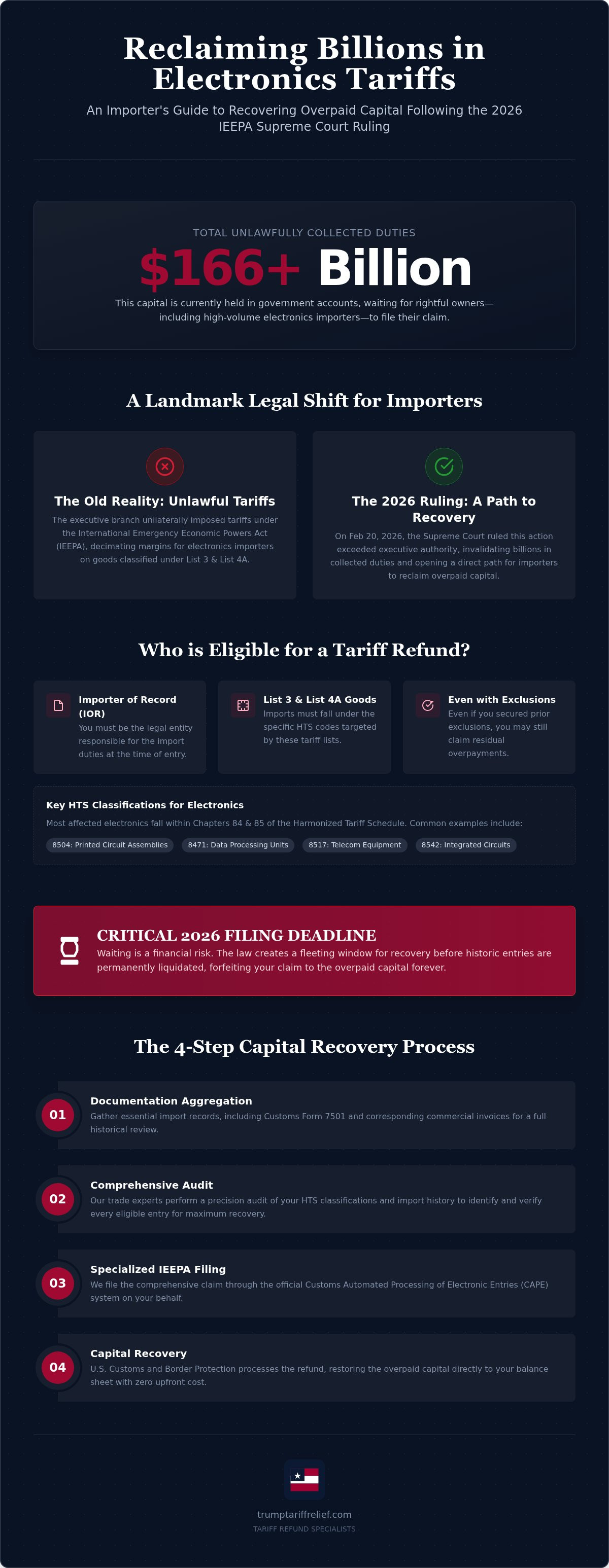
Over $166 billion in unlawfully collected duties is currently sitting in government accounts, waiting for its rightful owners to claim it. For electronics importers, these aren't just abstract figures; they represent the thin margins and suppressed capital growth that your business has endured for years. Securing a tariff refund for electronics is no longer a matter of "if" but "how." You've likely felt the burden of high-volume tariff payments and the frustration of navigating complex HTS code classifications, yet the 2026 Supreme Court ruling has finally opened a door to financial restoration.
You already know that every dollar of liquidity is vital in the fast-paced electronics sector. This article provides the roadmap to recovering millions in overpaid capital through specialized IEEPA claims before strict legal deadlines expire. We'll explore the implications of the recent litigation, the specific phases of the CAPE refund system, and how a zero-risk filing process can restore your balance sheet without adding to your operational overhead. It's time to reclaim the capital that belongs to your business.
Key Takeaways
- Understand how the 2026 Supreme Court ruling invalidated specific IEEPA duties, allowing electronics importers to reclaim millions in overpaid capital.
- Identify whether your specific HTS codes fall under List 3 or List 4A to verify your eligibility for a tariff refund for electronics.
- Recognize the critical 2026 filing deadlines that create a fleeting window for recovery before historic entries are permanently liquidated.
- Master the documentation requirements by aggregating Customs Form 7501 and commercial invoices for a comprehensive audit of your import history.
- Leverage a contingency-based recovery model to secure your capital with zero upfront costs and specialized trade expertise.
Understanding the IEEPA Ruling and the Electronics Industry
The legal landscape of American trade underwent a seismic shift on February 20, 2026. In a landmark decision, the U.S. Supreme Court ruled that the executive branch lacked the authority to unilaterally impose tariffs under the International Emergency Economic Powers Act (IEEPA). This ruling effectively invalidated billions of dollars in duties collected during the Trump administration. It's a clear case of righting a financial wrong. For the electronics sector, this isn't a theoretical legal victory; it's a direct path to reclaiming liquidity that was seized without proper legislative backing. Securing a tariff refund for electronics has become the top priority for CFOs looking to bolster their 2026 balance sheets.
The Legal Foundation of IEEPA Claims
The IEEPA was intended to provide the President with tools to manage genuine national emergencies. It was never meant to serve as a permanent mechanism for broad trade wars. When the Court of International Trade followed the Supreme Court's lead on March 4, 2026, it ordered U.S. Customs and Border Protection to begin the refund process. This specifically targets goods under "List 3" and "List 4A," which swept up thousands of electronics components into a net of unlawful taxation. If you want to understand the deeper legal precedents, you can find the IEEPA explained on our dedicated resource page. The transition from policy to litigation means that eligibility is now a matter of legal record rather than administrative discretion.
Why Electronics Importers are Primary Candidates
Electronics importers are the primary candidates for these refunds because of their high-volume, high-frequency import cycles. The industry saw its margins decimated as duties on circuit boards, sensors, and consumer hardware climbed. These weren't just one-time costs. They were recurring drains on R&D budgets and capital expansion. The accumulation of these overpaid duties represents a massive, untapped reserve of corporate capital.
The distinction here is vital. Standard duty drawbacks are often cumbersome and require proof of export. These IEEPA claims are different. They're based on the fact that the money should never have been taken in the first place. With an estimated $166 billion to $175 billion eligible for refund nationwide, the competition for processing priority is intense. 2026 is the year of final regulatory resolution. If you don't file your claim through the CAPE system now, you risk the permanent loss of this capital. We handle the heavy lifting, ensuring your HTS classifications are audited with the precision required to win.
Eligibility Criteria for Electronics Tariff Refunds
Determining if your business is entitled to a tariff refund for electronics requires a surgical look at your import history. While the Supreme Court decision was broad, the actual recovery process is granular. It hinges on the distinction between different tranches of the Section 301 tariffs on Chinese imports, specifically those categorized under List 3 and List 4A. These lists encompassed everything from semiconductors to consumer-facing hardware. Eligibility for a tariff refund for electronics is determined by the intersection of the specific entry date and the HTS classification of the imported goods.
Importantly, even if your company previously secured an exclusion for certain products, you aren't automatically disqualified from IEEPA recovery. These legal pathways are independent. An exclusion might have shielded you from some costs, but the IEEPA ruling challenges the very legality of the base duty itself. This means that even "excluded" entries may have residual overpayments that are now eligible for reclamation in 2026.
Key HTS Classifications for Electronics
Success in these filings depends on the precision of your HTS matching. Most electronics fall within Chapters 84 and 85 of the Harmonized Tariff Schedule. We focus on identifying high-value recovery targets like printed circuit assemblies (8504), data processing units (8471), and telecommunications equipment (8517). If your past filings suffered from "lazy" classification or broad catch-all codes, this recovery process allows us to rectify those errors. We audit your historical entries to ensure every eligible component is captured, maximizing the capital returned to your balance sheet. Precision at this stage is what separates a successful claim from a government rejection.
The Role of the Importer of Record (IOR)
To claim a refund, you must be the legal Importer of Record (IOR). This is the entity that actually paid the duties to U.S. Customs and Border Protection. Secondary retailers or distributors who purchased goods "duty-paid" from a domestic supplier typically cannot file a direct claim. The IOR is the only party with the standing to challenge the government's collection. If you aren't sure where you stand in the supply chain, a quick Tariff Refund Assessment can clarify your status immediately. Identifying these opportunities is the first step toward reclaiming your capital. If you suspect your 2026 projections are missing millions in overpaid duties, it's time for a professional eligibility review.
The 2026 Deadline: Why Waiting is a Financial Risk
Time is the greatest enemy of financial recovery. For electronics importers, the opportunity to secure a tariff refund for electronics isn't an open-ended invitation. It's a high-stakes race against a 3-year statute of limitations that is rapidly approaching its conclusion in 2026. Every day that passes without a filed claim is a day where your potential capital recovery shrinks. According to expert analysis on tariff risks, the legal frameworks surrounding these duties are volatile. Waiting for a "perfect" moment often results in missing the window entirely. We focus on assertive action because we know the government won't volunteer these funds; they must be claimed through precise, timely legal filings.
Understanding the 3-Year Filing Window
The deadline isn't a single date on the calendar. It's a rolling deadline triggered by the date of liquidation for each individual entry. For electronics businesses with high-frequency shipping patterns, this creates a complex web of expiration dates that are difficult to track manually. If an entry was liquidated more than 180 days ago without a protest, or if the three-year statutory window has closed, that capital is legally forfeited to the U.S. Treasury. Every day of delay could mean lost refund potential. As of June 29, 2026, approximately $104 billion in IEEPA tariff refunds had already been accepted for processing through the CAPE system. This massive volume has created a significant administrative backlog. Filing early in 2026 is critical. It ensures your entries are processed before the system becomes overwhelmed by a surge of last-minute applicants seeking their share of the estimated $175 billion total pool.
The Consequences of Missing the Window
Once a customs entry reaches legal finality, it's virtually impossible to reopen. Missing the filing window results in a permanent capital loss for your business. This isn't just a missed opportunity; it's a failure to restore your balance sheet at a time when 2026 fiscal planning requires maximum liquidity. Many importers make the strategic mistake of waiting for a "final" court decision or a government announcement that never arrives. By the time they realize the window is closing, the statute of limitations has already barred their recovery. Missing the window typically results in:
- Forfeited Capital: Funds that should have been reinvested in R&D or expansion remain with the Treasury.
- Fiscal Planning Disruptions: Your 2026 balance sheet misses out on a significant liquidity injection.
- Legal Finality: Closed entries cannot be reopened, regardless of future court rulings or legislative shifts.
We take on the risk and the heavy lifting to ensure your entries are filed correctly and on time. Righting this financial wrong requires a partner who understands that speed is a component of success. If you have questions about specific timelines or the status of your entries, our FAQ provides further clarity on the procedural hurdles you might face. Delaying your assessment is effectively a decision to leave your capital in the hands of the government.
The Recovery Process: From Documentation to Filing
Reclaiming a tariff refund for electronics is a rigorous, multi-stage legal process that demands extreme administrative precision. It's not a simple request for a rebate; it's a formal challenge to historical duty collections that were ruled unlawful in 2026. With over 53 million entries nationwide subject to these duties, the government has implemented the Consolidated Administration and Processing of Entries (CAPE) system to manage the surge. This automated system requires importers to move beyond manual processing and adopt a data-driven approach to recovery. It's about righting a financial wrong and restoring the capital that belongs on your balance sheet.
The recovery journey follows four assertive steps:
- Step 1: Audit. We conduct a comprehensive audit of all electronics import entries to identify which specific transactions fall under the invalidated IEEPA authority.
- Step 2: Aggregation. We gather essential proof, specifically Customs Form 7501 and related commercial invoices, to substantiate every dollar claimed.
- Step 3: Filing. We draft the CAPE Declaration and upload a validated CSV file containing all eligible entry numbers to the ACE Portal.
- Step 4: Management. We handle all subsequent government correspondence, including verification requests or documentation audits from U.S. Customs and Border Protection.
Essential Documentation for Electronics Claims
The 7501 Entry Summary is the most critical document in your recovery arsenal. It serves as the definitive legal record of the HTS code used, the value of the goods, and the exact amount of duty paid. In the high-volume electronics sector, digital record-keeping is the backbone of a successful recovery. Without organized digital archives, identifying thousands of individual entries becomes an insurmountable barrier to capital restoration. We provide end-to-end documentation management to ensure your claim is bulletproof. You can find more details on the necessary paperwork in our Required Documents Checklist.
Navigating the "Protest" Mechanism
Most importers are familiar with standard administrative claims, but IEEPA recovery often utilizes the Section 514 protest mechanism. These protests differ from standard claims because they are formal legal challenges to a Customs decision. A valid claim must meet strict technical requirements; mistakes in entry numbering or HTS alignment lead to immediate rejection. Because the 180-day protest window for liquidated entries is unforgiving, professional filing is superior to internal attempts by non-specialists. We act as your seasoned advocate, ensuring every filing meets the rigorous standards of the 2026 CAPE system. If you're ready to secure your capital, our team can begin a preliminary eligibility assessment today.
Maximizing Recovery with Trump Tariff Relief
Securing a tariff refund for electronics requires more than just a passing familiarity with trade law; it demands a surgical understanding of the electronics supply chain. Most general consulting firms treat tariff recovery as a sideline to their tax or accounting services. They often rely on hourly billing models that place the financial risk squarely on your shoulders, regardless of whether you actually see a dime of capital returned. We've built our model on a different foundation: assertive advocacy and shared success. Our contingency-based approach ensures that we only win when you win, aligning our motivation directly with your bottom line.
The technical complexity of electronics HTS codes, ranging from sophisticated semiconductors to integrated telecommunications hardware, leaves no room for error in the 2026 CAPE system. A single misstep in classification or a failure to match entries with the correct List 3 or List 4A tranche can result in an immediate government rejection. By partnering with us, you remove this administrative burden from your internal supply chain team, allowing them to focus on core operations while we handle the forensic audit and legal filings. You can see the full breakdown of our process on our How It Works page for complete transparency.
A Low-Risk, High-Reward Partnership
We eliminate the anxiety of upfront legal fees and unpredictable hourly billing. Our "we-do-the-work" narrative isn't just a slogan; it's a structural reality of how we operate. We handle the heavy lifting, from the initial data dump to managing complex correspondence with U.S. Customs and Border Protection. This specialized trade expertise is a powerful alternative to general corporate law, which often lacks the "insider" perspective needed to navigate the specific bureaucracy of the 2026 refund rollout. We identify the opportunities that others miss, ensuring that every cent of overpaid capital is identified and pursued.
Getting Started with Your Assessment
The 2026 roadmap is clear, but the window is narrowing. The first step is a zero-cost eligibility check that requires minimal time from your staff. We analyze your historical import data against the current IEEPA legal precedents to determine your total recovery potential. There are no hidden costs and no financial barriers to entry. This is your opportunity to right a financial wrong and restore the liquidity your business has earned. Don't let your capital remain in government hands due to administrative inertia. Secure your electronics tariff refund assessment now.
Reclaim Your Capital Before the 2026 Window Closes
The 2026 Supreme Court ruling has shifted the power back to importers, providing a definitive path to secure a tariff refund for electronics. You've endured the burden of high-volume duty payments for too long, but the window to right this financial wrong is narrowing. Success requires a combination of precise HTS auditing and timely filing through the CAPE system before the three-year statute of limitations expires. This is about more than just a refund; it's about restoring the liquidity your business needs to stay competitive.
We act as your assertive ally, providing specialized IEEPA legal expertise and end-to-end management of customs documentation to ensure your claim is bulletproof. Our partnership is entirely contingency-based, so there's no recovery and no fee. We take on the administrative heavy lifting so your team doesn't have to. Don't let your hard-earned capital remain in government accounts when it could be fueling your next phase of growth.
Start Your No-Risk Electronics Tariff Assessment today and take the first step toward financial restoration.
Frequently Asked Questions
Is the China tariff refund for electronics real?
The refund is a legitimate legal reality following the February 20, 2026, Supreme Court ruling that invalidated the use of IEEPA for unilateral tariffs. This legal catalyst enables importers to reclaim billions in overpaid duties. It isn't a government stimulus; it's a court-ordered restoration of capital. As of mid-2026, over $104 billion in claims have already been accepted for processing. This makes the tariff refund for electronics a vital liquidity source for impacted businesses.
Which electronics HTS codes are eligible for IEEPA refunds?
Eligibility primarily centers on electronics classified under Chapters 84 and 85 of the Harmonized Tariff Schedule. Key examples include printed circuit assemblies, data processing units, and telecommunications hardware that were included in List 3 and List 4A of the Section 301 duties. Because HTS complexity is high, we conduct a forensic audit to identify every eligible entry. Precise matching is required to ensure the government doesn't reject your claim during the CAPE system verification process.
What is the deadline to file for a tariff refund in 2026?
You must adhere to a strict three-year statute of limitations, which creates a rolling series of deadlines throughout 2026. Each deadline is triggered by the specific date your entry was liquidated by U.S. Customs and Border Protection. If you wait until the end of the year, you'll likely lose the ability to reclaim duties on your earliest shipments. We recommend initiating your assessment immediately to capture the maximum possible tariff refund for electronics before entries reach legal finality.
How much does it cost to hire a tariff recovery consultant?
Trump Tariff Relief operates on a pure contingency-fee basis, meaning there are zero upfront costs for your business. We don't utilize hourly billing or expensive consulting packages that place financial risk on the importer. We only receive a percentage of the total refund amount once it is successfully recovered from the U.S. Treasury. This model ensures that our interests are perfectly aligned with yours as we work to maximize your capital restoration and balance sheet recovery.
Can I file for a refund if I already used a duty drawback?
You can typically still file for an IEEPA refund even if you've previously utilized duty drawbacks for exported goods. However, the recovery amount must be adjusted to ensure there is no "double recovery" on the same duty payment. Our specialized legal team manages this calculation to ensure your filing is compliant and accurate. We distinguish between standard administrative drawbacks and the court-ordered restoration of unlawfully collected IEEPA duties to maximize your total available liquidity.
How long does the IEEPA refund process take?
The timeline depends on the complexity of your import history and the current administrative backlog within the CAPE system. Following the phased rollout that began in April 2026, many claims are seeing disbursement within several months of successful verification. However, the massive volume of entries means that early filers receive priority in the processing queue. We manage the entire end-to-end correspondence with the government to ensure your claim moves through the system as efficiently as possible.
Do I need a customs broker or a specialized consultant for this?
While customs brokers handle daily compliance, reclaiming capital under a Supreme Court ruling requires specialized legal and trade expertise. Brokers typically focus on ongoing entries rather than the forensic auditing of historical IEEPA claims. We act as a dedicated advocate, managing the technical HTS matching and the protest mechanism required for a successful recovery. Our focus is exclusively on the contingency-based reclamation of overpaid duties, providing a level of advocacy that standard brokerage services don't offer.
What if my company no longer imports the specific electronics in question?
Your current import status doesn't affect your eligibility for a refund on past entries. As long as your company was the legal Importer of Record at the time the duties were paid, you have the standing to file a claim. Many electronics firms have shifted sourcing strategies since the tariffs were first imposed, yet they remain entitled to the restoration of that overpaid capital. We audit your historical records from the relevant period to identify all eligible recovery targets regardless of your current supply chain.
Ready to find out what your business may be owed?
Check My Eligibility