
Your business likely contributed to the $170 billion in IEEPA tariffs that the U.S. Supreme Court recently declared unconstitutional. For years, these duties have functioned as a heavy tax on your growth, yet many importers hesitate to act because they fear the high cost to file for tariff refund through traditional legal channels. You shouldn't have to gamble your remaining capital on uncertain litigation or complex bureaucracy while trying to right this financial wrong.
We understand that high operational costs are already straining your margins, and the thought of navigating the new CAPE system alone is daunting. This guide promises a clear path to reclaiming your capital with zero upfront risk, utilizing a contingency fee model where you only pay for results. We'll explore the immediate implications of the 2026 ruling, the critical three year filing deadlines, and the strategic advantages of a managed recovery process. It's time to stop viewing these tariffs as a lost expense and start treating them as a recoverable asset ready for reinvestment in your company's future.
Key Takeaways
- Learn how the 2026 Supreme Court ruling on IEEPA tariffs has opened a fleeting window to reclaim billions in unconstitutionally collected duties.
- Understand why the cost to file for tariff refund shouldn't be a barrier when using a contingency-fee model that eliminates upfront financial risk.
- Identify the hidden dangers of in-house filing, where a single documentation error can lead to a total claim denial and lost capital.
- Calculate your potential recovery ROI by evaluating your total refundable amount against the complexity of your import documentation.
- Meet strict 2026 deadlines by partnering with a specialized ally who manages the entire eligibility and filing process from start to finish.
Understanding the Financial Landscape of Tariff Refund Claims
A tariff refund claim is a formal demand for the return of duties paid on imported goods, typically triggered by changes in trade law or judicial rulings. For many businesses, the primary concern is the cost to file for tariff refund, especially when navigating complex frameworks like Section 301 of the Trade Act of 1974. While the government provides mechanisms for these requests, the financial stakes shifted dramatically on February 20, 2026, when the Supreme Court ruled IEEPA tariffs unconstitutional. This decision transformed billions of dollars in "sunk costs" into claimable capital. If your firm has been paying these duties since 2018, you're no longer looking at a simple clerical correction; you're looking at a major capital restoration event.
Administrative Costs vs. Professional Recovery Fees
Direct administrative costs involve filing protests or Post-Summary Corrections (PSCs) through the ACE Secure Data Portal. While CBP doesn't charge a direct filing fee for these submissions, the hidden cost to file for tariff refund in-house often manifests as lost revenue. Standard government filings frequently overlook nuanced data points, resulting in partial recoveries. Implementing professional customs documentation management ensures every eligible entry is identified, maximizing the total claim size rather than settling for what is most obvious. Professional recovery services offer several advantages over internal attempts:
- Identification of unliquidated entries that qualify for immediate Phase 1 CAPE processing.
- Reconciliation of complex entries liquidated more than 80 days before the refund request.
- Verification of 6% interest accrual on all recovered capital.
If you rely solely on internal logistics teams, you risk missing the technical nuances of the phased CAPE rollout, which can lead to administrative delays or outright claim denials.
The Impact of the IEEPA Ruling on 2026 Filing Strategy
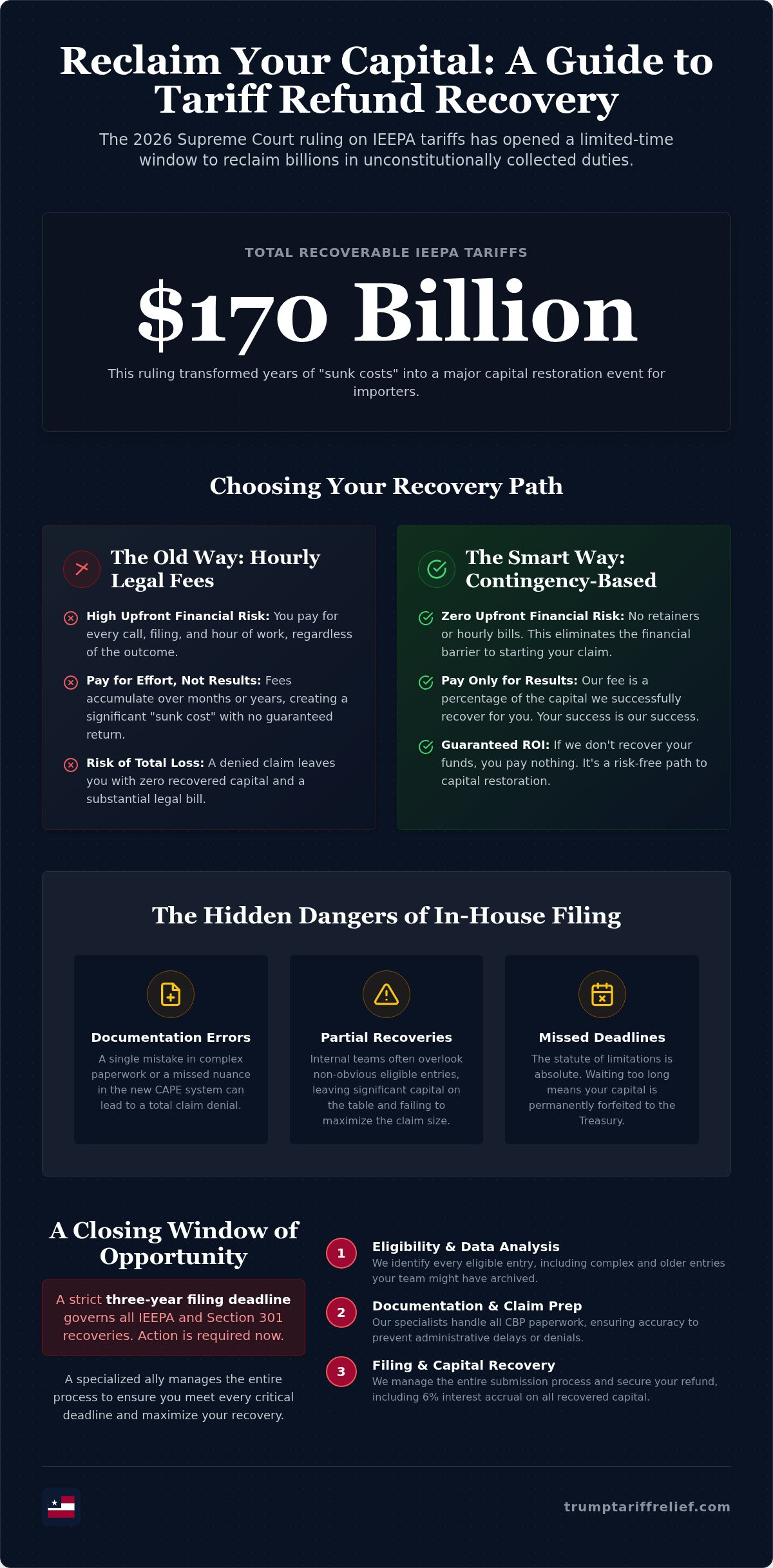
The 2026 legal precedent has invalidated roughly $170 billion in collected duties, creating an entirely new category of recovery. Importers who previously viewed these payments as unavoidable now have a high-stakes opportunity to right a financial wrong. However, the window is closing. The financial risk of ignoring the statute of limitations is absolute. Once the three-year deadline passes, that capital is permanently forfeited to the Treasury. Specialized trade consultants act as essential allies here, identifying recovery opportunities in older entries that internal accounting teams might have archived years ago. If you wait for the government to notify you of your eligibility, you've already lost. Success in 2026 requires an assertive strategy that treats recovery as a priority revenue event.
Comparing Hourly Legal Rates vs. Contingency-Based Recovery
Importers often view the recovery of duties as a legal expense rather than a capital injection. This perspective is a mistake. When you evaluate the financial path toward reclaiming your funds, you must choose between a model that bills you for effort and one that rewards results. The recent 2026 Supreme Court decision has made the stakes too high to gamble on traditional hourly billing. You need a partner whose compensation is directly tied to the success of your claim, ensuring that every action taken is focused on maximizing your return.
The True Cost of Traditional Legal Representation
Traditional customs attorneys typically operate on an hourly billing model. While this provides access to legal counsel, it creates a significant financial disconnect. If you're paying for every phone call, document review, and administrative filing, the cost to file for tariff refund grows regardless of the outcome. In complex trade litigation, such as the ongoing challenges discussed in this CSIS analysis of Section 301 tariffs, these fees can accumulate over years of bureaucratic back-and-forth.
The danger of "sunk costs" is a constant threat. If U.S. Customs and Border Protection (CBP) denies a claim after eighteen months of legal maneuvering, your business is left with zero recovered capital and a substantial legal bill. This model prioritizes the process over the result. It often lacks the professional urgency required to meet the strict three-year deadlines that govern IEEPA and Section 301 recoveries.
Why Contingency Fees are the Gold Standard for Importers
Contingency-based recovery flips the script. It removes the financial barrier to entry, making it accessible for businesses of all sizes to reclaim their capital. Under a "Success Fee" structure, the consultant's incentives are perfectly aligned with your recovery. They don't get paid until you receive your refund. This ensures the cost to file for tariff refund is never an out-of-pocket burden on your current cash flow.
A professional recovery partner absorbs all the risk. They handle the heavy lifting, from the initial eligibility assessment to the final documentation submission, while you remain the beneficiary. It's a high-performing partnership where the firm acts as your advocate within the CAPE system. You can see the full breakdown of this streamlined, risk-free process by reviewing how it works.
Efficiency is the natural byproduct of this model. Because the firm’s compensation depends on a successful outcome, they are motivated to identify every eligible entry and resolve documentation hurdles as quickly as possible. This approach eliminates the unnecessary delays often found in corporate legal billing, focusing entirely on the restoration of your business capital before the 2026 windows close.
Hidden Costs and Risks of In-House Filing Attempts
While the government’s ACE portal technically allows for self-service submissions, the true cost to file for tariff refund in-house is often measured in denied claims and triggered audits. Importers often underestimate the forensic level of detail required by U.S. Customs and Border Protection (CBP). A single misclassified HTS code or an incomplete entry summary doesn't just delay your refund; it can lead to a permanent rejection of your capital. You shouldn't risk your company’s financial restoration on a "best effort" internal project when billions of dollars are at stake.
Documentation Errors and the Price of Rejection
Errors in Harmonized Tariff Schedule (HTS) classifications are the most common reason for claim denials. When a protest is denied, the path to appeal is narrow and often requires expensive litigation. According to The Conference Board's analysis of tariff refund processes, the administrative burden of these investigations is substantial. Professional firms utilize advanced data reconciliation tools to ensure 100% accuracy, scrubbing years of import data to identify every eligible entry. Without this technology, your internal team is essentially guessing at the validity of their filings, risking not only the refund but also inviting broader Customs scrutiny into your general trade compliance.
Diverting Internal Resources from Growth to Bureaucracy
The man-hours required to audit the millions of entries impacted by IEEPA and Section 301 duties are astronomical. If you task your internal accounting or logistics teams with this project, you're effectively halting their progress on core business growth. This is the ultimate opportunity cost. Instead of optimizing supply chains or scaling operations, your top talent is buried in spreadsheets and regulatory jargon. Partnering with a tariff recovery specialist allows your team to maintain their focus on revenue-generating activities while experts handle the bureaucratic heavy lifting.
The risk of missing the three-year statute of limitations is the most significant hidden cost. In 2026, the windows for older entries are closing rapidly. An unprofessional, rushed filing might actually raise red flags with CBP, potentially leading to audits that extend far beyond the scope of your refund request. When you calculate the cost to file for tariff refund, you must weigh the small percentage of a contingency fee against the total loss of capital that occurs if your in-house attempt fails or expires. Professional intervention isn't just about convenience; it's about ensuring your capital actually returns to your balance sheet.
Calculating Your Potential ROI and Recovery Scale
Reclaiming capital from federal tariffs is more than a legal victory; it's a vital liquidity event for your 2026 fiscal strategy. To determine if the pursuit is worth the effort, you must evaluate the scale of your potential recovery against the operational friction involved. When calculating the cost to file for tariff refund, you shouldn't focus on the expense, but on the net capital restoration. A professional tariff refund assessment identifies value that standard accounting software often ignores, such as accrued interest and overlooked entry flags. This forensic approach ensures you aren't leaving money on the table while the government holds your capital.
Estimating Refund Amounts for Section 301 and IEEPA
The first step in estimating your ROI is identifying eligible List 3 and List 4a entries from your import history. These categories represent the bulk of the $170 billion in claimable IEEPA duties. You'll need to pull your historical data from the ACE portal and cross-reference your HTS codes with the 2026 Supreme Court invalidations. An eligible entry is any import transaction where duties were paid under a tariff authority later deemed unconstitutional or subject to exclusion, provided it falls within the three-year statute of limitations. Once you've flagged these entries, you can project a total recovery figure by totaling the paid duties and adding the mandated 6% interest rate. This projection provides a clear picture of the capital available for reinvestment into your core operations.
The Value of a Professional Tariff Audit
Internal accounting software is designed for compliance, not recovery. It typically lacks the sophisticated data analytics required to process thousands of entries efficiently. Experts use specialized algorithms to scrub your data for hidden refunds, such as entries that were misflagged during liquidation or those that qualify for the phased CAPE rollout. This level of validation strengthens your claim before it ever reaches the government's desk, significantly reducing the risk of a denial. By outsourcing this audit, you're ensuring that the cost to file for tariff refund remains zero until the capital is actually recovered. This model prioritizes your business liquidity, allowing you to secure your financial future without risking current cash flow. You can start your no-risk eligibility assessment today to secure the capital your business is owed.
Reclaiming Your Capital with Trump Tariff Relief
The path to financial restoration shouldn't be blocked by the very bureaucracy that collected unconstitutional duties in the first place. At Trump Tariff Relief, we transform the recovery process from a legal burden into a streamlined capital injection. By operating on a strictly contingency-fee basis, we ensure that the cost to file for tariff refund is never a line item on your expense report. We assume the entirety of the financial risk, allowing your business to pursue its rightful capital without diverting current cash flow or risking a single dollar on uncertain litigation.
A Full-Service Partnership for Zero Financial Risk
Our firm acts as a sophisticated navigator through the complexities of the CAPE system and the aftershocks of the 2026 Supreme Court ruling. We don't just provide advice; we execute the entire recovery engine on your behalf. Our specialized focus on IEEPA and Section 301 tariffs allows us to identify nuances in your import history that general legal counsel often overlooks. From the initial forensic audit of your entries to the final electronic disbursement from the Treasury, we handle the heavy lifting. This managed approach includes:
- Comprehensive Customs Documentation Management to ensure every filing meets the strict 2026 accuracy standards.
- Direct communication with U.S. Customs and Border Protection to resolve flags or data discrepancies.
- Aggressive advocacy to ensure your 6% mandated interest is calculated and paid in full.
This results-oriented model means our success is inextricably linked to yours. If we don't recover your capital, you owe us nothing. It's a high-stakes partnership designed to right the financial wrongs of the past decade with professional confidence and elite expertise.
Starting Your No-Cost Assessment Today
The window for recovery is not indefinite. With the three-year statute of limitations closing on older entries every day, hesitation is the only true cost to file for tariff refund. Our onboarding process is designed for maximum efficiency, requiring minimal time from your internal teams. We begin with a preliminary eligibility review, where we analyze your historical data to determine the scale of your potential refund and the strength of your claim. This initial phase is entirely complimentary and provides you with a clear roadmap for capital restoration.
You've already paid these tariffs; you shouldn't have to pay again just to get them back. Secure your firm's financial future by partnering with an advocate who understands the urgency of this moment. Learn how our process works and secure your refund today before the 2026 deadlines permanently forfeit your capital to the federal government.
Secure Your Capital Before the 2026 Deadlines Expire
The 2026 Supreme Court ruling on IEEPA tariffs represents a historic opportunity to restore billions of dollars to business balance sheets. As we've explored, the risks of inaction or improper filing are absolute. Missing the three year statute of limitations means your capital is permanently forfeited to the Treasury. By partnering with a specialized ally, you eliminate the prohibitive cost to file for tariff refund and replace it with a high performance, contingency based model.
We provide the specialized IEEPA legal expertise and comprehensive documentation management required to navigate the CAPE system's complexities. You don't have to gamble your current cash flow on uncertain legal bills or internal clerical errors. Our "no recovery, no fee" guarantee ensures that we take on all the financial risk while you focus on scaling your business. The time to act is now, while the 2026 windows remain open and your capital is still within reach.
Get Your Free Tariff Refund Assessment and start the process of righting this financial wrong today. Your business has already earned this capital; it's time to bring it home.
Frequently Asked Questions
Is there an upfront cost to file for a tariff refund with Trump Tariff Relief?
No, there is absolutely no upfront cost to file for a tariff refund when you partner with Trump Tariff Relief. We operate exclusively on a contingency-fee model, which means our firm assumes all financial risks associated with the assessment and filing process. You only pay a success fee once your capital is successfully recovered from the U.S. Treasury. This allows your business to pursue its rightful capital without impact on current cash flow.
How much does a tariff recovery consultant typically charge?
Professional recovery consultants typically utilize either hourly billing or a contingency-fee structure. While hourly models can create unpredictable expenses regardless of the outcome, our model is based on a success fee calculated as a percentage of the total recovered amount. This aligns our incentives with your results. We manage the entire process, from eligibility assessment to final documentation, ensuring the total cost to file for tariff refund is zero until your check arrives.
What happens if my tariff refund claim is denied?
If a claim is denied, you owe Trump Tariff Relief nothing. Because we operate on a "no recovery, no fee" guarantee, our firm absorbs the labor and administrative costs involved in the filing. This protection is vital given the complexity of the CAPE system and the strict documentation standards required by U.S. Customs. We perform rigorous data validation before submission to minimize this risk, ensuring only the strongest claims reach the government's desk.
Are there administrative fees I must pay to the government for filing?
U.S. Customs and Border Protection (CBP) does not charge any administrative fees for processing tariff refunds through the CAPE system or the ACE portal. Any request for a government filing fee is likely a scam and should be reported immediately. While the government process itself is free, the true challenge lies in the technical accuracy of the documentation required to secure a full recovery, including the mandated 6% interest on all unconstitutionally collected duties.
How long does it take to receive a refund after the filing is complete?
Refund timelines depend on the liquidation status of your entries and the current phase of the CAPE system rollout. Phase 1 launched in April 2026 for unliquidated entries, while Phase 3 covers older liquidated entries. Once CBP accepts a claim for processing, disbursements are issued electronically via ACH. As of mid-2026, billions in refunds have already been sent to the Department of Treasury for final disbursement to impacted importers across the country.
Can I file for a tariff refund on my own to save on fees?
Importers can technically file for refunds through the ACE Secure Data Portal without professional assistance. However, the internal cost to file for tariff refund often exceeds the potential savings due to high opportunity costs and the risk of documentation errors. A single mistake in HTS classification or entry summary can lead to a permanent denial of your claim. Our specialized expertise ensures 100% data accuracy, maximizing your recovery while your team stays focused on growth.
What is the deadline for filing IEEPA tariff refund claims in 2026?
The primary deadline is governed by a strict three-year statute of limitations from the date of entry or liquidation. Because IEEPA duties were collected over several years, windows for older entries are closing every day in 2026. If you fail to file before these individual deadlines pass, your right to reclaim that capital is permanently forfeited. Immediate action is required to perform a forensic audit of your records and secure your eligibility before these dates expire.
Does the size of my business affect the cost of filing for a refund?
The size of your business does not change our contingency-fee structure. Whether you are a mid-sized importer or a large-scale manufacturer, our "no-win, no-fee" model remains the same. This approach removes the financial barriers that often prevent smaller firms from challenging federal bureaucracy. We provide elite-level legal and trade expertise to businesses of all scales, ensuring every impacted company has a risk-free path to reclaiming their unconstitutionally collected duties following the Supreme Court ruling.
Ready to find out what your business may be owed?
Check My Eligibility