
What if the capital your manufacturing business needs for its next expansion is currently sitting in a federal vault, waiting for you to claim it? You've likely watched your margins shrink as Section 301 and IEEPA duties drained your cash flow, all while dealing with a labyrinth of shifting trade regulations that feel designed to keep your money out of reach. It's frustrating to see significant capital tied up in past customs entries because of complex laws that few internal teams have the capacity to audit. Securing a manufacturing tariff refund isn't just a routine tax filing; it's a strategic legal reclamation of your own hard-earned capital.
In this guide, you'll discover how to recover thousands in overpaid duties through specialized legal strategies. We'll show you exactly how to take advantage of the closing windows of opportunity created by recent trade litigation. You'll learn about the critical three-year statute of limitations, the specific eligibility requirements for IEEPA claims, and how an expert-led verification process can improve your cash flow without any upfront costs. It's time to stop viewing these duties as a lost expense and start reclaiming the capital that belongs to your business.
Key Takeaways
- Learn why 2026 is a pivotal year for manufacturers to audit their import history and secure capital before the three-year statute of limitations closes.
- Identify specific eligible materials from Section 301 Lists 3 and 4a, including steel, aluminum, and various chemical inputs used in production.
- Discover how to secure a manufacturing tariff refund by leveraging specialized legal strategies that recover overpaid IEEPA and Section 301 duties.
- Master the documentation audit process, focusing on HTS code eligibility and the specific records needed for a successful federal claim.
- Explore the advantages of a contingency-based recovery model that allows you to reclaim capital without any upfront consulting fees or financial risk.
Reclaiming Capital: The Current State of Manufacturing Tariff Refunds in 2026
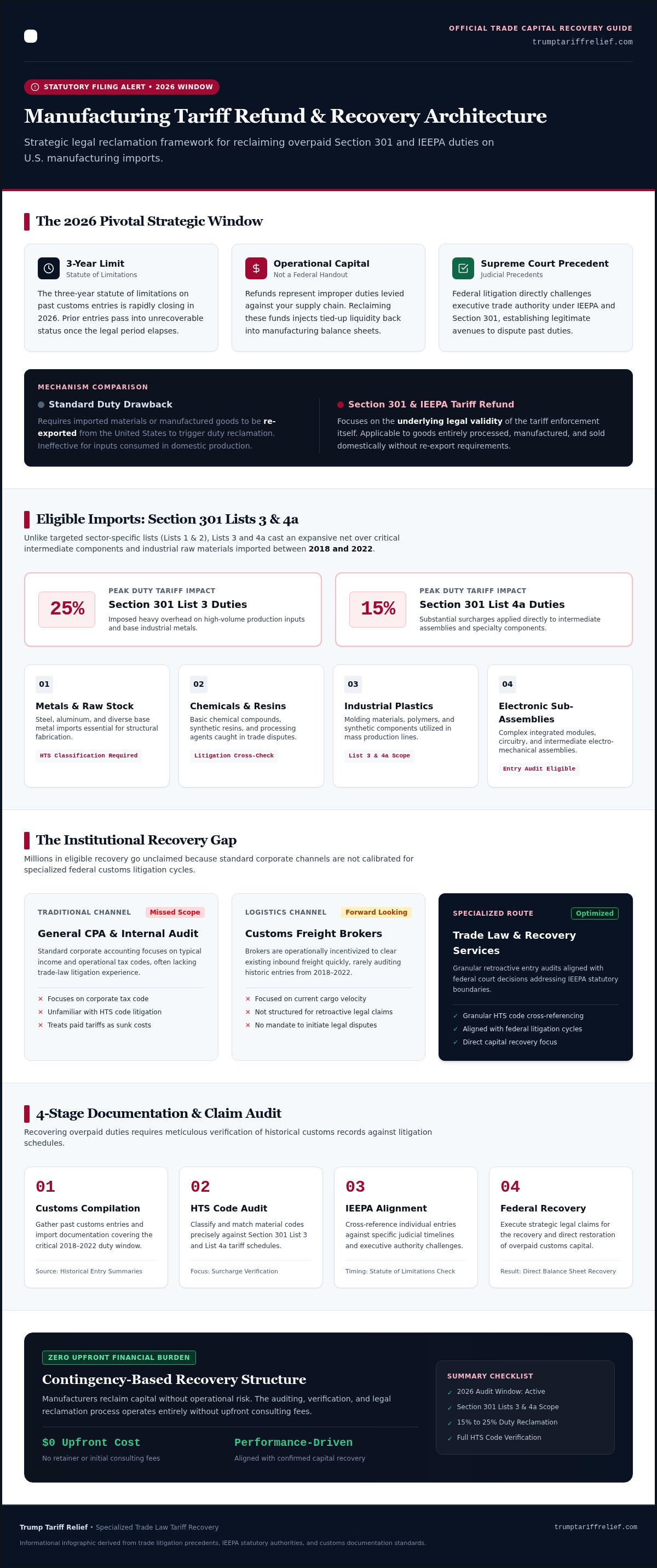
A manufacturing tariff refund represents the legal recovery of overpaid duties collected under Section 301 or IEEPA authorities. It's not a government handout; it's the restoration of capital that was improperly levied on your supply chain. As we move through 2026, the timeline has become a critical factor for every U.S. producer. The three-year statute of limitations on many of these entries is rapidly approaching, making this year a pivotal window for auditing your import history. Unlike standard duty drawback provisions, which typically require the re-export of goods to trigger a refund, these retroactive claims focus on the legal validity of the tariffs themselves. Recent Supreme Court precedents have challenged the government's expansive use of trade authority, effectively opening a door for manufacturers to claw back funds that were previously considered lost costs.
The IEEPA Ruling and Its Impact on U.S. Industry
The legal landscape shifted significantly when challenges to Section 301 authority moved into the realm of the International Emergency Economic Powers Act (IEEPA). Manufacturing firms bore the brunt of these tariffs because they rely heavily on imported steel, aluminum, and specialized components that were caught in the crossfire of trade disputes. These duties weren't just a line item; they were a direct hit to operational liquidity. IEEPA recovery is a specialized legal mechanism for reclaiming import capital. By identifying specific windows where the executive branch may have exceeded its statutory authority, manufacturers can now reposition themselves as eligible claimants for substantial refunds. This isn't about politics; it's about financial restoration for the engine of the American economy.
Why General CPAs Often Overlook These Claims
Many executives assume their internal accounting teams or general CPAs would have flagged these opportunities. However, there's a fundamental difference between standard tax accounting and the high-stakes world of trade-law recovery. Auditing years of customs entries requires a granular understanding of Harmonized Tariff Schedule (HTS) codes and federal litigation cycles that go far beyond a typical financial audit. Success depends on having IEEPA explained through the lens of customs law rather than the general corporate tax code. Most customs brokers aren't incentivized to look backward at old entries; they're focused on moving current freight. This creates a massive gap where millions in potential recovery go unclaimed simply because no one is looking in the right place.
Identifying Eligible Imports: Which Manufacturing Materials Qualify for Recovery?
Determining eligibility for a manufacturing tariff refund requires a granular look at your past customs entries, specifically those falling under Section 301 List 3 and List 4a. These two lists encompass a vast array of industrial inputs, from basic chemical compounds to complex electronic sub-assemblies. While List 1 and List 2 were targeted at specific high-tech sectors, List 3 and 4a cast a much wider net, catching many manufacturers off guard. Identifying whether your imports qualify depends entirely on the Harmonized Tariff Schedule (HTS) codes assigned at the time of entry. If your business imported goods under these lists between 2018 and 2022, you likely paid duties that are now subject to legal reclamation due to the specific legal challenges currently moving through federal courts.
Raw Materials and Intermediate Goods
Industrial production relies on a steady stream of imported inputs like plastics, base metals, and synthetic resins. Many of these materials were classified under HTS codes that faced 25% or 15% surcharges during the peak of trade tensions. To verify if your materials fall within the recovery window, you must cross-reference your historical entry data against the specific litigation dates associated with IEEPA challenges. For high-volume importers, a formal tariff refund assessment is the most efficient way to categorize these inputs and calculate potential returns. You can also consult the International Trade Administration duty drawback guide to understand how federal agencies view the general refund landscape. Success in this area isn't about guessing; it's about precise data mapping and legal alignment.
Capital Equipment and Tooling
Refund opportunities aren't limited to the materials you consume; they also extend to the tools of your trade. If your firm invested in new manufacturing machinery or specialized tooling between 2018 and 2022, those capital expenditures likely included significant tariff payments. High-value machinery imports often represent the largest single-entry recovery opportunities due to their high unit cost. Documentation requirements for these claims are rigorous, requiring original commercial invoices and proof of duty payment. If you've upgraded your facility recently, you should audit your equipment imports to ensure no capital is left on the table. Reclaiming these funds can provide the liquidity needed for your next round of industrial innovation or facility expansion.
The Manufacturer’s Dilemma: Internal Audits vs. Specialized Recovery Services
Manufacturers often face a difficult choice when they realize they've overpaid millions in duties. Should you use your internal finance team or hire a specialist? While internal teams know your products, they rarely have the bandwidth or the technical trade-law expertise to execute a successful manufacturing tariff refund claim. Attempting an internal audit carries significant hidden costs; you're diverting high-value personnel from growth initiatives to sift through years of customs entries. Additionally, your current customs broker likely isn't the right partner for this task. Brokers are focused on clearance and compliance for current shipments; they aren't incentivized to perform the forensic legal work required for retroactive recovery.
The biggest risk isn't just the effort; it's the ticking clock. Ignoring the tariff refund statute of limitations means leaving your capital in the government's hands forever. Once that three-year window closes, those funds are legally unreachable. Trump Tariff Relief acts as your specialized advocate, handling the heavy lifting of documentation and federal filing so your team can stay focused on production.
The Data Burden: Auditing Thousands of Customs Entries
Manufacturing supply chains are notoriously complex, often generating thousands of individual customs entries across hundreds of HTS codes. Manually identifying which specific entries qualify under the U.S. Customs and Border Protection's IEEPA duty refund guidance is a massive undertaking. It requires proprietary technology to filter through massive datasets and pinpoint every eligible dollar. Our how-it-works process is designed to streamline this data extraction, removing the burden from your IT and accounting departments while ensuring no eligible entry is missed.
Contingency Models vs. Hourly Legal Fees
Traditional law firms often charge high hourly rates regardless of the outcome, which adds financial risk to an already complex situation. A contingency-fee model is different. It provides a high-performing partnership where we take on all the risk and the administrative work. Contingency fees align the interests of the manufacturer and the recovery specialist because we only succeed when you successfully reclaim your capital. This "No Recovery, No Fee" structure ensures that pursuing your refund is a low-risk, high-reward decision for your bottom line.
The Documentation Audit: Preparing Your Manufacturing Firm for a Successful Claim
Securing a manufacturing tariff refund requires more than just a desire to recover capital; it demands a rigorous, forensic approach to your import records. The federal government doesn't simply hand back money upon request. Instead, every claim must be supported by a mountain of evidence that proves the duties were paid and that the goods fell under specific, challenged HTS codes. This process begins with an exhaustive documentation audit, which serves as the foundation for your legal reclamation. Precision here is non-negotiable. Even minor clerical errors can lead to a summary rejection by U.S. Customs and Border Protection (CBP).
- Step 1: Start by gathering the required documents for IEEPA tariff refund applications. This includes everything from entry summaries to commercial invoices.
- Step 2: Perform a comprehensive HTS code eligibility cross-reference. You must verify that the codes used at the time of entry align with the specific List 3 or List 4a litigation windows.
- Step 3: Calculate the total potential recovery. A successful claim often includes not just the overpaid duties, but also applicable interest, which can significantly increase the final payout.
- Step 4: Manage the formal filing process. This involves submitting the ACE CAPE declarations and navigating the technical requirements of the CBP's automated systems.
Essential Records for Manufacturing Importers
The most critical document in your arsenal is Customs Form 7501, also known as the Entry Summary. This record provides the definitive proof of the HTS classification, the value of the goods, and the exact amount of Section 301 or IEEPA duties paid. You'll also need commercial invoices that match these summaries to verify the nature of the industrial inputs. If your internal filing system is incomplete or missing records from 2018 or 2019, don't assume your claim is dead. We can often help recover these records through specialized data requests, ensuring your manufacturing tariff refund isn't derailed by historical paperwork gaps.
The Filing Timeline and Government Processing
Once your claim is submitted, the government enters a review phase that requires patience and persistence. In 2026, processing times for manufacturing-sector refunds vary based on the volume of claims and the specific legal status of the underlying litigation. You should expect a multi-month window for verification as federal auditors cross-reference your data against their internal logs. Verification is the final hurdle; if your documentation doesn't perfectly mirror the government's records, the claim will be denied. This is why having an insider advocate is vital. If you are ready to begin, you should start your documentation assessment today to ensure you meet the upcoming filing deadlines.
Securing Your Refund: Why a Specialized Partnership is the Low-Risk Path
Navigating the federal bureaucracy to secure a manufacturing tariff refund isn't a task for the uninitiated. It requires a level of trade-law precision that general accounting firms simply don't possess. While a generic CPA might offer relationship-driven advice, they lack the "insider" expertise needed to challenge customs classifications and navigate the ACE CAPE declaration process effectively. Partnering with a specialist means you aren't just filing paperwork; you're deploying a targeted legal strategy to reclaim capital that was improperly diverted from your operations. This approach minimizes your internal burden and maximizes your recovery potential by leveraging deep knowledge of current trade litigation and federal recovery mechanisms.
The Urgency of the 2026 Deadlines
Time is the greatest enemy of your recovery claim. The statute of limitations for tariff challenges follows a rolling three-year window, meaning that every day you delay, another batch of past import entries becomes legally unrecoverable. As we move through 2026, the opportunity to audit 2023 entries is already beginning to narrow. Every dollar left in a federal vault is capital that isn't funding your next production line or R&D project. If you're unsure about which specific dates apply to your import history, consult the FAQ for immediate deadline clarifications. Waiting for a "better time" is a strategy that only benefits the government, not your bottom line. We prioritize speed and accuracy to ensure no eligible entry is left behind as these windows close permanently.
The Trump Tariff Relief Commitment
We understand that manufacturers are already operating under tight margins. That's why we've removed the financial barriers that often prevent firms from pursuing their rightful refunds. Our commitment is built on a contingency-only model: we handle the entire process from data extraction to final filing, and we only receive a fee when you successfully receive your capital. There are no upfront consulting packages and no hidden hourly rates. This transparency ensures that our interests are perfectly aligned with yours. We take on the heavy lifting of documentation and legal advocacy, providing a streamlined path to financial restoration without adding to your overhead. Reclaiming your capital shouldn't be a financial gamble. If you're ready to improve your cash flow and right this financial wrong, start your assessment here today.
Take Decisive Action to Reclaim Your Industrial Capital
The capital your business lost to Section 301 and IEEPA duties isn't just a past expense; it's a vital resource that belongs back in your production cycle. You've seen how the complex intersection of trade law and federal litigation has created a fleeting opportunity for recovery. By identifying eligible HTS codes and managing the forensic documentation audit, your firm can finally right these financial wrongs. Don't let the rolling three-year statute of limitations turn your overpaid duties into permanent losses. Securing a manufacturing tariff refund requires a partner with the specialized expertise to navigate federal bureaucracy with precision.
Trump Tariff Relief provides a low-risk path through our contingency-based model, meaning you only pay if we successfully recover your money. We offer specialized IEEPA expertise and end-to-end documentation management to handle the heavy lifting for high-volume manufacturers. It's time to reclaim what's yours and reinvest in your future growth. Get Your Free Manufacturing Tariff Eligibility Assessment today and let us start the work of restoring your capital. Your financial restoration is within reach.
Frequently Asked Questions
Is the manufacturing tariff refund program real or a scam?
Yes, the manufacturing tariff refund is a legitimate legal mechanism based on federal trade litigation and recent Supreme Court precedents. It's not a government handout but a formal reclamation of overpaid Section 301 and IEEPA duties. Trump Tariff Relief operates on a contingency-fee basis, meaning we only receive payment if we successfully recover capital for your business. This model eliminates financial risk, as you never pay upfront fees or hourly rates.
Which manufacturing HTS codes are currently eligible for IEEPA refunds?
Eligibility is primarily centered on goods classified under Section 301 List 3 and List 4a. These encompass thousands of HTS codes, including industrial inputs like plastics, base metals, and specialized chemicals. Because the legal landscape is shifting, a precise HTS code cross-reference is required to verify which specific entries qualify for IEEPA-based recovery. We perform a granular audit of your historical data to ensure every eligible component in your supply chain is identified for reclamation.
How far back can a manufacturing company go to claim past tariffs?
Most claims are governed by a strict three-year statute of limitations from the date of entry or liquidation. This means manufacturers can typically look back at imports from 2023 and 2024, though specific windows for List 3 and List 4a litigation vary. Because this is a rolling deadline, every day of delay risks the permanent loss of capital. We prioritize the oldest eligible entries first to ensure your business doesn't miss these critical filing windows.
What if our manufacturing firm no longer has all our customs documentation?
Missing paperwork doesn't automatically disqualify your claim. While original documents like Customs Form 7501 and commercial invoices are ideal, we utilize specialized data requests to help recover missing records from federal databases. Our Customs Documentation Management service is designed to bridge these historical gaps. We handle the heavy lifting of data extraction, allowing your team to focus on production while we reconstruct the necessary evidence for a successful government filing.
How long does it typically take to receive a check from the government?
Once a claim is filed, the processing time typically spans several months. This duration depends on the volume of claims currently being handled by U.S. Customs and Border Protection and the specific status of the underlying trade litigation. While the timeline is subject to federal administrative cycles, we provide regular updates throughout the verification phase. Our goal is to move the claim through the system as efficiently as possible to restore your operational liquidity.
Does filing for a tariff refund trigger a broader customs audit?
Filing a focused reclamation for overpaid duties is a standard legal procedure and isn't designed to trigger a general customs audit. These claims are specific to the legal validity of Section 301 and IEEPA surcharges rather than your overall compliance history. By using an insider advocate to manage the filing, you ensure that the documentation is precise and compliant with ACE CAPE declaration procedures. This professional approach maintains a clear distinction between recovery and routine compliance.
Is there any upfront cost to starting a manufacturing tariff recovery claim?
There are zero upfront costs or hidden consulting fees when you partner with Trump Tariff Relief. We operate exclusively on a contingency-fee basis, which means our success is directly tied to yours. We take on the financial risk of the data audit and the legal filing process. You only pay a percentage of the capital we successfully recover for your business. This commitment makes pursuing your refund a low-risk, high-reward decision for your bottom line.
What is the deadline for filing a manufacturing tariff refund claim in 2026?
The deadlines in 2026 are rolling and depend on the specific date your goods entered the country or when the entries liquidated. Generally, you have a three-year window to challenge these duties. However, because specific IEEPA claim windows are tied to ongoing litigation, it's critical to perform an eligibility assessment immediately. Every month that passes in 2026 represents a closing door for entries from 2023. Acting now ensures you secure your manufacturing tariff refund before these windows shut.
Ready to find out what your business may be owed?
Check My Eligibility