What if recovering the IEEPA tariff costs that have been quietly eroding your margins required zero upfront investment on your part? If that sounds too good to be true, you're not alone in thinking it. Most business owners have absorbed their tariff payments as a sunk cost, assuming that challenging a government duty assessment means hiring expensive legal counsel, drowning in Customs and Border Protection paperwork, and gambling on an uncertain outcome. That assumption is costing them money they could legally recover.
The reality is that a no win no fee tariff refund model shifts every ounce of that burden away from your balance sheet and onto the experts managing your claim. You're right that IEEPA duty recovery is complex, time-sensitive, and bureaucratically demanding. Those are legitimate concerns, and they deserve a legitimate solution.
This article breaks down exactly how a contingency-based recovery process works, who qualifies to reclaim IEEPA duties, and why letting specialists handle your CBP documentation isn't just the low-risk option; it's the only logical one.
Key Takeaways
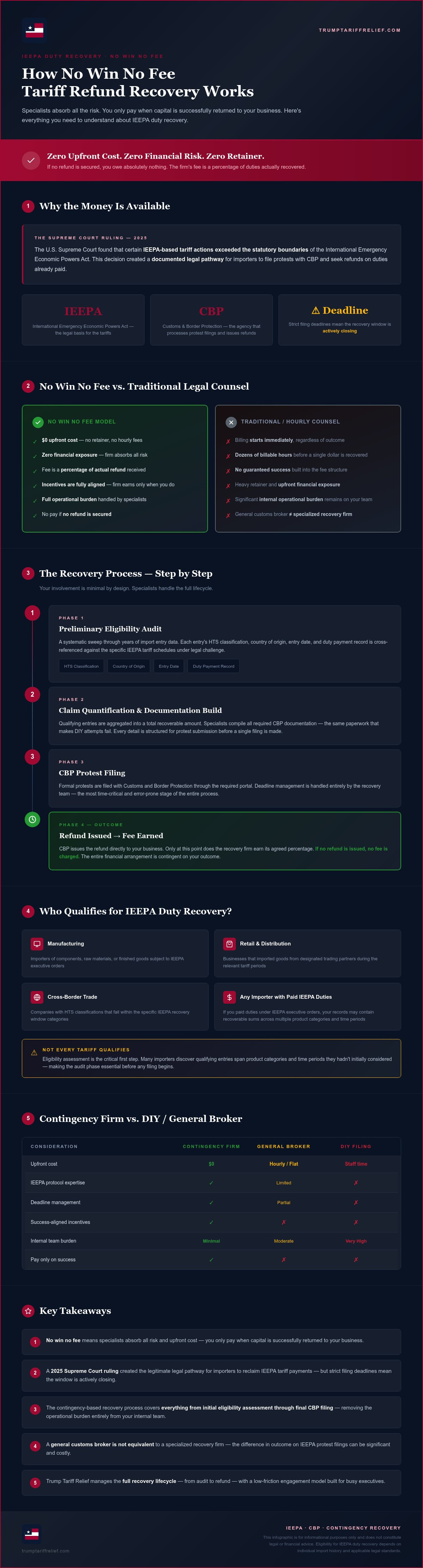
- A no win no fee tariff refund model means specialists absorb all the risk and upfront cost of your IEEPA duty recovery claim — you only pay when capital is successfully returned to your business.
- A recent Supreme Court ruling created a legitimate legal pathway for importers to reclaim IEEPA tariff payments, but strict filing deadlines mean the window for recovery is actively closing.
- The contingency-based recovery process covers everything from initial eligibility assessment through final CBP documentation, removing the operational burden entirely from your internal team.
- Relying on a general customs broker for IEEPA protest filings is not equivalent to engaging a specialized recovery firm — the difference in outcome can be significant and costly.
- Trump Tariff Relief manages the full recovery lifecycle on your behalf, from audit to refund, with a low-friction engagement model built for busy executives who cannot afford to lose more time.
What is a No Win No Fee Tariff Refund for IEEPA?
At its core, a no win no fee tariff refund is exactly what it sounds like: a contingency-based arrangement where a specialized recovery firm pursues your IEEPA duty refund claims on your behalf, and you only pay if capital is successfully returned to your business. No retainer. No hourly billing. No financial exposure on your end while the claim works its way through Customs and Border Protection. The firm's compensation is tied entirely to your outcome.
This model didn't emerge from thin air. It became viable because a specific legal event created a legitimate, documented pathway for importers to reclaim duties they were compelled to pay under the International Emergency Economic Powers Act.
The Legal Precedent: Why the Money is Available
The International Emergency Economic Powers Act grants the executive branch broad authority to regulate international commerce during declared national emergencies. That authority was the legal foundation for a sweeping series of tariffs imposed on imported goods, affecting thousands of importers across manufacturing, retail, and distribution. In 2025, the U.S. Supreme Court issued a ruling that directly challenged the scope of that authority, finding that certain IEEPA-based tariff actions exceeded the statutory boundaries of the Act. That decision created the legal basis for importers to file protests with CBP and seek refunds on duties already paid.
The categories of duties now eligible for recovery include tariffs applied under specific IEEPA executive orders targeting goods from designated trading partners. Not every tariff falls within this recovery window, which is precisely why eligibility assessment is the critical first step before any filing begins.
Defining the Contingency Recovery Model
Under a contingency structure, the recovery firm calculates its success fee as an agreed percentage of the total duties actually refunded to your business. If the claim succeeds, the firm earns its share. If no refund is secured, you owe nothing. That's the entire financial arrangement.
Contrast this with traditional customs litigation or hourly legal counsel, where clock-based billing begins immediately regardless of outcome. A complex CBP protest can require dozens of billable hours before a single dollar is recovered, and there's no guarantee of success built into that fee structure.
The no win no fee tariff refund model inverts that dynamic entirely. It aligns the firm's incentives with yours, removes the upfront financial barrier that has kept most importers from acting, and places the burden of proof, documentation, and deadline management squarely on the specialists who know the system. To understand how Trump Tariff Relief structures this process from initial assessment to final filing, review the full recovery process here.
The Mechanics of Contingency-Based Tariff Recovery
Understanding that a no win no fee tariff refund arrangement exists is one thing. Understanding precisely how the work gets done, and why your involvement is minimal by design, is what separates a business that recovers capital from one that simply intends to. The recovery process runs in two distinct phases before a single protest is filed with CBP, and both phases matter enormously to the outcome.
Step 1: The Preliminary Eligibility Audit
The process begins with a structured review of your import history, not a cursory glance, but a systematic sweep through years of entry data to identify which specific transactions fall within the legal recovery window created by the Supreme Court ruling. This is where specialized expertise earns its value immediately.
Your import records contain thousands of line items. Each entry carries a Harmonized Tariff Schedule classification, a country of origin designation, an entry date, and a duty payment record. Recovery specialists cross-reference each of those variables against the specific executive orders and IEEPA tariff schedules now subject to legal challenge. Entries that qualify on all dimensions move forward. Those that don't are filtered out before any filing resources are committed. That distinction protects you from wasted effort and, critically, protects the integrity of your overall claim.
The depth of this initial audit is what separates a recoverable sum from a missed opportunity. Many importers are surprised to discover that qualifying entries span product categories and time periods they hadn't initially considered. The Tariff Refund Assessment guide covers IEEPA eligibility criteria in detail, including the specific duty classifications and trading partner designations that determine whether your imports qualify for recovery.
Step 2: Documentation and Evidence Gathering
Once qualifying entries are identified, the documentation phase begins. This is where most self-managed claims fail. CBP protest filings require precise, complete, and properly formatted supporting evidence. A missing entry summary, an inconsistent classification record, or an improperly dated commercial invoice can result in an outright denial, regardless of whether the underlying legal argument is sound.
For 2026 filings specifically, IEEPA documentation must be pristine because CBP has no obligation to request missing information before issuing a denial on a deficient protest.
Specialists managing your Customs Documentation Management requirement pull and organize the relevant Customs Form 7501 entries, commercial invoices, bills of lading, and proof of duty payment into a filing package that meets CBP's evidentiary standards. Your internal team doesn't chase records or decode CBP formatting requirements. That burden transfers entirely to the recovery firm.
The practical result is a claim built on verified data, not assumptions. If you want to understand how this audit-to-filing workflow operates in practice, the full recovery process is outlined here.
Contingency Firm vs. DIY: Evaluating the Risks
Here's a question worth sitting with: how many hours has your trade compliance team already spent trying to understand whether your IEEPA payments are recoverable? If the answer is "some," that time has a cost. If the answer is "none," you may have already forfeited capital without realizing it. Both scenarios point to the same conclusion: the in-house approach to IEEPA duty recovery carries risks that don't announce themselves until it's too late to correct them.
The most common objection at this stage is predictable. "Can't our customs broker just handle this?" It's a reasonable question with an uncomfortable answer. A general customs broker manages the ongoing mechanics of import compliance: entry filing, classification guidance, and routine duty payment. That skillset is valuable for what it is. It is not, however, the same as the deep, litigation-adjacent expertise required to identify every qualifying IEEPA entry, construct a legally defensible protest package, and navigate CBP's evidentiary standards for a refund claim. Generalist brokers aren't designed for this work, and engaging them for it isn't a cost-saving measure; it's a risk transfer in the wrong direction.
Specialized trade recovery experts systematically audit entry data at a granularity that general practitioners rarely reach. They cross-reference HTS classifications, country-of-origin designations, entry dates, and applicable executive orders simultaneously, identifying qualifying transactions that a non-specialist review would miss. The practical consequence is a materially larger recoverable sum for businesses that engage the right expertise from the outset.
The Hidden Complexity of the CAPE System
CBP's Consolidated Administration and Processing of Entries system is often described as "automated," which creates a false sense of accessibility. For multi-entry importers, CAPE processing involves layered entry summaries, liquidation records, and protest tracking that interact in ways that aren't intuitive without hands-on experience. A single data inconsistency between an entry summary and a supporting commercial invoice can trigger a rejection that closes the recovery window permanently on that entry. "Automated" describes the system's architecture, not its forgiveness. Understand the full scope of IEEPA authority and its implications for your import history here.
Aligning Interests: Why Success Fees Win
An hourly firm bills for effort, not outcomes. There's no structural incentive to dig deeper into your entry history once a reasonable claim is assembled. A no win no fee tariff refund arrangement eliminates that dynamic entirely. The recovery firm's fee is a percentage of what's actually returned to you, which means their financial interest is identical to yours: find every qualifying dollar, build the strongest possible filing, and get it across the line. That alignment isn't incidental. It's the architecture of the model, and it's why CFOs in retail and manufacturing increasingly treat contingency-based recovery as the only rational structure for this type of claim. You don't pay for activity. You pay for results.
The risk of an incomplete or deficient protest isn't a minor procedural inconvenience. CBP denials on improperly filed claims can permanently foreclose recovery on those specific entries. There's no second attempt once a protest is denied and the appeal window closes. That finality is what makes the choice between generalist handling and specialized recovery not a matter of preference, but of financial consequence.
Maximizing Your Claim: Deadlines and Portal Requirements
The legal pathway created by the Supreme Court ruling doesn't stay open indefinitely. Every day that passes without a filed protest is a day closer to a permanently closed recovery window. Understanding exactly when that window shuts, and what's required to file before it does, is the difference between recovering capital and writing it off for good.
Navigating the 2026 Filing Deadlines
CBP protest filings for IEEPA duty recovery are governed by a strict statute of limitations. Under 19 U.S.C. § 1514, importers generally have 180 days from the date of liquidation of a given entry to file a protest. For entries that liquidated months or years before the Supreme Court ruling created the recovery basis, that clock has already been running. The practical consequence is that older entries are expiring on a rolling basis, not on a single calendar date.
The three-year look-back period adds another layer of urgency. While CBP's protest window is tied to liquidation dates, the outer boundary of recoverable entries is anchored to the original duty payment timeline. Entries that fall outside that look-back period cannot be reopened regardless of how strong the underlying legal argument is. That combination of rolling liquidation deadlines and a fixed look-back boundary means the total universe of recoverable duties is actively shrinking. The Tariff Refund Statute of Limitations blog details the critical deadlines for IEEPA claims and explains precisely which entry dates fall within the current recovery window.
The Role of the ACE and CAPE Portals
All CBP protest filings for IEEPA duty recovery run through the Automated Commercial Environment portal. Before any claim can be submitted, your ACE account must be active, properly credentialed, and linked to the correct importer of record number. An account that's dormant, misconfigured, or missing power-of-attorney authorizations will delay filing, and in a deadline-driven process, delay is denial.
The CAPE system, CBP's Consolidated Administration and Processing of Entries functionality, handles the back-end processing of multi-entry protest packages. It's not a simple submission queue. CAPE cross-references entry summaries, liquidation records, and protest data simultaneously, which means a single formatting inconsistency or mismatched entry identifier can trigger a Request for Information via CBP Form 28. That RFI pauses processing and introduces timeline risk that compounds as deadlines approach. Expert management of your filing package eliminates the most common triggers for Form 28 delays before submission, not after.
Before engaging a recovery specialist, gather the following to accelerate the eligibility assessment:
- Customs Form 7501 entry summaries for all imports from 2022 through present
- Commercial invoices and bills of lading corresponding to IEEPA-affected entries
- Your ACE importer of record number and current account access credentials
- Records of all duty payments made under IEEPA executive orders
- Any prior protest filings or CBP correspondence related to these entries
Having this documentation organized before your first conversation with a specialist compresses the audit timeline significantly. A no win no fee tariff refund engagement moves faster when the eligibility review can begin immediately rather than waiting on records retrieval. Review the FAQ to understand what Trump Tariff Relief needs from you to begin the assessment process.
Reclaim Your Capital with Trump Tariff Relief
Every section of this article has pointed toward the same conclusion: the capital is recoverable, the legal pathway is established, and the clock is actively running down. What separates importers who reclaim their IEEPA duties from those who don't isn't access to information. It's access to the right partner. That's where Trump Tariff Relief enters the picture.
Why Importers Trust Our Specialized Experts
Trump Tariff Relief isn't a general customs consultancy that added IEEPA recovery to a broader menu of services. The firm's expertise is concentrated specifically on IEEPA and Section 301 tariff recovery, which means the specialists managing your claim aren't learning the nuances of this legal landscape on your dime. They've built their entire practice around it. That depth translates directly into claim quality: more qualifying entries identified, documentation packages that meet CBP's evidentiary standards on first submission, and protest filings that don't generate avoidable Form 28 delays.
The approach to government bureaucracy is straightforward and unsentimental. CBP processes don't reward creativity; they reward precision and completeness. Trump Tariff Relief's team brings both, navigating the ACE portal, CAPE processing requirements, and protest filing mechanics with the fluency that only comes from concentrated, repeat engagement with the system. Review the full recovery process to see exactly how that expertise is applied to your claim.
Start Your Recovery Process Today
Onboarding is designed to be low-friction by intent. The first step is a preliminary eligibility assessment, a structured review of your import history to determine which entries fall within the current recovery window. You don't need a fully organized documentation package to begin. Providing your Customs Form 7501 entry summaries and importer of record details is enough to initiate the review.
Within the first 30 days of engagement, you can expect a clear picture of your recoverable duty exposure, a prioritized list of qualifying entries ranked by liquidation deadline urgency, and a fully managed documentation and filing strategy. Your internal team doesn't manage the process. Trump Tariff Relief does.
The no win no fee tariff refund commitment remains absolute from first conversation to final refund. No retainer. No hourly billing. No financial exposure while your claim moves through CBP. You pay only when capital is returned to your business.
The recovery window is narrowing with every passing week. The strongest claims are built on the most complete entry histories, and the most complete entry histories belong to importers who act before more liquidation deadlines expire. Don't absorb these costs as permanent losses when a legitimate, zero-upfront-cost recovery pathway exists. Schedule your free IEEPA eligibility assessment today and let Trump Tariff Relief put that capital back where it belongs.
The Window Is Open — But It Won't Stay That Way
The case for acting is straightforward. A Supreme Court ruling created a legitimate legal basis for recovering IEEPA duties you've already paid. A no win no fee tariff refund arrangement removes every financial barrier to pursuing that recovery. And specialized experts handle the eligibility audit, documentation preparation, and CAPE portal filing process entirely on your behalf.
Three things distinguish Trump Tariff Relief from every alternative: you only pay when funds are actually recovered, the team brings concentrated IEEPA trade law expertise rather than generalist customs knowledge, and the entire filing lifecycle is managed for you from first assessment to final refund.
Liquidation deadlines are expiring on a rolling basis. Every week of inaction narrows the recoverable universe of entries. The importers who recover the most capital are the ones who move first, not the ones who move eventually.
Don't let recoverable capital become a permanent write-off. Start your zero-risk tariff recovery assessment today and find out exactly what your business is owed.
Frequently Asked Questions
What does 'no win no fee' actually mean for a tariff refund?
A no win no fee tariff refund means the recovery firm earns nothing unless your claim succeeds and CBP actually returns duties to your business. There's no retainer, no hourly billing, and no financial exposure on your end while the claim is being built and filed. The firm's compensation is structured as an agreed percentage of the refund amount, payable only upon successful recovery.
This contingency structure matters because it completely aligns the firm's incentives with yours. They have every reason to find every qualifying dollar in your entry history and build the strongest possible filing, because their fee depends entirely on the outcome, not the effort.
Is the IEEPA tariff refund legitimate and real in 2026?
Yes. The recovery basis is grounded in a 2025 U.S. Supreme Court ruling that found certain IEEPA-based tariff actions exceeded the statutory boundaries of the International Emergency Economic Powers Act. That ruling created a documented legal pathway for importers to file protests with CBP and seek refunds on duties already paid under those specific executive orders.
This isn't a gray-area strategy or a speculative filing tactic. It's a formal CBP protest process governed by established trade law under 19 U.S.C. § 1514. The recovery window is real, but it's time-limited, which is why eligibility assessment needs to happen before more liquidation deadlines expire.
How much of a percentage do tariff recovery firms usually take?
Contingency fees in tariff recovery engagements are calculated as a percentage of the duties actually refunded to your business. The specific percentage varies by firm and by the complexity of the claim, and Trump Tariff Relief structures its fee transparently at the outset of engagement so there are no surprises when funds are returned.
What's important to understand is that the fee only applies to recovered capital. If no refund is secured, you owe nothing. For businesses that have absorbed IEEPA duties as a sunk cost, a contingency arrangement means the recovery process costs you nothing unless it actually works.
What is the deadline for filing an IEEPA tariff refund claim?
There isn't a single universal deadline. CBP protest filings are governed by a 180-day window measured from the liquidation date of each individual entry, meaning deadlines are rolling and expiring continuously across your import history. Entries that liquidated earliest are the most time-sensitive, and some may already be outside the recovery window.
A three-year look-back period also applies, creating an outer boundary on which duty payments are eligible regardless of liquidation status. The combined effect is that the total universe of recoverable duties shrinks every week. An eligibility audit conducted now will capture more qualifying entries than the same audit conducted three months from now.
Can I file for a tariff refund if my business is in the manufacturing sector?
Yes. Manufacturing importers are among the most common beneficiaries of IEEPA duty recovery, particularly those importing components, raw materials, or intermediate goods from trading partners targeted by the relevant executive orders. Eligibility is determined by the HTS classification of your imported goods, their country of origin, and the entry dates, not by your industry category.
The eligibility audit process cross-references all of those variables against the specific IEEPA tariff schedules subject to legal challenge. Many manufacturers discover that qualifying entries span multiple product lines and time periods they hadn't initially considered, which is precisely why a thorough audit is the essential first step.
How long does it take to receive the refund check from CBP?
CBP doesn't operate on a fixed processing timeline for protest refunds. Once a protest is filed and approved, the refund is issued through the ACE portal and typically arrives as a direct payment to the importer of record. Processing times can vary based on claim volume, the complexity of the filing, and CBP's internal workload at the time of adjudication.
What directly affects your timeline is the quality of the initial filing. Protest packages that are complete and properly formatted on first submission avoid the Request for Information delays that CBP Form 28 inquiries introduce. That's a core reason why documentation precision at the filing stage isn't optional; it's what keeps your refund moving forward without interruption.
What happens if my tariff refund claim is denied?
Under a no win no fee arrangement, a denied claim means you owe the recovery firm nothing. The financial risk of an unsuccessful filing sits entirely with the firm, not with your business. That's the structural protection the contingency model provides.
It's worth understanding that CBP denials on improperly filed protests can permanently close the recovery window on those specific entries. There's no second attempt once a protest is denied and the appeal period lapses. This is why the documentation preparation phase matters so much; a well-constructed filing built on verified entry data is the most reliable defense against denial and the permanent forfeiture that follows it.
Do I need to change my current customs broker to work with you?
No. Engaging Trump Tariff Relief for IEEPA duty recovery doesn't require you to replace or discontinue your existing customs broker relationship. Your broker handles ongoing import compliance; that work continues uninterrupted. Trump Tariff Relief operates in a distinct, specialized capacity focused exclusively on recovering duties already paid, which is a different function entirely.
A limited power of attorney is typically required to authorize Trump Tariff Relief to file protests and interact with CBP on your behalf for the recovery claim. That authorization is scoped specifically to the recovery engagement and doesn't affect your broker's role in your day-to-day import operations.
Ready to find out what your business may be owed?
Check My Eligibility