
The February 2026 Supreme Court ruling didn't just invalidate IEEPA tariffs; it ignited a high-stakes legal race to reclaim your company's capital. As an Importer of Record, you're likely facing a mountain of documentation for thousands of entries while a strict filing deadline approaches. Mastering the IEEPA tariff refund process is no longer a routine administrative task. It's a strategic necessity to overcome government appeals and technical hurdles within the CAPE platform.
We recognize that the DOJ's appeal of the CIT refund order creates uncertainty, and the sheer volume of required data can feel paralyzing. This guide provides the definitive roadmap to verify your eligibility and secure your rightful recovery. We'll break down the critical differences between Phase One and Phase Two filings, the specific requirements for finally liquidated entries, and the exact steps needed to reclaim your capital without disrupting your core operations.
Key Takeaways
- Understand why the 2026 Supreme Court ruling mandates the return of billions in unlawfully collected duties to U.S. importers.
- Identify how your entry status, whether liquidated or unliquidated, dictates your specific path to recovery and your filing deadlines.
- Master the technical requirements of the CAPE platform and the IEEPA tariff refund process within the ACE portal to ensure accurate submissions.
- Prepare for strategic risks, including the DOJ appeal and potential court stays that could delay your capital restoration.
- Discover how a contingency-based recovery model eliminates administrative overwhelm and financial risk for high-volume importers.
Understanding the IEEPA Refund Landscape in 2026
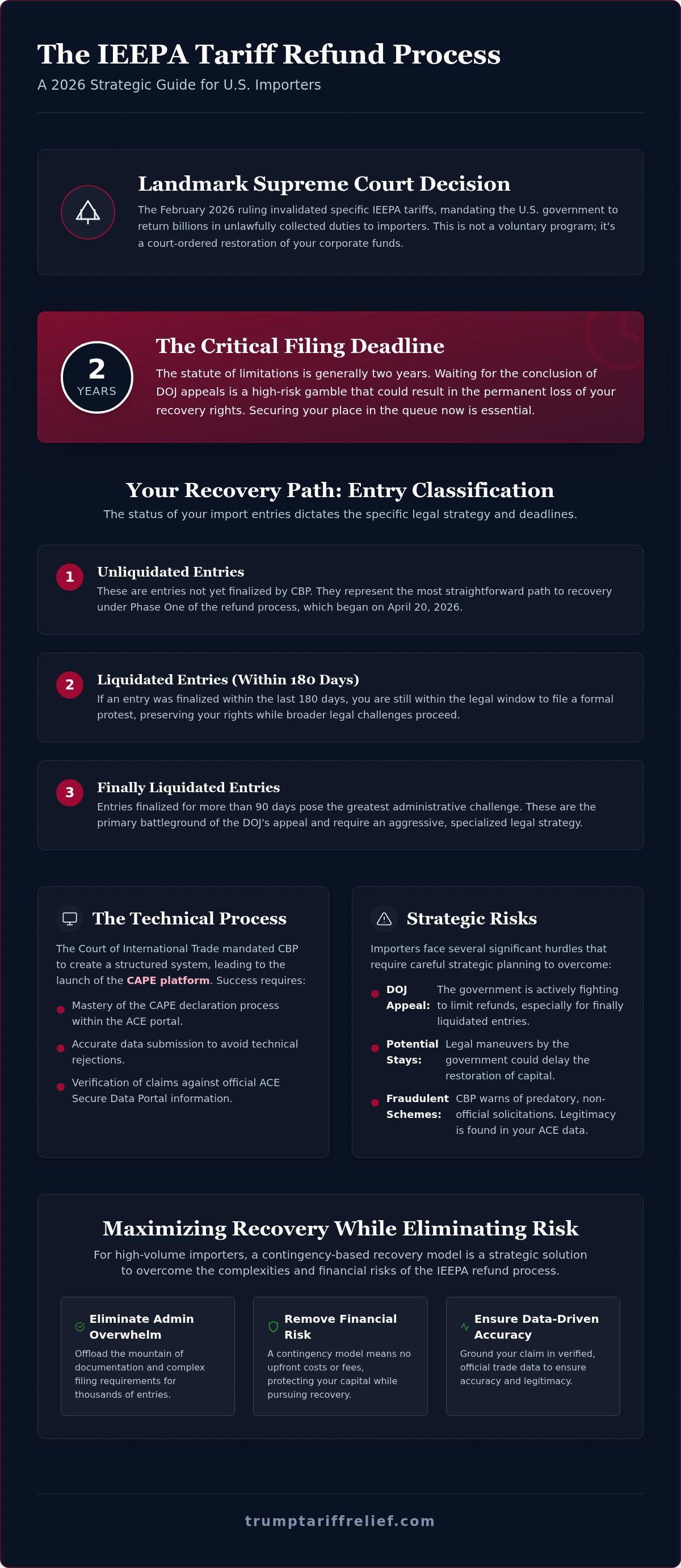
The February 2026 Supreme Court ruling in Learning Resources, Inc. v. Trump fundamentally shifted the trade landscape. The court determined that the executive branch exceeded its authority by imposing specific duties under the International Emergency Economic Powers Act (IEEPA) without proper justification. This landmark decision didn't just stop future collections; it established that billions of dollars in duties were taken unlawfully. The government is now legally required to return this capital to the importers who paid it, specifically targeting:
- Tariffs imposed under IEEPA without a verified, continuing national emergency.
- Duties that exceeded the temporal or statutory scope of the original executive orders.
- Payments made on entries that remained unliquidated or within the protest window at the time of the ruling.
The Court of International Trade (CIT) has taken an assertive role in this recovery effort. It mandated that U.S. Customs and Border Protection (CBP) implement a structured system for processing these claims, leading to the launch of the CAPE platform on April 20, 2026. This isn't a voluntary refund program; it's a court-ordered restoration of corporate funds. Identifying the specific entries eligible for the IEEPA tariff refund process requires a deep dive into your trade data. Only those duties directly tied to the invalidated executive actions qualify for recovery, and the CIT has already indicated it will process roughly 3,700 pending cases following the same logic as the initial plaintiff orders.
Is the IEEPA Refund Process Legitimate?
CBP has issued warnings regarding non-official solicitations and potential fraudsters looking to exploit the confusion surrounding these refunds. It's vital to distinguish between legitimate legal recovery and predatory schemes. You can verify a refund opportunity by cross-referencing your ACE Secure Data Portal information with the specific entry types identified in the CIT orders. Working with verified trade experts ensures your claim is grounded in official trade data rather than vague promises. Legitimacy is found in the data, not the sales pitch.
The Critical 2-Year Deadline
Time is your greatest adversary. The statute of limitations for filing suit at the CIT is generally two years from the date of the cause of action. Many importers mistakenly believe they should wait for the DOJ's appeal to conclude before acting. This is a dangerous gamble. If you miss the filing window while waiting for a court update, you could face a permanent loss of your recovery rights. You can learn more about the technical requirements on our IEEPA explained resource page. Securing your place in the queue now protects your claim regardless of how the appeal proceeds. The government’s attempt to delay or stay these orders shouldn't discourage you from asserting your rights while the window remains open.
Classification: Liquidated vs. Unliquidated Entries
Your path to recovery isn't a single lane; it's a multi-tiered legal framework where the status of your entry defines your success. The IEEPA tariff refund process treats an active entry very differently than one finalized years ago. Understanding where your data sits in the CBP lifecycle is the first step toward reclaiming your capital. If you don't categorize your entries correctly, you risk missing the specific filing windows established by the Court of International Trade (CIT).
- Category 1: Unliquidated Entries. These are entries not yet finalized by CBP. They're typically the most straightforward to recover, as they fall under Phase One of the refund process that began on April 20, 2026.
- Category 2: Liquidated Entries (Within 180 Days). If your entry liquidated within the last 180 days, you're within the legal window to file a formal protest. This action preserves your rights while the broader legal battles continue.
- Category 3: Finally Liquidated Entries. These entries have been liquidated for more than 90 days. They represent the most significant administrative hurdle and require a more aggressive legal strategy.
Distinguishing between these categories is essential because CBP's official IEEPA refund process utilizes different technical mechanisms for each. Phase Two, which launched on June 29, 2026, specifically handles reconciliation entries. However, the broader recovery for older, finally liquidated entries remains a point of intense legal contention between importers and the government.
The Challenge of Finally Liquidated Entries
Finally liquidated entries are the primary battleground for the DOJ's current appeal. While the CIT directed CBP to refund duties for a plaintiff on July 15, 2026, the government is fighting to prevent these refunds from becoming "universal" for all importers. If your entries fall into this category, you likely need an importer-specific court order to compel a refund. Relying on CBP to act voluntarily for older entries is a losing strategy. Filing a protest, even if your status seems uncertain, creates a legal placeholder that can be vital if the courts rule in favor of broader restitution. You can perform a preliminary eligibility assessment to see where your specific entries land.
How to Audit Your Entry History
Success begins with a comprehensive data audit. You must access the ACE (Automated Commercial Environment) portal to pull your historical trade data and identify every relevant entry. Focus on identifying HTS codes and duty rates specifically linked to the IEEPA actions invalidated by the Supreme Court. This documentation is the foundation of your CAPE declaration. Our IEEPA Eligibility and Recovery Guide provides deeper insights into which specific codes qualify for recovery under the current court mandates. Don't let administrative overwhelm stop you; the data is there, it just needs to be mined and organized for submission.
The Technical Process: Filing the CAPE Declaration
The Consolidated Administration and Processing of Entries (CAPE) platform is the technical engine that transforms a legal victory into actual capital recovery. It functions as a specialized module within the ACE portal, designed specifically to handle the high volume of claims generated by the Supreme Court's ruling. Successfully navigating the IEEPA tariff refund process requires more than just knowing you're owed money. It demands a precise, step-by-step execution within the Automated Commercial Environment (ACE) to ensure your claims aren't rejected for technical non-compliance.
The technical roadmap for a CAPE filing follows a rigorous sequence:
- Step 1: Establishing or Reactivating your ACE Trade Account. You cannot file a declaration without an active ACE account. If your account has lapsed or your credentials are outdated, reactivating this portal is your first non-negotiable priority.
- Step 2: Compiling Entry Summary Data. This involves mining your historical records to aggregate every entry number, date, and duty amount associated with the invalidated IEEPA tariffs.
- Step 3: Submitting the Declaration. Once your data is verified, you must transmit the declaration through the proper CBP channels. This isn't a standard protest; it's a specific CAPE-formatted submission.
- Step 4: Monitoring Status. After submission, you must track the declaration as it moves from 'filed' to 'accepted' and finally to 'liquidated' for refund.
While the CAPE platform was designed for efficiency, it's currently operating under the shadow of the DOJ appeal. The government may attempt to stay the processing of these declarations at any time. This makes immediate action vital. If you wait until the legal landscape is perfectly settled, you might find the technical window has already closed or been suspended by court order. Our how it works section details how we manage this technical heavy lifting for our partners.
Required Documentation for a Successful Claim
A successful claim lives or dies by the quality of your documentation. You must compile every CBP Form 7501 (Entry Summary) and the corresponding commercial invoices for the entries in question. Precise HTS code matching is the only way to prove your goods fall under the specific IEEPA exclusions mandated by the court. Even a minor discrepancy in a code or a date can result in a summary rejection of your entire claim. For a detailed breakdown of what you need, consult The 2026 Importer’s Checklist for IEEPA Documents to ensure your records are audit-ready.
Common Filing Errors to Avoid
Technical errors are the most common reason for delayed or denied refunds. Mismatched Importer of Record (IOR) data or transposed entry numbers will trigger an immediate system flag. Furthermore, filing for entries that fall outside the eligible 2026 date ranges is a waste of administrative resources. Perhaps most critically, importers often miss the 180-day window for Post-Summary Corrections (PSC). If your entry has already liquidated and you've missed this window, the IEEPA tariff refund process becomes significantly more complex, often requiring individual litigation rather than a standard administrative filing.
Strategic Risks: The DOJ Appeal and Potential Stays
While the CAPE platform provides a technical gateway for recovery, the Department of Justice (DOJ) is actively working to narrow that opening. The government's primary argument focuses on preventing "universal" refunds, as they contend that only the specific companies that filed individual lawsuits should benefit from the Court of International Trade (CIT) orders. This legal posturing creates a significant hurdle for importers who have relied solely on administrative channels. If the DOJ successfully secures a stay of the Refund Order, the IEEPA tariff refund process could be frozen for months or even years while the appeal moves through the higher courts.
A stay would effectively halt all pending payments, even for entries that have already been accepted within the ACE portal. For non-litigants, this is a precarious position. Relying on a standard administrative filing may not be enough to secure your capital if the final ruling limits restitution to active plaintiffs. To mitigate this, many sophisticated importers are utilizing protective filings. By asserting your rights through a formal summons at the CIT now, you ensure your claim remains viable regardless of the appeal's outcome. This proactive approach transforms your status from a passive bystander to a protected litigant.
The 'Wait and See' Trap
Waiting for the DOJ appeal to conclude is a multi-million dollar gamble that few businesses can afford to lose. The two-year statute of limitations continues to run, and once that window closes, your right to recover those specific duties is extinguished forever. History provides a stark warning; in previous Section 301 litigation, proactive importers who filed early protected their interests, while those who waited for a "final" resolution often found themselves barred by expired deadlines. Don't let a procedural delay become a permanent financial loss. You can see how we navigate these timelines by reviewing how it works for high-volume importers.
Administrative Filing vs. Judicial Action
There is a critical distinction between submitting data through the ACE portal and filing a formal summons at the CIT. While the ACE portal handles the technical data transmission, a judicial action provides the legal weight necessary to compel payment if CBP resists. Joining a mass-action suit can significantly lower the individual cost of litigation while providing the same legal protections as an individual filing. If your recovery amount is substantial, moving beyond simple administrative steps is the only way to ensure you aren't left behind by a future court stay. If you're ready to secure your claim, you can start your recovery assessment today to determine the best legal path for your specific entry history.
Maximizing Recovery with Trump Tariff Relief
The complexity of the IEEPA tariff refund process often deters even the most diligent trade compliance teams. Between mining thousands of entries in the ACE portal and tracking the volatile DOJ appeal, the administrative burden is immense. Trump Tariff Relief eliminates this barrier by serving as your specialized recovery engine. We don't just provide advice; we execute the entire end-to-end recovery. Our team manages everything from the initial eligibility assessment to the final technical submission in the CAPE platform.
Standard customs brokers often lack the specialized legal framework required to navigate CIT litigation. We fill that gap. By combining deep technical expertise with a results-oriented legal strategy, we ensure your claims are audit-ready and positioned for maximum recovery. We take on the heavy lifting of data mining and documentation management, allowing your business to reclaim capital that was unlawfully collected without diverting your internal resources. If the legal landscape shifts, we pivot our strategy instantly to protect your interests.
Zero-Risk Recovery for Your Business
We operate on a strict contingency-fee basis. This "no refund, no fee" commitment removes every financial barrier to entry. If the government’s appeal results in a stay or if your entries are deemed ineligible, you owe nothing. This model creates a high-reward partnership where our success is directly tied to your capital restoration. While we navigate the complexities of the IEEPA explained landscape, your internal teams can stay focused on core operations. We act as your advocate, righting the financial wrong of these invalidated duties while you maintain business as usual.
Get Your Preliminary Assessment Today
Initiating your recovery is a streamlined process designed for efficiency. We begin with a comprehensive data analysis of your historical entries to identify every dollar eligible for a refund. To start, our team typically requires access to your ACE reports and a sample of your CBP Form 7501 entry summaries. We then perform a deep-dive audit to categorize your entries by liquidation status and HTS code accuracy. Don't let the 2026 deadlines pass while your capital remains in government hands. You can Request Your Free IEEPA Eligibility Assessment today to secure your place in the recovery queue.
Secure Your Capital Before the Window Closes
The 2026 trade environment is defined by a fleeting opportunity to reclaim billions in unlawfully collected duties. As we've explored, your entry classification and the technical accuracy of your CAPE filings are the only things standing between your business and a successful recovery. The IEEPA tariff refund process is moving quickly; the DOJ's ongoing appeal means that today's administrative path could be tomorrow's legal stalemate. Waiting for perfect clarity is a strategy that often leads to expired deadlines and forfeited rights.
Don't let administrative overwhelm or legal uncertainty result in a permanent loss of your corporate funds. Trump Tariff Relief offers a specialized, contingency-based recovery model that removes all financial risk from your shoulders. Our partnership includes a comprehensive ACE data audit and the deep trade expertise required to navigate these shifting regulations without upfront costs. We take on the heavy lifting so your internal teams can stay focused on operations while we right this financial wrong.
Secure Your IEEPA Refund Assessment Now and let our team manage the complexities of your recovery. Your capital belongs on your balance sheet, not in a government escrow account. We're ready to help you win back what's yours.
Frequently Asked Questions
How long does the IEEPA tariff refund process take?
The timeline for your recovery depends on your specific entry category. Phase One processing for unliquidated entries began on April 20, 2026, while Phase Two for reconciliation entries launched on June 29, 2026. Finally liquidated entries are currently subject to the DOJ's appeal, which could introduce delays of several months or more depending on the court's final ruling.
Can I file for a refund if my company is no longer importing from China?
You can absolutely file for a refund even if your company no longer imports from China. Eligibility is determined by the duties you paid during the period invalidated by the Supreme Court, not your current trade volume. If your historical trade data confirms you paid these specific tariffs, you maintain the legal right to reclaim those funds regardless of your current operations.
What happens if the DOJ wins its appeal against the refund order?
A DOJ victory would likely limit refunds to companies that filed individual lawsuits at the Court of International Trade. This outcome would bar "universal" refunds for importers who only utilized administrative channels. Filing a protective summons now is the only way to ensure your recovery remains viable regardless of the appeal's final outcome or government attempts to stay the order.
Is there a minimum refund amount required to work with a consultant?
We prioritize cases based on the complexity and recovery potential of your entry history. While we don't set a rigid minimum, our specialized data mining and legal framework are most effective for importers with significant duty exposure. Every preliminary assessment evaluates whether the potential recovery justifies the administrative effort required to manage the IEEPA tariff refund process for your specific business.
What is the difference between a CAPE Declaration and a standard protest?
A standard protest is a routine administrative tool used to challenge CBP decisions within 180 days of liquidation. In contrast, a CAPE Declaration is a specialized technical submission within the ACE portal designed specifically for the IEEPA tariff refund process. It follows a unique set of technical rules mandated by the CIT's 2026 orders and is the primary mechanism for electronic restoration.
Will my customs broker handle this IEEPA refund process for me?
Most customs brokers aren't equipped to manage the legal complexities or historical data audits required for these refunds. Brokers typically focus on active entries and routine compliance. Our team provides the specialized legal and trade expertise necessary to navigate CIT litigation and high-volume data mining that standard brokerage services don't offer, ensuring your claim isn't lost in administrative backlogs.
Are Section 301 tariffs and IEEPA tariffs the same thing?
Section 301 and IEEPA are separate legal authorities. Section 301 tariffs are based on trade investigations into foreign practices, while IEEPA tariffs are based on executive emergency powers. The February 2026 Supreme Court ruling specifically targeted duties where the government overreached its authority under the International Emergency Economic Powers Act, creating a distinct path for recovery separate from other trade remedies.
What documents do I need to start the assessment process?
You need your ACE Secure Data Portal reports and sample CBP Form 7501 Entry Summaries to begin the audit. These documents allow our team to identify your specific HTS codes and historical duty payments. Once we have this data, we can perform a comprehensive assessment to verify your eligibility and calculate your total recovery potential without disrupting your daily business operations.
Ready to find out what your business may be owed?
Check My Eligibility