
Only IEEPA duties are currently eligible for these refunds, and the importer that paid them, not a downstream HVAC supplier, must apply. For valid claims, U.S. Customs and Border Protection says refunds generally go out 60 to 90 days after a CAPE declaration is accepted.
That distinction matters: buying HVAC equipment from a U.S. supplier does not automatically give you the right to claim a refund from the government. Potential recovery depends, in part, on whether tariff charges were listed separately or built into the price you paid.
This guide explains how to assess a tariff refund for HVAC equipment importers, identify the records needed, and estimate duties that may be recoverable. You’ll see how tariff type, entry status, and documentation affect the next steps, so you can focus on charges tied to eligible entries.
Key Takeaways
- Separate duties paid directly on imported HVAC equipment from tariff costs passed through by a U.S. supplier; the distinction can affect who may pursue recovery.
- Match each customs entry to its tariff type and entry status before assessing potential eligibility.
- Track liquidation dates closely: U.S. Customs and Border Protection generally allows 180 days after entry liquidation to file a protest challenging a customs duty assessment.
- Use entry records, invoices, and tariff line items to estimate recoverable costs and identify charges that may have been built into product prices.
When Will Importers Receive Tariff Refunds?
Yes, U.S. HVAC importers may recover eligible IEEPA duties already paid. After the February 20, 2026 ruling, valid refunds are generally issued electronically 60 to 90 days after U.S. Customs and Border Protection accepts a CAPE declaration.
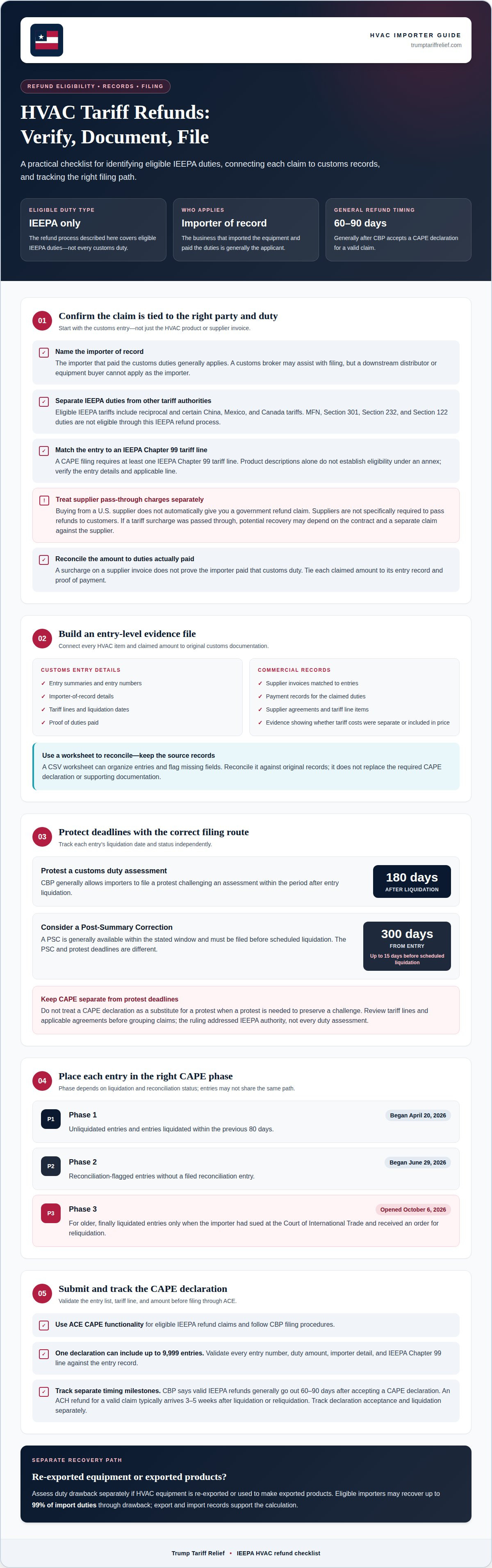
- Start with the importer of record. The business that imported the equipment and paid the duties is generally the one that applies for a refund. A customs broker may assist with filing, but a downstream distributor or equipment buyer cannot apply as the importer. A tariff refund for HVAC equipment importers therefore starts with the entry record showing who imported the goods.
- If you bought from a U.S. importer or distributor, review your invoices for separately stated tariff charges. Suppliers are not specifically required to pass refunds on to customers. If a surcharge was passed through, any potential recovery may depend on your contract and a separate claim against the supplier.
- Separate IEEPA tariffs from other duties. Current refund eligibility covers IEEPA tariffs, including reciprocal and certain China, Mexico, and Canada tariffs. MFN, Section 301, Section 232, and Section 122 duties aren’t eligible through this IEEPA refund process.
- Check the entry record and HTSUS tariff lines. A CAPE filing requires at least one IEEPA Chapter 99 tariff line. Match the equipment’s entry details to the applicable tariff line; product descriptions alone don’t establish eligibility under an annex. A tariff refund for HVAC equipment importers depends on the qualifying tariff line, not simply the equipment category.
- For Section 301, identify the duty separately. These tariffs primarily apply to goods from China and were imposed during Donald Trump’s first term. They don’t qualify for the IEEPA refunds described here.
- If HVAC equipment is re-exported or used to make exported products, assess duty drawback separately. Eligible importers may recover up to 99% of import duties through drawback; export and import records support the calculation.
- Consumers cannot apply directly for these refunds. Tie any claim to duties actually paid and reconcile each amount with the entry record. A tariff surcharge on a supplier invoice does not prove that the importer paid that customs duty.
Tariff refund process and filing resources
Build a claim from entry-level records, then choose the filing route that fits each entry’s status. Preserve protest deadlines separately from CAPE submissions.
-
Gather Documents and Entry Records
Collect entry summaries, importer-of-record details, tariff lines, liquidation dates, and proof of duties paid. Match each entry number to the HVAC equipment, supplier invoice, and payment record so you can trace the claimed amount to customs documentation. A CSV worksheet can help organize entries and flag missing fields, but reconcile it against the original records before filing. Keep supplier agreements and invoices that show whether tariff costs were listed separately or included in the price.
-
Check Customs Duty Refund Deadlines
Calendar the liquidation date for every entry, then choose the appropriate filing path promptly. According to U.S. Customs and Border Protection, importers generally have 180 days after entry liquidation to file a protest challenging a customs duty assessment. A Post-Summary Correction is generally available within 300 days of entry, up to 15 days before scheduled liquidation. These deadlines differ, so don’t treat a CAPE declaration as a substitute for a protest when a protest is needed to preserve a challenge.
Separate IEEPA claims from duties imposed under Section 232 or other tariff authorities. The Supreme Court ruling addressed IEEPA authority, not every duty assessment. Review the entry’s tariff lines and applicable agreement before grouping claims.
-
Submit Refund Claims and CSV Declarations
Use the ACE portal’s CAPE functionality for eligible IEEPA refund claims, following U.S. Customs and Border Protection filing procedures. List entry numbers accurately; one CAPE declaration can include up to 9,999 entries. Validate each number, duty amount, and IEEPA Chapter 99 tariff line against the entry record. Keep a CSV worksheet as a reconciliation tool, and don’t assume it replaces the required CAPE declaration or supporting documentation.
Before filing, compare the claim total with customs records and confirm the importer-of-record details. Trump Tariff Relief can assess eligibility and manage the documentation and filing process.
Refund processing timelines
Check each entry’s phase and status before estimating when payment may arrive. IEEPA refund claims are processed through separate CAPE phases.
-
Review CBP Refund Processing Phases
Match each entry to its liquidation and reconciliation status. CAPE Phase 1 began April 20, 2026, covering unliquidated entries and entries liquidated within the previous 80 days. Phase 2 began June 29, 2026, for reconciliation-flagged entries without a filed reconciliation entry.
For older, finally liquidated entries, Phase 3 opened October 6, 2026, only when the importer had sued at the Court of International Trade and received an order for reliquidation. This phased refund process follows the February 20, 2026 Supreme Court ruling on tariffs imposed under the International Emergency Economic Powers Act. Don’t assume every entry can use the same filing phase.
-
Estimate Refund Processing Timelines
Use the relevant processing milestone, not the date duties were paid at the border, to estimate timing. CBP says valid IEEPA refunds generally go out 60 to 90 days after accepting a CAPE declaration. An ACH refund for a valid claim typically arrives 3 to 5 weeks after liquidation or reliquidation. These are different reference points, so track declaration acceptance and entry liquidation separately.
Phase placement can add time before payment. The first phase was estimated to cover 63% of IEEPA tariffs, while the remaining 37% were assigned to later phases. By October 2, 2026, CBP had accepted about $136.6 billion in claims into CAPE and certified and sent about $126 billion, including interest, to the Treasury for payment. Those figures describe system-wide processing, not an individual importer’s expected refund date.
Record the CAPE acceptance date, liquidation status, and payment details for each entry. If entries are in different phases, monitor them separately rather than assuming there will be one release date for all claims.
Estimating recoverable tariff costs
Estimate potential recovery entry by entry, separating eligible duties from supplier charges and other tariff costs.
- Export your customs entries from the ACE portal and sort them by country of origin, product classification, and tariff line. For each entry, record the duty actually paid, the applicable tariff rate, and the authority listed. This gives you a traceable starting point instead of treating every HVAC shipment or supply-chain surcharge as recoverable.
- Isolate duties imposed under the International Emergency Economic Powers Act (IEEPA). The refund estimate should include only eligible IEEPA duty amounts, not every charge associated with an imported unit. Keep Section 301 and Section 232 amounts in separate columns because those tariff categories aren’t eligible through the IEEPA refund process described here.
- Reconcile entry totals against customs payment records and commercial invoices. If an invoice combines the equipment price and tariff costs, do not count the full price as duty. If a U.S. distributor charged a separate tariff surcharge, record it apart from customs duties paid by the importer. This distinction shows what your business paid directly and what may require a separate supplier claim.
- For goods exported after importation, assess duty drawback as a separate recovery route. Eligible importers may recover up to 99% of import duties when goods are exported or used to make exported products. Link each exported shipment to its original import record, then calculate the relevant duties without adding IEEPA refund amounts twice.
- Use the completed worksheet to estimate the claim, not gross tariff exposure. An estimated $50 billion in eligible U.S. import-duty refunds goes unclaimed annually, but each company’s potential recovery depends on eligible entries, duties paid, and supporting records. For HVAC products with mixed origins or tariff authorities, a Tariff Eligibility Assessment can help classify recoverable costs before filing.
Trump Tariff Relief: IEEPA Tariff Refund Recovery
Trump Tariff Relief assists businesses seeking IEEPA tariff refunds for duties paid on imported HVAC equipment. Turn to the firm when records span multiple shipments, tariff lines, or liquidation stages, making eligibility review and claim preparation difficult to manage internally.
A Tariff Eligibility Assessment helps identify entries that may qualify, while Customs Documentation Management organizes supporting records for filing. Trump Tariff Relief manages the refund process from eligibility review through government filings. The service is contingency-based, with no upfront cost: payment is only a percentage of the amount recovered.
For importers balancing supplier invoices, customs entries, and filing deadlines, Trump Tariff Relief provides a focused path from an initial eligibility review to a documented claim. Submit your company and import-history information to discuss potential recovery.
Turn Potential Recovery Into a Clear Next Step
Make tariff recovery part of your finance team’s import review, not just a reaction to policy changes. A documented assessment can help distinguish amounts tied to potentially eligible entries from costs that belong elsewhere in your records. This clarity supports cash planning and more informed discussions across finance, procurement, and the supply chain.
For a tariff refund for HVAC equipment importers, the practical next step is to move from an initial estimate to a reviewed claim strategy. Trump Tariff Relief can assess eligibility and manage the recovery process, with decisions grounded in your company’s entry and payment records.
There’s no need to navigate that transition alone. Contact Trump Tariff Relief for help and take a focused next step toward evaluating your potential recovery.
Frequently Asked Questions
How do the refunds work?
U.S. Customs and Border Protection recalculates eligible IEEPA duties after an importer submits a claim through the applicable process. The importer of record must match claimed amounts to customs entry data and supporting records. For example, if an entry includes both IEEPA and Section 232 duties, separate the amounts because the IEEPA refund process does not cover both tariff types.
What are the timelines for requesting a tariff refund?
Request timing depends on the entry’s liquidation status and the applicable filing route. CAPE Phase 1 covers unliquidated entries and entries liquidated within the previous 80 days. For a separate protest challenging a customs duty assessment, U.S. Customs and Border Protection says importers generally have 180 days after entry liquidation. Track each entry’s status and deadline individually.
Will Tariffs Be Refunded Under the Latest US Trade Policies?
No, a policy change does not make every tariff refundable. The refund program described applies to duties imposed under IEEPA, while MFN, Section 301, Section 232, and Section 122 duties are outside that refund eligibility. Check the tariff authority recorded for each entry, since an HVAC shipment may carry more than one duty type and only qualifying IEEPA amounts belong in that claim.
Which tariffs on imported HVAC equipment are eligible for refunds or duty drawback?
IEEPA duties may qualify for the tariff refund process, subject to entry and filing requirements. Duty drawback is a separate route for eligible duties when imported goods are exported or used to make exported products; eligible importers may recover up to 99% of import duties through drawback. Keep export evidence linked to the original import entries, and don’t treat drawback as an automatic refund.
Are HVAC imports eligible for Section 301 tariff exclusions or refunds on past duties?
Section 301 duties aren’t eligible for the IEEPA refund process described here. Section 301 tariffs primarily apply to goods from China, so review the entry’s tariff lines and origin details before classifying past payments. Exclusion eligibility is separate from IEEPA refunds; an exclusion does not itself establish a refund claim for duties already paid.
How can importers request a refund of customs duties from U.S. Customs and Border Protection?
Importers of record submit eligible IEEPA refund claims through CBP’s ACE portal using CAPE functionality. Assemble entry numbers, tariff lines, duty amounts, and supporting records, then reconcile the filing against customs data before submission. Keep the acceptance date and each entry’s liquidation status on file to track processing and determine which filing deadlines apply.
Ready to find out what your business may be owed?
Check My Eligibility