
Did you know that $166 billion in duties collected from over 330,000 importers was recently declared unlawful by the U.S. Supreme Court? On February 20, 2026, the legal landscape for international trade shifted overnight, yet most businesses still have their capital locked away in unconstitutional tariffs. You've likely felt the weight of these costs on your bottom line, perhaps fearing that the complexity of the CBP’s CAPE portal or the ticking three-year statute of limitations will leave your funds out of reach. It’s a common anxiety; the government doesn't make it easy to take back what’s yours. This is why partnering with a risk-free tariff recovery service is no longer just an option, but a vital capital restoration strategy.
In this guide, you’ll discover how to reclaim your share of the IEEPA refund pool, plus interest, with zero upfront financial exposure. We'll explore the specific eligibility requirements for Phase 1 of the CAPE portal and explain how a contingency-based approach removes the burden of documentation from your internal teams. You'll learn exactly how to navigate this fleeting window of opportunity to ensure your business doesn't leave its rightful assets behind. This is your roadmap to securing the interest-bearing refunds you're owed without the drain on your internal resources.
Key Takeaways
- Learn how a risk-free tariff recovery service operates on a pure contingency basis, ensuring you pay absolutely nothing unless the CBP successfully issues your refund.
- Understand the intricacies of the CAPE portal and why the shift toward mass-processing requires a specialized strategy to navigate Phase 1 eligibility hurdles.
- Compare the financial impact of success-fee models against traditional hourly legal rates to see how "no-win, no-fee" structures protect your bottom line.
- Master the four-step roadmap for capital restoration, beginning with a comprehensive audit of your ACE portal data to build an audit-ready claim file.
- Discover how specialized expertise in IEEPA and Section 301 recovery can accelerate your filing process and secure your position in the refund queue.
What is a Risk-Free Tariff Recovery Service?
A risk-free tariff recovery service acts as a sophisticated navigator through the labyrinth of federal trade regulations. At its core, this is a specialized consultancy that manages IEEPA refund claims on a contingency fee basis. The narrative here is one of financial restoration; it's about righting a wrong that saw billions of dollars unconstitutionally stripped from American businesses. By utilizing a "No-Win, No-Fee" guarantee, these services ensure that importers face zero financial exposure while pursuing their rightful capital. You pay $0 unless the CBP successfully issues a refund. The process is turn-key, moving from a meticulous tariff refund assessment to the final technical submission in the CAPE portal.
This model is built on professional confidence. When a recovery partner takes on a case, they're investing their own time, legal expertise, and technical resources into your claim. They handle the complex data aggregation from the Automated Commercial Environment (ACE) and ensure every entry meets the strict criteria for mass-processing. Because their revenue is tied directly to your success, their motivation is perfectly aligned with your goal: maximizing the recovery of duties plus accrued interest. It’s a bold, results-oriented approach that transforms a daunting bureaucratic hurdle into a streamlined capital restoration event.
The 2026 Supreme Court Ruling Context
The trade landscape shifted fundamentally on February 20, 2026, when the U.S. Supreme Court ruled that IEEPA-based tariffs were an unlawful overreach of executive authority. This decision exposed the unconstitutionality of the duties collected during the previous year. While the tariffs were officially terminated on February 24, 2026, the government hasn't offered an automatic payout. Instead, they've established a complex recovery mechanism for the estimated $166 billion pool. For the 330,000 affected importers, this ruling isn't just a legal victory; it's a critical opportunity to reclaim liquidity that was taken without proper authority.
Why "Risk-Free" Matters for Your Balance Sheet
Trade-war costs often act as an anchor on corporate growth, tying up capital that should be used for innovation or expansion. A risk-free tariff recovery service removes the financial friction typically associated with high-level legal challenges. By shifting the administrative labor and the burden of proof to a recovery specialist, you preserve your internal bandwidth for core operations. This model protects your balance sheet during the filing process, as the specialist absorbs all operational costs. It ensures that even firms hit hardest by the 2025 tariffs can pursue a full recovery without a board-level budget appropriation.
Understanding the CAPE Portal and Eligibility Hurdles
The Consolidated Administration and Processing of Entries (CAPE) portal represents a radical departure from traditional customs refund protocols. Launched on April 20, 2026, this system was engineered to handle the sheer volume of the 53 million customs entries impacted by the Supreme Court’s ruling. Previously, importers would file entry-by-entry protests, a slow and resource-heavy method that often stalled in bureaucratic gridlock. CBP’s shift to mass-processing through CAPE aims for efficiency, but it introduces significant technical barriers for the uninitiated. Relying on a risk-free tariff recovery service is often the only way to navigate these hurdles without draining your own internal resources.
The high-stakes nature of the "CAPE attestation" cannot be overstated. When you file a claim, you aren't just asking for money back; you're legally certifying the accuracy of every data point across thousands of entries. Any discrepancy between your records and the CBP’s internal data in the ACE Secure Data Portal can lead to immediate rejection or even unwanted audit scrutiny. The technical barrier isn't just the portal itself, but the data verification required before submission. A risk-free tariff recovery service provides its greatest value here by managing the technical validation and ensuring your claim is audit-ready before it ever hits the portal.
Phase 1 vs. Phase 2 Eligibility
Eligibility is currently dictated by the status of your customs entries. Phase 1 is limited to unliquidated entries and those liquidated within 80 days of the claim, covering roughly 63% of the affected duties. If your entries fall outside this window, you're looking at Phase 2, which involves more complex administrative hurdles and potentially different legal pathways. It's also vital to note that only the Importer of Record (IOR) has legal standing to file. Downstream retailers or consumers who paid higher prices due to passed-on tariff costs are excluded from direct recovery. If you're unsure where your entries land, you can see how the recovery process works for different entry types.
The Burden of Documentation
While the CAPE portal was intended to streamline refunds, "simple" submissions often fail due to minor data mismatches. CBP requires rigorous validation to ensure that the IEEPA duties paid match the specific HTS codes and entry dates on file. Without precise data aggregation, your claim is at risk of being flagged for manual review, which can delay your refund for months. To avoid these pitfalls, read our checklist on the required documents for IEEPA tariff refund to ensure your internal records are complete and audit-ready.
Contingency Fees vs. Hourly Legal Rates: A Financial Comparison
Traditional international trade attorneys often bill between $1,000 and $1,500 per hour. For an importer with thousands of impacted entries, the audit and filing process can generate a bill that swallows 20% to 30% of the total refund before the CBP even processes the claim. This "hourly trap" creates a significant financial barrier for businesses already strained by the capital locked in unconstitutional IEEPA duties. Choosing a risk-free tariff recovery service eliminates this gamble. Instead of paying for a firm's administrative time, you pay for their actual results. This shift in the financial model ensures that your recovery efforts don't become another line-item expense on an already burdened balance sheet.
The fundamental difference lies in the alignment of incentives. A contingency partner works as a high-performing extension of your team because their revenue is tied directly to your recovery size. They don't just look for the obvious entries; they dig into the data to identify every eligible duty plus the 6-7% accrued interest that the government owes you. This approach ensures that every hour spent on your file is focused on increasing your bottom line. Transparency is the bedrock of this relationship. By structuring the success fee clearly, firms like Trump Tariff Relief create a win-win outcome where the importer keeps the vast majority of the refund without ever reaching into their own pockets to fund the litigation or administrative process.
The "Success-Fee" Advantage
This model effectively eliminates "sunk cost" anxiety. If the government disputes specific entries or if the technical criteria for Phase 1 mass-processing aren't met, you aren't left holding a bill for the failed attempt. You gain access to elite trade expertise without the typical $50,000 retainer required by general corporate legal teams. Furthermore, a contingency partner is naturally incentivized to pursue the maximum statutory interest. Since they only profit when you win, they're motivated to fight for the interest-bearing portion of the $166 billion pool that hourly firms might overlook during a standard filing.
Evaluating Your Recovery Partner
Not all contingency models are created equal, so you must scrutinize the fine print. Ask potential partners about hidden "cost-reimbursement" clauses or "administrative filing fees" that can quietly erode your recovery. A specialized consultancy focuses exclusively on IEEPA and Section 301 recovery, providing a level of precision that general legal teams often lack. They should be able to explain exactly how they handle data mismatches in the CAPE portal. To see this specialized expertise in action, explore how it works for a full breakdown of our transparent, result-driven process.
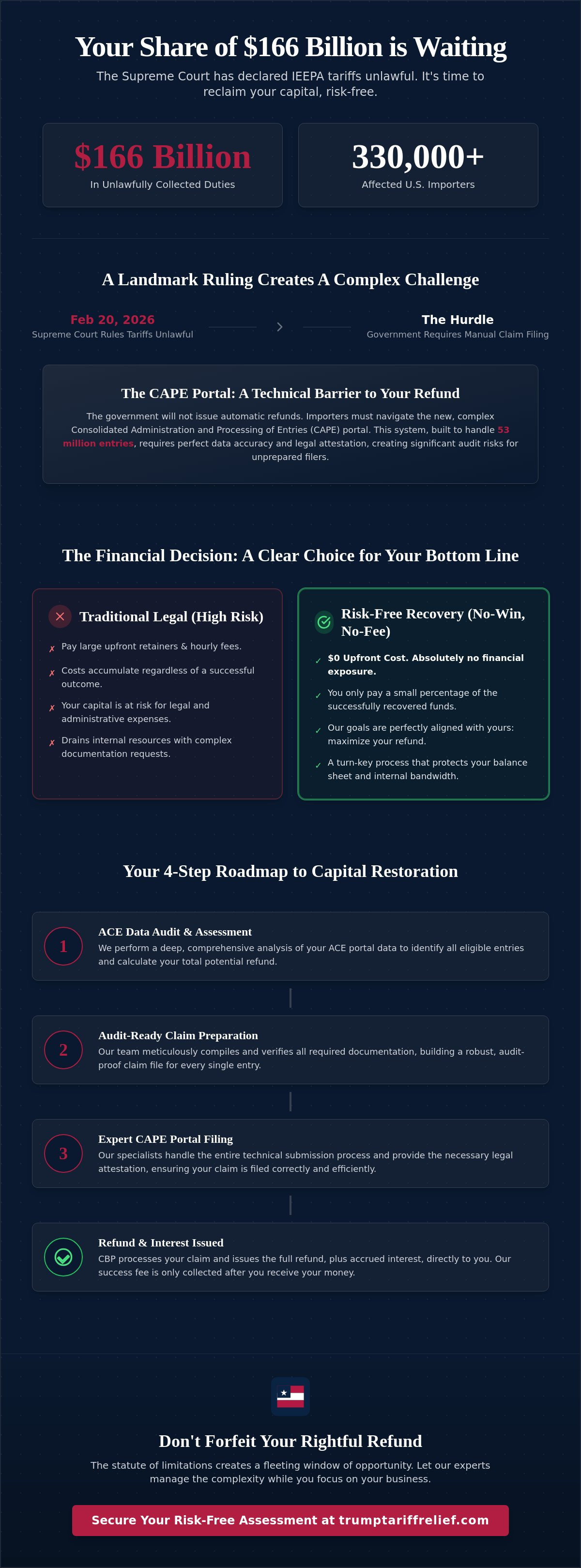
The 4-Step Process to Reclaiming Your Capital
Restoring your liquidity isn't a matter of luck; it's a matter of methodical execution. While the legal victory of February 2026 cleared the path, the actual recovery of your funds requires a disciplined technical approach. A risk-free tariff recovery service manages this entire lifecycle, ensuring that your claim isn't just filed, but successfully liquidated. This four-step framework is designed to move your firm from exposure to restoration without disrupting your daily operations.
- Step 1: Preliminary Eligibility Assessment. We begin by identifying your specific exposure to Section 301 and IEEPA-based duties. This audit determines which of your entries fall under the unconstitutional window and categorizes them by their liquidation status to determine Phase 1 or Phase 2 eligibility.
- Step 2: Data Aggregation. Using your ACE portal data, we build an audit-ready claim file. This stage is where our Customs Documentation Management expertise becomes critical, as we reconcile your internal records with CBP’s data to eliminate the mismatches that trigger manual reviews.
- Step 3: CAPE Portal Submission. We handle the technical filing within the CAPE system. This includes managing the high-stakes attestation requirements and ensuring your claim is correctly positioned in the Phase 1 queue for expedited processing.
- Step 4: Resolution & Recovery. Our team monitors the status of your claim through to completion. We verify that the CBP's payout includes the full 6-7% statutory interest you're owed, protecting you from under-calculated government settlements.
Meeting the Tariff Refund Statute of Limitations
Timing is your greatest risk. The 3-year statute of limitations is an absolute deadline; if you don't file within this window, your right to recovery expires regardless of the Supreme Court's ruling. Procrastination risk is real, especially as the political landscape continues to shift. Waiting for a "better time" often leads to missing the Phase 1 window entirely. You can find more detail on these critical deadlines in our guide on the tariff refund statute of limitations.
Audit-Proofing Your Claim
A successful refund isn't the end of the story. CBP retains the right to conduct post-refund audits or duty re-assessments. To mitigate this risk, we store and organize every piece of supporting documentation in a format that is ready for immediate government inspection. This proactive approach to Customs Documentation Management ensures that your recovered capital stays on your balance sheet where it belongs. If you're ready to secure your share of the $166 billion pool, you should start your preliminary assessment today to ensure your entries are captured before the statute expires.
Why Trump Tariff Relief is the Leader in Risk-Free Recovery
Success in international trade recovery isn't about general legal knowledge; it's about specialized technical execution. Trump Tariff Relief has carved out a position as the definitive leader because we don't dilute our focus. While general corporate firms juggle various litigation types, we concentrate exclusively on IEEPA and Section 301 recovery. This specialization allows us to move with a level of precision that generalists simply can't match. We understand that for your business, this isn't just about a legal ruling; it's about reclaiming liquidity that was unconstitutionally stripped from your balance sheet.
With the CAPE portal now live as of April 20, 2026, the race to secure Phase 1 refunds is on. We leverage an accelerated filing process designed to bypass the common data bottlenecks that stall other claims. Our goal is to get your firm at the front of the queue, ensuring your capital is restored within the standard 60 to 90 day window after the acceptance of a CAPE Declaration. By utilizing our risk-free tariff recovery service, you ensure that your firm isn't left behind as the government processes the initial wave of the $166 billion refund pool.
The core of our model is a commitment to your financial security. Our pure contingency structure means your firm never writes a check to us. We absorb the operational costs, the administrative labor, and the technical risks. If we don't recover your duties plus the accrued 6-7% interest, we don't get paid. This is the ultimate alignment of interests; we only win when you win. We act as your bold advocate in a system that is notoriously difficult to navigate, providing the protective strength needed to push through federal bureaucracy and demand the restoration of your assets.
The Trump Tariff Relief Difference
Our team possesses deep insider knowledge of CBP processing trends and the specific quirks of the CAPE portal that often trip up internal logistics teams. We take a no-nonsense approach that values your efficiency over fluff. By identifying the specific HTS codes and entry dates that qualify for Phase 1 mass-processing, we ensure your claim is audit-proof from the moment it's submitted. We don't just file papers; we position your business as a high-performing partner in a complex regulatory landscape, ensuring every detail is managed with professional confidence.
Secure Your Preliminary Assessment Today
The window for Phase 1 claims is active right now, and the 3-year statute of limitations continues to tick. Every day your capital remains with the government is a day it isn't working for your business growth. Starting the process takes under five minutes and requires no upfront financial commitment. Don't let government complexity or administrative hurdles stand in the way of your rightful refund. Get Your Free Tariff Eligibility Assessment Now and begin the journey toward full capital restoration today.
Restore Your Liquidity and Right the Regulatory Wrong
The path to reclaiming your share of the $166 billion IEEPA refund pool is now clearly defined, but it isn't automatic. Success requires a precise navigation of Phase 1 eligibility and a rigorous approach to customs data validation within the CAPE portal. By choosing a risk-free tariff recovery service, you align your business with experts who specialize exclusively in IEEPA and Section 301 recovery. Our contingency-only model ensures that you never face an upfront bill or a retainer fee; our success is entirely dependent on your financial restoration. It's a high-stakes opportunity to reclaim what is rightfully yours while the government's mass-processing window remains open.
Don't let the three-year statute of limitations or complex government bureaucracy keep your capital out of reach. It's time to take the administrative burden off your internal teams and place it in the hands of seasoned advocates who understand the intricacies of federal trade law. You can begin this process today without any financial exposure or internal resource drain. Your business has already paid the price of these unconstitutional tariffs; now it's time to bring that capital home where it can finally fuel your growth again.
Secure Your Risk-Free Tariff Recovery Assessment
Frequently Asked Questions
Is the China tariff refund real or a scam?
The IEEPA tariff refund is a legitimate financial restoration opportunity established by the February 20, 2026, Supreme Court ruling. This decision confirmed that the Executive Branch exceeded its authority when imposing these specific duties. While the $165 billion pool is real, you must avoid fraudulent schemes promising "tariff dividends" or individual payouts. A legitimate risk-free tariff recovery service operates through the official CBP CAPE portal to reclaim documented business duties.
How much does a risk-free tariff recovery service cost?
A specialized recovery service typically operates on a pure contingency model. This means your business faces zero upfront capital requirements and no hourly billing. You only pay a success fee after the CBP successfully issues your refund check. If a recovery isn't secured, you don't owe anything. This structure removes the financial barrier for firms hit hardest by the 2025 trade actions.
What is the deadline for filing an IEEPA tariff refund claim in 2026?
The primary deadline is governed by a three-year statute of limitations from the date of entry or liquidation. However, Phase 1 of the CAPE portal is currently restricted to unliquidated entries and those liquidated within 80 days of the claim. Waiting to file increases your "procrastination risk." Once these statutory windows close, your legal right to reclaim these unconstitutional duties is permanently lost.
Can I file for a tariff refund if I am a retailer but not the importer of record?
No, only the legal Importer of Record (IOR) has standing to file for an IEEPA refund. The Supreme Court's decision applies specifically to the entity that paid the duties directly to U.S. Customs and Border Protection. Retailers or consumers who paid higher prices because of passed-on tariff costs are excluded from this administrative recovery process. Standing is strictly limited to the firm listed on the customs entry documentation.
How long does it take for CBP to process a CAPE portal refund?
CBP generally issues valid refunds within 60 to 90 days after they accept a CAPE Declaration. This timeline assumes your data aggregation is perfect and matches the government's records in the ACE portal. Utilizing a risk-free tariff recovery service helps prevent the technical mismatches that trigger manual reviews. Audit-ready filings move through the system much faster than those requiring CBP intervention.
What happens if my tariff refund claim is denied?
If your claim is denied, you typically have the right to pursue an administrative protest or move the case to the Court of International Trade. Denials usually happen because of eligibility errors or data discrepancies in the filing. Professional recovery partners focus on mitigating this risk by validating every entry against the ACE Secure Data Portal before the final CAPE attestation is submitted.
Do I need a lawyer to file for a tariff refund through the CAPE portal?
You aren't technically required to have a lawyer to use the CAPE portal, but the legal weight of the filing is significant. You are certifying the accuracy of your trade data under penalty of law. Many businesses prefer specialized consultancies over general legal teams because they offer the same level of bureaucratic navigation without the burden of high hourly retainers or complex legal billing.
Is statutory interest included in the IEEPA refund amount?
Yes, statutory interest is a critical component of the recovery amount. Interest has been accruing on the duties paid under the unconstitutional IEEPA tariffs at a rate of 6-7%. A comprehensive recovery strategy doesn't just look for the base duty; it ensures the government correctly calculates and pays out the full interest-bearing portion of your claim.
Ready to find out what your business may be owed?
Check My Eligibility