
Your company's balance sheet is likely hiding millions of dollars in overpaid duties that the government has no legal right to keep. You've spent years watching your operating capital vanish into a black hole of trade policy, feeling the mounting pressure to hit 2026 fiscal recovery targets while navigating a maze of regulatory confusion. It's a common frustration to see your liquidity locked away, especially when the legal grounds for those payments have fundamentally shifted.
The recent Supreme Court ruling on China tariffs has finally cleared the air, drawing a sharp line between standing Section 301 duties and the now-invalidated IEEPA assessments. This landmark decision has opened a multi-billion dollar pathway for US importers to recover duties paid on List 3 and List 4a goods. In this guide, you'll learn how to verify your eligibility and navigate the high-stakes ACE filing process before the strict three year statute of limitations expires. We'll show you how to bypass bureaucratic administrative finality with a risk-free recovery strategy that puts your capital back where it belongs.
Key Takeaways
- Identify how the latest Supreme Court ruling on China tariffs invalidated specific IEEPA duties, creating a multi-billion dollar restoration event for impacted US importers.
- Discover the technical requirements of the 2026 CAPE Declaration and why your standard customs broker may not be equipped to manage this specialized ACE filing.
- Act now to secure your capital before the three-year statute of limitations permanently closes the window on early 2023 import entries.
- Learn to avoid fatal documentation errors, including HTS code mismatches and missing Form 7501 summaries, that frequently trigger administrative denials.
- Explore a low-risk, high-reward partnership that provides elite trade advocacy on a contingency basis, ensuring you only pay when your capital is recovered.
The 2026 Supreme Court Ruling on China Tariffs: Legitimacy and Impact
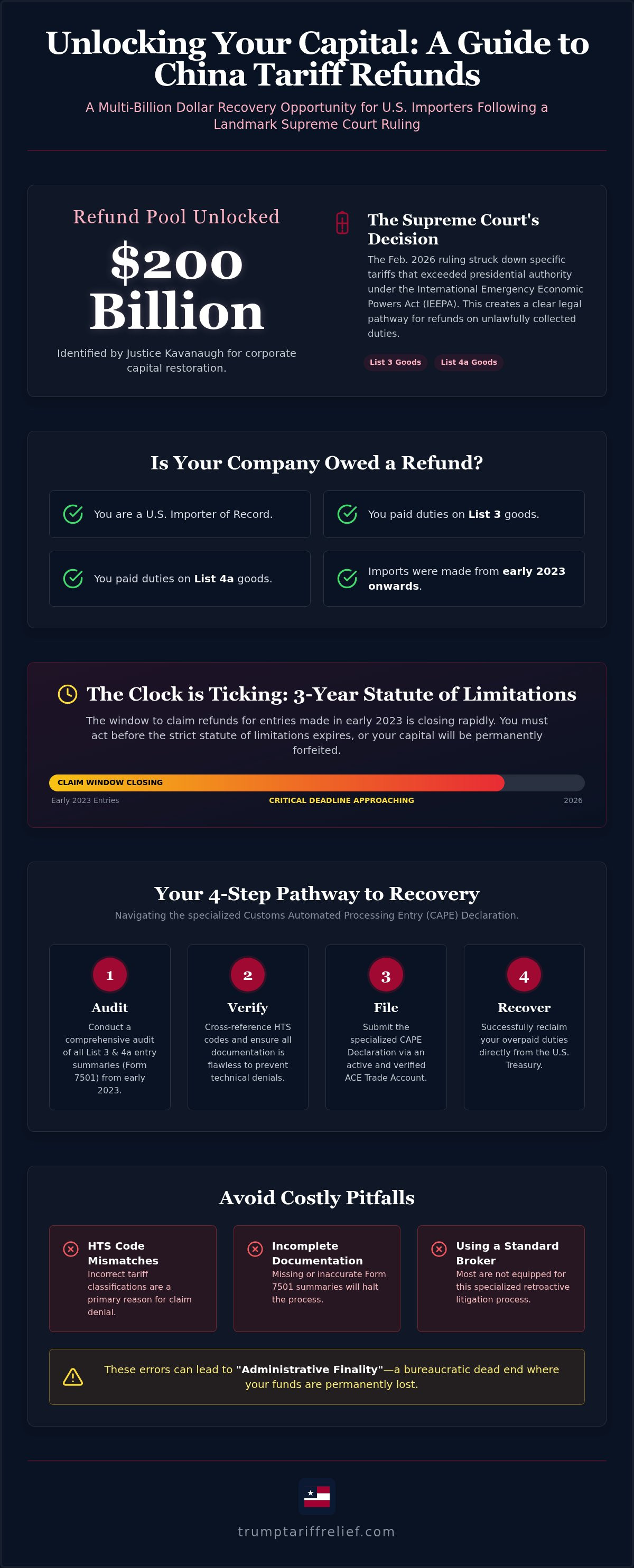
The 2026 Supreme Court ruling on China tariffs has fundamentally rewritten the rules of trade litigation. For years, US importers operated under the assumption that List 3 and List 4a duties were an immovable cost of doing business. The Court's February 2026 decision shattered that assumption. It struck down specific tariffs that exceeded presidential authority under the International Emergency Economic Powers Act (IEEPA), confirming that the executive branch overstepped its constitutional boundaries. This isn't just a legal theory; Justice Kavanaugh explicitly identified a $200 billion refund pool, signaling a massive opportunity for corporate capital restoration.
From Section 301 to IEEPA: The Legal Turning Point
The legal history of the China-United States trade war reveals a critical shift in how duties were applied. Initially, tariffs were justified under Section 301 of the Trade Act of 1974 to combat unfair trade practices. However, as the dispute escalated, the executive branch began relying on IEEPA to bypass the procedural limits of the Trade Act. The Supreme Court's 6-3 decision focused on this specific overreach, ruling that emergency powers cannot be used to permanently alter tax and trade policy without explicit Congressional consent. This distinction is vital. While standard trade protests often fail against the broad discretion of Section 301, the IEEPA overreach creates a specific, narrow, and highly successful pathway for duty recovery. You can review the specifics of this IEEPA legal nexus to see how it applies to your previous entries.
Why Importers Are Owed Billions
Between 2023 and 2025, the U.S. Treasury collected billions in duties that the Supreme Court has now deemed unlawful. This ruling reverses years of significant capital drain that hampered US-based manufacturing and retail growth. The Court of International Trade is currently tasked with executing this mandate, processing claims for importers who paid these invalidated List 3 and List 4a duties. The Supreme Court ruling on China tariffs effectively forces the government to address the financial damage caused by its own regulatory overstep. If your business imported goods under these categories, you're not just asking for a favor; you're reclaiming capital that belongs on your balance sheet. The 2026 ruling represents the final word on eligibility, providing a clear green light for those ready to navigate the ACE filing hurdles.
The CAPE Declaration and ACE Filing Process for 2026
The 2026 Supreme Court ruling on China tariffs didn't just provide a legal win; it mandated a technical overhaul of how importers reclaim their funds. The primary vehicle for this restoration is the Customs Automated Processing Entry (CAPE). You shouldn't confuse this with a standard post-summary correction or a routine protest. A CAPE Declaration is a specialized forensic filing designed specifically to address the IEEPA-invalidated duties. Most customs brokers are experts in logistics and clearing current shipments, not retroactive trade litigation. Relying on standard entry processes for a multi-million dollar refund is a high-stakes gamble. It often leads to "administrative finality," a bureaucratic dead end where your funds are permanently forfeited due to minor clerical errors or missed deadlines.
To participate in this recovery, your business must maintain an active and verified ACE Trade Account. This isn't just a login; it’s a rigorous verification of your corporate standing with Customs and Border Protection (CBP). If your account has been dormant or your Trade Account Owner (TAO) information is outdated, you'll be locked out of the filing window. Accuracy is the only shield against government retention of your capital. CBP will scrutinize every line item, looking for any reason to deny the claim based on technicalities rather than the merit of the ruling. If you're unsure about your account's current status, it's wise to undergo a preliminary eligibility assessment before the window closes.
Step-by-Step Pathway to Refund Recovery
Winning your capital back requires a methodical approach that leaves no room for federal scrutiny. The process follows a strict sequence:
- Step 1: Conduct a comprehensive audit of all List 3 and List 4a entry summaries (Form 7501) from early 2023 onward to identify overpayments.
- Step 2: Cross-reference your specific HTS codes with the IEEPA ruling exclusions. According to analysis from the Council on Foreign Relations, while the pool of funds is vast, eligibility depends on hyper-specific product classifications.
- Step 3: Electronically submit the formal CAPE Declaration via the ACE portal with all supporting documentation attached.
Avoiding the ACE Portal Trap
The Automated Commercial Environment (ACE) is a complex gatekeeper. Many importers find their TAO status has lapsed, causing immediate filing rejections that can be difficult to appeal. You can't rely on blanket filings; CBP requires "entry-by-entry" verification to ensure every dollar claimed matches an original payment record. Once filed, the "Reconciliation" phase begins. This is where documentation management becomes critical. If your internal data doesn't align perfectly with CBP’s digital records, the disbursement will be denied. This phase is the final hurdle where the government attempts to retain capital through technical disqualification. You must ensure your data is scrubbed and verified before the final submission hits the portal.
The 3-Year Statute of Limitations: Why 2026 is the Critical Year
Time is the most expensive competitor your business faces in 2026. While the Supreme Court ruling on China tariffs has cleared the path for multi-billion dollar recoveries, it didn't pause the relentless clock of federal law. The International Emergency Economic Powers Act (IEEPA) claims are governed by a strict three year statute of limitations. This means the window for recovery is closing on an entry-by-entry basis. If you imported goods in early 2023, those specific duties are reaching their expiration date right now. Waiting for further news or a simplified government process is a strategic error that could cost your company millions in unrecoverable capital.
Many importers are confused by the interaction between the standard 180-day protest window and this broader ruling. Normally, once 180 days pass after an entry is liquidated, the opportunity to challenge the duty is lost. However, the Supreme Court's decision on IEEPA overreach allows for a different legal pathway that extends to the three year mark. This creates a high-stakes environment where entries from 2023 and 2024 are still "live" for recovery, but only if the CAPE filing is submitted before the individual anniversary of each entry. The 2026 regulatory calendar is already becoming congested; as more firms realize the legitimacy of these claims, Customs and Border Protection (CBP) processing speeds are expected to slow significantly under the weight of new filings.
The Deadline for 2023 and 2024 Entries
Your recovery window isn't a single date; it's a rolling deadline. To protect your capital, you must identify the exact date each of your List 3 and List 4a entries was filed. For example, an entry filed on March 10, 2023, must have its refund claim submitted no later than March 10, 2026. Any delay beyond that 36-month mark results in permanent forfeiture. You can use our guide on the Tariff Refund Statute of Limitations to calculate your firm's unique deadlines and prioritize your most at-risk entries.
Administrative Finality: The Importer's Silent Enemy
In customs law, administrative finality is the point where a government decision becomes unreviewable and set in stone. If you miss your filing window by even twenty-four hours, the original duty assessment becomes "final," and no court or agency has the power to return your money. This legal trap is why early 2023 entries are currently the highest priority for recovery teams. Industry data from early 2026 suggests that the average processing time for a CAPE refund declaration is approximately 180 days, which makes immediate action vital to ensure your claim is logged before the statute of limitations shuts the door forever.
Common Pitfalls in China Tariff Refund Claims
The path to recovery is paved with technical landmines that can trigger immediate administrative denials. While the Supreme Court ruling on China tariffs has confirmed the illegitimacy of certain IEEPA duties, the burden of proof remains entirely on the importer. The government isn't handing out checks based on good faith; they're conducting forensic reviews of every digital record. Many companies fail because they treat these claims like routine accounting adjustments rather than high-stakes trade litigation. Precision is your only defense against a federal agency that is incentivized to retain your capital.
One of the most frequent strategic errors is the "Protest Gap." Importers often stop filing standard 180-day protests on recent entries while waiting for the CAPE system to fully roll out. This is a fatal mistake. You must preserve your legal rights through every available channel to ensure no entry falls into the trap of administrative finality. Additionally, incomplete reconciliation data often leads to partial refund denials. If your internal records don't align perfectly with the Automated Commercial Environment (ACE) data, Customs and Border Protection (CBP) will simply reject the mismatched portions of your claim without offering a second chance to correct the record.
Documentation Errors That Lead to Denials
Digital estimates and spreadsheet summaries are not enough to satisfy a CBP audit. The agency requires the original Form 7501 entry summaries for every single line item in your claim. As the Importer of Record (IOR), the responsibility for maintaining this forensic documentation chain rests solely on your shoulders. If your previous customs broker has purged these records or provided incomplete files, your claim is dead on arrival. You should immediately verify your records against our Required Documents for IEEPA Tariff Refund checklist to identify any missing links in your documentation chain before you hit the portal.
Misinterpreting the Eligibility Window
Confusion between different tariff lists is a primary cause of claim rejection and unwanted federal scrutiny. The IEEPA ruling specifically targets the emergency power overreach associated with List 3 and List 4a. Duties paid under List 1 and List 2 were generally authorized under different legal frameworks and remain excluded from this specific recovery path. Filing for these excluded goods is a dangerous gamble; it often triggers a full CBP audit of your entire import history. For complex multi-component imports, you must verify the status of every Harmonized Tariff Schedule (HTS) code to ensure they fall within the 2023-2025 eligibility window. Don't leave your capital to chance; secure your tariff eligibility assessment today to ensure your filing is bulletproof.
Strategic Recovery: The Case for Contingency-Based Advocacy
The Supreme Court ruling on China tariffs has created a massive administrative burden that your standard legal team isn't built to handle. While your general corporate counsel is likely an expert in risk mitigation or contract law, the ACE portal is a digital fortress designed to keep capital in federal hands. Navigating the CAPE filing process requires a hyper-specialized understanding of trade documentation and forensic accounting that goes beyond traditional legal training. This isn't just a legal dispute; it's a technical battle against a bureaucratic system that rewards precision and punishes minor clerical oversights. By partnering with trade-specific advocates, you gain an insider's perspective that ensures your claim isn't just submitted, but actually paid.
Professional advocacy maximizes your total recovery by identifying "hidden" eligible entries that your internal team might overlook. Many importers focus only on high-value shipments, but a comprehensive audit often reveals millions in smaller, aggregated duties that are just as eligible for restoration. We act as a no-nonsense partner, taking on the heavy lifting of government bureaucracy and documentation management. This allows your leadership team to stay focused on 2026 operational targets while we handle the aggressive follow-up required to move your claim through the Reconciliation phase and toward disbursement.
Contingency vs. Hourly: Aligning Your Interests
Hourly legal fees are a drain on your remaining liquidity, especially when there's no guarantee of a successful outcome. If a claim is denied after months of billing, your firm loses twice. The contingency model changes the math entirely. With this structure, Trump Tariff Relief only wins when you get paid, which aligns our motivation perfectly with your bottom line. This approach allows mid-sized firms to pursue massive claims against the government without the budget risk of upfront retainers or ongoing consulting costs. You can explore the details of this partnership on our How it Works page to see how we eliminate the financial barriers to recovery.
Get Your Free Tariff Eligibility Assessment
The first step toward reclaiming your capital is a non-binding, comprehensive audit of your Section 301 duty exposure. Our experts navigate the complex nuances of the court's decision to determine exactly which of your entries fall within the validated recovery window. You can learn more about the legal catalyst for these refunds by reading our section on IEEPA Explained. Don't let the statute of limitations shut the door on your company's liquidity. Secure your Free Tariff Eligibility Assessment today and take the first step toward righting this financial wrong.
Secure Your Capital Before the 2026 Deadline
The window to restore your company's liquidity is open, but it's narrowing with every passing day. The Supreme Court ruling on China tariffs provided the legal catalyst to reclaim overpaid duties. Success now depends on navigating the technical maze of the CAPE declaration and avoiding the administrative traps that lead to permanent forfeiture. You don't have to face the federal bureaucracy alone. You shouldn't risk upfront capital on uncertain legal fees.
Our team provides end-to-end management of the ACE/CAPE filing process. We leverage specialized expertise in the IEEPA and Section 301 legal nexus to identify every dollar you're owed. We operate on a contingency-based model; if we don't recover your funds, you don't pay a fee. This is your chance to right a financial wrong and strengthen your balance sheet for the 2026 fiscal year. Your capital belongs in your business, not in a government account.
Reclaim Your Capital: Get a Free Tariff Eligibility Assessment
Take command of your recovery strategy today and secure the restoration your business deserves.
Frequently Asked Questions
Is the China tariff refund real or a scam?
The opportunity is legitimate and based on a judicial mandate. The Supreme Court's February 2026 ruling invalidated tariffs imposed via the International Emergency Economic Powers Act (IEEPA), creating a multi-billion dollar refund pool for US importers. While you should be wary of unverified solicitations, the legal pathway for duty recovery is documented and real. You must ensure your filing follows the official CAPE declaration process within the ACE portal to remain compliant and secure your capital.
Who is eligible to get money back from China tariffs under the 2026 ruling?
Importers who paid duties on List 3 and List 4a goods during the 2023 through 2025 period are the primary candidates for recovery. Eligibility specifically hinges on whether your goods were subject to the emergency power overreach addressed in the Court's decision. You must conduct a line-by-line audit of your HTS codes to verify which entries qualify for restoration. This process requires matching your historical import data against the hyper-specific exclusions defined by the ruling.
How long does it take to receive an IEEPA tariff refund once filed?
Most claimants should expect a processing window of approximately 180 days once a CAPE declaration is successfully submitted. After your filing enters the ACE portal, it undergoes a rigorous reconciliation phase where Customs and Border Protection (CBP) verifies every entry against digital records. Processing speeds in 2026 are heavily influenced by the volume of incoming claims. Early filers typically bypass the significant backlogs expected as the statute of limitations draws near for more importers.
What is the deadline to file for a China tariff refund in 2026?
The deadline is governed by a rolling three year statute of limitations based on your specific entry dates. There's no single closing date for all claims. Instead, entries from early 2023 are reaching their expiration point right now in 2026. Once an entry passes the 36-month mark without a filed claim, it reaches administrative finality. This means your capital becomes permanently unrecoverable by law, making an immediate audit of your 2023 and 2024 entries a fiscal necessity.
Do I need a customs broker or a lawyer to file for a tariff refund?
You need a specialized advocate who understands the technical intersection of ACE portal mechanics and IEEPA law. Standard customs brokers focus on current logistics and often lack the forensic expertise required for retroactive litigation. Similarly, general corporate counsel frequently lacks the insider knowledge of the CAPE declaration system. A dedicated recovery partner manages the entire process on your behalf, ensuring technical errors don't lead to a summary denial of your company's claim.
What documents are required to start a tariff recovery claim for my business?
You must provide the original Form 7501 entry summaries for every shipment included in your claim. These documents serve as the foundational proof of duty payment and are required for the CBP audit process. Additionally, you'll need the specific HTS codes and liquidation dates for each entry to verify their status. Digital estimates or high-level spreadsheets are insufficient for federal review. Having a complete documentation chain is the only way to survive the scrutiny of a reconciliation audit.
Can I claim a refund for Section 301 duties paid in 2023?
Yes, you can claim refunds for these duties if they were collected under the invalidated IEEPA authority. The Supreme Court ruling on China tariffs distinguished between legitimate Section 301 trade actions and the emergency power overreach used to expand List 3 and List 4a. If your 2023 entries fall into these specific categories, they are prime candidates for recovery. You must move quickly to file before the three year window closes on those specific shipments from early 2023.
What is the success fee for professional tariff refund recovery services?
Professional recovery services typically operate on a contingency-based model to eliminate risk for the importer. This means there are no upfront costs, hourly retainers, or hidden consulting fees for your business to worry about. The advocate only receives a success fee once your refund is successfully recovered and deposited into your account. This structure ensures that the pursuit of financial justice doesn't create an additional burden on your company's operating capital or annual budget.
Ready to find out what your business may be owed?
Check My Eligibility