
Your recent denial from CBP isn't a legal finality; it's a calculated jurisdictional tactic designed to keep your capital in the government's hands. You've likely spent months watching the $166 billion recovery pool grow while your own entries are met with confusing bureaucratic rejections. It's deeply frustrating to see CAPE Phase 1 process $23 billion in refunds for others while your business is sidelined by the DOJ's June 2 appeal. We understand that seeing your capital tied up in unlawful tariffs feels like an unfair battle against a system designed to make you quit, especially when the 2026 recovery window is closing fast.
The good news is that appealing a denied IEEPA claim is still a viable, high-reward strategy if you move quickly. This guide reveals the strategic legal pathways required to reverse a denial and secure your share of the $30 billion currently held in contested "finally liquidated" entries. You'll discover how to navigate the Court of International Trade and why the government's current stance makes individual litigation a necessity for many importers. We will break down the exact steps to transition from a rejected protest to a successful recovery, allowing you to reclaim what is rightfully yours without any upfront cost.
Key Takeaways
- Identify the jurisdictional tactics used by the DOJ to block automatic CAPE refunds and why your previously approved filings are now facing rejection.
- Navigate the "Finally Liquidated" entry trap by understanding how the 19 U.S.C. § 1501 reliquidation period impacts your specific claim eligibility.
- Discover the strategic legal pathways for appealing a denied IEEPA claim through individual litigation, which is now the only remaining route for older entries.
- Follow a structured audit process to re-verify HTS codes and entry dates, ensuring your documentation is prepared for a successful reversal.
- Leverage a contingency-fee recovery model to remove financial barriers and reclaim your share of the $166 billion tariff pool with zero upfront cost.
Understanding the Wave of IEEPA Claim Denials in 2026
The $166 billion standoff between U.S. importers and the federal government reached a fever pitch in mid-2026. While the Supreme Court's February ruling in Learning Resources v. United States initially signaled a massive victory for trade equity, the actual recovery process has become a bureaucratic battlefield. An IEEPA claim denial occurs when U.S. Customs and Border Protection (CBP) rejects a refund request for duties previously collected under the International Emergency Economic Powers Act (IEEPA). Many importers are shocked to find that filings previously marked as "approved" or "pending" in the CAPE portal are now being summarily dismissed. This isn't usually due to a clerical error on your part; it's a deliberate jurisdictional rejection orchestrated by the Department of Justice (DOJ).
The government is currently fighting to prevent what it calls "universal injunctions," arguing that only companies that have filed individual lawsuits should receive refunds. This creates a high-stakes environment where appealing a denied IEEPA claim is no longer just a secondary option; it's the primary mechanism for financial restoration. If your entry status has shifted from "eligible" to "denied," you're likely caught in the $30 billion "finally liquidated" trap. You can learn more about the specifics of these regulations on our IEEPA explained page.
The DOJ’s Strategic Appeal
On June 2, 2026, the DOJ filed a formal appeal against the Court of International Trade’s order for universal refunds. By leveraging the legal precedent from Trump v. CASA, Inc., the government aims to restrict payments to a narrow group of active litigants. They're betting that thousands of businesses will simply walk away rather than engage in the legal system. Waiting for a "legislative solution" or a change in policy is a high-risk strategy that could cost your business millions. The DOJ's current trajectory suggests they'll continue to force every importer into individual litigation to exhaust their resolve and let the 2026 recovery window expire.
Identifying Your Denial Type
Not all rejections are created equal. You must distinguish between a CAPE system rejection, which is often an automated response to "finally liquidated" entries, and a formal Protest denial under 19 U.S.C. § 1514. Identifying the specific language in your notice is the first step toward appealing a denied IEEPA claim. Look for these red flags:
- Jurisdictional Deficiencies: This indicates the government is challenging your right to a refund based on timing rather than the merits of your HTS codes.
- Lack of Pending CIT Action: A clear sign that your entries are in Group 3 (finally liquidated without litigation) and require immediate legal intervention.
- Expiration of the 90-day window: If CBP hasn't exercised its voluntary reliquidation authority, your claim enters a state of permanent forfeiture unless a formal appeal is filed.
Understanding these distinctions is vital because the clock is ticking. If you don't act within the 180-day window following a formal denial, your opportunity to reclaim those tariffs vanishes forever. Our team specializes in identifying these nuances to ensure your recovery strategy is airtight.
The Finally Liquidated Entry Trap: Why CBP is Rejecting Older Claims
The government's primary weapon in the $166 billion refund battle is the "finality" of liquidation. In customs law, liquidation is the final computation of duties on an entry. CBP's logic is simple. They argue that once an entry is finally liquidated, meaning the final duty calculation is set, their administrative power to issue a refund expires after a very short window. This is why Group 1 entries, which are unliquidated or not yet final, are seeing $23 billion in approved refunds while older entries are being blocked. When you're appealing a denied IEEPA claim, you're often fighting a timeline, not just a tariff.
Under 19 U.S.C. § 1501, CBP has the authority to voluntarily reliquidate an entry within 90 days of the original liquidation date. Once that 90-day cliff is passed, the government claims its hands are tied. However, this administrative hurdle ignores the Uniformity Clause of the U.S. Constitution, which requires that all duties be uniform throughout the United States. If the Supreme Court ruled these tariffs unlawful, applying that ruling only to recent entries while keeping the capital from older entries creates a constitutionally prohibited disparity. This is a critical component for any importer appealing a denied IEEPA claim who was left out of the CAPE Phase 1 disbursements.
The 90-Day Cliff
CBP calculates finality with mathematical precision. If you don't take action within the 90-day voluntary reliquidation period, the agency will likely issue an automated denial. But "finally liquidated" doesn't mean "unrecoverable." It simply means the administrative path is closed and the judicial path is now mandatory. The U.S. Court of International Trade possesses exclusive nationwide jurisdiction over civil actions that challenge the assessment and collection of customs duties. To preserve your rights, you must be prepared to file a protest with CBP within the strict 180-day window following the date of liquidation.
Countering the Jurisdictional Objection
The DOJ relies heavily on the CASA, Inc. precedent to argue that the Court of International Trade (CIT) cannot issue "universal injunctions" that cover every importer. Judge Eaton, however, has signaled that the unique nature of IEEPA tariffs may require a broader remedy. Your appeal should emphasize that these weren't standard duty disputes but rather a systemic executive overreach. If you are unsure where your entries fall on this high-stakes timeline, a preliminary eligibility assessment can clarify your standing and identify which entries are at the highest risk of permanent forfeiture.
CAPE vs. Individual Litigation: Navigating the Recovery Paths
The recovery landscape is currently split between two divergent paths: the automated CAPE system and formal individual litigation. While the CAPE portal was designed as a streamlined vehicle for processing the $166 billion in tariff refunds, it has largely stalled for the most complex claims. For many importers, the simple administrative route is no longer an option. If your business is currently appealing a denied IEEPA claim, understanding why the government is funneling cases toward the courts is the only way to protect your capital. The choice between waiting for a system update and taking proactive legal action will determine whether you see a refund in 2026 or lose your rights entirely.
The CAPE System Limitations
CAPE Phase 1 launched on April 20, 2026, targeting unliquidated entries. While it processed roughly $90 billion in claims within its first six weeks, only $23 billion in actual refunds were approved and sent to the Treasury. This massive discrepancy highlights the "Uneven Implementation" problem identified by trade experts. Phase 3, targeted for late July 2026, was intended to cover the high-risk "finally liquidated" entries. However, the DOJ’s current position is that Phase 3 refunds will only be processed for importers who have already filed lawsuits at the CIT. You can find a detailed breakdown of how the IEEPA refund process works to see where your specific entries sit within this rollout.
The Litigation Path
The DOJ’s refusal to grant universal refunds has triggered a massive wave of individual court actions, following the precedent set by the V.O.S. Selections, Inc. v. Trump litigation. To join this wave, you must first ensure you have complied with 19 U.S.C. § 1514 by filing a formal protest within the 180-day window. While the administrative CAPE path is theoretically faster, it is currently a dead end for the $30 billion in contested Group 3 entries. Litigation is now the only guaranteed path to recovery for older entries. The Federal Circuit’s recent refusal to stay proceedings is a significant win for importers, as it prevents the government from dragging these cases out for years. Inaction is your biggest enemy; once the statute of limitations passes, even a favorable final ruling won't help you appealing a denied IEEPA claim that was filed too late.
The cost of filing an individual suit can be prohibitive for some, but group actions and contingency-based models have removed these barriers. By aligning with a partner who manages the documentation and legal filings, you can navigate the CIT without the burden of upfront legal fees. The focus must remain on the 2026 window, as the government’s strategy relies on importers missing these critical deadlines.
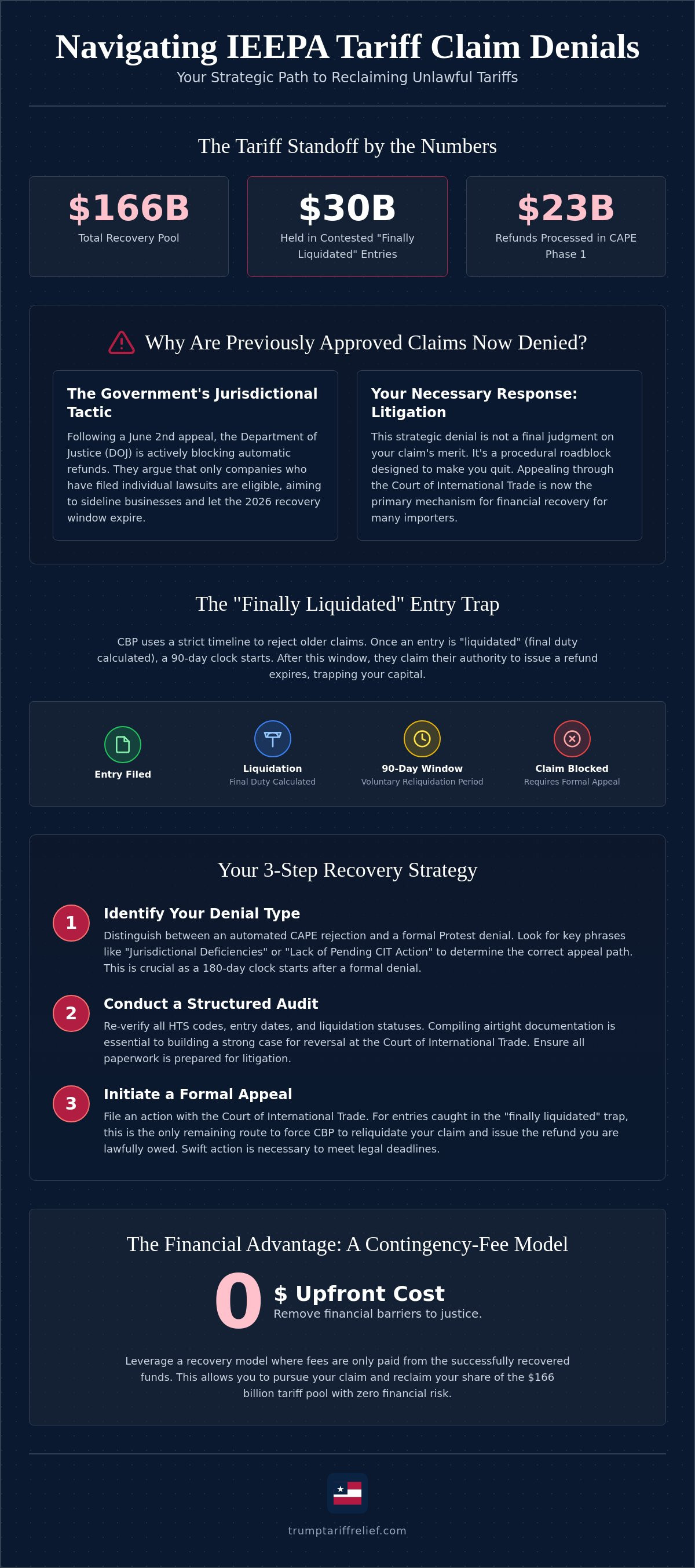
How to Appeal: A Step-by-Step Recovery Strategy for Importers
Moving from a bureaucratic rejection to a successful recovery requires a methodical, aggressive approach. The government isn't going to hand over your capital voluntarily; you must demonstrate that your claim is legally sound and procedurally perfect. If you're currently appealing a denied IEEPA claim, your strategy must transition from passive waiting to active litigation. Follow these four critical steps to dismantle a CBP denial and position your business for a court-ordered refund.
- Step 1: Audit your denial notice for specific HTS code rejections. CBP often uses blanket denials, but you must identify if they're challenging the specific classification of your goods. If your items fall under List 3 or List 4a, ensure your documentation proves their origin and classification with absolute certainty.
- Step 2: Re-verify entry dates against the liquidation timeline. Check the exact date of liquidation for every entry in your claim. You have a strict 180-day window from the date of denial to file a formal protest or move to the next legal stage. Missing this by even 24 hours can result in permanent forfeiture.
- Step 3: Prepare a supplemental protest or summons for the CIT. When administrative protests fail, a summons to the Court of International Trade is the only remaining lever. This document must clearly state why the DOJ’s jurisdictional objections are secondary to the Supreme Court’s ruling on tariff illegality.
- Step 4: Align with a specialized trade consultancy to manage the legal burden. The complexity of the CAPE system and the CIT's procedural rules make DIY appeals nearly impossible. Partnering with experts who specialize in IEEPA recovery ensures your filings are handled on a contingency basis, removing the financial risk of litigation.
Documentation Verification
Success depends on the integrity of your data. You must ensure your List 3 and List 4a entries are properly categorized to avoid "technical" rejections that the DOJ uses to stall payments. Your customs brokerage data is the backbone of your claim, providing the necessary proof of duties paid. Before filing your appeal, review the required documents for IEEPA tariff refund to ensure your evidentiary package is complete. Any gap in your records gives the government an opening to uphold the denial.
The 2026 Filing Window
The DOJ is banking on importers missing their deadlines. Their legal strategy relies on the fact that many businesses will find the 180-day protest window too narrow to navigate. Understanding the tariff refund statute of limitations is non-negotiable. If you don't act before these dates expire, your entries move into the "unrecoverable" category regardless of future court victories. The 2026 window is closing, and every day of delay strengthens the government's position. To secure your standing, you should schedule your IEEPA eligibility assessment today and lock in your path to recovery.
Reclaiming Your Capital with Trump Tariff Relief
The path to recovery is often blocked by high legal fees and complex bureaucratic hurdles. While traditional law firms demand hourly rates regardless of the outcome, Trump Tariff Relief operates on a performance-driven foundation. We recognize that appealing a denied IEEPA claim is a high-stakes endeavor that requires both technical precision and financial courage. By removing the upfront cost barrier, we align our success entirely with yours. If we don't recover your capital, you don't pay. This model transforms a risky legal battle into a strategic business opportunity, allowing you to pursue the $166 billion pool without draining your current operational budget.
Our firm bridges the gap between a CBP rejection and a Department of the Treasury refund. We manage the entire lifecycle of your claim, from the initial documentation audit to the final filing at the Court of International Trade. For manufacturers and retailers who have seen their capital locked away in Group 3 entries, our specialized approach has already proven effective in navigating the DOJ’s jurisdictional traps. We aren't just filing paperwork; we're executing a comprehensive recovery strategy designed to bypass the limitations of the CAPE system.
No-Risk Eligibility Assessment
Most importers give up when they see a "finally liquidated" status on their entries. We do the opposite. Our proprietary assessment process identifies the specific entries that are eligible for recovery under the Supreme Court's mandate, even if they fall outside the standard 90-day window. By getting your IEEPA eligibility explained through our specialized lens, you gain a clear roadmap for your appeal. We turn a confusing CBP denial into a structured pathway for reclaiming your share of the $30 billion in contested funds.
Our Team of Trade Experts
General corporate legal advice is often insufficient for the nuances of international trade law. Our team consists of seasoned insiders who understand the internal logic of CBP and the strategic motivations of the DOJ. We handle the heavy lifting of the documentation audit, ensuring every HTS code and entry date is verified for maximum recovery potential. This level of specialization is why businesses trust us to manage the process of appealing a denied IEEPA claim. We offer a level of advocacy that generalists simply can't match:
- Expert Documentation Audits: We scrub your historical data to identify every eligible dollar.
- Strategic Government Filings: Our team manages the complex CIT summons and protests on your behalf.
- Zero-Risk Recovery: Our contingency-fee model ensures that we take the financial risk, not you.
The window for action is closing, and the government is counting on your hesitation to let the clock run out. You should start your IEEPA refund assessment today to secure your standing before the 2026 deadlines expire. Don't let your capital remain in the government's hands when a proven path to restoration is available.
Secure Your Share of the $166 Billion Recovery Window
The window to reclaim your capital is rapidly closing as the 2026 deadlines approach. You've seen how the DOJ uses jurisdictional tactics to block automatic refunds, but these administrative rejections are merely obstacles, not final verdicts. By transitioning from the stalled CAPE portal to targeted litigation at the Court of International Trade, you can bypass the "finally liquidated" trap and secure the refunds your business is owed. Success in appealing a denied IEEPA claim requires precise documentation and an aggressive legal stance that the government simply cannot ignore.
Trump Tariff Relief provides the specialized expertise needed to navigate this $166 billion ruling with absolute confidence. We manage the entire lifecycle of your recovery, from auditing complex customs documentation to handling every CIT court filing. Because we operate on a contingency-fee basis, we take on all the financial risk; you pay nothing unless we successfully restore your capital. Don't let your funds remain in the government's hands due to a tactical denial or a missed deadline.
It's time to take the final step toward financial restoration. Get a Free IEEPA Denial Review today and let our team fight for the capital your business deserves.
Frequently Asked Questions
Why was my IEEPA refund claim denied by CBP?
Most denials in 2026 are jurisdictional rejections stemming from the DOJ’s June 2 appeal. CBP is currently rejecting claims for "finally liquidated" entries to limit the scope of the Supreme Court's ruling. By issuing these denials, the government is essentially forcing importers to prove their standing through individual litigation rather than allowing automatic processing through the CAPE portal. It is a strategic move designed to keep capital in the government's hands.
Can I appeal an IEEPA claim if my entries were finally liquidated?
Yes, you can still recover funds through the judicial system even if your entries have reached final liquidation. While the 90-day administrative window for voluntary reliquidation might have closed, filing a formal protest or a summons with the Court of International Trade remains a viable path. Appealing a denied IEEPA claim for liquidated entries is now the primary method for reclaiming capital from the $30 billion currently held in Group 3 filings.
What is the deadline to appeal a denied tariff refund in 2026?
Importers typically have 180 days from the date of a formal CBP denial or the date of liquidation to file a Form 19 protest. Missing this critical window can result in the permanent loss of your refund rights. Because the 2026 recovery window is closing fast, you must act quickly to ensure your claim remains active and stays within the mandatory statute of limitations for judicial review.
How long does the IEEPA appeal process take?
Timelines vary significantly between automated administrative processing and formal judicial action. While CAPE Phase 1 approvals moved in as little as six weeks, contested appeals in the Court of International Trade can take several months. The Federal Circuit’s refusal to stay proceedings has helped maintain momentum for importers, but you should prepare for a methodical legal process rather than an immediate, overnight refund disbursement.
Do I need a lawyer to appeal a denied IEEPA claim?
While not strictly required for administrative protests, navigating the Court of International Trade demands specialized legal and trade expertise that general counsel often lacks. The DOJ is aggressively contesting these claims, and a single procedural error can lead to a permanent dismissal of your case. Aligning with a specialized recovery partner ensures your documentation is airtight and your filings meet all strict jurisdictional requirements without upfront legal fees.
What is the difference between a CAPE refund and a CIT court action?
CAPE is CBP's automated portal for processing unliquidated or straightforward refunds, which handled roughly $23 billion in early 2026. A CIT court action is an individual lawsuit required for the "finally liquidated" entries that the CAPE system currently rejects. If your claim falls into the $30 billion contested Group 3 category, individual litigation is the only guaranteed path to recovery under the government's current legal strategy.
Is the China tariff refund really happening in 2026?
The recovery process is actively underway following the Supreme Court's landmark ruling earlier this year. As of June 2026, CBP has already processed refunds on nearly 8.5 million entries through the first phase of the CAPE rollout. However, the government is actively attempting to limit these refunds to active litigants only, making it essential for importers to take proactive legal steps to ensure they aren't excluded from the disbursements.
What happens if I miss the 90-day reliquidation window?
Missing the 90-day voluntary reliquidation window means CBP will no longer issue an automatic refund for that specific entry. Once this administrative door closes, your entries are considered finally liquidated, and you must transition to the formal protest and litigation phase. Appealing a denied IEEPA claim becomes mandatory at this stage to preserve your share of the $166 billion pool and prevent the permanent forfeiture of your capital.
Ready to find out what your business may be owed?
Check My Eligibility