
The U.S. government is currently holding millions of dollars in capital that rightfully belongs on your balance sheet, and many importers are mistakenly writing it off as a lost cause. While the June 2026 Supreme Court decision ended broad litigation for many, a specialized path for a Section 301 List 4A tariff refund remains viable through IEEPA legal recovery. You shouldn't have to accept these overpaid duties as a permanent cost of doing business. If your company imported goods under List 4A, you're likely facing significant capital constraints that could be solved by reclaiming what was never legally theirs to keep.
It's frustrating to watch your margins shrink while navigating a labyrinth of conflicting legal rulings and strict filing deadlines. We understand the confusion between Section 301 and IEEPA mandates, but this distinction is exactly where your recovery opportunity exists. This article will show you how to navigate the complex eligibility requirements and secure a successful recovery of overpaid duties without taking on additional financial risk. We'll preview the specific documentation you need and explain how a contingency-based partnership ensures you only pay when you win.
Key Takeaways
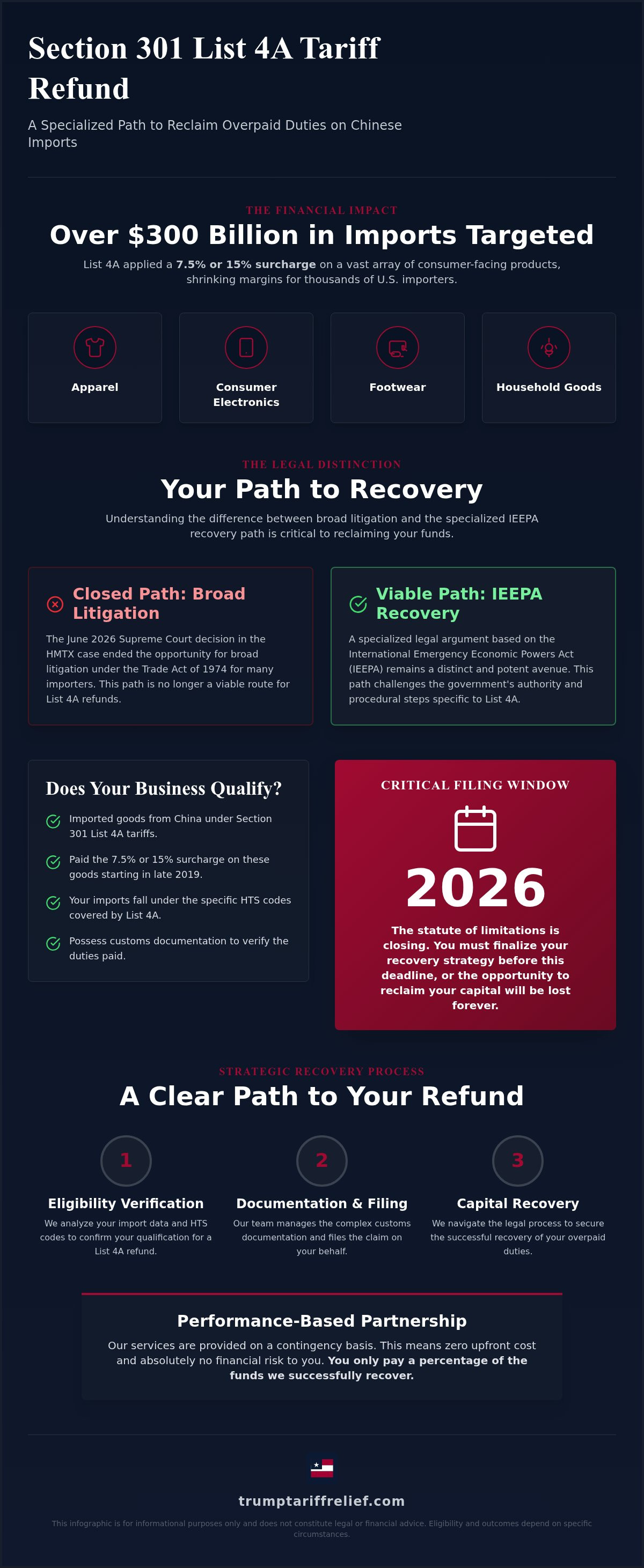
- Learn how Section 301 List 4A impacts your bottom line by targeting over $300 billion in imports like apparel and consumer electronics.
- Understand the critical legal distinction between standard duties and the specialized IEEPA recovery path used to secure a Section 301 List 4A tariff refund.
- Verify your eligibility by identifying specific HTS codes and historical filing requirements necessary for a successful claim.
- Master the documentation and filing lifecycle to navigate strict 2026 deadlines before your window for recovery closes forever.
- Explore a high-performing partnership that manages complex customs documentation on a contingency basis, ensuring you only pay for results.
What is the Section 301 List 4A Tariff Refund Opportunity?
The Section 301 List 4A tariff refund opportunity is a direct response to what many trade experts call executive overreach. This specific tranche of tariffs targeted approximately $300 billion in Chinese imports, representing a massive expansion of the trade war that began in 2018. While previous lists focused on industrial components and raw materials, List 4A hit the heart of the U.S. economy. It applied duties to a vast array of consumer-facing products, including consumer electronics, apparel, footwear, and household goods. If your business imported these items from China starting in late 2019, you likely paid a 7.5% or 15% surcharge that is now at the center of a high-stakes legal recovery effort.
The core argument for reclaiming these funds is straightforward: the U.S. government exceeded its statutory authority. When the U.S. Trade Representative (USTR) implemented List 4A, it relied on Section 301 of the Trade Act of 1974. However, legal challenges assert that the USTR failed to follow the required administrative procedures and lacked the power to indefinitely expand the scope of the tariffs without a new investigation. As we move through 2026, the window to finalize these recovery strategies is narrowing. Businesses that haven't yet verified their eligibility or documented their overpayments are running out of time to reclaim their capital before the statute of limitations renders the opportunity void.
The Distinction Between List 3 and List 4A
Timing and scope define the gap between these two major tariff tranches. List 3 hit $200 billion in goods in 2018, but List 4A was the final push that brought almost all remaining Chinese imports into the tariff net. List 4A represents the final major expansion of Section 301 duties enacted in 2019. Because the USTR justified List 4A using different administrative reasoning than the initial lists, your legal recovery must be tailored specifically to these later filings. You can't rely on a one-size-fits-all approach; the specific dates your goods entered the country and the HTS codes used will dictate your path to a successful Section 301 List 4A tariff refund.
Why This Refund Opportunity Is Legitimate
Many CFOs and logistics managers initially dismissed these claims as too good to be true. The reality is that this is a sophisticated legal process validated by the Court of International Trade (CIT). Thousands of American companies have joined the litigation, arguing that the government's procedural missteps created an unlawful financial burden on U.S. importers. This isn't a loophole or a scam; it's a pursuit of justice through the federal court system. If your company paid these duties, you have a right to seek restoration of those funds. For a deeper look at the legal foundations, you can explore the evidence here: Is the China tariff refund real?
The Legal Catalyst: IEEPA and the Supreme Court Influence
The International Emergency Economic Powers Act (IEEPA) serves as the legal backbone for many of the most aggressive trade actions in recent history. While Official USTR Section 301 Investigations initially defined the trade war landscape, the shift toward IEEPA-based authority changed the rules of engagement for every U.S. importer. This statute grants the President broad authority to regulate international commerce during a declared national emergency. However, recent legal challenges have questioned whether this power allows for the "indefinite" imposition of tariffs without specific congressional oversight. The Supreme Court's influence on administrative law has become the ultimate arbiter in determining if these emergency measures were applied within their statutory boundaries.
For businesses pursuing a Section 301 List 4A tariff refund, IEEPA represents the master key. It's the technical legal mechanism that distinguishes viable recovery paths from those that have been exhausted. While broad litigation under the Trade Act faced a significant hurdle in June 2026 when the Supreme Court declined to review the HMTX case, the specific application of IEEPA authority remains a distinct and potent avenue for recovery. This legal distinction is why some importers continue to see success while others have given up. Understanding how these statutes interact is the only way to unlock capital currently held by the government.
Understanding the IEEPA Ruling for Importers
The timing of the List 4A imposition is the central pillar of the IEEPA legal challenge. Legal experts argue the executive branch missed the statutory window for modification, making the duties void from the moment they were enacted. This argument suggests that the government cannot use a years-old investigation to justify new, unrelated tariffs on consumer goods. This ruling doesn't just impact your past payments; it creates a framework for how future trade emergencies must be handled. You can find a deeper breakdown of these specific mechanics at IEEPA Explained.
The Role of the Court of International Trade (CIT)
The Court of International Trade (CIT) is the primary venue for these multi-billion dollar disputes because it possesses specialized expertise in trade law. It's where thousands of individual lawsuits were consolidated to challenge the USTR's authority. The CIT ruling established the framework for thousands of individual importer claims. As we move through 2026, the status of current litigation continues to evolve, providing a narrow window for businesses to file their claims. If your company has been sitting on the sidelines, you should assess your eligibility now to ensure you're positioned for a recovery before the statute of limitations expires.
Eligibility and Verification: Does Your Business Qualify?
Determining your eligibility for a Section 301 List 4A tariff refund requires a rigorous look at your historical import data. If your business acted as the Importer of Record (IOR) for goods originating from China between September 2019 and the present, you likely have capital waiting to be reclaimed. The primary criteria for qualification focus on U.S.-based importers who paid duties on the specific HTS codes defined in the 4A tranche. Unlike earlier rounds of tariffs, List 4A was designed to hit consumer goods directly, which is why the retail, technology, and manufacturing sectors are the most frequent beneficiaries of these recovery efforts.
Success in this arena often hinges on procedural history. To qualify for a refund in 2026, your business typically needs to have filed administrative protests or participated in the original litigation groups that challenged the USTR’s authority. If you didn't take these steps, your path to recovery may be more complex, but it's not necessarily closed. Identifying List 4A items within your historical data is the first step in building a winning case. Our team sifts through years of entry summaries to isolate every eligible transaction, ensuring that no overpayment is left on the table.
The Importance of HTS Code Accuracy
Precision is your greatest asset during a Tariff Refund Assessment: A Guide to IEEPA Eligibility. How slight variations in Harmonized Tariff Schedule (HTS) codes determine eligibility cannot be overstated. A product classified under one code might be exempt, while a nearly identical item under a different code carries the full List 4A burden. Misclassification is a common pitfall that can lead to missed opportunities or, worse, audits that complicate your recovery potential. We verify each code against the official List 4A annexes to guarantee your claim stands up to government scrutiny.
Verifying Your Potential Recovery Amount
Calculating your total duty paid under List 4A from 2019 to the present involves more than just adding up line items; it's a comprehensive financial reconstruction. You've also got to account for the impact of interest, which the government is required to pay on successfully reclaimed duties. In many cases, the interest alone can add a significant percentage to the final refund amount. Because of these complexities, a professional audit is necessary to capture every eligible dollar. We use specialized software to cross-reference your entry data with current CIT rulings, providing you with a clear, risk-free view of your total recovery potential.
Navigating the Claim Process and Critical 2026 Deadlines
The recovery lifecycle is a methodical progression from initial discovery to final settlement. It begins with a comprehensive assessment of your historical entry data to identify every eligible transaction. Once the scope is defined, the process shifts to documentation and filing, where precision is the only defense against government rejection. Waiting until a final court mandate is issued for the Section 301 List 4A tariff refund is a strategic error that could cost your business millions. The government typically requires these claims to be active and filed before specific legal windows close, meaning those who hesitate often find themselves barred from recovery despite having a valid claim.
The complexity of Customs and Border Protection (CBP) requirements cannot be overstated. CBP documentation is notoriously rigid; even a minor clerical error can result in a denied claim. The Statute of Limitations plays a critical role here. It acts as an absolute barrier to recovery. If your entries aren't protested or filed within the statutory timeframe, the duty payments become final and unrecoverable. You're essentially leaving your own capital in the government's coffers with no further legal recourse.
Essential Documentation for a Successful Claim
A successful recovery depends entirely on the strength of your paper trail. You must provide a clear link between the goods imported and the duties paid. A standard checklist for this process includes entry summaries (CBP Form 7501), commercial invoices, and packing lists that verify the HTS code used at the time of entry. If you find your historical records are incomplete, don't assume your claim is dead. We can often reconstruct necessary data through the Automated Commercial Environment (ACE) portal. For a full breakdown of what you'll need, refer to our Required Documents for IEEPA Tariff Refund Checklist.
The 2026 Filing Window
The 2026 calendar is punctuated by several hard deadlines, including the November 9, 2026, expiration of many product-specific exclusions, that will define the success of your Section 301 List 4A tariff refund strategy. The clock is ticking. It's vital to understand the difference between protesting a new entry and reclaiming a past one through the IEEPA framework. Protests must be filed within 180 days of liquidation, while other recovery paths have different triggers based on the court's timeline. You can view the specific cut-off dates in our guide on Tariff Refund Statute of Limitations: Critical Deadlines.
Don't leave your capital in the government's hands while the window for action remains open. You should request your preliminary assessment today to secure your place in the recovery queue.
Strategic Recovery with Trump Tariff Relief
Trump Tariff Relief isn't just a service provider; we're an assertive ally for businesses that want their capital back. We specialize in IEEPA Tariff Refund Recovery, taking on the complex administrative weight so your internal teams can stay focused on core operations. While traditional firms might offer generic consulting, our approach is built on specialized insider knowledge of trade law and a direct, no-nonsense path through government bureaucracy. By handling the entire Customs Documentation Management process, we eliminate the friction that often prevents importers from pursuing their Section 301 List 4A tariff refund. We're the active engine in this process, ensuring that the burden of proof and filing rests entirely on our shoulders.
Our partnership model is designed for high-performance results. We understand that your business has already been penalized by these duties, so we don't believe you should take on more risk to get your money back. We've structured our services to be as low-friction as possible, providing a streamlined path toward financial restoration. If your company is tired of watching millions in capital sit in government accounts, we're the partner that takes on the heavy lifting to bring it home.
The Contingency-Fee Advantage
Most legal avenues for tariff recovery are bogged down by billable hours and upfront retainers that eat into your potential returns before you've even seen a dime. We've removed these financial barriers. Our contingency-fee model ensures that our incentives are perfectly aligned with your business's financial restoration. If we don't secure your refund, you don't owe us a fee. This structure makes us the preferred choice for risk-averse CFOs who need to see a clear, high-reward outcome without the risk of sunk legal costs. We only succeed when you get your money back, which motivates us to move quickly and accurately through every filing.
Getting Started: Your Preliminary Assessment
Initiating your recovery doesn't require a massive internal project or weeks of preparation. It starts with a simple, free Tariff Eligibility Assessment. Within the first 30 days of our engagement, we conduct a deep-dive audit of your historical ACE data to pinpoint every overpaid entry. We provide a transparent, data-driven report of your total recovery potential, allowing you to make an informed decision without any initial investment. You don't have to guess whether you qualify; we'll give you the facts. You can see the full breakdown of how we secure your Section 301 List 4A tariff refund at How it Works.
Take Decisive Action on Your Overpaid Duties
Reclaiming your capital from the U.S. government isn't just a financial strategy; it's about restoring the balance your business deserves. We've explored how the IEEPA mechanism remains a powerful tool for those who acted early and why the 2026 deadlines make immediate filing a necessity. Whether you're in retail, tech, or manufacturing, the window to secure a Section 301 List 4A tariff refund is rapidly closing. You don't have to navigate these complex government filings alone.
Our expert trade and legal team manages the entire documentation and recovery process with zero upfront costs for your business. Because we operate on a contingency basis, you only pay when we successfully recover your funds. This is a low-risk, high-reward partnership designed to return your capital without adding to your administrative burden. Your business has already paid the price for these tariffs; it's time to bring that money back home.
Secure Your Section 301 List 4A Refund Assessment Today
Frequently Asked Questions
Is the Section 301 List 4A tariff refund real or a scam?
The Section 301 List 4A tariff refund is a legitimate legal opportunity rooted in federal court challenges against the U.S. Trade Representative's authority. Thousands of American companies have filed claims through the Court of International Trade, arguing that the government failed to follow administrative procedures when expanding the trade war to consumer goods. This isn't a loophole; it's a pursuit of financial restoration through the U.S. legal system.
Can I still file for a refund if I didn’t join the original lawsuit?
You can still potentially secure a recovery even if you weren't part of the initial 3,500 lawsuits filed in previous years. While the primary Section 301 litigation reached a conclusion in mid-2026, specialized IEEPA recovery paths and timely administrative protests remain viable for many importers. Success depends on the specific HTS codes and entry dates of your goods, making a professional eligibility assessment essential to identify your remaining legal avenues.
What is the deadline for filing a List 4A refund claim in 2026?
Deadlines vary based on the status of your specific entries, but the most critical window for 2026 involves the 180-day protest period following the liquidation of an entry. Additionally, product-specific exclusions are set to expire at 11:59 p.m. ET on November 9, 2026. Because the statute of limitations is an absolute barrier, you must act before these individual clocks run out to avoid losing your right to recovery.
How much does it cost to hire a tariff recovery consultant?
Hiring a specialized recovery partner like Trump Tariff Relief involves zero upfront costs for your business. We operate on a contingency-fee model, which means our compensation is tied directly to the successful recovery of your overpaid duties. If we don't secure a refund for you, you don't pay a fee. This structure aligns our incentives with your financial success and eliminates the risk of billable legal hours.
What specific products were included in Section 301 List 4A?
Section 301 List 4A targeted approximately $300 billion in Chinese imports, focusing heavily on consumer-facing sectors. Impacted products include apparel, footwear, consumer electronics, household appliances, and various plastic goods. If your company imported these items starting in late 2019, your entries were likely hit with a 7.5% or 15% duty surcharge that is now eligible for a Section 301 List 4A tariff refund claim.
How long does the government take to process tariff refund checks?
Processing times for tariff refund checks fluctuate based on the volume of claims and the specific stage of the legal mandate. Once a court order is finalized and CBP receives the directive, it can take several months for the treasury to issue payments. We manage the entire follow-up process with government agencies to ensure your settlement is processed as efficiently as the bureaucracy allows.
Do I need to change my current customs broker to claim a refund?
You don't need to change your current customs broker or disrupt your ongoing logistics operations to pursue a refund. Our recovery services function independently of your daily brokerage activities. We work alongside your existing data and documentation to reconstruct historical entries and file the necessary legal claims, allowing your team to maintain their current workflows while we handle the specialized recovery efforts.
What happens if my documentation is incomplete?
Incomplete documentation isn't necessarily a deal-breaker for your claim. While entry summaries and commercial invoices are preferred, we can often reconstruct missing historical records using data from the Automated Commercial Environment (ACE) portal. Our team specializes in Customs Documentation Management, meaning we take on the heavy lifting of gathering and verifying the data required to build a compliant and successful filing.
Ready to find out what your business may be owed?
Check My Eligibility