
What if the only thing standing between your business and a substantial tariff refund isn't a lack of eligibility, but a single technical error or an overlooked 180-day deadline? You've likely spent months navigating the complex bureaucracy of trade regulations, only to feel the sting of a summary rejection. It's frustrating to watch your capital sit in government accounts while you wrestle with a system that often feels designed to favor the house. Understanding the common reasons for Section 301 claim denial is the first step toward reclaiming what belongs to your company and righting a financial wrong.
This guide identifies the critical documentation gaps and procedural tripwires that trigger these denials, giving you the tools to bulletproof your recovery strategy. We'll examine the specific technical errors that sink most claims and outline a low-risk path to securing your 2026 refunds. You'll gain a clear blueprint for navigating the current landscape, including the strict timelines for protests and the evolving requirements for Brazil and China imports. By mastering these details, you can transform a denied claim into a successful recovery before the next regulatory window closes.
Key Takeaways
- Identify the most common reasons for Section 301 claim denial, focusing on technical mismatches between HTS codes and product descriptions that trigger immediate rejections.
- Master the strict 180-day administrative protest window to ensure your submission isn't disqualified by the statute of limitations.
- Learn how to perform a rigorous audit of your CBP Form 7501 to catch clerical errors before they jeopardize your capital recovery.
- Distinguish between standard CBP protest deadlines and the specific litigation windows for IEEPA claims to protect your long-term refund eligibility.
- Discover how a contingency-based recovery model removes the financial risk from the filing process while leveraging expert trade knowledge to secure your refund.
Why Section 301 Tariff Refund Claims Face Denial in 2026
A Section 301 denial occurs when U.S. Customs and Border Protection (CBP) formally rejects an importer's administrative protest or refund request for duties paid on Chinese goods. While the term sounds like a final judgment on your product's eligibility, it is often a rejection of your paperwork rather than your legal right to a refund. The financial stakes are staggering. Thousands of American importers lose millions of dollars in recoverable capital every year because of simple clerical errors or missed procedural windows. In 2026, this issue has reached a boiling point as the U.S. Trade Representative (USTR) conducts its second four-year review of Section 301 of the Trade Act of 1974, creating a high-pressure environment where even minor mistakes lead to immediate claim forfeiture.
Understanding the distinction between being truly ineligible and being denied for a technicality is vital for your bottom line. An ineligible claim means your goods were never subject to the exclusions or legal challenges in the first place. A denial, however, often means you had a winning case but tripped over a bureaucratic hurdle. Identifying the common reasons for Section 301 claim denial allows you to audit your current filings and prevent your capital from being permanently absorbed into the federal treasury.
The Role of U.S. Customs and Border Protection (CBP)
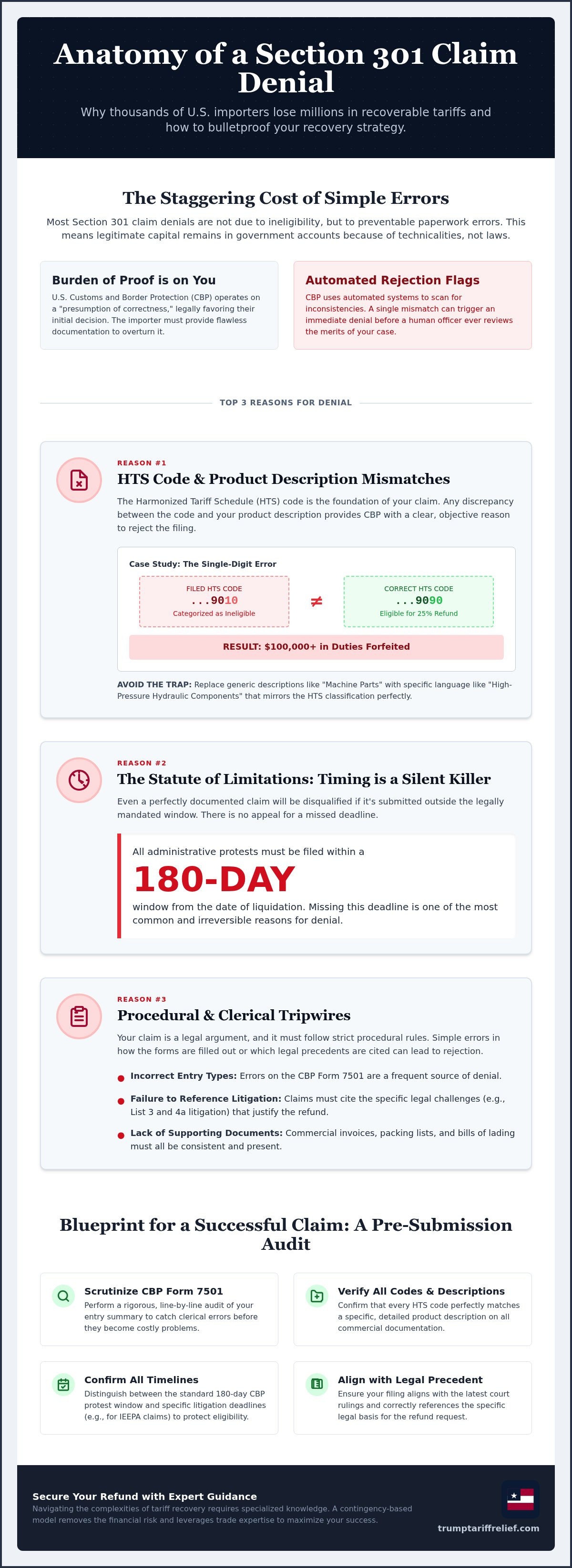
CBP serves as the primary gatekeeper for all refund requests. When you file a protest, you are operating under a "presumption of correctness," which legally favors the government's initial decision. This means the burden of proof rests entirely on the importer to demonstrate that the original duty payment was an error. CBP utilizes automated flags to scan entry summaries for inconsistencies. If your filing triggers an automated mismatch, your claim can be rejected before a human officer even reviews the merits of your case. Accuracy is not just a preference; it is the only way to bypass these digital filters.
Eligibility vs. Procedural Errors
Most refund rejections are not actually about the product's physical characteristics. Instead, they stem from "procedural tripwires" such as incorrect entry types or failing to reference the specific litigation that justifies the refund. For instance, the ongoing List 3 and List 4a litigation continues to influence how claims are processed in 2026. If your documentation does not align with the latest legal precedents, CBP will likely issue a denial. You can find more detail on how these legal frameworks interact with your recovery efforts by reviewing our guide on IEEPA Explained. Mastering the procedural side ensures that your eligibility actually translates into a deposited check.
Technical Reason #1: HTS Code and Product Description Mismatches
The Harmonized Tariff Schedule (HTS) is the absolute foundation of every trade recovery effort. If your HTS code is incorrect, your entire claim is built on sand. In many cases, misclassification serves as the primary weapon for claim denial because it provides U.S. Customs and Border Protection (CBP) with a clear, objective reason to reject a filing. According to a Congressional Research Service analysis of Section 301, the complexity of the exclusion process often leads to these technical errors, which remain among the most common reasons for Section 301 claim denial in 2026.
The financial consequences of a minor clerical slip are severe. Consider a case study where an importer of specialized industrial valves used an HTS code ending in '10' instead of '90.' While the products were functionally similar, the '10' suffix placed them in a category ineligible for the 25% refund. This single-digit discrepancy resulted in a denial of over $100,000 in recoverable duties. CBP officers are trained to look for these mismatches; they aren't looking for reasons to grant your refund, they're looking for reasons to protect the government's revenue.
The Specificity Trap in Product Descriptions
Your commercial invoice and packing list must perfectly mirror the HTS classification. Generic descriptions are dangerous. If you label a shipment as "Machine Parts" but your HTS code specifies "High-Pressure Hydraulic Components," CBP will flag the entry for inconsistency. You should avoid 'basket' categories, which are descriptions ending in "Other," whenever possible. These general classifications invite extra scrutiny and often trigger automated rejections. Every claim must be verified at the 10-digit HTS level to ensure your technical specs align with regulatory requirements.
Inconsistent Classification History
CBP keeps an exhaustive record of your historical entries. If you imported the same product under one HTS code in 2024 and switched to a different code for a 2026 refund claim, you've created a red flag. CBP uses this past data to invalidate current claims by arguing that the importer is "rate shopping" rather than correcting an error. You must reconcile your historical data and provide a logical, documented reason for any classification changes before filing. A thorough eligibility assessment can help align your history with current recovery standards.
The Statute of Limitations: Why Timing is the Silent Killer
Eligibility is only half the battle. You can have a perfect case for recovery, yet still face a total loss of your capital if you ignore the calendar. The clock is the most ruthless adversary in trade law, and missing a deadline is one of the most common reasons for Section 301 claim denial. Many importers mistakenly believe that as long as the underlying litigation is active, their rights are protected. This is a dangerous assumption. In the eyes of U.S. Customs and Border Protection (CBP), your right to a refund is tied to specific, non-negotiable windows that begin the moment your goods enter the country.
In 2026, the pressure to act has intensified. As older entries reach their finality and new tariff structures take hold, the window for correcting past errors is closing fast. If you don't file within the prescribed timeframe, your duties are permanently forfeited to the government, regardless of how much you were overcharged. Timing isn't just a procedural detail; it's the difference between a successful recovery and a permanent financial loss.
Liquidation and the Protest Deadline
Liquidation is the "final accounting" of an import entry. It's the moment CBP decides the final amount of duties owed. Once an entry liquidates, you have a strict 180-day window to file an administrative protest under 19 U.S.C. § 1514. If you miss this 180-day rule, the liquidation becomes final and conclusive. Waiting for a "better time" or a more favorable political climate often leads to a permanent loss of rights. You can review the CBP Section 301 Guidelines to understand how these deadlines apply to specific entry types. Accuracy in tracking these dates is your only defense against an "untimely" denial.
IEEPA Litigation: A Different Timeline
There is a critical distinction between a standard CBP protest and recovery through litigation. Some importers who faced a Section 301 denial because they missed an administrative window may still have a path forward through IEEPA challenges. A previous Supreme Court context changed the landscape for certain List 3 and List 4a imports, allowing for recovery even when traditional protest routes were blocked. However, these opportunities also carry their own 2026 filing deadlines. You must check your entry dates against these specific litigation windows to ensure you aren't leaving money on the table. Understanding these IEEPA litigation nuances is essential for any business seeking to maximize its refund potential.
Checklist: How to Audit Your Documentation for Refund Success
If it isn't in the paperwork, it didn't happen. This is the "Golden Rule" of trade recovery, and ignoring it is one of the most common reasons for Section 301 claim denial. U.S. Customs and Border Protection (CBP) does not operate on intent or verbal agreements; they operate on a rigid trail of evidence. In 2026, the scrutiny on documentation has never been higher. A single missing signature or a blurred scan can provide the administrative grounds for a total claim rejection. Your goal is to build a "bulletproof" file that leaves no room for government interpretation.
The foundation of your audit is the CBP Form 7501, also known as the Entry Summary. This document serves as the official record of your import and the basis for all duty calculations. You must ensure that every data point on this form aligns perfectly with your secondary evidence. Discrepancies between the 7501 and your commercial invoices are red flags that trigger automated rejections. To prepare effectively, review our Required Documents for IEEPA Tariff Refund to ensure your internal files meet the 2026 standards.
The Essential Document Audit
Successful recovery requires more than just an invoice. You must provide definitive proof of duty payment. CBP officers often deny claims because the importer provided an invoice showing the amount owed, but failed to include the ACH confirmation or bank record showing the amount was actually remitted. Additionally, you should include technical specifications and high-resolution images of your products. Visual proof helps confirm that your goods match the HTS classification you're claiming, especially if you're seeking an exclusion that was previously granted to a specific product type.
Verifying Importer of Record (IOR) Details
Clerical errors in your Importer of Record (IOR) information are low-hanging fruit for CBP rejections. You must verify that your Employer Identification Number (EIN) or IOR number is consistent across all filings. If your company has undergone a merger, name change, or restructuring since the duties were originally paid, the claimant name must still logically connect to the entity that paid the duties. Correcting these administrative "tripwires" before you file is the only way to prevent a summary denial. If you're unsure about your documentation's integrity, our team can provide expert customs documentation management to secure your recovery path.
Overcoming Denial Risk with Trump Tariff Relief
The complexity of trade law means that even the most diligent internal teams can fall victim to the procedural traps discussed in this guide. Professional management is the only definitive way to eliminate the common reasons for Section 301 claim denial. While your staff focuses on core operations, our specialized trade experts conduct the deep forensic audits required to satisfy U.S. Customs and Border Protection. We don't just file paperwork; we build a comprehensive legal and technical narrative that justifies your recovery. By removing the element of human error from the equation, we transform a high-risk bureaucratic gamble into a streamlined financial win.
Our firm specializes in high-volume, complex Section 301 and IEEPA claims that other consultants often overlook. We understand that your capital has been tied up in tariffs for years, and our mission is to restore that liquidity with zero risk to your current budget. We take on the heavy lifting of bureaucracy, ensuring that every HTS code is verified and every proof of payment is cross-referenced against federal records. This level of precision is why businesses trust us to handle their most significant trade recovery opportunities. We act as your powerful ally, navigating the legal gravitas of trade remedies to ensure your company receives the justice and financial restoration it deserves.
Our 2026 Recovery Process
We begin every partnership with a free initial assessment to categorize your entries. This step identifies "low-risk" opportunities where the documentation is already strong and "high-risk" entries that require technical correction before filing. Once we establish eligibility, our team manages the entire documentation lifecycle. We handle the 10-digit HTS verification, audit your Entry Summaries (Form 7501), and reconcile your historical data to ensure consistency. You can learn more about how it works and how we shield your business from the administrative errors that lead to summary rejections.
Zero Upfront Cost, Maximum Advocacy
The contingency-based model is the cornerstone of our service. We only win when you recover your capital. This structure perfectly aligns our interests with yours; we are highly motivated to secure the maximum possible refund because our success is tied directly to your results. There are no upfront consulting packages or hidden fees. We provide the elite trade advocacy you need to navigate the CBP bureaucracy without adding a single dollar to your overhead. If you're ready to right a financial wrong and reclaim your overpaid duties, now is the time to act. Get your free tariff refund assessment today and let our experts secure your 2026 recovery.
Secure Your Capital Before the 2026 Deadlines Close
The window to reclaim your overpaid duties is narrow, and the path is littered with bureaucratic tripwires. You've seen how technical mismatches and missed 180-day protest windows represent the most common reasons for Section 301 claim denial. In the high-stakes environment of 2026, relying on internal guesses or outdated documentation is a risk your bottom line shouldn't have to bear. Success requires a combination of HTS precision and a deep understanding of evolving trade litigation.
We specialize in navigating these complexities through a model built on accountability. With our specialized IEEPA expertise and a strict contingency-based fee structure, we take on the heavy lifting of recovery with no upfront costs. We only win when you successfully recover your capital. Don't let clerical errors or administrative delays result in a permanent forfeiture of your funds to the government. You have the right to challenge these financial barriers and restore your company's liquidity.
Take the first step toward financial restoration and professional advocacy. Start your zero-risk tariff recovery assessment today. Your business deserves a partner that fights for every dollar you're owed.
Frequently Asked Questions
What is the most common reason for a Section 301 claim denial?
The most common reason for a Section 301 claim denial is failing to meet the strict 180-day administrative protest window after an entry liquidates. Even with a valid legal argument for eligibility, CBP will summarily reject any filing that arrives after this non-negotiable deadline. Technical mismatches between the Harmonized Tariff Schedule (HTS) code and the product description on entry documents also represent a primary cause for immediate rejections.
Can I re-file a Section 301 claim if it was already denied by CBP?
You cannot simply re-file the same administrative claim once it has been formally denied, but you can challenge the decision in court. Importers have 180 days from the date of the protest denial notice to file a civil action in the U.S. Court of International Trade. Professional management is critical during the initial filing phase to prevent these common reasons for Section 301 claim denial from occurring and forcing your business into expensive litigation.
How long do I have to protest a denied tariff refund?
Importers have exactly 180 days from the date of liquidation to file a formal administrative protest with CBP. This is a hard deadline established by 19 U.S.C. § 1514, and there are no provisions for extensions regardless of the complexity of your case. If you miss this window, the liquidation becomes final and conclusive, which effectively bars your business from recovering those specific tariff payments through standard administrative channels.
Is a Section 301 denial the same as an IEEPA denial?
No, a Section 301 denial is an administrative rejection by CBP, whereas an IEEPA denial typically relates to specific litigation windows or the lack of a timely court filing. Section 301 claims focus on HTS classification and product exclusions, while IEEPA claims challenge the underlying legal authority to impose the tariffs. Some businesses that face a Section 301 rejection can still find a path to recovery through the broader IEEPA framework.
What documents are absolutely required to avoid a denial?
To avoid a denial, you must provide a completed CBP Form 7501 (Entry Summary), detailed commercial invoices, and definitive proof of duty remittance, such as ACH confirmations or bank records. Providing technical specifications and high-resolution product images is also essential to verify your HTS classification against government standards. Without this complete evidentiary trail, CBP will likely flag your entry for insufficient documentation and issue an immediate rejection of your refund request.
Does a 'clerical error' automatically lead to a claim rejection?
Yes, simple clerical errors like a single mistyped digit in an EIN or HTS code frequently lead to automated claim rejections. CBP systems are designed to flag inconsistencies between the entry summary and supporting documents before a human officer even reviews the case. While some errors can be corrected through a Post Summary Correction (PSC) before liquidation, any mismatch found during the formal protest phase usually results in a summary denial.
How does the statute of limitations affect my 2026 refund claim?
The statute of limitations restricts your 2026 refund claim to entries that have liquidated within the last 180 days or those currently covered by active IEEPA litigation. As the USTR conducts its second four-year review of China tariffs in 2026, many older entries are reaching permanent finality. Acting quickly is the only way to protect your right to a refund before these specific legal windows close and your capital is permanently forfeited.
Should I use a consultant to avoid Section 301 denials?
Using a specialized consultant is highly recommended to navigate the bureaucracy and eliminate the technical tripwires that cause rejections. Expert management ensures your documentation is audited at the 10-digit HTS level and that all filing deadlines are strictly monitored. A contingency-based partnership provides this high-level advocacy with no upfront costs, ensuring that the team managing your claim is directly motivated to secure your capital recovery.
Ready to find out what your business may be owed?
Check My Eligibility