
The path to an IEEPA tariff refund depends on who paid the duty. Businesses that were the importer of record or the licensed customs broker that directly paid the tariffs may qualify to submit a CAPE Declaration during phase 1, so how to get money back from tariffs begins with identifying the payer on each entry.
The U.S. Supreme Court ruled on February 20, 2026, that the Administration’s IEEPA tariffs were unconstitutional and must be refunded. If your business paid these duties, getting ready to claim them means matching eligible entries to clear payment and shipment records.
This guide explains who may qualify for a tariff refund, how the federal process works, and which entry summaries and supporting documents to gather. You’ll also learn why entry status matters and how complete, accurate records can help keep a refund claim on track.
Key Takeaways
- Phase 1 eligibility depends on whether your business was the importer of record or a licensed customs broker that directly paid the IEEPA tariffs.
- Understand how to submit a CAPE Declaration through the federal portal, including why accuracy matters before filing.
- Gather entry summaries, payment evidence, and shipment records to support the entries included in a refund request.
- Determine whether entries are liquidated or unliquidated, since their status affects the available refund process and timing.
Refund eligibility for importers of record and customs brokers
On February 20, 2026, the Supreme Court of the United States ruled that the Administration’s IEEPA tariffs were unconstitutional and must be refunded. For a business, eligibility turns on the importer of record, the party responsible for the customs entry, or a licensed customs broker that directly paid the IEEPA duties. During phase 1, either may qualify if it was the importer of record or the licensed broker that paid.
Who can file and who receives funds are related but distinct. Only the importer of record or the licensed customs broker that filed the entries can submit a CAPE Declaration. CBP can issue payment to the importer of record or a Notify Party designated on CBP Form 4811, provided that recipient has U.S. bank information in its ACE Portal account. A broker’s role in preparing customs paperwork alone does not make it the refund recipient.
Are refunds available for tariffs ruled illegal or later suspended? IEEPA duties covered by the Court’s ruling may qualify. During Phase 1, entries that are suspended, extended, or under review may also be included in a CAPE Declaration, with validated refunds issued at liquidation.
Eligible entry summaries help identify which duties were paid and by whom. Businesses can use CBP Form 7501 alongside importer-of-record details, shipment records, invoices, and transaction records. Phase 1 covers certain unliquidated entries and certain entries within 80 days of liquidation, so entry status and timing matter. A consolidated declaration should include eligible entries supported by consistent records.
How long do U.S. tariff refunds take, and do they include interest? Valid Phase 1 CAPE entries may take 60-90 days to process. CBP includes interest, generally calculated from deposit or estimated duty payment through liquidation or reliquidation.
What should you consider when choosing help with a tariff refund claim? The importer remains central to the filing, and an accepted CAPE Declaration cannot be amended. Additional eligible entries require a new declaration. Before proceeding, clarify who will file and how any omitted entries will be addressed.
Submitting a refund request through the federal portal
U.S. Customs and Border Protection (CBP) handles federal customs duty refunds. Eligible IEEPA duty refund requests use CBP’s CAPE refund portal. The eligible importer of record or a licensed customs broker submits a CAPE Declaration through the federal system. A retailer or consumer who did not file the entries cannot submit one on the importer’s behalf.
Before filing, organize the entries you intend to include and the records that support them. Keep entry identifiers, duty-payment information, invoices, and shipment documents together so each entry can be matched to evidence. The request should identify the correct filer and eligible entries. Reconcile records before submitting to reduce the risk of mismatches complicating review.
CBP began issuing all refunds electronically by ACH on February 6, 2026, subject to limited exceptions. The recipient needs U.S. bank information in its ACE Portal account. CBP does not charge fees to process tariff refunds. Use the federal process for the refund request, and keep the filing record and supporting documents available for follow-up.
A retail price increase does not create a direct consumer claim against CBP. Consumers cannot obtain IEEPA tariff refunds directly from the agency. A business that receives a refund is not legally required to pass it on to shoppers; any repayment to consumers depends on whether the business or carrier chooses to provide one. A higher checkout price alone does not make a shopper the importer of record.
For businesses, the key questions are who paid the IEEPA duties and who is authorized to file. The International Emergency Economic Powers Act (IEEPA) refund process applies to eligible customs entries, not every downstream price increase. Keep records connecting the payment, entry, and filer, then submit a CAPE Declaration through the federal portal. Understanding the IEEPA refund filing process can help clarify how these details fit together.
Entry summaries and proof of duty payments
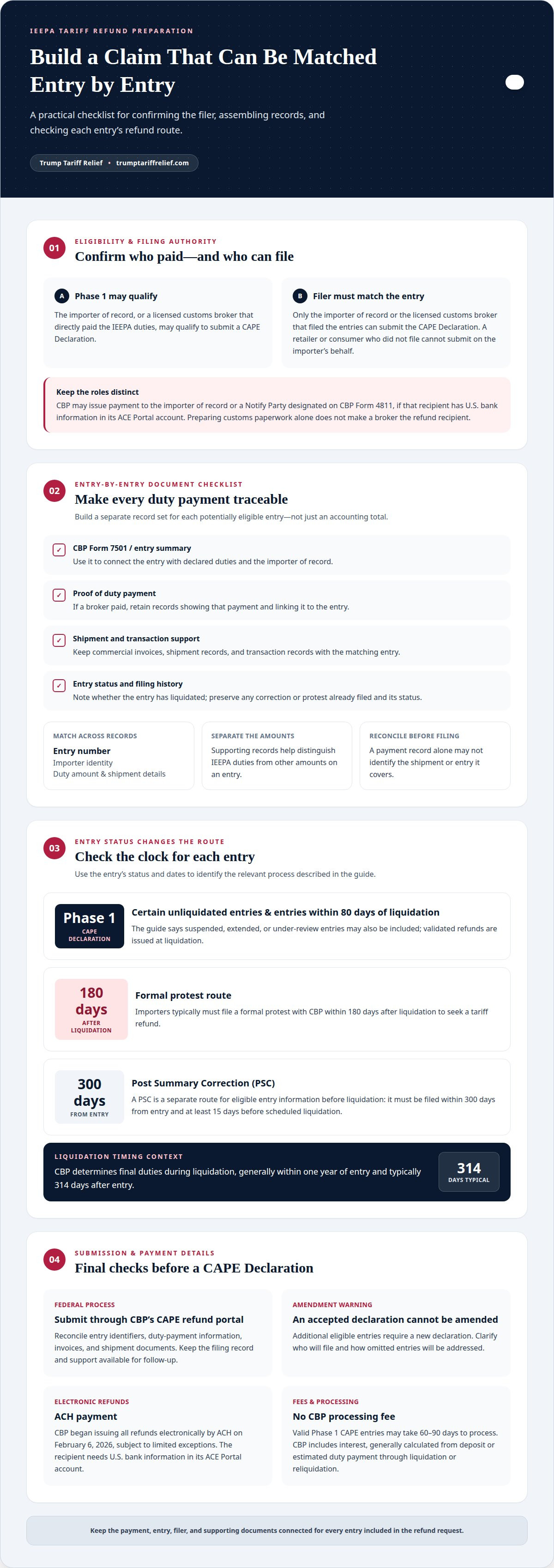
CBP Form 7501, the entry summary, connects an imported shipment with its declared duties and importer of record. For a refund review, match each potentially eligible entry to its summary and payment record. The entry number, importer identity, duty amount, and shipment details should align across the documents. If a broker paid the duties, retain the records showing that payment and its connection to the entry.
Build a record set for each entry instead of relying on an accounting total. Useful supporting documents include commercial invoices, shipment records, transaction records, and evidence of duty payment. These records help distinguish IEEPA duties from other amounts on an entry. A payment record alone may not identify the shipment or entry it covers; the entry summary provides that connection.
Liquidation changes the timing and route for a refund claim. CBP determines final duties during liquidation, generally within one year of entry and typically 314 days after entry. Importers typically must file a formal protest with CBP within 180 days after liquidation to seek a tariff refund, according to U.S. Customs and Border Protection. Track liquidation dates against each entry so a protest deadline is not confused with the date goods arrived.
A Post Summary Correction is a separate route for eligible entry information before liquidation. It must be filed within 300 days from entry and at least 15 days before scheduled liquidation. That deadline makes entry status essential: an entry nearing liquidation may require a different action from one already liquidated.
Organize records so each portal submission can be traced to source documents. Keep the Form 7501 with the matching invoice, shipment record, and proof of payment, and note whether the entry has liquidated. If a correction or protest has already been filed, preserve that filing and its status. This record trail helps show who paid, what duties were assessed, and which entries support the requested refund.
Liquidated and unliquidated entries
Liquidation is CBP’s final determination of duties on an entry; an unliquidated entry has not reached that point. This status matters because Phase 1 of the IEEPA refund process covers certain unliquidated entries and certain entries within 80 days of liquidation. U.S. Customs and Border Protection launched Phase 1 on April 20, 2026.
For an unliquidated entry, the next action depends on its status and whether it falls within Phase 1. Entries that are suspended, extended, or under review may be included in a CAPE Declaration. If validated, their refunds are issued at liquidation. Include the entry’s identifying details and keep its status aligned with the declaration.
Liquidated entries require a different assessment. The Phase 1 window includes certain entries within 80 days of liquidation, so the liquidation date can determine whether an entry fits. Do not treat every liquidated entry as eligible for the same portal process. Separate entries by status and liquidation timing before preparing a filing.
The scale of the national review underscores why entry-level sorting matters. About 20.1 million U.S. import entries remained unliquidated as of March 4, 2026. The Supreme Court ruling on tariffs imposed under the International Emergency Economic Powers Act changed the basis for seeking refunds, but each entry still has its own processing status and record trail.
CBP does not email CAPE status updates. Filers can monitor ACE Reports or request updates from their customs broker, then match each change to the affected entry. Keep the declaration record with any subsequent liquidation action. This makes it easier to see which entries still need attention and which have progressed through the electronic refund process.
If entry status or liquidation timing is unclear, get help assessing your eligible entries before taking the next filing action.
Trump Tariff Relief
Trump Tariff Relief helps businesses assess potential IEEPA refund eligibility, organize customs records, and pursue recovery through the federal process. If you’re unsure which entries may qualify or who should file, a Tariff Eligibility Assessment reviews the relevant importer, payment, and entry details. Customs Documentation Management helps organize the records supporting a claim, while IEEPA Tariff Refund Recovery supports the refund process.
This support can be useful when entries cover multiple shipments, records are spread across systems, or liquidation status affects the next filing step. Trump Tariff Relief manages the process from eligibility assessment and documentation through government filings. Its contingency-based fee means no upfront costs: payment is only a percentage of funds successfully recovered.
If you want help assessing your entries and records, contact Trump Tariff Relief.
Turn Your Records Into a Clear Next Step
The practical answer to how to get money back from tariffs is more than submitting a request. It means deciding which entries to pursue, how the records support each claim, and what action the entry’s status calls for. A focused review can help your business turn scattered paperwork into an organized recovery effort.
Use the review to establish a reliable record trail and clarify responsibilities before further filings. Align everyone handling the entries on which documents are available and which actions have already been taken. This gives your business a stronger foundation for managing the process as individual entries move forward.
If you want support determining your next step, contact Trump Tariff Relief. A thoughtful assessment can help bring clarity to your recovery path and put your records to work.
Frequently Asked Questions
How can I prepare for a potential refund of IEEPA duties?
Start by building an entry-by-entry record that connects your business, the importer of record, and the duties paid. Separate IEEPA amounts from other duties and note each entry’s liquidation status. For an eligibility check, gather basic company information, estimated tariff fees paid, import regions, and available documents. Keep records organized so the filer can trace each claim to its supporting evidence through Trump Tariff Relief guidance.
What Documentation Should You Gather?
Gather CBP Form 7501 entry summaries, commercial invoices, transportation documents, duty statements, shipment records, and transaction records. For each entry, identify which document shows the importer and which shows payment. For example, an invoice may describe the goods, while a duty statement helps substantiate the amount paid. Keep documents grouped by entry so details can be matched during claim preparation.
What are IEEPA tariffs?
IEEPA tariffs are duties imposed under the International Emergency Economic Powers Act, a federal law cited as authority for certain tariffs on imported goods. The Supreme Court of the United States ruled on February 20, 2026, that IEEPA does not authorize the president to impose tariffs. The ruling concerns tariffs imposed under that law, not every U.S. customs duty or import charge.
When Should Businesses Expect a Refund?
Timing depends on entry status and whether the CAPE Declaration is valid and eligible for processing. Valid Phase 1 CAPE entries may take 60-90 days to process; entries that are suspended, extended, or under review are refunded at liquidation after validation. CBP sends refunds electronically by ACH, subject to limited exceptions. Filers should monitor ACE Reports for updates because CBP does not email CAPE status notices.
Who can get a refund of U.S. tariffs or import duties?
For IEEPA refunds, the importer of record is generally the party eligible to receive payment. A licensed customs broker may submit a CAPE Declaration if it filed the entries, but filing authority and refund recipient are distinct. CBP may pay a Notify Party named on CBP Form 4811 if that party has U.S. banking details properly established in the automated commercial environment. Consumers cannot claim directly from CBP.
How do I request a refund of tariffs paid on imported goods?
For a business asking how to get money back from tariffs, the filing route depends on the duty and entry. For eligible IEEPA duties, the authorized importer of record or licensed customs broker submits a CAPE Declaration through CBP’s federal portal. Sort entries by status, prepare supporting records, and ensure the intended recipient’s banking information is in ACE. An accepted declaration cannot be amended, so additional eligible entries require a new declaration.
Ready to find out what your business may be owed?
Check My Eligibility