
The choice in a post summary correction vs protest for refunds depends first on whether U.S. Customs and Border Protection (CBP) has liquidated the entry. Before liquidation, an eligible importer may generally file a post-summary correction within 300 days of the initial filing or at least 15 days before scheduled liquidation, whichever limit comes first. After liquidation, a post-summary correction is no longer available, but an eligible protest may be filed within 180 days.
It’s easy to assume these are interchangeable ways to correct an overpayment. They aren’t: the entry’s status, the CBP decision being challenged, and the tariff involved determine which route may apply. IEEPA duty refunds follow a separate process, and CBP does not allow them to be requested through a post-summary correction.
This guide explains what a protest is, how it differs from a post-summary correction, and what the deadlines mean for older entries. It also explains where IEEPA refund claims fit, so you can identify the relevant process before a filing window closes.
Key Takeaways
- Use the entry’s liquidation status to identify whether a pre-liquidation correction or a protest may be the relevant route.
- Older overpayments can still have a path to recovery, but protest deadlines make the entry timeline critical.
- IEEPA tariff refunds follow a separate process, so a standard entry correction may not be the right filing.
- A focused eligibility and documentation review can help match the claim to the appropriate recovery route.
What are the Differences between a Post Summary Correction and a Protest?
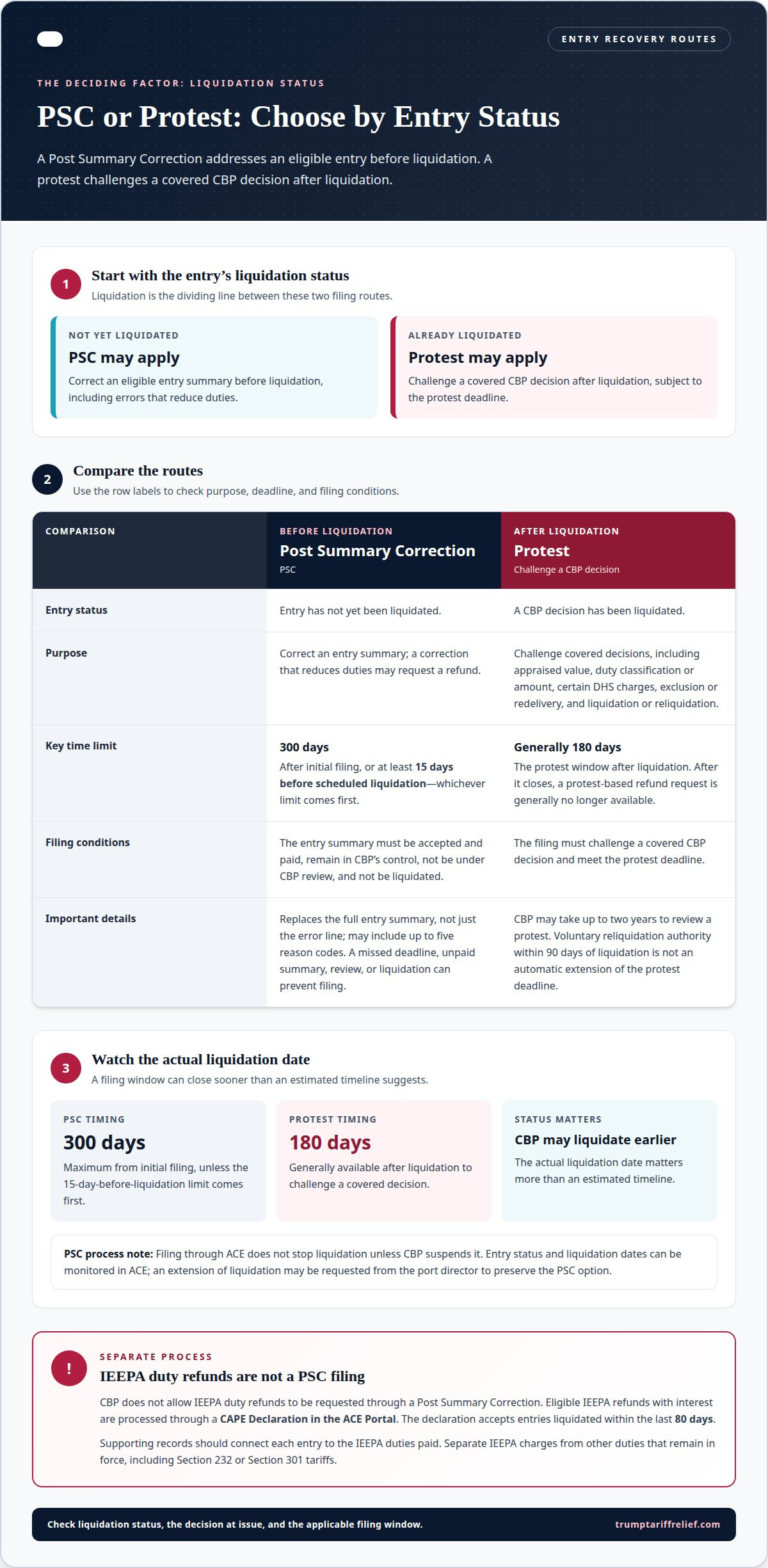
Liquidation is the dividing line. Before an entry liquidates, an eligible importer may generally submit a Post Summary Correction (PSC) within 300 days after initial filing or no later than 15 days before scheduled liquidation, whichever limit comes first. CBP may liquidate earlier than 314 days, so the actual liquidation date matters more than an estimated timeline.
A PSC corrects an entry summary before liquidation, including errors that reduce duties. A protest challenges a CBP decision after liquidation and can address appraised value, duty classification or amount, certain DHS charges, exclusion or redelivery decisions, and liquidation or reliquidation. In short, a PSC may adjust charges on an eligible unliquidated entry, while a protest can dispute covered charges or decisions after liquidation.
A PSC may be available when the entry summary has been accepted and paid, remains in CBP’s control, is not under CBP review, and has not yet been liquidated. It replaces the full entry summary, not just the line containing an error, and may include up to five reason codes. A missed deadline, an already-liquidated entry, an unpaid summary, or an entry under CBP review can prevent filing.
For an eligible entry, a professional reviews the supporting records, prepares the corrected entry summary, and submits the PSC through ACE. Filing does not stop liquidation unless CBP suspends it. Professionals monitor entry status and liquidation dates in ACE; if more time is needed, they can request an extension of liquidation from the port director to preserve the PSC option.
| Option | Entry status | Purpose | Key limit |
|---|---|---|---|
| PSC | Not liquidated | Correct an entry summary | 300 days or 15 days before scheduled liquidation, whichever comes first |
| Protest | Liquidated decision | Challenge a covered CBP decision | Generally within 180 days |
When comparing post-summary correction versus protest for refunds, consider the entry’s liquidation status, the CBP decision at issue, and whether the filing meets its timing and documentation requirements.
Can I recover overpaid duties from years ago?
The appropriate recovery route depends on liquidation status, filing history, and the reason for the overpayment. First distinguish a timely correction from a challenge to an older CBP decision.
Refunds for Overpaid Duties
For an unliquidated entry, a Post Summary Correction can request a refund if correcting the entry reduces duties. The filer reconciles the entry summary with commercial and customs records, identifies the error, and submits the corrected summary with a reason code and explanation. This route corrects an eligible entry before liquidation; it does not replace a protest after liquidation.
CBP has no fixed statutory or regulatory deadline to decide a PSC. In the usual process, ACE acceptance alone does not trigger payment; the refund follows liquidation. The entry’s status and the supporting correction therefore affect the route and timing.
Recovery After the Protest Window
Once liquidation has occurred, U.S. U.S. Customs and Border Protection says that, for entries made on or after December 18, 2004, an importer seeking a refund after liquidation has 180 days to file a protest. After that window, a protest-based refund request is generally no longer available. CBP may have authority to voluntarily reliquidate an entry within 90 days of liquidation, but this is not an automatic extension of the protest deadline.
For an older entry, review the liquidation record, classification issue, and any CBP decisions to identify another applicable route. Establishing the entry’s final status helps clarify which options remain.
Decision times differ: CBP may take up to two years to review a protest, while PSCs have no fixed adjudication deadline. Since February 6, 2026, CBP has issued refunds electronically, with payment sent to the importer’s bank account set up in ACE.
For increased duties, taxes, and fees resulting from a PSC, professionals manage payment by ACH, required effective August 5, 2026. They reconcile the corrected amounts and payment details as part of filing, reducing the risk of a mismatch between the entry and payment records.
Excess customs deposits are due for refund within 30 days of liquidation or reliquidation. A professional tracks that event and confirms the importer of record’s ACE banking setup, so a valid refund can be delivered electronically.
IEEPA tariff challenges and potential refunds
The Supreme Court issued its IEEPA tariff ruling on February 20, 2026, affecting over $130 billion in collections. These refund claims follow a separate channel from ordinary entry corrections, so identifying the tariff basis and entry status is essential.
CBP prohibits requesting IEEPA duty refunds through a Post Summary Correction, according to CSMS #68340863. Instead, CBP processes eligible IEEPA refunds with interest through a CAPE Declaration in the ACE Portal. The Declaration accepts entries liquidated within the last 80 days. A broker’s routine PSC filing is not a substitute for this process.
Before a declaration is prepared, a professional organizes records that connect each entry to the IEEPA duties paid. The package should reconcile entry summaries, importer-of-record information, tariff assessments, and payment records. Clear entry-level documentation helps distinguish IEEPA charges from other duties that remain in force, including Section 232 or Section 301 tariffs.
That distinction matters. The Supreme Court’s IEEPA ruling did not remove Section 232 or Section 301 measures. A professional therefore separates the duty types and identifies which entries relate to IEEPA tariffs, rather than treating every tariff charge as refundable. This focused review also helps resolve mismatches between customs records and internal payment data.
Liquidation status guides the next step, but standard PSC timing does not control an IEEPA refund request. For ordinary corrections, the general window is 300 days from initial filing or 15 days before scheduled liquidation, whichever comes first. For IEEPA duties, the CAPE Declaration is the designated route, and its 80-day acceptance window makes current entry status central. An accelerated protest process is separate and does not replace CAPE.
Because the filing route and documentation differ, a professional assessment can map tariff eligibility to the correct entries and assemble a consistent claim. A concise IEEPA tariff explanation can also help clarify how the ruling relates to potential refunds.
Differences between a post-summary correction and a protest
The decisive difference is what the filing asks CBP to do. A Post Summary Correction (PSC) amends an eligible entry summary before liquidation; a protest challenges a covered CBP decision after it. The PSC process is administrative, while a protest follows the legal framework in 19 U.S.C. 1514 and 19 CFR Part 174.
A PSC corrects information reported on the entry summary, such as classification or duty calculations. Because it replaces the full entry summary, the corrected filing must present the entry consistently rather than revise just one isolated line. A customs broker can submit the PSC electronically through ACE when the entry remains eligible and unliquidated.
A protest is broader in a different way: it challenges CBP’s decision on matters such as appraised value, classification, duty amount, liquidation, or certain charges. The filer must identify the decision being contested and support the claim with relevant documents. A protest may cover multiple entries when the filer, merchandise category, and common decision align.
The submission method also differs. PSCs use ACE, while a protest may be filed electronically through an authorized data interchange system or on paper using CBP Form 19. In either route, a complete record helps connect the entry, the disputed amount, and the requested correction or relief.
| Criterion | Post Summary Correction | Protest |
|---|---|---|
| Purpose | Amend an entry summary | Challenge a CBP decision |
| Timing | Before liquidation, within the applicable filing window | After a protestable decision, within its deadline |
| Submission | Electronically through ACE | Electronic filing or CBP Form 19 |
| Scope | Replaces the full entry summary | May include related entries sharing a common decision |
To choose, confirm the entry’s liquidation status first, then match the filing to the issue: amend eligible summary data through a PSC, or contest a covered CBP decision through a protest. For organized filing records, manage your customs documentation around the entry and the decision at issue.
Trump Tariff Relief: IEEPA Tariff Refund Recovery
Trump Tariff Relief helps businesses assess potential IEEPA duty claims and pursue eligible refunds. Its Tariff Eligibility Assessment reviews whether entries may qualify, and Customs Documentation Management organizes the records needed to support the claim and related filings.
For businesses with a potential claim, Trump Tariff Relief manages the recovery process from eligibility assessment and documentation through government filings. The service is contingency-based: there is no upfront cost, and payment is only a percentage of funds successfully recovered. Refund outcomes are not guaranteed.
If you want professional help assessing an IEEPA refund claim, contact Trump Tariff Relief to discuss your situation.
Turn a refund review into a stronger process
Use the decision about post summary correction vs protest for refunds as a starting point for improving how your business manages customs exposure. A focused review can reveal where classification decisions, entry data, or internal handoffs create recurring uncertainty. Addressing those process gaps can help your team make better-informed decisions on future imports, not just pursue a past recovery.
Bring the relevant records together and establish who is responsible for each part of the claim. Clear ownership helps keep the rationale, supporting documents, and filing history aligned as the matter progresses. It also gives decision-makers a clearer view of the potential recovery and the documentation needed to support it.
If you’re ready to discuss the next step, contact Trump Tariff Relief. A considered review can put your recovery effort on a clearer footing and help your business move forward with confidence.
Frequently Asked Questions
What is a Protest?
A customs protest is a formal challenge to a decision made by U.S. Customs and Border Protection (CBP). An importer can use one to dispute issues such as a duty assessment, merchandise classification, or liquidation decision. For example, if CBP liquidates an entry using a classification the importer contests, a protest asks CBP to review that decision. Supporting records should explain the issue.
What Options Do Importers of Record Have To Seek Refunds of IEEPA Tariffs?
For IEEPA duties, the designated refund route is a CAPE Declaration submitted through the ACE Portal, not a Post Summary Correction. CBP accepts CAPE entries liquidated within the last 80 days. A professional can identify entries tied to IEEPA payments, organize entry and duty records, and prepare the declaration. The importer of record information and supporting documentation should align across the claim.
Does CBP pay the refund when it accepts the PSC?
No. In the usual PSC process, ACE acceptance does not itself trigger payment; the refund follows liquidation. An accepted correction may still need to move through the entry’s liquidation cycle before a refund is issued. CBP refunds customs duties electronically, so the importer’s ACE Portal banking information is also relevant to receiving payment.
How long is the window?
The applicable window depends on the filing route and entry status. For a standard PSC, the general deadline is 300 days after initial filing or 15 days before scheduled liquidation, whichever comes first. For a protest seeking a refund after liquidation, U.S. Customs and Border Protection gives importers 180 days to file. IEEPA CAPE declarations have a separate 80-day acceptance window for liquidated entries.
What is the difference between a PSC and a protest for requesting refunds?
A PSC corrects entry-summary information before liquidation, while a protest asks CBP to reconsider a covered decision after liquidation. For example, an unliquidated entry with a documented duty-calculation error may fit a PSC; a dispute about CBP’s liquidation decision may require a protest. IEEPA duty refunds use the CAPE Declaration route, so neither standard filing should replace that process.
What are the filing deadlines for a PSC and a customs protest?
A PSC is generally due within 300 days after initial filing or at least 15 days before scheduled liquidation, whichever comes first. A refund protest after liquidation must be filed within 180 days, according to U.S. Customs and Border Protection. Because CBP may liquidate earlier than expected, the recorded liquidation status can change which deadline applies to an entry.
Ready to find out what your business may be owed?
Check My Eligibility