Who filed the customs entry can matter as much as who paid the tariff. Getting money back from tariffs may be possible for eligible IEEPA duties, but Phase 1 is limited to certain unliquidated entries and entries within 80 days of liquidation; only the Importer of Record or the licensed customs broker who filed the entries can submit a CAPE Declaration.
If your company absorbed higher import costs, it’s understandable to want a clear answer on whether a refund could help offset them. The key is to connect the right entries to the right filer and supporting records, then understand which claims fit the current process.
This guide explains how businesses may use refunds, who may be eligible, which entries may qualify during Phase 1, and the deadline that can apply to a formal protest. You’ll also see how the refund process works and what documentation helps support a claim, so you can assess the path to recovery with a clearer view of the requirements.
Key Takeaways
- Tariff refunds may help businesses offset import costs, but the benefit depends on identifying eligible duties and supporting each claim with the right records.
- Phase 1 eligibility turns on entry status and timing; the 80-day liquidation window is a key factor in determining which entries may qualify.
- Refund preparation involves more than entry summaries: importer-of-record details, shipment records, invoices, and transaction records may also support a claim.
- Timing matters beyond Phase 1: according to U.S. Customs and Border Protection, importers typically must file a formal protest within 180 days after liquidation to obtain a tariff refund.
Companies’ use of refunds to offset rising costs
- Identify the cash-flow purpose before pursuing tariff refunds. A recovered duty may help a business absorb import costs, restore working capital, or support pricing decisions—areas where financial advisory and accounting firms like True North Consulting often help businesses model balance-sheet impacts. Walmart estimated it was owed $2.4 billion in tariff refunds and suggested refunds could help reduce shopper prices. Busy Baby founder Beth Benike said the company received a $50,000 refund. These examples show how recovery can affect different business priorities.
- Separate IEEPA refund claims from drawback or duty-free programs. Can businesses recover tariffs through drawback or duty-free programs? Those are separate customs mechanisms, not the IEEPA refund process described here. A professional assesses the duties and entries involved, then identifies the appropriate route rather than treating the programs as interchangeable.
- Build an entry-level record set before filing. Professionals organize entry summaries, including CBP Form 7501, alongside Importer of Record details, shipment records, invoices, and transaction records. They match documents to the relevant entries and flag gaps that could affect claim support. This Customs Documentation Management work creates a consistent record trail for review and submission.
- Confirm filing authority and portal readiness. Only the Importer of Record or the licensed customs broker who filed the entries can submit a CAPE Declaration. A professional prepares the declaration through CAPE, the refund functionality in CBP’s ACE platform, and checks that an ACE Portal account and refund bank-account information are in place. CBP began issuing refunds electronically via ACH on February 6, 2026, subject to limited exceptions.
- Protect the claim and track its progress through authorized channels. What are the risks of tariff refund scams or unauthorized claims? An unauthorized filing can misdirect a claim or expose sensitive entry and banking information, so businesses should use an authorized filer and controlled access. Where can businesses check the status of a customs duty refund claim? Filers can review ACE Reports or ask their customs broker; CBP does not email CAPE status updates.
Eligible entries during Phase 1
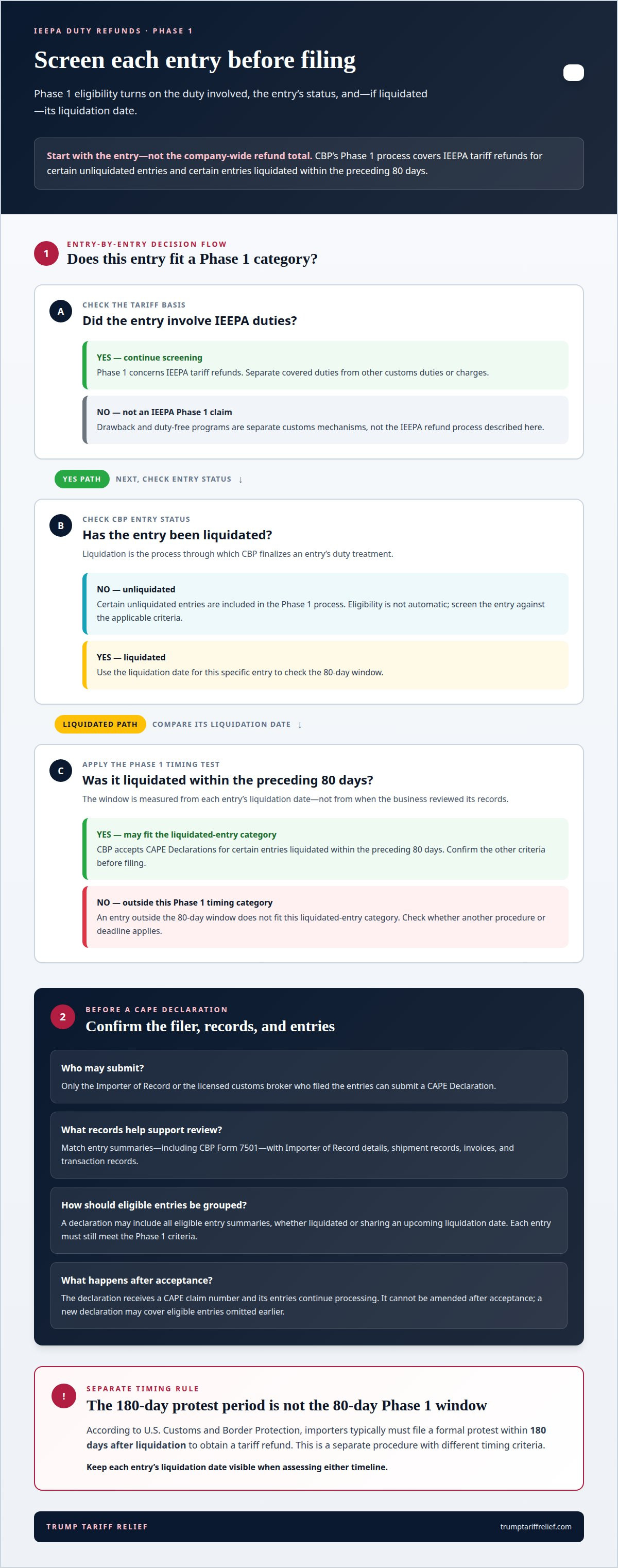
- Isolate entries that involved IEEPA duties. Phase 1 concerns IEEPA tariff refunds, not every customs duty paid by a business. For a business getting money back from tariffs, the first review separates covered duties from other charges, including amounts that may have been estimated. This classification matters because an entry’s tariff basis determines whether it belongs in a Phase 1 claim. An explanation of IEEPA tariffs can clarify the scope.
- Separate unliquidated entries from liquidated entries. CBP’s phase-one process is limited to certain unliquidated entries and certain entries within 80 days of liquidation. Liquidation is the process through which CBP finalizes an entry’s duty treatment. A professional sorts entries by status first, so the administration can assess each entry under the applicable Phase 1 category.
- Apply the 80-day window to each liquidated entry. During Phase 1, CBP accepts CAPE Declarations for entries liquidated within the preceding 80 days. The relevant point is each entry’s liquidation date, not simply the date a business first reviewed its records. A professional compares those dates against the filing window and separates entries that fall outside it.
- Group eligible entry summaries carefully. A CAPE Declaration may include all eligible entry summaries, whether they have liquidated and whether they share an upcoming liquidation date. This allows a claim to include eligible entries with different statuses or projected dates. It doesn’t make every entry eligible; each still has to meet the Phase 1 criteria.
- Check the entries and supporting records before submitting. Only the Importer of Record or the licensed customs broker who filed the entries can file a CAPE Declaration. Once accepted, the declaration receives a CAPE claim number and its entries continue processing. It cannot be amended after acceptance, so review the entries carefully before filing. A new declaration may cover eligible entries omitted from an earlier one. Careful screening helps businesses pursue getting money back from tariffs through the appropriate claim process.
What is the deadline to request a U.S. customs duty refund?
- Start with the liquidation date for each entry. Importers typically must file a formal protest with CBP within 180 days after liquidation to obtain a tariff refund, according to U.S. Customs and Border Protection. The clock is tied to liquidation, not the date your company first reviews its refund options. Organize entries by their individual liquidation dates so approaching deadlines are visible.
- Separate the protest deadline from Phase 1 timing. The formal protest period is 180 days after liquidation, while Phase 1 accepts CAPE Declarations for certain entries liquidated within the preceding 80 days. These are different procedures with different timing criteria. A professional sorts entries by status and deadline, then determines which filing route applies to each group.
- Build the protest record around each affected entry. Use its entry summary and supporting import documents to identify the liquidation being challenged and the duties involved. Keep records organized by entry rather than relying on one company-wide total. This makes it easier to connect a protest to the specific customs decision and present the relevant information for CBP’s review.
- Track the result after filing. CBP may take up to two years to review an allowed formal protest unless the importer requests accelerated disposition. If CBP denies a protest, the next procedural deadline may matter: a lawsuit must be filed within 180 days after denial, or within two years after the cause of action first accrues. Beyond administrative customs appeals, organizations navigating broader cross-border trade and commercial disagreements often engage dedicated disputes and corporate counsel like Fervent Chambers LLC to protect their interests.
- Track the timeline for each entry and filing separately. Entries liquidated on different dates may have different protest deadlines, even when they involve similar goods. Record each liquidation date, protest filing date, CBP decision, and any resulting deadline in one place. An organized timeline helps prioritize time-sensitive claims and avoid missing a procedural step.
How do tariff refunds work after a tariff is ruled unlawful or canceled?
- Identify whether the duty relates to the ruling. On February 20, 2026, the U.S. Supreme Court ruled that IEEPA does not authorize the president to impose tariffs. On March 4, 2026, the U.S. Court of International Trade directed CBP to refund IEEPA tariffs. The process concerns eligible IEEPA duties, not every customs charge paid on an import.
- Match entries to the available refund process. CBP activated Phase 1 on April 20, 2026, using CAPE, or Consolidated Administration and Processing of Entries. CAPE operates within the Automated Commercial Environment, known as ACE. The first phase covers eligible entries under its criteria; more complex claims involving finally liquidated entries remain subject to procedural uncertainty.
- Confirm who can submit the claim. Only the Importer of Record or the licensed customs broker who filed the entries can file a CAPE Declaration. In the refund system, eligible payments go to the Importer of Record or a Notify Party designated on CBP Form 4811, provided the recipient’s U.S. bank-account information is in ACE.
- Prepare for electronic payment. CBP began issuing all refunds electronically through Automated Clearing House on February 6, 2026, subject to limited exceptions. A final rule for electronic refund issuance was published on January 2, 2026. CBP generally expects valid IEEPA refunds within 60 to 90 days after accepting a CAPE Declaration, unless a compliance concern requires further review.
- Account for interest in the recovery calculation. Interest is included in eligible IEEPA duty refunds and generally runs from the deposit or estimated duty payment date to liquidation or reliquidation. The rate is 6 percent for eligible customs overpayments of $10,000 or less, and 4.5 percent for amounts exceeding $10,000.
- For help assessing entries and preparing a recovery claim, review the IEEPA refund recovery process.
Trump Tariff Relief
Trump Tariff Relief helps businesses assess potential IEEPA tariff refunds and manage the claim process. Its team can review eligibility, organize customs documentation, and manage IEEPA Tariff Refund Recovery. This support helps clarify which entries may fit the process and what records are needed for a claim.
The service operates on a contingency-fee basis: there are no upfront costs, and payment is due only if a refund is successfully recovered. If you want professional help evaluating your potential claim, contact Trump Tariff Relief.
Turn a Potential Refund Into a Clear Next Step
For companies considering getting money back from tariffs, the practical next step is to assess import records and develop a claim strategy. A useful review connects entries, filing authority, and documentation to the refund route that may apply. This gives decision-makers a clearer basis for weighing a potential recovery alongside cash-flow and pricing priorities.
Trump Tariff Relief supports this work through Tariff Eligibility Assessment, Customs Documentation Management, and IEEPA Tariff Refund Recovery. The focus is on assessing potential eligibility and managing the claim process, so your team can make decisions with a clearer understanding of its position.
If professional support would help your business assess its next move, contact Trump Tariff Relief. A well-organized claim starts with a clear view of the entries and the path ahead.
Frequently Asked Questions
How can a professional prepare your business for a potential refund of IEEPA duties?
Trump Tariff Relief reviews import history against the IEEPA refund process, screening potentially eligible entries and excluding anti-dumping duties and reconciled entries. The team organizes records, identifies whether the Importer of Record or the customs broker that filed the entries can submit, and prepares the appropriate filing. Supplied business information is kept strictly confidential and is never shared without explicit consent.
What documentation should businesses gather for a professional refund claim?
Useful records include entry summaries, commercial invoices, transportation documents, and duty statements. They connect the goods, shipment, and duties paid to the relevant entries. The eligibility check also uses basic company data, estimated tariff fees paid, import regions, and documentation availability. Reviewing records entry by entry can show which documents are missing and whether the issue is a documentation gap or an entry outside the refund criteria.
What are IEEPA tariffs?
IEEPA tariffs are import duties imposed under the International Emergency Economic Powers Act. The law was invoked as authority for certain tariffs. On February 20, 2026, the U.S. Supreme Court ruled that IEEPA does not authorize the president to impose tariffs. That decision opened a refund path for eligible IEEPA duties, but it didn’t make every tariff payment automatically refundable. Eligibility depends on the entry and claim procedure.
When Should Businesses Expect a Refund?
CBP generally expects to issue a valid IEEPA refund within 60 to 90 days after accepting a CAPE Declaration, unless a compliance concern requires further review. This timing starts after acceptance, not when a business begins collecting records or assessing eligibility. CAPE filers can follow claim status through ACE Reports or their customs broker; CBP doesn’t email status updates. Allow for review when planning cash-flow assumptions.
Who can get a refund of U.S. tariffs already paid?
Businesses that paid IEEPA duties on entries meeting refund criteria may qualify, but payment alone doesn’t establish eligibility. The Importer of Record or a Notify Party designated on CBP Form 4811 may receive payment when U.S. bank-account information is in ACE. Only the Importer of Record or licensed customs broker who filed the entries can file a CAPE Declaration. Entry status also affects Phase 1 eligibility.
How can businesses work with a professional to claim a refund for tariffs or customs duties?
For potential IEEPA refunds, Trump Tariff Relief reviews import history, assesses entries, organizes supporting records, and manages eligible refund filings. Its services include Tariff Eligibility Assessment, Customs Documentation Management, and IEEPA Tariff Refund Recovery. There is no upfront cost: payment is only a percentage of funds successfully recovered. Eligibility is assessed case by case using relevant import and documentation information, and a refund is not guaranteed.
Ready to find out what your business may be owed?
Check My Eligibility