A tariff refund for cosmetics importers isn’t automatic: eligible U.S. importers of record must submit a request through CAPE using the Automated Commercial Environment (ACE). Cosmetics shipments may qualify if they were assessed eligible IEEPA tariffs, but some entries are excluded from the initial processing phase. The importer of record, not a customer who indirectly paid the cost, submits the claim.
If you paid these duties, the key question is how your entries fit the refund process. This guide explains how to assess eligibility, prepare entry details, file through CAPE and ACE, and understand the expected payment timeline. You’ll also see why entry status and accurate customs records matter, so you can pursue a refund with a clear view of the steps ahead.
Key Takeaways
- Use the entry’s liquidation status to understand which filing options may still be available. U.S. Customs and Border Protection allows 180 days after initial liquidation to file a protest that may delay final liquidation and possibly preserve a refund claim.
- Build your claim around entry-level records: a bill of lading alone isn’t enough when submitting independently.
- Distinguish an IEEPA tariff refund from duty drawback, which may apply when goods are exported or used in products for export.
- Get support assessing eligibility and organizing customs records before moving a claim through the refund process.
Eligibility for IEEPA tariff refunds
A tariff refund for cosmetics importers depends on the tariff charged, the entry, and the business that imported the goods. Review these factors before pursuing a claim.
-
Identify eligible tariff categories
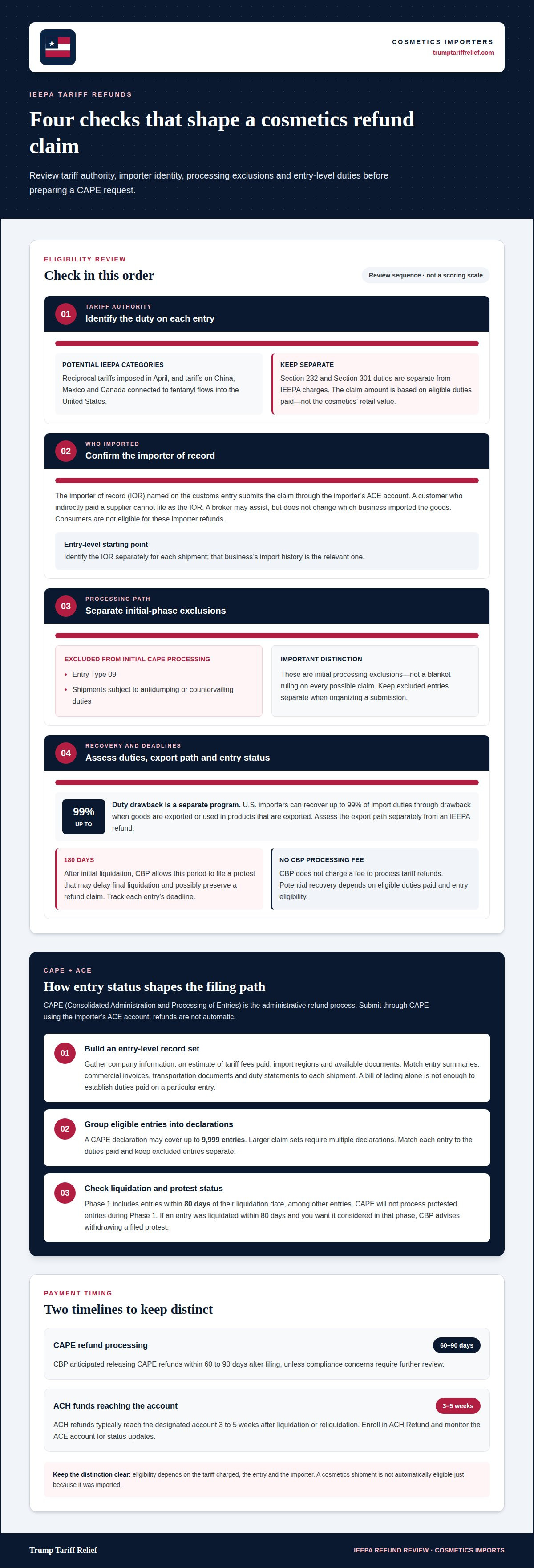
Match each entry to its tariff authority. Eligible IEEPA categories include reciprocal tariffs imposed in April and tariffs on China, Mexico, and Canada connected to fentanyl flows into the United States. Section 232 and Section 301 duties are separate from IEEPA charges. The initial CAPE phase excludes Entry Type 09 and shipments subject to antidumping or countervailing duties. These are initial processing exclusions, not a blanket ruling on every possible claim.
-
Confirm importer and broker eligibility
Identify the importer of record for each shipment. The importer of record is the business named on the customs entry and is the party whose import history matters for an IEEPA refund claim. A customer that indirectly paid a supplier cannot file as the importer of record. A customs broker may assist with customs processes, but that does not change which business imported the goods. Consumers are not eligible for these importer refunds. For a tariff refund for cosmetics importers, start with the importer named on each entry.
-
Check applicable refund programs
Separate IEEPA recovery from duty drawback. U.S. importers can recover up to 99% of import duties through drawback when goods are exported or used in products that are exported. Cosmetics may be relevant to drawback when they are exported or used in products that are exported. Drawback is distinct from an IEEPA refund, so assess the tariff basis and the goods’ export path separately.
-
Assess recoverable duties and fees
Calculate a potential claim from eligible duties paid on qualifying entries. The amount depends on the duty charged and entry eligibility, not the cosmetics’ retail value. U.S. Customs and Border Protection doesn’t charge a fee to process tariff refunds. U.S. Customs and Border Protection allows importers 180 days after initial liquidation to file a protest that may delay final liquidation and possibly preserve a tariff refund claim. Track the deadline for each entry.
Submitting refund requests through CAPE and ACE
Submit the IEEPA claim through CAPE, the administrative refund process, using the importer’s ACE account. Follow these steps to move from entry identification to payment.
- Gather the information needed for an eligibility review. Collect basic company information, an estimate of tariff fees paid, the regions your business imported from, and the documents available. Entry summaries, commercial invoices, transportation documents, and duty statements help connect the claimed duties to specific imports.
- Organize eligible entries into a CAPE declaration. CAPE, or Consolidated Administration and Processing of Entries, groups entry details for processing. A declaration may cover up to 9,999 entries; larger claim sets require multiple declarations. Match each entry to the duties paid and keep excluded entries separate, so they don’t complicate the submission.
- Account for liquidation and protest status. Phase 1 includes entries within 80 days of their liquidation date, among other entries. CAPE won’t process protested entries during Phase 1. If an entry was liquidated within 80 days and you want it considered in that phase, CBP advises withdrawing a filed protest. Review protest status before submitting, because it affects the processing path.
- Track processing and electronic payment. Refunds aren’t automatic after an entry qualifies; a request must be filed in ACE. CBP anticipated releasing CAPE refunds within 60 to 90 days after filing, unless compliance concerns require further review. ACH refunds typically reach the designated account 3 to 5 weeks after liquidation or reliquidation. Enroll in ACH Refund and monitor the ACE account for status updates.
For help coordinating records and filing steps, review the tariff refund process before preparing a CAPE submission.
What documentation is needed to request an IEEPA tariff refund?
Prevent avoidable claim problems by matching every entry to its IEEPA duties and supporting records. Missing entries, an incorrect importer of record, or a bill of lading without entry numbers can leave a submission incomplete.
- Collect entry summaries and payment records. Assemble the customs entry details for each cosmetics shipment and records showing IEEPA duties were paid. These documents help connect the amount claimed to the specific import entry, rather than relying on a product invoice or shipment description alone.
- Match documents to each entry. Organize entry summaries, commercial invoices, transportation documents, and duty statements together for each shipment. A bill of lading or product invoice alone may not establish which duties were paid on a particular entry.
- Review the entries and tariff basis. Compare your entry summaries with duty statements and other supporting records. Separate IEEPA duties from other tariff charges, and flag entries that may be excluded, including anti-dumping duties and reconciled entries. Eligibility depends on the specific import history and documentation.
- Connect the records to the Supreme Court ruling. On February 20, 2026, the U.S. Supreme Court ruled that IEEPA doesn’t authorize the President to impose tariffs. Use the tariff identification and entry records to distinguish IEEPA charges from duties imposed under other authorities. The ruling concerns IEEPA-based tariffs, not every customs duty on imported cosmetics.
- Include payment details and account for interest. Submit bank account information through the ACE portal for electronic payment, alongside the entry information supporting the request. IEEPA refunds are to include interest. Under 19 U.S.C. § 1505(c), interest on excess money deposited with CBP accrues from the deposit of estimated duties until liquidation or reliquidation. The applicable calculation follows the entry’s payment and liquidation history.
Which U.S. tariff laws or programs allow import duty refunds on cosmetics?
Check whether the potential refund relates to IEEPA duties and whether the entry meets the applicable requirements. Different tariff charges and entry circumstances can affect eligibility.
- Separate IEEPA duties from other tariff charges. Trump Tariff Relief’s refund recovery service focuses on eligible IEEPA tariff payments. Other duties, including anti-dumping duties, are not part of this recovery process. A cosmetics entry with other tariff charges does not become eligible simply because another entry may qualify.
- Keep Section 232 and Section 301 duties distinct. These tariff authorities are separate from IEEPA. A cosmetics importer should identify which duty appears on each entry before assigning it to a refund route. For example, an entry with Section 232 duties should not be represented as an IEEPA refund claim solely because the same shipment also faced an eligible IEEPA charge.
- Consider duty drawback for exported goods. U.S. importers can recover up to 99% of import duties through duty drawback when goods are exported or used in products that are exported. Exporting goods may provide a separate route for recovering import duties. The key distinction is the goods’ export disposition, not the tariff’s IEEPA status.
- Match the program to the entry and product movement. Start with the customs entry and separate IEEPA duties from other duties. Then determine whether the cosmetics remained in the United States, were exported, or were incorporated into exported products. The tariff basis guides an IEEPA claim; export use guides drawback eligibility. Keep those records and calculations separate to avoid claiming the same duty under the wrong program.
Trump Tariff Relief: IEEPA Tariff Refund Recovery
Trump Tariff Relief helps cosmetics importers assess potential IEEPA refunds and manage the recovery process. If your entries include IEEPA duties, a Tariff Eligibility Assessment can help identify which entries may qualify and where exclusions or liquidation status affect the claim.
For eligible claims, Trump Tariff Relief manages customs documentation and the refund process, including preparation and filing of the appropriate claim documents. The firm charges no upfront cost: payment is only a percentage of funds successfully recovered. No refund outcome is guaranteed, and eligibility depends on the specific import history and documentation.
Contact Trump Tariff Relief to discuss your cosmetics import entries and potential refund claim.
Turn your refund review into a clear next step
A tariff refund for cosmetics importers is more than a customs filing. It can affect cash planning, internal reporting, and how your business tracks past import costs. Give the recovery effort a clear owner, keep finance and trade teams aligned, and document decisions as the claim moves forward. That structure helps your business understand what has been submitted and what still needs attention.
Trump Tariff Relief can help assess your situation and manage the recovery work. If you’re ready to discuss your imports and potential claim, contact Trump Tariff Relief. A focused conversation can help you identify a practical path forward and take the next step with greater clarity.
Frequently Asked Questions
How exactly will the refund system work?
The importer of record submits a claim through CAPE in the ACE portal, rather than receiving an automatic refund. The declaration identifies entries with IEEPA duties and provides payment details for electronic disbursement. CBP anticipated releasing refunds within 60 to 90 days after filing, unless compliance concerns require further review. The timeline may also depend on an entry’s liquidation or reliquidation status.
Do I qualify for a refund?
Your business may qualify if it was the importer of record and paid eligible IEEPA duties on cosmetics entries. The tariff basis, entry status, and supporting documents all matter. A shipment with only other types of duties does not qualify as an IEEPA claim. For example, a retailer that bought imported cosmetics from a U.S. distributor cannot file as importer of record simply because tariff costs affected its purchase price.
Are Tariffs Refundable for US Importers in 2026?
Yes, eligible IEEPA duties already paid by U.S. importers may be claimed through the administrative process. That doesn’t make every tariff refundable. A claim must identify eligible IEEPA charges, and the importer of record submits it. Duties imposed under separate authorities, such as Section 232 or Section 301, aren’t IEEPA duties simply because they appear on the same cosmetics entry.
How can I prepare for a potential refund of IEEPA duties?
Organize import records by entry and keep them tied to the business that acted as importer of record. For example, assemble entry summaries, invoices, duty statements, and transportation documents in a consistent file structure. Confirm the company’s ACE access and electronic payment details are ready. This preparation makes it easier to reconcile entries and identify gaps before a declaration is submitted.
Can U.S. cosmetics importers get refunds for tariffs already paid?
Yes, a cosmetics importer may seek a refund for eligible IEEPA tariffs it already paid, but filing is required. A company that imported products directly and paid qualifying duties can pursue a claim as importer of record. A cosmetics brand that purchased finished goods from a domestic wholesaler generally isn’t the importer of record for those entries and cannot submit that importer’s claim.
How can importers claim refunds for tariff overpayments or incorrect HTS classifications on cosmetics?
First separate an IEEPA refund claim from a correction of an overpayment or tariff classification. CAPE claims address eligible IEEPA duties, not every HTS classification dispute. For a classification issue, the relevant route depends on whether the entry remains unliquidated or has been liquidated. A post-liquidation protest uses CBP Form 19; preserve the entry records and the basis for the classification correction.
Ready to find out what your business may be owed?
Check My Eligibility