U.S. Customs and Border Protection’s phase-one process allows businesses to qualify for an IEEPA tariff refund if they were the importer of record or the licensed customs broker who directly paid the tariffs. The Supreme Court ruled on February 20, 2026, that IEEPA does not authorize the president to impose tariffs, but eligibility depends on who paid and which entries qualify. If you’re asking, “can I get my tariff money back,” the first step is to identify the importer of record for the affected entries.
It’s reasonable to expect a refund when duties were charged on your imports, but the recovery process depends on customs records and entry status. CBP activated phase one of its CAPE process for IEEPA refunds on April 20, 2026. This guide explains who may qualify, which payment and shipment records can support a claim, and why liquidation timing matters. You’ll also see how an eligibility assessment and organized customs documentation can help clarify the next step.
Key Takeaways
- Start by identifying who was listed as the importer of record and who directly paid the IEEPA duties; that can determine who may seek a refund.
- Gather entry summaries, invoices, payment proof, and shipment records to help connect the duties paid to the affected imports.
- Track each entry’s liquidation status and deadline: according to U.S. Customs and Border Protection, importers typically need to file a formal protest within 180 days after liquidation to seek a tariff refund.
- A Tariff Eligibility Assessment and Customs Documentation Management can help organize the claim process and clarify the next recovery step.
Who can receive tariff refunds from U.S. Customs and Border Protection
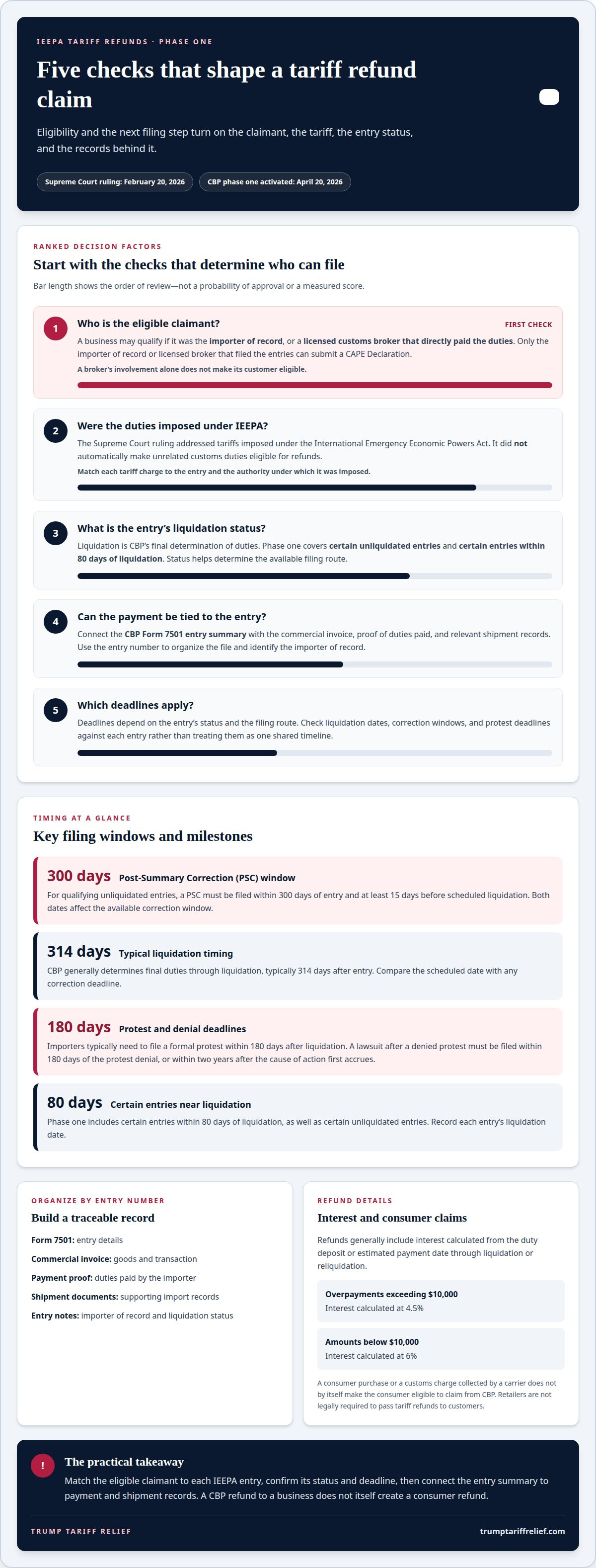
For phase-one eligibility, the key questions are who is listed as the importer of record and who directly paid the IEEPA duties. A business may qualify if it was the importer of record, or if it was a licensed customs broker that directly paid the tariffs. A broker’s involvement alone does not make the importer’s customer eligible to claim a refund.
Are tariff refunds available for goods imported through a customs broker? Yes, if the importer of record or qualifying licensed broker meets the CAPE filing requirements. Only the importer of record or licensed broker that filed the entries can submit a CAPE Declaration.
How are tariff refunds calculated, including interest? Refunds generally include interest calculated from the duty deposit or estimated payment date through liquidation or reliquidation. Interest on customs overpayments exceeding $10,000 is calculated at 4.5%; for amounts below $10,000, the rate is 6%.
- Identify the claimant. Match each entry to the importer of record and payment evidence. If a licensed broker paid the duties, establish whether it filed the entries and can submit the declaration.
- Separate consumer purchases from importer claims. FedEx or DHL may have handled customs processing or collected import charges, but that alone doesn’t make a consumer eligible to claim from CBP. The importer of record or qualifying broker remains central to the federal refund process.
- Understand the retailer’s role. Importers aren’t legally required to pass tariff refunds to customers. A retailer decides whether to share recovered costs, so a CBP refund to a business doesn’t itself create a consumer refund.
- Prepare for CAPE. CBP activated phase one on April 20, 2026. Eligible filers should be prepared to provide the information needed to receive electronic refunds. The CAPE and ACE filing process consolidates refund claims and payments.
- Allow for processing volume. As of March 4, 2026, 20.1 million entries remained unliquidated. Entry status and accurate claimant records therefore matter when a claim moves through review.
Entry summaries, invoices, and proof of tariff payments
- Match each entry to its payment evidence. Pair the CBP Form 7501 entry summary with the commercial invoice and proof of duties paid. The summary identifies the entry details; the invoice connects the goods to the transaction. Payment records help show that the importer paid IEEPA duties, rather than relying on an estimate or an unrelated charge.
- Organize records by entry number. Keep each Form 7501 with its invoice, payment confirmation, and relevant shipment documents. Use the entry number to connect those records, then note the importer of record and the entry’s liquidation status. A clear file makes discrepancies between declared goods, assessed duties, and payments easier to identify.
- Review eligible unliquidated entries for corrections. A Post-Summary Correction, or PSC, lets an importer electronically correct entry summary data with U.S. Customs and Border Protection. For qualifying unliquidated entries, a PSC must be filed within 300 days of entry and at least 15 days before scheduled liquidation. The available correction window depends on both dates.
- Preserve the liquidation timeline. CBP generally determines final duties through liquidation, typically 314 days after entry. Compare the scheduled liquidation date with the PSC deadline before relying on a correction. Once an entry liquidates, the correction route described for unliquidated entries may no longer apply; the entry’s status shapes the next filing step.
- Respond promptly if a claim is denied. Read the denial decision and identify whether it concerns claimant eligibility, entry details, or supporting payment records. A lawsuit after a denied protest must be filed within 180 days of the protest denial, or within two years after the cause of action first accrues. Customs documentation support can help organize entry records for review.
For a denial, the filing deadline is critical: the stated periods are 180 days after protest denial or two years after the cause of action first accrues. Organizing Form 7501 summaries, invoices, and payment evidence by entry can make the claim record clearer. Explore customs documentation support for help structuring those records.
Eligible entries and liquidation deadlines
The Supreme Court ruled on February 20, 2026, that the International Emergency Economic Powers Act does not authorize presidential tariffs. That ruling concerns IEEPA duties, not every customs duty. If you’re asking, “Can I get my tariff money back?” the entry’s tariff type, status, and filing deadlines all matter.
- Identify whether the entry involved IEEPA duties. Match the tariff charge to the entry and the authority under which it was imposed. The Supreme Court decision addressed tariffs imposed under the International Emergency Economic Powers Act. It didn’t automatically make unrelated duties eligible for refunds. Separate IEEPA entries from charges imposed under other tariff measures.
- Check whether the entry is liquidated. Liquidation is CBP’s final determination of duties for an entry. Phase one covers certain unliquidated entries and certain entries within 80 days of liquidation. Record the liquidation date for each entry because it affects the available filing route. For a business asking, “Can I get my tariff money back?” this status is a key part of the answer.
- Protect the protest deadline. According to U.S. Customs and Border Protection, importers typically need to file a formal protest within 180 days after liquidation to seek a tariff refund. Track that period from the entry’s liquidation date. A missed deadline can affect the options available for challenging the final duty determination.
- Review each entry before filing. Compare the tariff type, liquidation status, and claimant information. If an entry fits phase one’s categories, determine whether it qualifies for the CAPE filing process. Keep entries with different liquidation dates distinct, rather than treating a shipment’s records as one deadline.
- Distinguish a ruling from repayment. The Supreme Court decision didn’t mean every importer received an electronic refund automatically. The government’s refund process depends on entry eligibility and the required filing route. Congress’s role in authorizing tariffs is separate from CBP’s handling of claims for duties already paid.
Shipment, invoice, and transaction records
- Build a shipment-level record. Connect each shipment to its entry number, commercial invoice, bill of lading or air waybill, and delivery documentation. These records show which goods moved, when they moved, and how the shipment relates to the customs entry. Keep records together even when a broker handled the filing.
- Connect invoices to payment evidence. Match supplier invoices and freight documents with customs duty payment confirmations, broker statements, and accounting entries. If one payment covers multiple shipments, retain the allocation detail that ties each amount to its entry. This helps distinguish duties actually paid from other charges appearing on an invoice.
- Preserve transaction records across the supply chain. Purchase orders, sales invoices, payment ledgers, and credit notes can help explain the transaction behind an imported shipment. For example, a purchase order can identify the goods, while a ledger entry can show how the importer recorded customs costs. Keep amendments and revised invoices with the original documents.
- Clarify who handled each customs step. Record the importer of record, the broker’s role, and the party that paid the duties. A broker may have submitted entry information while the importer funded the payment. Keeping that distinction clear helps connect supporting records to the right claimant, especially when company names differ across invoices and customs paperwork.
- Maintain a traceable archive. Use consistent file names based on entry number, shipment date, and supplier, then preserve correspondence explaining corrections or payment discrepancies. CBP requires drawback-related records to be retained for at least three years after claim liquidation. The Supreme Court ruling concerns IEEPA tariffs, so keep relevant entry and payment records identifiable within complex archives.
- Prepare the documentation for review. A structured record set makes it easier to identify missing links between a shipment, invoice, and customs payment. Organize your tariff recovery documentation before those connections become harder to reconstruct.
Trump Tariff Relief
Trump Tariff Relief helps businesses assess potential IEEPA refund eligibility and organize the records needed for a claim. Its team can bring entry details, payment evidence, and liquidation status together to assess a potential recovery. Services include a Tariff Eligibility Assessment, Customs Documentation Management, and IEEPA Tariff Refund Recovery, including claim evaluation and government filings. The service is contingency-based: there are no upfront costs, and payment is only a percentage of funds successfully recovered.
If you’re ready to discuss your records and next steps, contact Trump Tariff Relief.
Turn your records into a clear next step
Knowing whether you can get your tariff money back starts with turning entry records into a clear picture of your potential recovery. Gather the relevant documents and assess them together as a claim, rather than treating each invoice or shipment in isolation. This helps show what the records support and what steps may be needed next.
A focused eligibility assessment can help distinguish a potential claim from a file that needs more organization. You do not need to resolve every procedural question before taking that step. Submit the information you already have so the assessment can identify what needs attention next.
Discuss your potential claim with Trump Tariff Relief. A well-organized starting point can help you move forward with greater clarity.
Frequently Asked Questions
How can I prepare for a potential refund of IEEPA duties?
Start by assembling your import history and identifying the business entities involved in each transaction. Match entry records with payment evidence and establish which party acted as the importer of record. Note the import regions and documents available. These details help assess potential claims and identify records that may need attention before a filing is prepared.
What Documentation Should You Gather?
Gather entry summaries, commercial invoices, transportation documents, and duty statements. Include your import history, estimated tariff amounts paid, and import regions. Keep amended invoices and payment records with the related shipment documents so each entry can be traced through the transaction. Note which records are available and which are missing; that distinction helps focus document assembly on gaps in the claim file.
When Should Businesses Expect a Refund?
For a valid IEEPA refund, payment is generally expected within 60 to 90 days after CBP accepts a CAPE Declaration. A compliance concern can require further review. The period begins after acceptance, not when a business starts preparing its filing. Keep the acceptance status and any CBP notices together, so you can track the claim’s progress and understand whether further review affects payment timing.
Can U.S. importers get tariff refunds?
U.S. importers may qualify for IEEPA tariff refunds if they meet the claimant and entry requirements. If you’re asking, “Can I get my tariff money back?”, identify the importer of record and determine whether that entity directly paid the duties. A U.S. customer’s purchase alone does not make the customer the customs claimant. Import and payment records help establish who may file.
Who is eligible for a tariff refund in the United States?
For phase one, eligible filers are the importer of record or a licensed customs broker that directly paid the tariffs and filed the entries. Eligible entries include certain unliquidated entries and certain entries within 80 days of liquidation. The claimant’s role and each entry’s status matter. Paying a supplier invoice alone doesn’t establish eligibility to file a CAPE Declaration.
How do I file a tariff refund claim with U.S. Customs and Border Protection?
For phase-one IEEPA refunds, the importer of record or licensed customs broker that filed the entries submits a CAPE Declaration through an ACE Portal account. Be prepared to provide payment details as part of the refund process. Whether you can get your tariff money back depends on claimant eligibility, entry status, and supporting records. Liquidated entries may require a separate protest filing route.
Ready to find out what your business may be owed?
Check My Eligibility